
At a glance: How To Open A Restaurant With No Money: start small with a pop-up, catering, ghost kitchen, or food truck partnership; use preorders, grants, crowdfunding, vendor credit, and an investor or revenue-share partner.
Avoid high rent and build proof of demand first. Check licensing, health permits, taxes, and lease obligations before committing.
How To Open A Restaurant With No Money is possible only by starting without a full dining room: use a pop-up, catering, shared kitchen, presales, partners, grants, or financing instead of cash savings.
The SBA says 7(a) loans can reach $5 million, but approval requires repayment ability, collateral review, and lender underwriting.
The trade-off is control and risk. Investors dilute ownership; loans create fixed payments before revenue stabilizes. The Bureau of Labor Statistics reported that about 20% of U.S. private-sector establishments fail within one year.
Treat this as a high-risk plan, verify current SBA rules, state permits, and local health-code costs before signing any lease.
Why no money still needs capital
“No money down” does not mean “no cash needed.” A restaurant can open with borrowed funds, investor money, landlord concessions, or supplier credit, but payroll, permits, rent, inventory.
And card-processing delays still create real cash needs.
The risk is timing. Money often goes out before sales come in, and restaurants already operate on thin margins, so a small shortfall can become a closure risk.
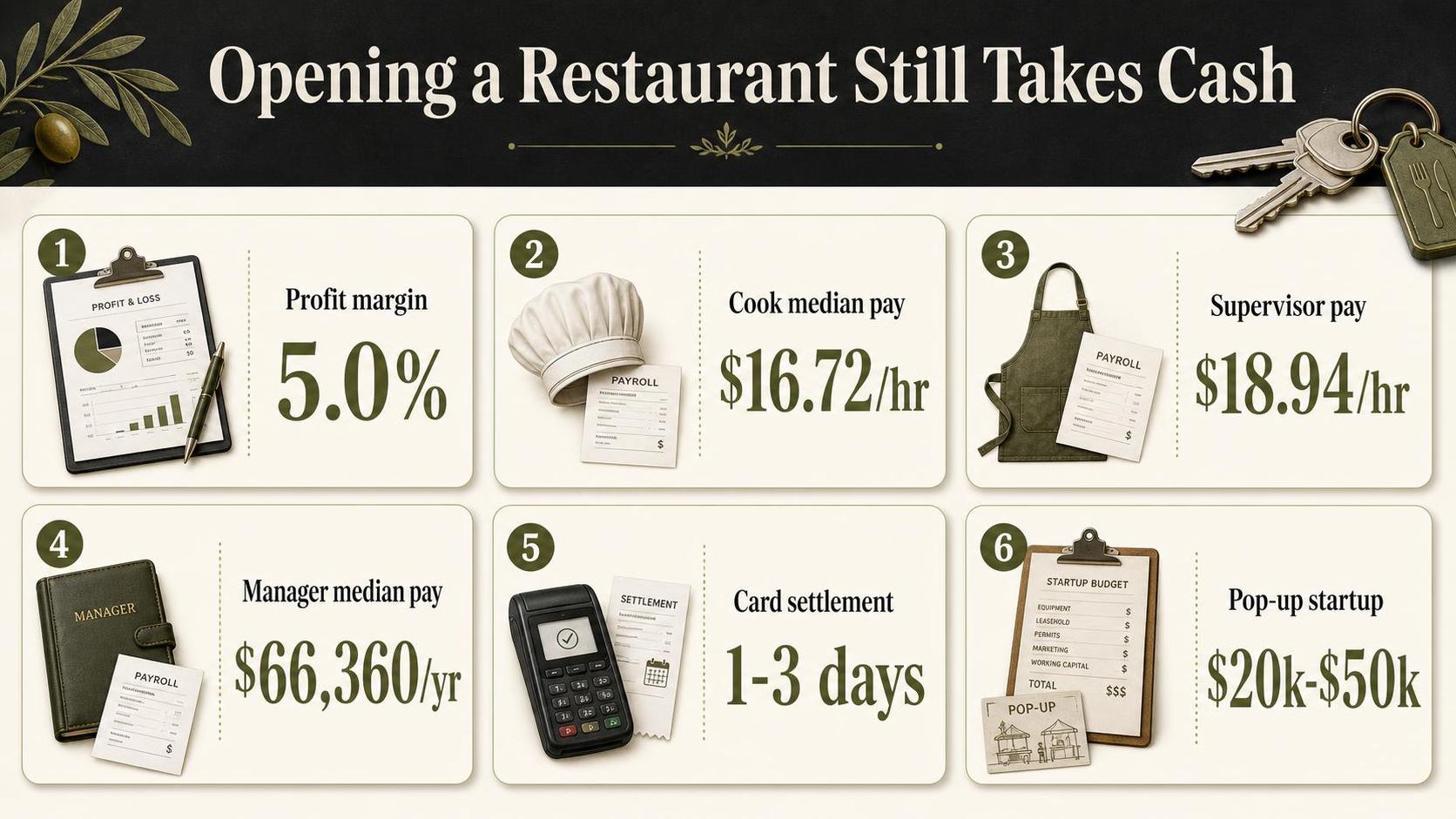
The National Restaurant Association reports the median pre-tax profit margin for restaurants was 5.0% in 2024. That leaves little room for cost overruns, slow opening weeks, or equipment failures.
A founder relying on debt or deferred payments needs working capital, not only startup funding, because obligations continue even if revenue ramps slowly.
Labor is one reason cash is unavoidable. The U.S. Bureau of Labor Statistics reported median pay in May 2024 of $18.94 per hour for first-line supervisors of food preparation and serving workers, $16.72 for cooks, restaurant, and $15.93 for combined food preparation and serving workers, including fast food.
Even a small team can create a weekly payroll bill before the business reaches break-even.
| Cost pressure | Figure | Source |
| Median restaurant pre-tax profit margin | 5.0% in 2024 | National Restaurant Association, 2025 State of the Restaurant Industry |
| Cook, restaurant median pay | $16.72/hour | U.S. Bureau of Labor Statistics, Occupational Employment and Wage Statistics, May 2024 |
| Foodservice manager median pay | $31.90/hour or $66,360/year | U.S. Bureau of Labor Statistics, Occupational Outlook Handbook |
| Credit card processing delay | Often 1–3 business days for settlement | Consumer Financial Protection Bureau and processor disclosures; check the processor agreement |
Occupancy costs also arrive early. The U.S. Small Business Administration says startup businesses should estimate both one-time startup costs and at least several months of ongoing expenses, including rent, utilities, insurance, licenses, and inventory.
Landlords may also require a security deposit or personal guaranty, which increases risk even if initial rent is reduced.
Supplier terms help, but they do not remove the need for cash. Food vendors may extend net-7 or net-30 terms, yet those invoices still come due whether sales are strong or weak. Card sales can also settle after payroll or deliveries must be paid.
- Bootstrapping reduces ownership dilution, but it raises personal cash-flow pressure.
- Debt preserves equity, but interest and fixed payments increase failure risk.
- Investors reduce monthly strain, but founders give up control and future upside.
Caution: permit fees, liquor rules, wage laws, and lease terms vary by state and city. Check the primary source for local requirements before signing a lease, borrowing money, or hiring staff.
Restaurant startup costs by format
Restaurant startup costs change sharply by format. A lower-cost model can reduce the cash needed upfront, but it often trades space, visibility, or control for that savings.
Figures below are published estimates; local rent, permits, and health rules can move the total materially.
| Format | Published startup cost | Source | Main trade-off |
| Pop-up restaurant | $20,000 to $50,000 | Toast, “How Much Does It Cost to Start a Restaurant?” | Lower fixed costs, but limited schedule and less predictable traffic |
| Ghost kitchen | $20,000 to $60,000 | Toast, “How Much Does It Cost to Start a Restaurant?” | No dining room costs, but heavy dependence on delivery platforms and commissions |
| Food truck | $50,000 to $175,000 | Toast, “How Much Does It Cost to Start a Restaurant?” | Lower real-estate cost, but vehicle, fuel, maintenance, and location limits |
| Traditional brick-and-mortar restaurant | $95,000 to more than $2 million | Toast, “How Much Does It Cost to Start a Restaurant?” | Most control and seating, but the highest build-out and lease exposure |
If the goal is opening with little or no money, pop-ups and ghost kitchens usually have the smallest published entry cost. That can make them easier to bootstrap with savings, side income, or small outside funding instead of a large bank loan.
The downside case matters. A ghost kitchen may cost less to launch, but delivery marketplaces can take a large share of each order.
Uber states on its merchant site that delivery commission plans can run as high as 30%, which can pressure already-thin margins.
Food trucks avoid full dining-room build-outs, but they are not “cheap” by default. The U.S. Chamber of Commerce says permits, licenses, and legal compliance can add thousands of dollars, and the truck itself can be one of the largest expenses.
Brick-and-mortar restaurants carry the biggest cash risk because build-out costs can escalate fast.
The National Restaurant Association says restaurant operators face high food, labor, occupancy, and insurance costs, so a large fixed lease can become dangerous if sales start slowly.
- Lowest cash entry: Pop-up or ghost kitchen.
- Best mobility: Food truck, with vehicle risk.
- Highest upside and highest risk: Traditional location.
Caution: Do not rely on national averages alone before signing a lease or buying equipment.
Verify permit fees, zoning, health department rules, insurance costs, and landlord build-out terms with the city, county, and contract documents in the specific market.
Low cash paths to opening
If there is no cash for a full build-out, the practical path is to shrink the first version of the business. That means using a lower-cost format, outside financing, or both. The trade-off is less control, lower margins, and slower growth.
A caution matters here: low cash does not mean low risk.
The U.S. Bureau of Labor Statistics reported that 20.4% of private-sector businesses fail within one year and 49.4% fail within five years, so a test-first approach can reduce losses before a long lease or equipment purchase.
| Low-cash option | Real figure | Source |
| SBA Microloan | Maximum loan size $50,000; average microloan about $13,000 | U.S. Small Business Administration |
| Kiva small-business loan | Up to $15,000 at 0% interest | Kiva U.S. |
| Rollover for Business Startups (ROBS) | Typical setup cost about $5,000 and monthly administration about $140 | Guidant Financial |
| Restaurant leases | Median asking rent for retail space was $23.39 per square foot in Q4 2023 | CBRE U.S. Retail Figures |
One path is to avoid a full dining room at the start. A pop-up, stall, or delivery-first concept can delay the largest fixed cost: rent.
CBRE said U.S. retail asking rents had a median of $23.39 per square foot in late 2023, and many restaurant spaces also require deposits, tenant improvements, and long terms.
Another path is a shared or borrowed facility. In many states, food sold to the public must be prepared in a licensed commercial kitchen, not a home kitchen, unless a state cottage-food law applies.
Rules differ sharply by state, so a reader should verify requirements with the state health department or agriculture department before spending money.
Financing can fill a small gap, but it does not remove the risk. SBA microloans cap at $50,000 and average about $13,000, which may cover permits, a used refrigerator, initial inventory, or insurance, but usually not a full restaurant build.
Kiva’s U.S. program offers up to $15,000 at 0% interest, but approval depends on underwriting and social-network support.
- Sublease unused kitchen hours from an existing operator. This lowers startup cash, but the business depends on another company’s schedule and compliance.
- Launch a narrow menu first. Fewer SKUs can cut food waste, which the U.S. Department of Agriculture identifies as a major cost issue across the food system.
- Avoid retirement rollovers unless the structure and tax risk are clear. The IRS warns that ROBS arrangements can create serious compliance problems if handled incorrectly.
The downside case is simple: if sales miss, fixed obligations remain.
Before signing anything, compare the monthly rent, debt payment, insurance, payroll, and permit costs against a conservative sales estimate from local foot traffic and menu pricing.

Funding options and ownership trade-offs
Opening a restaurant with no cash usually means trading something else: future cash flow, ownership, or control. The lowest-cost money is often the hardest to qualify for, and the fastest money often carries the highest long-term risk.
A practical plan is to compare each funding path by three points: how much it can raise, what it costs, and what rights the funder gets. That matters because a bad capital stack can sink a restaurant before it stabilizes.
| Funding option | Real figure | Ownership trade-off | Source |
| SBA Microloan | Up to $50,000 | No equity dilution, but personal guarantee or collateral may be required by the intermediary lender | U.S. Small Business Administration |
| SBA 7(a) loan | Up to $5 million | No equity dilution, but debt service reduces cash flow and lenders commonly require guarantees | U.S. Small Business Administration |
| Rewards crowdfunding | 5% platform fee, plus payment processing fees of about 3% to 5% | No ownership given up, but campaign rewards create fulfillment costs and public failure risk | Kickstarter |
| Equity crowdfunding | Companies can raise up to $5 million in a 12-month period under Regulation Crowdfunding | Ownership dilution and more investors to answer to | U.S. Securities and Exchange Commission |
SBA debt preserves ownership, but repayment starts whether sales are strong or weak.
That is a real downside in restaurants, where pre-opening delays, labor shortages, or slower table turns can leave owners making loan payments before the business reaches steady volume.
Rewards crowdfunding can work for a strong local brand because it avoids equity loss.
The trade-off is execution risk: if the campaign promises prepaid meals, merchandise, or events, those obligations still cost money even if opening runs late or food costs rise.
Equity crowdfunding and private investors can solve the “no money down” problem faster. The price is dilution. A founder may keep day-to-day control at first, but future profits, voting rights, and exit proceeds are shared with investors.
- Lowest ownership loss: SBA microloans and 7(a) loans, if the business can support payments.
- Lowest immediate cash strain: Equity funding, because it does not create monthly debt service.
- Highest hidden cost: Underestimating fees, reward fulfillment, and investor control terms.
Caution: Do not rely on a funding option based on headline limits alone. Terms, guarantees, securities rules, and state franchise or alcohol licensing costs can materially change the risk.
Check SBA, SEC, IRS, and state agency primary sources before signing any agreement.
Licenses permits and compliance costs
Opening a restaurant with little cash often fails at the compliance stage, not the menu stage. Licenses, health approvals, tax registrations, and building-code fixes can require cash before the first sale.
The cheapest items are often not the ones that delay opening. The expensive part is local approval, plan review, and correcting the space so it passes health, fire, and accessibility rules.
Some required registrations are free, but local permits are not. Exact costs depend on the city, county, concept, and whether the location already has a commercial kitchen.
| Requirement | Real figure | Source |
| Employer Identification Number | $0 | Internal Revenue Service, EIN application information |
| California seller’s permit | $0 | California Department of Tax and Fee Administration |
| Texas sales tax permit | $0 | Texas Comptroller of Public Accounts |
| New York City Food Service Establishment Permit | $280 annually | NYC Department of Health and Mental Hygiene fee schedule |
Those figures show the trade-off. Basic tax registration may cost nothing, but a restaurant still needs local health approval and often building-related sign-offs before opening.
Health departments may require plan review for a new build-out, remodel, or change of use. Fire officials may require hood suppression, alarm work, or extinguisher service.
Accessibility work may also be needed under the Americans with Disabilities Act.
If the site was not previously licensed for food service, the downside case is larger than many no-money startup plans assume.
A cheap lease can become expensive if the space needs plumbing upgrades, grease interception, ventilation, or hand-washing sinks to pass inspection.
- Ask the city or county health department for the current permit fee and whether plan review is separate.
- Ask the building department whether the space needs a change-of-occupancy permit.
- Ask the fire marshal what suppression, exits, and alarm work are required.
- Ask the state labor agency and insurer about workers’ compensation rules before hiring.
Caution: Do not rely on a landlord, broker, or online checklist alone. Permit rules and fees change, and opening without the right approvals can trigger fines, shutdowns, or a rejected inspection.
Verify every requirement with the city, county, state, and IRS before spending scarce cash.
Cash flow risks before opening day
The biggest pre-opening risk is timing. Cash leaves weeks or months before a restaurant records its first sale, and several bills are fixed even if the launch slips.
That matters more when starting with little or no cash. A short delay in permits, construction, or inspections can force payroll, rent, and interest costs to keep running without revenue.
Payroll is an early pressure point. Training staff before opening creates wage costs before any tables are served.
The U.S. Department of Labor sets the federal minimum wage at $7.25 an hour, and the IRS says employers also owe 7.65% for Social Security and Medicare taxes on covered wages.
| Pre-opening cash item | Real figure | Source | Why it matters |
| Minimum hourly wage floor | $7.25 per hour | U.S. Department of Labor | Even a low-wage training schedule creates cash out before opening. |
| Employer FICA tax | 7.65% of wages | IRS, Publication 15 | Payroll costs exceed gross wages. |
| FUTA headline rate | 6.0% on the first $7,000 per employee; as low as 0.6% with the maximum credit | IRS | Hiring adds tax obligations before sales begin. |
| SBA microloan maximum | $50,000 | U.S. Small Business Administration | Useful for a small launch, but often too small for a full-service buildout. |
| SBA microloan average | About $13,000 | U.S. Small Business Administration | Average proceeds may not cover delays, equipment, and opening inventory. |
| Restaurant startup cost estimate | $95,000 to more than $2 million | Toast, industry estimate | Shows how quickly a funding gap can become structural, not temporary. |
A simple training example shows the squeeze. Ten workers trained for 20 hours each at the federal minimum wage would cost $1,450 in wages.
Employer FICA adds about $111, before state unemployment taxes, workers’ compensation, meals, or uniforms.
Debt can deepen the problem. SBA says its microloans can go up to $50,000, but the agency says the average microloan is about $13,000.
That can help with small equipment or working capital, yet it may be too little if permits or construction take longer than expected.
The downside case is a delayed opening with fixed obligations still due. If cash is tight, owners can end up using personal credit, missing tax deposits, or opening undercapitalized.
Check local permit rules, lease terms, and payroll tax deadlines in primary sources before committing money.
- Build a delay buffer, not only an opening-day budget.
- Model at least one month of payroll with no sales.
- Verify every local fee and inspection step with the city, county, and state.

What Coin Abul independently reviewed
Opening a restaurant with no money usually means starting with little personal cash, not literally zero. Coin Abul reviewed federal lending limits, nonprofit financing, and lower-cash operating models to see what is realistic for a U.S. reader.
The main finding is simple: outside capital can reduce the cash needed upfront, but it does not remove risk. A reader should verify current program rules, fees, and state licensing with the primary source before signing any lease or loan.
| Option reviewed | Verified figure | Source | Main trade-off |
| SBA Microloan | Maximum loan size: $50,000; average microloan: about $16,000 | U.S. Small Business Administration | Often too small for a full dine-in buildout |
| SBA 7(a) | Maximum loan size: $5 million | U.S. Small Business Administration | Underwriting is strict; lenders usually want strong credit and repayment ability |
| Kiva U.S. | 0% interest loans up to $15,000 | Kiva | Small loan size; fundraising process can take time |
| Restaurant Revitalization Fund | $28.6 billion program; funds are no longer available | U.S. Small Business Administration | Readers should not plan on this as current startup funding |
For a first-time operator with little cash, the SBA Microloan program is one of the most concrete options because the cap and average size are clearly stated by the SBA.
The downside is scale: an average microloan of about $16,000 may help with permits, initial inventory, or a shared-kitchen launch, but it may not cover construction, ventilation, furniture, and payroll.
SBA 7(a) loans offer much larger limits, up to $5 million according to the SBA. The trade-off is qualification risk.
A “no money” applicant may still need strong personal credit, collateral support, a business plan, and enough projected cash flow for lender approval.
Kiva’s U.S. program is notable because it advertises 0% interest and loan amounts up to $15,000. That can lower borrowing cost, but it does not solve undercapitalization.
Restaurants fail when working capital runs short, so a small loan can leave an owner underfunded after opening.
Coin Abul also reviewed the expired Restaurant Revitalization Fund because it still appears in older articles. The SBA states the program awarded $28.6 billion and is closed.
A reader should treat any article suggesting those grants are still available as outdated.
- Lower-cash formats such as pop-ups, shared kitchens, or food stalls can reduce startup needs, but local health, zoning, and fire rules still apply.
- Debt taken too early can turn a low-cash start into high-cost failure if sales ramp slowly.
- Before acting, check SBA.gov, Kiva.org, and the city or county health department for current rules.
When opening may be too risky
Opening a restaurant with no money can become dangerous when the plan depends on expensive debt, thin reserves, and optimistic sales.
The biggest problem is simple: the funding often available to a first-time owner is far smaller than the money a restaurant typically needs.
Caution: a restaurant lease, personal guarantee, or credit card balance can follow the owner long after the business closes. Readers should verify terms with the lender, landlord, and state filings before signing anything.
| Risk point | Figure | Source |
| SBA microloan size | Maximum $50,000; average microloan about $13,000 | U.S. Small Business Administration |
| Estimated restaurant startup cost | Average about $375,000, or about $3,046 per seat | Toast, restaurant startup cost research |
| Typical credit card borrowing cost | 22.75% average APR on accounts assessed interest in Q4 2023 | Federal Reserve, G.19 Consumer Credit |
That gap matters. If a startup budget is near Toast’s $375,000 estimate, an SBA microloan at the SBA’s average $13,000 covers only a small fraction of the need. Even the SBA’s $50,000 cap leaves most of the project unfunded.
Owners sometimes try to bridge the gap with credit cards. At the Federal Reserve’s 22.75% average APR, a $50,000 revolving balance would generate roughly $11,375 in interest over one year if the balance stayed unchanged.
That is before principal repayment, fees, payroll, rent, or food costs.
Risk rises further if the owner must sign a personal guarantee. Many small-business leases and loans require one. If sales miss target, the business can close while the owner still owes the debt personally.
That downside is more severe for borrowers with limited savings, unstable income, or existing high-interest debt.
Opening may be too risky when any of these are true:
- No emergency reserve exists for personal bills and the owner would rely on business cash immediately.
- The project needs heavy renovation, a full liquor buildout, or major equipment purchases that borrowed cash cannot realistically cover.
- The only available funding is high-APR credit card debt.
- The owner must pledge personal assets or sign broad guarantees without understanding the legal exposure.
A lower-risk path may be a food stall, ghost kitchen, catering operation, or pop-up first. The action is to test demand with less fixed cost, then compare actual sales to lender terms and lease obligations before opening a full restaurant.
Frequently Asked Questions
Can someone realistically open a restaurant with no money?
Yes, but usually not from literal zero cash. The U.S. Small Business Administration states startups often combine owner savings with loans or investors, and the National Restaurant Association reports the restaurant industry is capital-intensive.
So operators who start with limited funds often reduce risk by using pop-ups, ghost kitchens, food trucks, or shared commercial kitchens first.
Do not sign a lease or equipment contract based on projected sales alone; verify licensing, food safety, and zoning with local authorities before spending anything.
What is the cheapest restaurant model to start first?
A pop-up, delivery-only concept, or shared-kitchen business is often the lowest-cost path because it avoids a full dining room buildout and long commercial lease.
The U.S. Department of Agriculture notes shared-use kitchens can lower entry barriers for food businesses, while the SBA says controlling fixed overhead is critical for startup survival.
Costs vary by city and kitchen operator, so check local commissary fees, health department rules, and permit requirements directly before choosing a model.
How can a new owner fund a restaurant without personal cash?
Common options include SBA-backed loans through private lenders, crowdfunding, supplier credit, equipment financing, grants, and bringing in an equity partner.
The SBA 7(a) program is the agency’s primary business loan program, but approval depends on lender underwriting, credit, collateral, and cash-flow projections, not the idea alone.
Debt can put personal assets at risk if there is a personal guarantee, so review terms with a qualified attorney or accountant before accepting financing.
Can a landlord or vendor help reduce startup costs?
Sometimes.
A landlord may offer tenant improvement allowances or free-rent periods, and food or beverage suppliers may extend short-term trade credit.
But these concessions depend on market conditions and the operator’s financial profile rather than being standard.
The SBA recommends negotiating major fixed costs early because occupancy and inventory commitments can strain cash flow, so get every concession in writing and have the contract reviewed before signing.
What should be done before trying to raise money for the restaurant?
Prepare a business plan, realistic startup budget, menu costing, break-even analysis, and required license list before approaching lenders or investors.
The SBA says lenders typically want a business plan and financial projections, and the U.S. Bureau of Labor Statistics reports many businesses fail within the first years, which is why backers focus on cash flow, not only food quality.
Do not use generic numbers from the internet as your budget; confirm rent, labor, insurance, permit, and food-cost assumptions with local primary sources.
Related Reading
- Where To Buy Appliances Cheap?
- How Much Bank Statement For Canada Student Visa?
- How Much Does It Cost To Open A Coffee Shop?
- How Much Is The Apartment? What You Need to Know
- Extreme Frugal Living – What You Need to Know
- Which Furniture Stores Offer Financing?
- Why Are New Car Prices So High?
- When Do Kitchen Appliances Go On Sale?
- All Blog Guides