

Key takeaway: What insurance does Walgreens accept: Walgreens generally accepts many major prescription insurance plans, including Medicare Part D and many commercial plans, but accepted coverage varies by location, plan network, and service.
For pharmacy, vaccination, or clinic coverage, verify directly with Walgreens, the specific store, or the insurer before relying on coverage.
What Insurance Does Walgreens Accept is plan-specific: Walgreens commonly processes many commercial pharmacy plans, Medicare Part D, Medicare Advantage drug benefits, Medicaid where contracted, and select vaccination benefits,.
But acceptance varies by store, network, drug, and state.
Insurance usually pays first after the pharmacy verifies eligibility, then the patient pays any deductible, copay, coinsurance, or noncovered charge.
Document the insurance card, prescription, prescriber, prior authorization, receipts, denial codes, and explanation of benefits. Check CMS Medicare Plan Finder, Medicaid agencies, or the state department of insurance before relying on coverage.
Insurance Walgreens commonly accepts
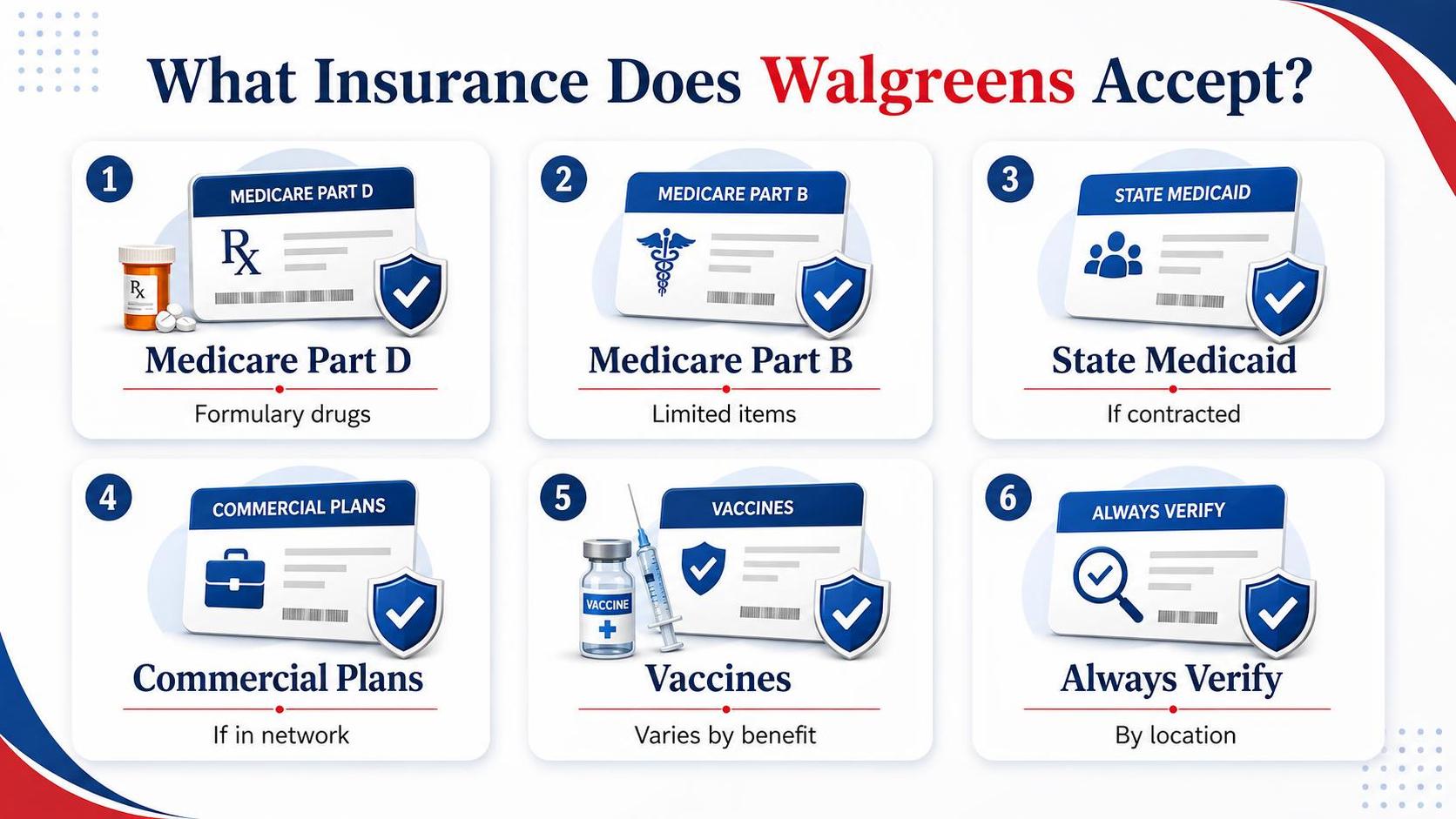
Walgreens pharmacies commonly process claims from Medicare Part D drug plans, many state Medicaid programs, and a wide range of employer and individual commercial plans.
Acceptance is not the same as coverage: the plan must list Walgreens as an in-network pharmacy, and the drug or service must be a covered benefit.
For anything that varies by state or plan, the claimant should confirm the pharmacy network and benefit rules in the plan’s formulary, Evidence of Coverage, insurer directory, or state Medicaid handbook.
CMS, the NAIC, and each state department of insurance are the primary sources for those rules.
| Coverage type | What Walgreens commonly can bill | What usually is not guaranteed |
| Medicare Part D | Retail prescription drugs covered under the plan formulary | Any drug not on formulary, out-of-network pricing, or costs before deductible/copay rules are applied |
| Medicare Part B | Limited pharmacy items Part B covers, such as certain diabetic testing supplies and some vaccines or drugs when Part B rules apply | Routine retail prescriptions, which usually fall under Part D instead |
| State Medicaid | Covered outpatient drugs if Walgreens participates in that state’s Medicaid or managed care network | Drugs needing prior authorization, quantity limits, or non-preferred status |
| Commercial plans | Covered prescriptions and some vaccines when Walgreens is in network | Out-of-network claims, excluded drugs, or services subject to deductible |
Who pays first depends on coordination of benefits. Medicare says an employer group health plan may pay before Medicare in some cases, while Medicare may pay first in others, depending on employer size and eligibility basis.
Medicaid is generally the payer of last resort under federal Medicaid rules.
A claimant should bring the insurance card, member ID, BIN, PCN, and group number if the plan uses them.
Walgreens or the pharmacy benefit manager may also require date of birth, the prescriber’s National Provider Identifier, and prior authorization records for restricted drugs.
For vaccines and other pharmacy services, coverage may sit under the medical benefit or the pharmacy benefit. That changes what the pharmacy can bill at the counter and what the patient owes first under the deductible, copay, or coinsurance.
Caution: do not assume a plan “accepted” at one Walgreens location will process the same way everywhere. Network participation, Medicaid managed care contracts, and formularies change.
Check the insurer directory, CMS Medicare Plan Finder, or the state Medicaid agency before filling a time-sensitive prescription.
- CMS is the primary source for Medicare Part B, Part D, and coordination-of-benefits rules.
- The state Medicaid agency is the primary source for Medicaid pharmacy coverage and prior authorization rules.
- The NAIC and the state department of insurance are primary sources for consumer rights on commercial plan networks, appeals, and surprise billing limits.

How Walgreens verifies pharmacy benefits
Walgreens verifies pharmacy benefits by sending an electronic claim to the patient’s pharmacy benefit plan at the point of sale.
The response tells the pharmacy whether the drug is covered, what utilization rules apply, and how much the patient owes under that plan.
This process verifies pharmacy coverage, not total medical coverage. A paid pharmacy claim does not prove a drug will be covered under a medical benefit, reimbursed later, or covered the same way at another pharmacy.
Most retail pharmacies use the NCPDP Telecommunications Standard to submit and receive pharmacy claims in real time.
The Centers for Medicare & Medicaid Services recognizes NCPDP as the standard format for pharmacy eligibility and claim transactions under Medicare Part D.
| Fact | What it means at Walgreens | Primary source |
| BIN = 6 digits | Routes the claim to the correct processor or PBM | NCPDP Pharmacy ID Card Standard |
| PCN = variable length | Further directs the claim within the processor’s system | NCPDP Pharmacy ID Card Standard |
| Group number = plan-specific | Links the member to the employer or plan benefit design | NCPDP Pharmacy ID Card Standard |
| Medicare Part D transition supply can be temporary | A paid fill during transition does not guarantee ongoing coverage | CMS Medicare Prescription Drug Benefit Manual, Ch. 6 |
Walgreens usually needs the member’s name, date of birth, plan ID, BIN, PCN, and group number from the insurance card.
For Medicare Part D, the pharmacy may also need the Medicare Beneficiary Identifier or the exact Part D plan information shown in the member record.
The insurer or PBM pays first only if Walgreens is in network and the claim adjudicates successfully. If another payer is primary, that payer must be billed first.
Coordination-of-benefits rules decide payment order for dual coverage and can vary by plan.
If the claim rejects, common reasons include inactive coverage, noncovered drug status, refill too soon, prior authorization, quantity limits, step therapy, or missing coordination-of-benefits data.
Medicare Part D plans must provide standardized denial information and coverage determination rights under CMS rules.
Patients should keep the prescription, insurance card, and any denial or rejection notice. If a claim is denied, document the date, store location, drug name, National Drug Code if available, prescriber, and the reject message shown by the pharmacy.
- Ask whether the rejection is an eligibility issue, utilization management rule, or network problem.
- Request the exact payer name and processor information used on the claim.
- For plan-specific limits, check the plan formulary, Evidence of Coverage, or Summary of Benefits.
- For state-dependent external review or complaint rights, use the state department of insurance or CMS, depending on the coverage type.
Caution: do not rely on a verbal “covered” answer alone before paying cash for an expensive drug. Final patient cost can change after deductible status, network status, coordination of benefits, or prior authorization review is applied.
Medicare coverage at Walgreens pharmacies
Walgreens pharmacies can process many Medicare-covered prescriptions and vaccines, but coverage depends on the part of Medicare and the specific plan network. A drug being sold at a Walgreens counter does not mean Medicare pays for it.
Start by identifying the coverage source: Original Medicare Part B, a stand-alone Part D plan, or a Medicare Advantage plan with drug coverage. Then confirm Walgreens is in-network for that plan, because network rules and copays are plan-specific.
| Medicare coverage source | What it usually covers at a pharmacy | What it usually does not cover |
| Part B | Certain vaccines and limited drugs/supplies, including flu, COVID-19, pneumococcal, and hepatitis B vaccines for eligible risk groups; some diabetes testing supplies | Most retail prescription drugs, routine OTC items, and most shingles/travel vaccines |
| Part D | Most outpatient prescription drugs and vaccines not covered by Part B | Drugs excluded by Medicare law and items outside the plan formulary unless an exception is approved |
| Medicare Advantage (Part C) | At least Part A and Part B benefits; many plans also include Part D drug coverage | Out-of-network pharmacy claims, if the plan restricts pharmacy networks, except as plan rules allow |
CMS states Part B covers flu, COVID-19, and pneumococcal shots with no cost sharing when Medicare covers the service.
CMS also states Part D covers adult vaccines not covered by Part B, and, since 2023, ACIP-recommended adult vaccines under Part D have no deductible or copay.
Who pays first matters. If a person has Medicare and other insurance, Medicare may be primary or secondary under Medicare Secondary Payer rules.
CMS bases that order on factors such as employer size, retirement status, ESRD status, and whether coverage is through active employment.
At the counter, a claimant should bring the red, white, and blue Medicare card or Medicare Beneficiary Identifier, the Part D or Medicare Advantage card, and any other insurance card.
For some claims, the pharmacy may also need the prescriber’s information and updated coordination-of-benefits data.
Keep the receipt, vaccine record, National Drug Code if available, and any denial notice. Those documents help if the claim rejects, if reimbursement is requested, or if an appeal is needed.
Coverage rules vary by state, plan contract, and pharmacy network. Check the plan’s Evidence of Coverage, CMS Medicare.gov materials, and Medicare Secondary Payer guidance.
For plan complaints or agent conduct, use the state department of insurance or the NAIC consumer tools. Do not assume a Medicare card alone guarantees payment.
Medicaid and state plan differences
Walgreens may accept Medicaid, but coverage is not uniform nationwide.
Medicaid is a joint federal-state program, so the card, network rules, copays, and prior authorization standards depend on the state Medicaid agency and, often, the managed care plan.
Payment order matters.
If a person has Medicaid and other insurance, Medicaid is generally the payer of last resort, meaning other liable coverage pays first and Medicaid may pay remaining covered amounts, subject to state rules.
According to Medicaid.gov and the Centers for Medicare & Medicaid Services (CMS).
What Medicaid covers at Walgreens can differ by state and by plan.
Common variables include whether the prescription is on the state Preferred Drug List, whether the pharmacy is in-network, whether the beneficiary is in fee-for-service Medicaid or a managed care organization, and whether prior authorization is required.
| Issue | What usually controls it | Primary source to check |
| Pharmacy network participation | State Medicaid fee-for-service rules or the enrollee’s managed care plan contract | State Medicaid agency website or plan member handbook |
| Copay amount | State Medicaid cost-sharing rules | State Medicaid agency; CMS cost-sharing guidance |
| Drug covered or not | State Preferred Drug List and utilization rules | State Medicaid formulary/PDL |
| Prior authorization | State or plan pharmacy benefit rules | State Medicaid DUR/PDL pages or managed care plan rules |
| Other insurance pays first | Federal third-party liability rules | Medicaid.gov; CMS third-party liability guidance |
Federal law sets some limits, but states still have room to differ.
For example, federal Medicaid rules generally cap most outpatient prescription drug copayments for beneficiaries with income at or below 150% of the federal poverty level at nominal amounts.
While allowing different treatment for some higher-income groups, according to CMS cost-sharing rules.
Documentation matters when a claim rejects. A claimant should keep the Medicaid card, any managed care plan card, the exact BIN/PCN/group numbers used by the pharmacy, the prescription, denial or reject code, and any prior authorization notice.
If other insurance exists, keep the explanation of benefits showing what paid first.
Caution: do not assume a drug is covered because Walgreens accepts Medicaid in general. Pharmacy participation and drug coverage can change.
Check the state Medicaid agency, the managed care plan formulary, and the state department of insurance for plan oversight issues that vary by state. NAIC’s consumer tools can help identify the correct regulator.
Vaccines and clinic services coverage
Walgreens may bill vaccines and clinic services through different parts of insurance.
The vaccine may run through a pharmacy benefit or a medical benefit, while a clinic visit is usually billed as medical care by the clinic operator, not by Walgreens itself.
Coverage depends on the plan, network status, age, and vaccine type. Check the member ID card and plan documents before the visit, because state rules, employer plan design, and Medicare or Medicaid status can change what the patient owes.
For private insurance, many vaccines are covered at no out-of-pocket cost only when the plan is non-grandfathered and the shot is an ACIP-recommended preventive service delivered in-network.
That rule comes from the Affordable Care Act and CMS guidance for private plans.
| Coverage situation | What the primary source says | What the patient may owe |
| Private non-grandfathered plan, in-network ACIP vaccine | ACA preventive services rules require coverage without cost-sharing for routine ACIP immunizations in-network, per CMS | $0 cost-sharing in many cases; out-of-network rules vary by plan |
| Medicare Part B vaccines | CMS says Part B covers flu, pneumococcal, COVID-19, and hepatitis B for people at medium or high risk | No deductible or coinsurance if the provider accepts assignment |
| Medicare Part D vaccines | Since January 1, 2023, CMS says adult vaccines recommended by ACIP are covered with no deductible, copayment, or coinsurance | $0 if billed correctly under Part D |
| Medicaid adult vaccines | CMS says state Medicaid and CHIP programs must cover ACIP-recommended adult vaccines and administration without cost-sharing starting October 1, 2023 | $0 in many cases, but provider participation still matters |
Clinic services are different. A sore-throat visit, lab test, or physical exam is usually billed under the medical benefit, with copay, deductible, or coinsurance based on the plan.
If the clinic is operated by a third party at or near Walgreens, that provider’s network status controls payment.
Who pays first depends on the patient’s primary and secondary coverage. Medicare coordination rules come from CMS.
For private plans, coordination of benefits rules are often set by the policy and state insurance rules; the state department of insurance or NAIC consumer guides are the best primary references.
- Bring the insurance card, photo ID, and the exact legal name and birth date on the policy.
- If asking for reimbursement, keep the itemized receipt, National Drug Code if shown, CPT code, diagnosis code, date of service, and provider NPI.
- Ask whether the claim will be sent to the pharmacy benefit or medical benefit before the service is given.
- If a denial cites network, prior authorization, or age limits, request the denial in writing and compare it with the plan’s Evidence of Coverage.
Do not assume a “covered vaccine” means every Walgreens location or clinic visit is fully paid.
Verify the provider, billing channel, and network status first, then confirm details with the insurer or the relevant CMS or state insurance source.
What the editorial team reviewed
We reviewed Walgreens’ public pharmacy-insurance information against primary-source rules from CMS, Medicare.gov, NAIC, and state insurance departments.
The goal was narrow: explain what “accepted insurance” usually means at a retail pharmacy, what it does not guarantee, and what documents a claimant or insured person should keep.
We did not treat a Walgreens location listing or plan logo as proof of payment. At a pharmacy, acceptance usually means the store can submit a claim through a plan’s pharmacy network.
It does not mean every drug, vaccine, or service is covered, or that the patient owes nothing.
| Issue reviewed | What we checked | Why it matters |
| Network participation | Walgreens pharmacy insurance pages and plan look-up materials | A store may process claims for many plans, but an individual plan can still mark a location out of network or preferred/non-preferred. |
| Who pays first | CMS Medicare Secondary Payer guidance and Medicare.gov coordination rules | When a person has more than one payer, claim order affects out-of-pocket cost and whether a claim rejects. |
| Drug coverage limits | Medicare Part D rules and plan formulary guidance | A covered pharmacy is not the same as a covered drug. Prior authorization, quantity limits, and step therapy can still apply. |
| Claim records | NAIC consumer guidance and insurer appeal standards | Receipts, NDC/drug name, BIN/PCN/group numbers, and denial notices matter if a claim must be reprocessed or appealed. |
We focused on the payment sequence because consumers often confuse medical insurance with pharmacy benefits. For most retail prescriptions, the pharmacy submits first to the plan listed as primary in the pharmacy-benefit system.
If that payer rejects or pays only part, a secondary payer may be billed if the plan allows coordination of benefits.
For Medicare, we checked CMS and Medicare.gov because the rules change by coverage type. Medicare Part D handles outpatient prescription drug claims. Medicare Part B can cover limited drugs and certain vaccines in specific circumstances.
Medicaid, employer plans, Medigap, and state rules can change who pays first.
We also reviewed what a claimant should document.
The key records are the insurance card, member ID, Rx BIN, PCN, group number if used, the prescription label or drug name and strength, date filled, National Drug Code when available, itemized receipt, and any rejection or denial message.
Caution: a Walgreens cashier or pharmacy technician cannot override plan terms. Before relying on coverage, check the plan’s formulary, network directory, and coordination-of-benefits rules.
For state-specific rights, use the state department of insurance. For Medicare questions, use CMS or Medicare.gov. For general insurance standards, use NAIC consumer resources.

What to document before paying
Before paying at Walgreens, document the exact claim details, not only the card in a wallet.
A pharmacy benefit can cover one drug, dosage, quantity, or vaccine and deny another under the same plan because formularies, network rules, and coordination rules differ by plan.
Save proof before the transaction. That record matters if the claim rejects, a secondary plan should pay, or reimbursement is requested later.
Start with the insurance identifiers Walgreens uses to submit a pharmacy claim: member ID, RxBIN, RxPCN, group number, and the cardholder’s name and date of birth.
Also keep the prescriber’s name, the drug name, strength, quantity, days’ supply, and the National Drug Code if it appears on the label or receipt.
Document what the plan said it would cover. Ask whether the item is in network, on formulary, subject to prior authorization, step therapy, quantity limits, or excluded.
If the item is a vaccine, ask whether it is billed under the pharmacy benefit or the medical benefit, because that changes who pays first and where the claim must go.
| Situation | What to document | Primary source |
| Medicare Part B-covered drug or service | Whether the supplier accepts assignment and whether Medicare pays 80% of the Medicare-approved amount after the Part B deductible | CMS, Medicare & You |
| Active worker age 65 or older with employer coverage | Whether the employer has 20 or more employees; if yes, the group health plan generally pays first and Medicare pays second | CMS, Medicare Secondary Payer rules |
| Disabled and covered by a large group health plan | Whether the employer has 100 or more employees; if yes, the large group health plan generally pays first | CMS, Medicare Secondary Payer rules |
| End-stage renal disease | The start date of Medicare eligibility and the 30-month coordination period | CMS, Medicare Secondary Payer rules |
Keep every receipt and denial notice. For an appeal or reimbursement claim, document the date of service, amount charged, amount paid, denial code, and the reason stated by the plan.
If Walgreens is out of network, save proof that no in-network option was reasonably available if the plan allows exceptions.
Plan rules and state protections vary. Check the insurer’s evidence of coverage, the state department of insurance for complaint and appeal rights, and NAIC consumer guides for coordination and coverage basics.
Do not rely on a store clerk’s statement alone for a final coverage decision.
Frequently Asked Questions
What kinds of insurance does Walgreens typically accept?
Walgreens pharmacies generally process many commercial prescription plans, Medicare Part D drug plans, and some Medicaid plans, but acceptance depends on the specific plan network and the pharmacy location.
Walgreens advises patients to confirm participation with the store and the insurance card information before filling a prescription, because out-of-network claims can cost more or be denied.
Does Walgreens accept Medicare for prescriptions?
Walgreens commonly works with many Medicare Part D and Medicare Advantage drug plans, but not every Walgreens store is in every plan’s preferred network.
Medicare beneficiaries should check their plan documents and Walgreens’ pharmacy network lookup tools, because copays and preferred pricing can differ by plan according to Medicare and Walgreens plan-participation rules.
Does Walgreens take Medicaid?
Some Walgreens locations accept Medicaid, but Medicaid pharmacy networks vary by state and by managed care organization.
A reader should verify with the state Medicaid program or the specific managed care plan before relying on Walgreens for a prescription, because state rules and contracted pharmacies can change.
Can Walgreens tell a patient whether a specific insurance plan is accepted?
Yes, a Walgreens pharmacy can usually check billing eligibility using the member ID, BIN, PCN, and group information on the insurance card.
That check is useful, but it is not a substitute for the insurer’s own confirmation, because prior authorization, formulary limits, and network status can still affect final coverage.