
Key takeaway: What Insurance Company Covers Mounjaro depends on the plan, not only the insurer.
Major insurers such as UnitedHealthcare, Aetna, Cigna, Blue Cross Blue Shield, and Humana may cover Mounjaro when prescribed for FDA-approved type 2 diabetes, often with prior authorization. Weight-loss use is usually not covered.
Check the plan formulary.
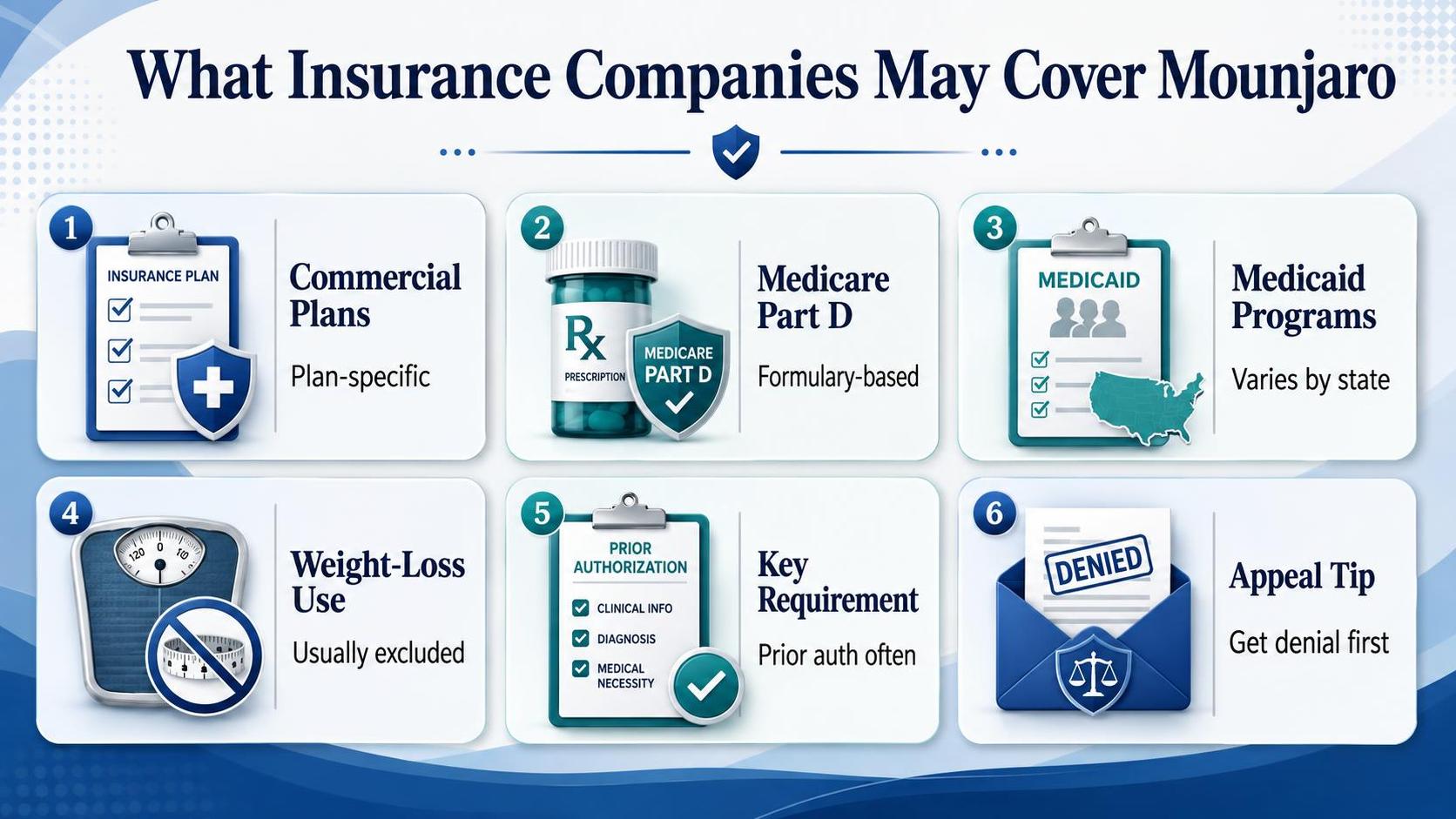
What Insurance Company Covers Mounjaro is plan-specific: commercial insurers, Medicare Part D plans, and Medicaid programs may cover Mounjaro when the policy lists tirzepatide on its formulary and the documented diagnosis meets plan rules.
The insurer or drug plan pays first after deductibles, copays, prior authorization, and step therapy rules; the patient pays excluded or noncovered costs.
Claimants should document diagnosis, prescription, prior drugs tried, lab records, and denial notices. Check CMS, the state department of insurance, or NAIC-linked resources for rules that vary by plan or state.
Which insurers may cover Mounjaro
Mounjaro is tirzepatide, a prescription drug FDA approved for adults with type 2 diabetes, not for weight loss alone.
Coverage depends on the member’s pharmacy benefit, the plan’s formulary, and prior authorization rules, not the drug’s brand name by itself.
Most insured patients need the pharmacy benefit to pay first.
If the patient has more than one health plan, coordination of benefits usually follows NAIC model rules and the plan documents; the primary plan pays before any secondary plan considers the remaining allowed amount.
| Insurer or program type | May cover Mounjaro | What usually decides coverage |
| Employer or individual commercial plans, including many Blue Cross Blue Shield plans, UnitedHealthcare, Aetna, Cigna, and Humana products | Sometimes | Plan formulary tier, prior authorization, step therapy, and diagnosis requirements in the pharmacy benefit manager’s drug list |
| ACA marketplace plans | Sometimes | Issuer formulary and state benchmark rules; formularies vary by metal tier and service area |
| Medicare Part D and Medicare Advantage plans with drug coverage | Sometimes | Part D formulary status, utilization management, and CMS formulary rules |
| State Medicaid programs | Sometimes | State preferred drug list, prior authorization criteria, and any managed care formulary rules |
For commercial coverage, the claimant usually must document the FDA-approved use.
Common records include the prescription, diagnosis code for type 2 diabetes, chart notes, recent A1C or glucose history, and proof that any required lower-cost drugs were tried first if the plan uses step therapy.
For Medicare drug coverage, the member should check the plan’s formulary and coverage determination process.
CMS requires Part D plans to publish formularies and explains exceptions, prior authorization, and appeals in plan materials and Medicare.gov resources.
For Medicaid, rules vary by state and by managed care organization. The safest source is the state Medicaid preferred drug list and prior authorization criteria; for broader insurance rules, check the state department of insurance.
NAIC explains coordination of benefits standards, but the policy certificate controls.
- Mounjaro may be excluded when prescribed only for weight loss, because that is not the FDA-approved indication for this brand.
- A coupon or manufacturer savings card does not replace insurance coverage and usually cannot be used with federal programs.
- Before filing an appeal, get the denial reason in writing and match the submission to the plan’s stated criteria.
Caution: do not assume a national insurer covers Mounjaro on every plan.
The member should verify the exact formulary, prior authorization form, and appeal deadlines in the policy documents and primary sources from CMS, the state Medicaid agency, or the state department of insurance.
When Mounjaro is covered for diabetes
Mounjaro is tirzepatide, a prescription drug the U.S. Food and Drug Administration approved in May 2022 to improve blood sugar control in adults with type 2 diabetes.
Coverage usually exists only when the member’s plan covers the drug on its formulary and the prescription matches the plan’s diabetes rules.
For most insured patients, Mounjaro is paid under the pharmacy benefit, not the medical benefit, because it is a self-injected outpatient drug. The pharmacy claim goes to the primary drug plan first.
If the patient has secondary drug coverage, coordination rules are plan-specific and should be verified in the policy and with the state department of insurance.
Insurers commonly cover Mounjaro for diabetes only after documentation shows medical necessity. That usually means a type 2 diabetes diagnosis, the prescriber’s chart notes, and any prior authorization form the plan requires.
Plans may also require step therapy or quantity limits before they pay.
| Coverage point | What usually applies | Primary source |
| FDA-approved use | Adults with type 2 diabetes; approved May 13, 2022 | FDA prescribing information for Mounjaro |
| Benefit that pays first | Pharmacy benefit usually pays first for a self-administered pen injector | Plan Evidence of Coverage or formulary; state insurance rules vary |
| Utilization controls | Prior authorization, step therapy, and quantity limits may apply | CMS Medicare Part D formulary rules; NAIC consumer guidance; plan formulary |
| What the claimant must document | Diagnosis, prescription, medical necessity, and any failed-drug history if step therapy applies | Plan prior authorization criteria and prescriber forms |
On Medicare, Part D plans may use formularies and utilization management tools, including prior authorization and step therapy, under CMS rules.
CMS requires each Part D plan to publish a formulary and notice documents explaining restrictions and exceptions. A member should check the plan’s current formulary because Medicare coverage is plan-specific, not universal.
On employer and individual market plans, state law can affect appeals, external review rights, and some utilization controls. Those rules vary by state.
Check the state department of insurance, the plan’s certificate of coverage, and NAIC consumer resources before relying on a general article.
- Ask the plan whether Mounjaro is on the formulary for type 2 diabetes.
- Confirm whether prior authorization or step therapy applies before filling the prescription.
- Keep diagnosis records, A1C history, prior medication history, and denial letters for an appeal.
- If coverage is denied, request the written reason and the appeal deadline.
Caution: coverage rules change by plan year, employer contract, and state. A patient should not assume a drug is covered based on another person’s plan or an older formulary.

Why weight loss coverage is different
Mounjaro is tirzepatide, but insurance coverage depends on the FDA-approved use billed to the plan. Mounjaro is approved to improve blood sugar in adults with type 2 diabetes, not as a weight-loss drug, according to the U.S. Food and Drug Administration.
That distinction matters because many plans treat diabetes drugs and anti-obesity drugs under different rules.
The member’s medical necessity documents, diagnosis code, and prior authorization form often determine whether the claim is processed as covered, excluded, or denied.
The clearest split is Medicare.
Federal law generally excludes drugs “used for anorexia, weight loss, or weight gain” from Medicare Part D, and the Centers for Medicare & Medicaid Services says Part D sponsors must follow that rule.
| Program or rule | What the primary source says | Practical effect for Mounjaro |
| FDA labeling | Mounjaro is approved for adults with type 2 diabetes; Zepbound is tirzepatide approved for chronic weight management in eligible adults. Source: FDA prescribing information. | Coverage usually follows the labeled indication the prescriber documents. |
| Medicare Part D | Part D excludes drugs used for weight loss. Source: CMS guidance and Medicare Prescription Drug Benefit Manual. | A Part D plan may cover Mounjaro for type 2 diabetes, but not when the claim is for weight loss alone. |
| ACA essential health benefits | Prescription drugs are an essential health benefit, but specific formularies vary by plan and state benchmark. Source: CMS EHB rules. | Marketplace and employer plans may cover or exclude anti-obesity drugs differently. |
Commercial and employer plans often pay first only after step therapy or prior authorization.
A plan may require proof of type 2 diabetes, a recent A1C result, diagnosis codes, medication history, and chart notes showing why a formulary alternative was not appropriate.
For weight management, documentation is different. Plans that cover anti-obesity treatment often ask for body mass index, weight-related conditions such as hypertension or sleep apnea, and evidence of a supervised diet and exercise program.
- Check the plan’s formulary and prior authorization criteria.
- Check the Evidence of Coverage or Certificate of Coverage for exclusions.
- For state-regulated plans, verify mandates or exclusions with the state department of insurance.
- For plan standards and consumer terms, use NAIC consumer resources and CMS Medicare materials.
Caution: a drug name alone does not prove coverage.
A claimant should confirm the exact diagnosis submitted, whether the pharmacy or medical benefit pays first, and whether an appeal needs physician records before filling a prescription or changing treatment.

Who pays first for Mounjaro
Mounjaro is usually paid under a prescription drug benefit, not a general medical benefit, because it is a self-administered outpatient drug.
Which insurer pays first depends on coordination-of-benefits rules, the type of coverage, and whether the person has Medicare, Medicaid, employer coverage, or more than one private plan.
The drug itself is tirzepatide. The FDA approved Mounjaro for adults with type 2 diabetes, so plans often require proof of that diagnosis before paying.
Coverage rules, prior authorization, and step therapy vary by plan and state, so the claimant should verify the current formulary and utilization rules in the plan documents.
| Coverage situation | Who usually pays first for Mounjaro | Primary source |
| Employer plan + Medicare, age 65 or older, employer has 20 or more employees | Employer group health plan pays first; Medicare pays second | CMS Medicare Secondary Payer guidance |
| Employer plan + Medicare, age 65 or older, employer has fewer than 20 employees | Medicare pays first; employer plan pays second | CMS Medicare Secondary Payer guidance |
| Employer plan + Medicare due to disability, employer has 100 or more employees | Employer group health plan pays first; Medicare pays second | CMS Medicare Secondary Payer guidance |
| Employer plan + Medicare due to disability, employer has fewer than 100 employees | Medicare pays first; employer plan pays second | CMS Medicare Secondary Payer guidance |
| ESRD + employer plan + Medicare | Employer plan pays first during the 30-month coordination period; Medicare usually pays first after that | CMS Medicare Secondary Payer guidance |
| Medicaid + any other health coverage | Medicaid is generally the payer of last resort | CMS Medicaid coordination rules |
When two private plans exist, the plan’s coordination-of-benefits clause controls. The National Association of Insurance Commissioners has a model COB regulation, but states can adopt different versions.
The claimant should check the policy certificate and the state department of insurance for the controlling rule.
- Submit the Mounjaro prescription claim to the primary drug plan first.
- Keep the explanation of benefits showing what the primary plan paid or denied.
- If there is secondary coverage, send that EOB with the secondary claim.
- Be ready to document diagnosis, prescriber notes, prior authorization approval or denial, formulary tier, and any step-therapy history.
Important caution: do not assume a second plan will pay because the first denied the claim. A denial for non-covered use, missing prior authorization, or formulary exclusion may still leave the patient responsible.
Check CMS, the state department of insurance, and the plan’s evidence of coverage before relying on this information.

What prior authorization must document
Prior authorization for Mounjaro usually turns on diagnosis, plan rules, and the exact use requested.
The requester must show that the drug fits the policy’s covered indication, that lower-cost alternatives were considered when the plan requires step therapy, and that the member meets the formulary criteria.
Mounjaro is Eli Lilly’s brand name for tirzepatide.
The FDA approved it as an adjunct to diet and exercise to improve glycemic control in adults with type 2 diabetes mellitus, and the label lists once-weekly strengths of 2.5 mg, 5 mg, 7.5 mg, 10 mg, 12.5 mg, and 15 mg.
The claim file should first establish who pays under the policy. Pharmacy benefits usually pay first for self-administered Mounjaro pens, not the medical benefit, unless a plan document says otherwise.
If another payer is primary, the member may need an explanation of benefits before the secondary plan reviews the request.
| Documentation item | Why the insurer asks for it |
| Diagnosis code and chart note confirming type 2 diabetes | To match the FDA-approved indication and the plan’s formulary language |
| Recent clinical data, such as A1C or glucose records if required by the plan | To show medical necessity and baseline disease status |
| Medication history, including metformin or other antidiabetic drugs tried, failed, or contraindicated | To satisfy step therapy or exception review rules |
| Requested dose and titration plan | To confirm the request fits labeled strengths and quantity limits |
| Current medication list | To check duplication, interactions, and safety issues |
| Benefit information and other coverage details | To determine whether another insurer or benefit pays first |
If the request is for weight loss alone, many plans deny Mounjaro because that use is outside Mounjaro’s FDA-approved indication. Some policies exclude weight-loss drugs entirely.
Check the plan’s evidence of coverage, formulary, and utilization-management criteria before filing.
For Medicare drug coverage, Part D sponsors may use prior authorization only within CMS formulary rules, and coverage generally must align with a medically accepted indication. Medicaid and fully insured commercial plans can differ by state.
State-specific appeal, step-therapy, and external-review rules should be checked with the state department of insurance or Medicaid agency.
- Use the exact diagnosis and attach supporting chart notes.
- Include failed-drug history, adverse effects, or contraindications if step therapy applies.
- Attach lab data only if the plan’s criteria ask for it.
- Document primary and secondary coverage to avoid billing-order denials.
Do not rely on a general article to file a prior authorization. Coverage rules change by plan year, employer group, PBM, and state.
Verify current requirements with the insurer’s formulary criteria, CMS guidance for Medicare, the NAIC consumer resources, and the state department of insurance.

State and Medicare rules to verify
Mounjaro is Eli Lilly’s brand name for tirzepatide, approved by the U.S. Food and Drug Administration for type 2 diabetes, not for weight loss.
Coverage depends on the policy’s formulary, utilization rules, and whether another payer must pay first.
Do not assume any insurer “covers Mounjaro” across all plans. The claimant should verify the exact plan document, then confirm state-specific appeal and step-therapy rules with the state department of insurance or CMS.
| Rule to verify | What the primary source says |
| Medicare Part D deductible, 2025 | CMS says the standard maximum deductible is $590 in 2025. |
| Medicare Part D out-of-pocket cap, 2025 | CMS says Part D enrollees have a $2,000 annual out-of-pocket cap in 2025. |
| Who pays first for active workers age 65+ | CMS Medicare Secondary Payer rules say an employer plan pays first if the employer has 20 or more employees; Medicare pays first if the employer has fewer than 20. |
| Who pays first for disability-based Medicare | CMS says a large group health plan pays first if the employer has 100 or more employees; Medicare pays first below that threshold. |
For Medicare, Mounjaro may be covered under Part D when prescribed for a medically accepted indication, usually type 2 diabetes.
Medicare generally does not cover drugs used only for weight loss because the statute excludes agents used for anorexia, weight loss, or weight gain; CMS explains this in Part D drug coverage guidance.
A claimant should document the diagnosis, prescribing clinician’s chart notes, the National Drug Code if requested, prior medication history, and any lab or clinical records the plan requires for prior authorization.
If the plan denies coverage, keep the denial notice and request an exception or appeal by the deadline in the Evidence of Coverage.
State-regulated plans vary on formularies, step therapy, continuity-of-care protections, and external review rights.
Verify those rules with the state department of insurance and the NAIC’s consumer resources, because self-funded employer plans often follow federal ERISA rules instead of state insurance mandates.
- Check whether the plan is fully insured, self-funded, Medicare Part D, or Medicaid managed care.
- Check the formulary tier, prior authorization criteria, quantity limits, and step-therapy rules.
- Check whether another payer pays first under CMS coordination rules.
- Check appeal rights with CMS, the state department of insurance, or the plan administrator.
Caution: coverage decisions can turn on diagnosis coding and plan type.
Acting on a general article alone can cause claim denials or unexpected bills; confirm the current rule in the plan’s official documents and the primary regulator’s guidance.

What the editorial team reviewed
The editorial team reviewed how US health coverage for Mounjaro usually works in practice: the drug’s FDA-approved use, common formulary rules, and which payer is billed first.
The review focused on primary sources because Mounjaro coverage varies by plan, employer, and state oversight.
Mounjaro is tirzepatide, approved by the US Food and Drug Administration to improve blood sugar control in adults with type 2 diabetes mellitus.
The current FDA prescribing information does not approve Mounjaro for weight loss, which matters because many plans tie coverage to the approved indication and diagnosis submitted.
| Item reviewed | Primary source | Why it matters |
| Mounjaro indication | FDA prescribing information for Mounjaro | Plans often require the claim and prior authorization to match the approved use. |
| Part D formulary and utilization management | Centers for Medicare & Medicaid Services (CMS) Medicare Prescription Drug Benefit Manual | Shows that Part D plans may use formularies, prior authorization, quantity limits, and step therapy within CMS rules. |
| State external review and appeals rights | State department of insurance and NAIC consumer resources | Appeal deadlines and review rights vary by state and policy type. |
| Copay card restrictions | Eli Lilly Mounjaro Savings Card terms | Manufacturer savings programs generally exclude people enrolled in federal or state government programs. |
The editorial team compared the documents above against standard claim flow. If a patient has primary and secondary insurance, the primary plan pays first.
The secondary plan is billed only after the primary insurer issues an explanation of benefits, and the secondary plan may cover some remaining eligible cost-sharing.
For a successful claim or prior authorization, the plan usually wants documents that prove medical necessity.
Common examples include the prescription, member ID, diagnosis code for type 2 diabetes, chart notes, recent A1C or other diabetes history, and records showing previous therapies if the plan uses step therapy.
- Commercial plans may cover Mounjaro when it is on formulary and the member meets utilization rules.
- Medicare Part D coverage depends on the specific plan’s formulary and restrictions under CMS rules.
- Medicaid coverage varies by state program and preferred drug list.
- Employer plans may add their own prior authorization language or exclude some uses.
A plain caution: no article can confirm an individual plan’s coverage.
Readers should check the plan’s formulary, summary of benefits, and prior authorization criteria, then confirm appeal rights with the state department of insurance, CMS, or the NAIC consumer resources if the policy language is unclear.
Frequently Asked Questions
What insurance companies may cover Mounjaro?
Many large commercial insurers, employer health plans, Medicare Part D plans, and some state Medicaid programs may cover Mounjaro, but coverage depends on the exact plan formulary rather than the insurer’s brand name alone.
Eli Lilly states coverage varies by insurance plan, and the U.S. Food and Drug Administration says Mounjaro is approved to improve blood sugar control in adults with type 2 diabetes, which is the indication plans most often review for coverage.
Is Mounjaro usually covered for weight loss?
Coverage for weight loss is less predictable because Mounjaro is FDA-approved for type 2 diabetes, not chronic weight management; the FDA approved Mounjaro in 2022 and approved Zepbound, tirzepatide for chronic weight management, in 2023.
A reader should not assume an insurer will pay for off-label use, because many plans restrict coverage to FDA-approved uses or their own formulary rules; check the plan’s current drug list and medical policy.
Does Medicare or Medicaid cover Mounjaro?
Medicare Part D may cover Mounjaro when it is on a plan’s formulary, but each Part D plan sets its own covered drugs, tiers, and utilization rules, according to Medicare.gov.
Medicaid coverage can exist, but it is set by each state program and managed care plan, so a reader should verify the state’s preferred drug list or call the plan before acting on coverage assumptions.
How can someone check whether their plan covers Mounjaro?
The fastest check is the insurer’s formulary search tool, member portal, or pharmacy benefits manager site, then the drug’s tier, prior authorization status, and quantity limits should be reviewed.
Eli Lilly also directs patients to verify coverage with their insurer, and that step matters because out-of-pocket cost can change based on deductible, copay, coinsurance, and whether the prescription matches the plan’s approved indication.
What happens if insurance denies Mounjaro?
A denial often means the plan wants prior authorization, step therapy, or proof of medical necessity tied to type 2 diabetes treatment goals, as described in many insurer formularies and utilization management policies.
The next step is to ask the prescriber for the denial reason and appeal instructions, because acting without the plan’s written criteria can lead to avoidable out-of-pocket costs; for current price or assistance terms.
Use the insurer’s documents and Eli Lilly’s official program details.
If someone has two insurance plans, which one pays for Mounjaro first?
If someone has more than one health plan, the primary plan usually pays before any secondary plan considers the remaining allowed amount. Coordination of benefits usually follows NAIC model rules and the plan documents, but the policy certificate controls.
For most insured patients, Mounjaro is paid under the pharmacy benefit, not the medical benefit, because it is a self-injected outpatient drug.
Check the policy, the exact formulary, and the state department of insurance because coordination rules are plan-specific and state rules can vary.
Related Reading
- Which Insurance Is Primary?
- What Insurance Does Walgreens Accept?
- Does Health Insurance Cover Injuries From a Car Accident
- What an Insurance Adjuster Actually Does With an Injury Claim
- Health Insurance Liens on Personal Injury Settlements
- Uninsured and Underinsured Motorist Coverage, Explained
- How Insurance Subrogation Works After an Injury Settlement
- Med-Pay vs PIP: Which One Pays Your Medical Bills After a Crash
- All Blog Guides