

Quick answer: Extreme Frugal Living is a lifestyle of aggressively minimizing expenses by cutting nonessential spending, reusing items, cooking cheaply, avoiding debt, and prioritizing savings over convenience.
It can help reduce financial stress, but extreme cost-cutting should not compromise health, safety, insurance coverage, legal obligations, or essential nutrition.
Extreme Frugal Living is a money-management approach that cuts spending to essentials, often by rethinking housing, food, transportation, subscriptions, and buying habits.
It is not just “being cheap”; it means using deliberate, sometimes strict choices to preserve cash, reduce debt, or reach a financial goal faster.
This article explains practical extreme frugality ideas, where they can save money, and where they can become risky.
Readers should avoid decisions that threaten health, legal obligations, insurance coverage, or long-term financial stability; major money choices should be checked against current bills, contracts, and professional advice when needed.
What extreme frugal living means
Extreme frugal living means reducing spending far beyond ordinary budgeting, usually by changing housing, transportation, food, and consumption habits. The goal is not just “saving money,” but permanently lowering the cost of daily life.
It can include sharing housing, going car-free, cooking nearly all meals, buying used goods, repairing items, and avoiding most paid entertainment. It is different from deprivation when it is planned, safe, and sustainable.
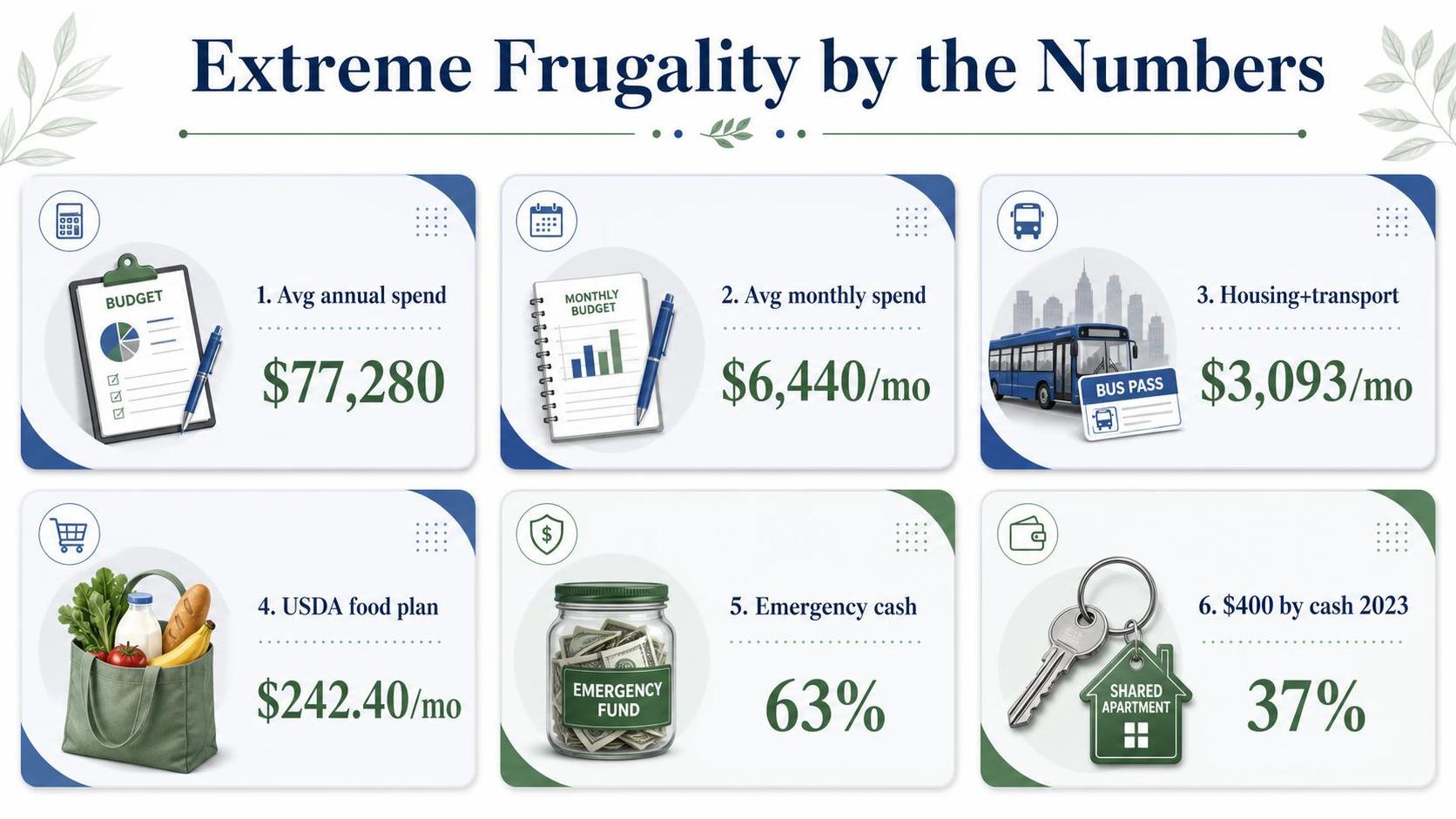
U.S. household spending shows why these categories matter. The U.S. Bureau of Labor Statistics reported average annual consumer expenditures of $77,280 in 2023.
Housing was the largest category at $25,436, followed by transportation at $13,174 and food at $9,985.
| Spending category | 2023 average annual spending | Source |
| Housing | $25,436 | U.S. Bureau of Labor Statistics, Consumer Expenditures 2023 |
| Transportation | $13,174 | U.S. Bureau of Labor Statistics, Consumer Expenditures 2023 |
| Food | $9,985 | U.S. Bureau of Labor Statistics, Consumer Expenditures 2023 |
| Total consumer spending | $77,280 | U.S. Bureau of Labor Statistics, Consumer Expenditures 2023 |
Extreme frugality focuses first on the largest fixed costs because small sacrifices rarely offset expensive housing or car ownership.
For example, eliminating a vehicle can reduce insurance, fuel, repairs, registration, parking, and depreciation, but only if local transportation options are reliable.
Food changes are another common area. The USDA’s official food plans show that grocery costs vary widely by age, household size, and spending level.
Readers should check the latest USDA Food Plans before setting a food budget, because prices change over time.
- Practical examples: Renting a room instead of an apartment, using public transit, meal planning, batch cooking, buying secondhand, and canceling recurring subscriptions.
- More extreme examples: Living with relatives, house hacking, biking year-round, no-spend months, dumpster-diving where legal, or strict minimalism.
- Not the same as poverty: Extreme frugality is voluntary when a person has safer alternatives; poverty is constrained by lack of resources.
A plain caution: do not cut essentials such as health insurance, prescribed medication, safe housing, adequate food, or legally required auto insurance just to save money.
Acting on frugal advice without considering safety, law, and health can cause serious harm.
The best definition is intentional spending below mainstream norms while protecting basic needs.
Extreme frugal living works only when the savings plan is realistic, legal, and matched to the person’s income, location, family responsibilities, and health needs.

When extreme frugality becomes risky
Extreme frugality becomes risky when saving money increases the chance of medical bills, legal problems, unsafe housing, foodborne illness, or lost income.
A budget cut is not “smart” if it transfers today’s expense into a larger future liability.
Caution: Do not use general frugal-living advice as a substitute for medical, legal, insurance, tax, or financial advice. Rules, costs, and risks vary by state and household.
| Cost-cutting choice | Why it can backfire | Source-backed fact |
| Skipping health insurance or care | Delaying treatment can turn manageable conditions into emergencies and medical debt. | KFF reported that 20 million U.S. adults owed medical debt in 2022, based on its analysis of the Survey of Income and Program Participation. |
| Driving uninsured | A crash can create legal penalties, license issues, and personal liability for injuries or property damage. | The Insurance Research Council estimated that 14.0% of U.S. motorists were uninsured in 2022. |
| Buying unsafe or expired food | Food poisoning can cause missed work, medical visits, and serious illness for children, older adults, and immunocompromised people. | The CDC estimates that 48 million people in the United States get sick from foodborne diseases each year. |
| Ignoring home repairs | Small leaks, faulty wiring, or broken heat can become health hazards and expensive emergencies. | FEMA states that just 1 inch of water can cause up to $25,000 of damage to a home. |
Some frugal tactics also create hidden income risk. Turning down reliable transportation, internet access, professional licensing, childcare, or work clothing can reduce employability.
The cheapest option is not always the option with the lowest total cost.
- Medical care: Avoiding preventive visits, prescriptions, dental care, or mental health care may save cash now but increase later costs. Ask providers about sliding-scale clinics, generics, charity care, or payment plans before skipping care.
- Insurance: Dropping auto, renters, health, disability, or liability coverage can expose a household to losses that exceed years of savings. Check state minimums and policy terms directly with regulators or insurers.
- Food: Stretching groceries is different from eating spoiled food. Follow USDA and FDA storage guidance, especially for meat, dairy, eggs, and leftovers.
- Housing and utilities: Living without safe heat, cooling, plumbing, or electricity can be dangerous. Local utility assistance, weatherization programs, and landlord-tenant rules may provide safer options.
- Debt: Paying every spare dollar toward debt while keeping no emergency cash can force reliance on high-cost credit after a car repair or medical bill.
A useful test is whether the cut increases exposure to a catastrophic cost.
If the possible downside could threaten health, housing, transportation, employment, or legal compliance, treat the expense as a risk-management decision, not just a budgeting choice.

Housing cuts with serious tradeoffs
Housing is often the largest budget line, so extreme frugal living usually starts with rent, utilities, and square footage. The savings can be real, but the risks include unsafe leases, longer commutes, crowding, and loss of legal protections.
The U.S. Bureau of Labor Statistics reported that housing accounted for 32.9% of average annual consumer expenditures in 2022, more than transportation or food. That makes housing cuts powerful, but not automatically wise.
| Housing move | Potential savings logic | Serious tradeoff |
| Renting a room instead of a full apartment | Splits rent, utilities, and internet across more people | Less privacy, possible lease violations, and conflict over guests, noise, or chores |
| Moving farther from work | Lower rent in many outer suburbs or rural areas | Higher fuel, insurance, maintenance, and unpaid commuting time |
| Living in a vehicle or informal unit | May reduce or avoid monthly rent | Safety, sanitation, parking enforcement, weather exposure, and lack of tenant rights |
| Taking on roommates | Can divide fixed costs such as rent and utilities | Joint liability if everyone is on one lease; one missed share can affect all tenants |
A useful reality check is the federal housing-cost burden measure. The U.S. Department of Housing and Urban Development describes households spending more than 30% of income on housing as cost burdened, and more than 50% as severely cost burdened.
Extreme cuts can backfire when they create hidden costs. A cheaper apartment that adds 40 miles of daily driving may raise gasoline, tire, repair, and depreciation costs.
The IRS standard mileage rate was 67 cents per mile for business use in 2024, illustrating how expensive vehicle use can be.
Caution: Do not move into an illegal garage, basement, shed, or overcrowded unit based only on monthly price. Local building, fire, zoning, and landlord-tenant rules vary, and unsafe housing can create health and eviction risks.
- Check the lease first. Many leases restrict subletting, long-term guests, pets, or additional occupants.
- Price the commute. Include fuel, parking, tolls, vehicle wear, transit passes, and lost time.
- Verify utility responsibility. A low rent can be misleading if heat, electricity, water, trash, or internet are separate.
- Keep an exit fund. Extreme housing arrangements can collapse quickly if a roommate leaves or a landlord objects.
The safest frugal housing cuts are usually documented, legal, and reversible: smaller units, negotiated renewals, vetted roommates, or relocation after comparing total costs.
The riskiest cuts are informal arrangements where the tenant has little proof, little privacy, and no clear remedy if things go wrong.

Food savings without unsafe shortcuts
Food is one of the easiest places to cut spending, but the cheapest choice is not always safe.
Extreme frugal living should prioritize planned meals, waste reduction, and safe storage rather than risky leftovers, unsafe canning, or spoiled discount food.
The U.S. Department of Agriculture’s Economic Research Service reported that U.S. consumers spent 11.2% of disposable personal income on food in 2023. Cutting that category carefully can matter, especially for households with tight cash flow.
| Food-saving move | Useful number | Source |
| Plan meals around food already at home | 31% of food loss at the retail and consumer levels was estimated by USDA researchers in a 2014 study using 2010 data | USDA Economic Research Service, Buzby, Wells and Hyman |
| Use leftovers quickly | Cooked leftovers should be used within 3 to 4 days in the refrigerator | USDA Food Safety and Inspection Service |
| Keep refrigerators cold enough | Refrigerators should be kept at 40°F or below; freezers at 0°F | U.S. Food and Drug Administration |
| Avoid room-temperature storage | Perishable food should not sit out more than 2 hours, or 1 hour above 90°F | USDA Food Safety and Inspection Service |
A practical frugal strategy is to build meals from low-cost staples: oats, rice, beans, lentils, eggs, frozen vegetables, potatoes, canned tomatoes, and seasonal fruit.
Compare unit prices, not package prices, because a larger package is only cheaper if it is used before spoiling.
- Shop from the kitchen first: Make a short inventory of the freezer, refrigerator, and pantry before buying more food.
- Cook once, portion safely: Divide large batches into shallow containers so they cool faster, then refrigerate or freeze promptly.
- Use “best by” correctly: The USDA says product dating is generally about quality, not safety, except infant formula.
- Buy ugly or discounted produce carefully: Bruised produce can be used quickly, but moldy or slimy food should be discarded.
- Choose frozen when waste is likely: Frozen vegetables can reduce spoilage when fresh produce routinely goes unused.
Do not stretch savings by eating food that smells spoiled, has visible mold, or was left out overnight. The Centers for Disease Control and Prevention estimates that 48 million people in the United States get sick from foodborne diseases each year.
Home canning deserves special caution. The CDC warns that improperly home-canned foods can cause botulism, a rare but serious illness.
Anyone preserving low-acid foods should follow current USDA Complete Guide to Home Canning instructions, not social media shortcuts.
Food banks, SNAP, WIC, school meals, and community pantries can be safer than extreme restriction.
Eligibility rules vary by program and state, so readers should check official state agency pages or Benefits.gov before assuming they do or do not qualify.

Transportation choices for ultra-low budgets
Transportation is often the difference between a workable frugal budget and an impossible one.
The cheapest choice is usually not “no car” in every place; it is the lowest-risk mix of walking, biking, transit, rideshare, and limited car use.
The Bureau of Labor Statistics reported average U.S. household transportation spending of $13,174 in 2023 in its Consumer Expenditures release.
AAA’s 2024 “Your Driving Costs” estimated the average new vehicle cost at $12,297 per year when driven 15,000 miles.
| Driving reduced | IRS 2025 mileage rate | AAA 2024 average new-car cost |
| 100 miles avoided | $70, using the IRS 2025 rate of 70 cents per mile | About $82, based on $12,297 divided by 15,000 miles |
| 500 miles avoided | $350, using the IRS 2025 rate | About $410, using AAA’s 2024 estimate |
| 1,000 miles avoided | $700, using the IRS 2025 rate | About $820, using AAA’s 2024 estimate |
Caution: Mileage-rate savings are estimates, not guaranteed cash in hand. Insurance, loan payments, parking permits, and registration may stay the same unless a household sells a vehicle, changes coverage, or eliminates paid parking.
- Walk the fixed trips first. The best candidates are repeat errands under one mile: grocery top-offs, library trips, school drop-offs, or pharmacy pickups. A walking plan works best when the route is daylight-safe and does not require carrying more than can be handled safely.
- Use a basic bicycle for predictable trips. A used commuter bike, helmet, lights, lock, and tire pump can replace short car trips. Before relying on it, check local helmet rules, theft risk, winter conditions, and whether the route has safe shoulders or bike lanes.
- Compare transit by total trip cost. A bus pass can be cheaper than gasoline, parking, and insurance, but only if it reliably serves work hours. Check the transit agency’s current fare page, reduced-fare programs, transfer rules, and service alerts before building a budget around it.
- Keep car use for high-value trips. If giving up a car would risk employment, medical care, or child custody schedules, the frugal option may be an older paid-off vehicle used sparingly, with strict maintenance and no unnecessary driving.
- Carpool carefully. Splitting fuel can help, but missed pickups can cost a shift or job. Put pickup times, backup plans, and payment expectations in writing, even with friends or relatives.
For ultra-low budgets, the goal is not transportation purity. The goal is to preserve income, safety, and essential appointments while cutting the most expensive miles first.

Debt, insurance, and emergency protections
Extreme frugal living is safest when it protects against financial shocks, not just when it cuts spending. Debt costs, insurance gaps, and missing emergency cash can erase months of savings quickly.
Do not cancel core protections or skip legal payments based on a budget article alone. Insurance rules, debt rights, and benefit eligibility vary by state, contract, and household circumstances.
Prioritize high-cost debt before cosmetic cuts
Credit-card debt is usually the first target because rates are high. The Federal Reserve reported an average credit-card interest rate of 22.76% for accounts assessed interest in May 2024.
By comparison, the Federal Reserve’s reported average 24-month personal-loan rate was 12.49% in May 2024. That gap means a $1,000 credit-card balance can be much more expensive than many installment debts.
| Debt or protection item | Source figure | Frugal action |
| Credit cards | 22.76% average interest rate on assessed-interest accounts, Federal Reserve, May 2024 | Pay above the minimum and stop new charges if possible |
| Personal loans | 12.49% average 24-month rate, Federal Reserve, May 2024 | Compare payoff order by APR, fees, and collateral risk |
| Emergency savings | Only 54% of U.S. adults could cover a $400 emergency using cash or its equivalent, Federal Reserve 2023 survey | Build a starter buffer before taking risky cuts |
| Uninsured medical risk | 26.4 million people in the U.S. lacked health insurance in 2022, U.S. Census Bureau | Check Medicaid, ACA marketplace subsidies, or employer options |
Keep insurance that prevents catastrophic loss
A bare-bones budget should not automatically remove health, auto, renters, disability, or liability coverage. The cheaper move may be raising deductibles, shopping quotes, or removing duplicate coverage, not going uninsured.
Auto liability insurance is legally required in nearly every state, and state minimums differ. Drivers should verify requirements with the state motor vehicle or insurance department before reducing coverage.
Renters insurance is often inexpensive relative to replacement costs, but premiums vary by location, building, deductible, and insurer. Tenants should compare actual quotes instead of relying on national averages.
Build an emergency floor
The Federal Reserve’s 2023 Economic Well-Being report found that 63% of adults said they would cover a $400 emergency expense with cash, savings, or a credit card paid off at the next statement.
For extreme frugality, a practical first milestone is one month of essential expenses: housing, utilities, food, transportation, insurance, and minimum debt payments. After that, many households work toward three months.
- List every debt by balance, APR, minimum payment, and whether collateral is at risk.
- Keep required insurance active before cutting subscriptions, dining out, or discretionary travel.
- Use nonprofit credit counseling or a legal aid office for collections, garnishment, or bankruptcy questions.
- Before selling structured settlement payments or taking lawsuit funding, compare total cost and court-approval requirements where applicable.

What Coin Abul independently reviewed
Coin Abul independently reviewed extreme frugal living as a household cash-flow strategy, not as investment, legal, tax or medical advice.
The review focused on federal data, consumer-protection guidance and practical risks that can arise when cost-cutting becomes too aggressive.
Extreme frugality can reduce spending quickly, but readers should not skip insurance, medical care, safe housing, debt payments or legally required obligations based on general budgeting advice.
A qualified professional or primary source should be checked before making high-stakes financial decisions.
Core data sources reviewed
| Source | Fact reviewed | Why it matters |
| U.S. Bureau of Labor Statistics, Consumer Expenditure Surveys, 2023 | Average annual consumer expenditures were $77,280 per consumer unit in 2023. | Shows the broad spending baseline extreme frugal households often try to reduce. |
| U.S. Bureau of Labor Statistics, Consumer Expenditure Surveys, 2023 | Housing averaged $25,436 in 2023, the largest major spending category. | Housing changes usually matter more than small daily cuts. |
| U.S. Bureau of Labor Statistics, Consumer Expenditure Surveys, 2023 | Transportation averaged $13,174 in 2023. | Car ownership, commuting and fuel choices can dominate a frugal budget. |
| U.S. Bureau of Labor Statistics, Consumer Expenditure Surveys, 2023 | Food averaged $9,985 in 2023. | Meal planning may help, but food cuts have health and time trade-offs. |
| Federal Reserve, Economic Well-Being of U.S. Households in 2023 | 63% of adults said they could cover a $400 emergency expense using cash, savings or a credit card paid off at the next statement. | Emergency savings are a key reason households pursue intense frugality. |
Areas evaluated for real-world usefulness
- Housing: Coin Abul reviewed downsizing, house hacking, roommate arrangements and relocation. These can be powerful, but lease terms, zoning rules, safety, school access and moving costs can erase savings.
- Transportation: The review compared car-free living, older paid-off vehicles, public transit, biking and reduced driving. Readers should verify insurance minimums and state registration requirements before changing coverage or ownership.
- Food: Reviewed tactics included pantry cooking, bulk staples, store-brand substitution and reducing restaurant spending. Coin Abul did not treat under-eating or medically unsuitable diets as valid frugality strategies.
- Debt and bills: The review considered calling creditors, comparing recurring subscriptions and avoiding late fees. Skipping secured debt, taxes, child support or court-ordered payments can cause serious legal or financial harm.
- Risk controls: Coin Abul reviewed Federal Trade Commission consumer guidance on scams and debt-relief claims, because extreme financial stress can make unrealistic savings promises more tempting.
The conclusion was that extreme frugal living works best when it targets large recurring costs, preserves health and legal compliance, and creates measurable cash reserves rather than simply minimizing every purchase.
Frequently Asked Questions
What is extreme frugal living?
Extreme frugal living means cutting spending far beyond ordinary budgeting, often by minimizing housing, transportation, food, utilities and discretionary costs.
It can improve savings, but readers should avoid choices that risk health, safety, legal compliance or required insurance coverage.
How much can housing choices affect a frugal budget?
Housing is usually the largest household expense: the U.S. Bureau of Labor Statistics reported that housing accounted for 32.9% of average annual consumer expenditures in 2022.
Downsizing, house-sharing or relocating can reduce costs, but renters and homeowners should review lease terms, local rules, insurance needs and moving costs before acting.
Is extreme couponing still worth it?
Couponing can help on items a household already uses, but it is not automatically frugal if it encourages bulk purchases, food waste or buying higher-priced brands.
The practical test is the final unit price compared with a cheaper generic or store-brand option, not the size of the advertised discount.
Can extreme frugality help pay off debt faster?
Yes, redirecting avoided spending toward principal can shorten repayment time, especially on high-interest credit card debt.
However, borrowers should first confirm minimum payments, fees and hardship options with the creditor, because missing required payments can damage credit and trigger penalties.
When does frugal living become financially risky?
It becomes risky when savings depend on skipping medical care, underinsuring a car or home, ignoring taxes, eating an inadequate diet or using unsafe housing and transportation.
A safer approach is to cut optional costs first while preserving emergency savings, legally required coverage and basic health needs.
Related Reading
- What Price Apartment Can I Afford?
- Top 10 Brilliant Money Saving Tips – What You Need to Know
- Why Personal Finance Is Important?
- How Much Bank Statement For Canada Student Visa?
- What Bank Is Cash App On Plaid?
- Creative Ways To Save Money – What You Need to Know
- Best Pre Settlement Loan Companies
- All Blog Guides
- USDA Food Plans: Cost of Food Monthly Reports (2025)
- FDA Are You Storing Food Safely? (2024)
- CDC Food Safety (2024)
- Consumer Financial Protection Bureau Your Money, Your Goals Toolkit (2024)
- U.S. Department of Energy Energy Saver Guide (2024)
- University of Minnesota Extension Save Money by Reducing Food Waste (2024)