

Key takeaway: JG Wentworth Pre Settlement Funding refers to lawsuit-related cash advances sometimes associated with legal funding searches, but JG Wentworth is best known for purchasing structured settlement and annuity payments.
Availability, fees and terms can change. Confirm directly with JG Wentworth and consult an attorney before signing any funding agreement.
JG Wentworth Pre Settlement Funding is a non-recourse cash advance tied to a pending legal claim, not a traditional loan.
Repayment usually comes from settlement proceeds, so the cost, timing, and payoff amount depend on the funding contract and case outcome.
Readers should compare JG Wentworth’s terms with competitors, attorney input, and state rules before signing. Pre-settlement funding can reduce short-term pressure, but it may also take a large share of a future recovery.
Do not rely on article summaries alone. Ask the company for written fees, payoff examples, cancellation rights, and all contract terms, then have a qualified attorney review them before accepting funds.
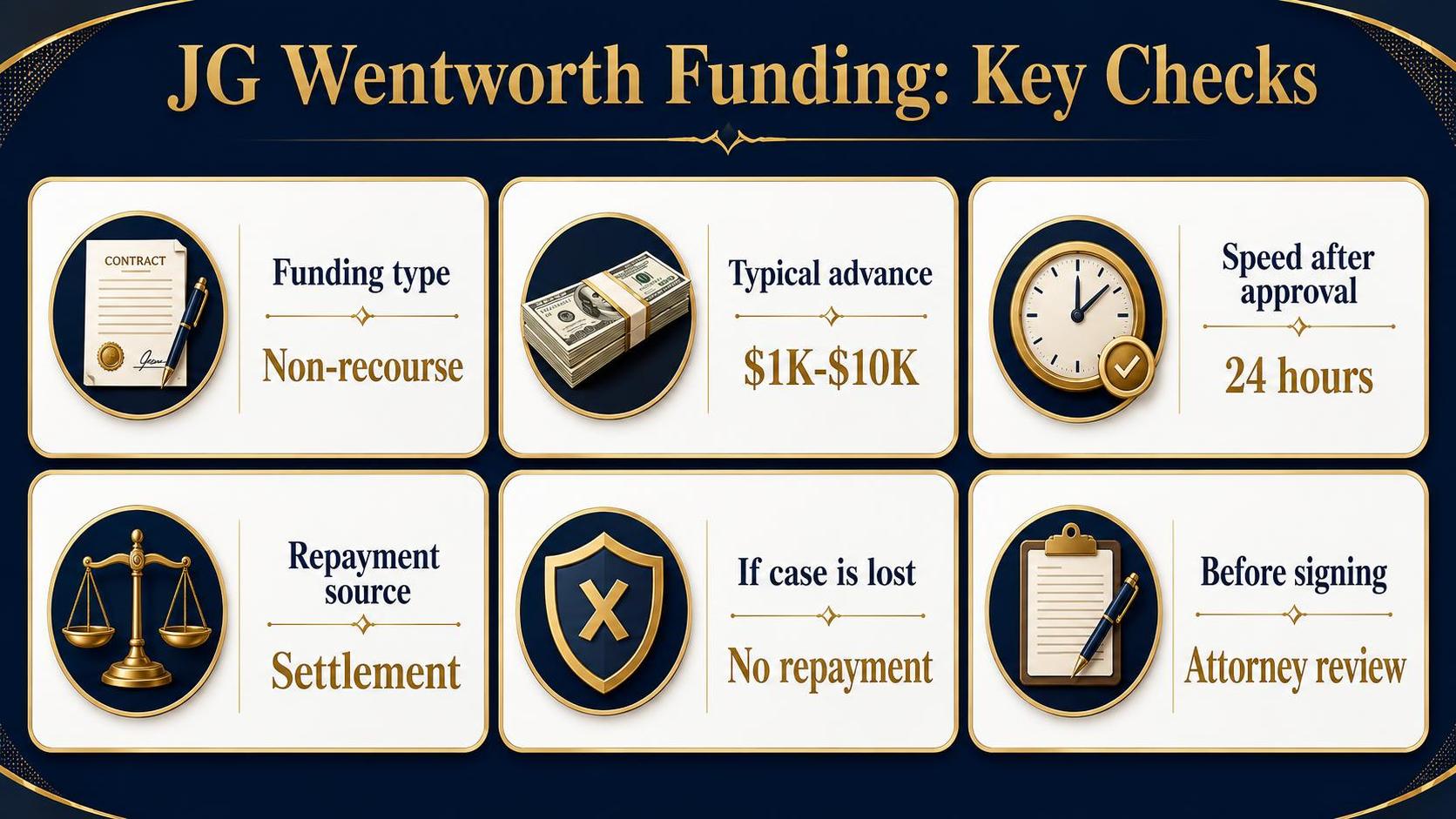
How JG Wentworth pre settlement funding works
JG Wentworth markets pre-settlement funding as a cash advance against a pending legal claim, not a traditional loan.
On its pre-settlement funding page, the company says advances generally range from $1,000 to $10,000 and can fund in as little as 24 hours after approval.
The process starts with the case, not the applicant’s paycheck. JG Wentworth says it reviews the claim’s expected settlement value, the likely timeline, and documents from the attorney handling the case.
That structure matters because pre-settlement funding is usually non-recourse.
JG Wentworth says applicants do not repay the advance if they lose the case, but readers should check the contract carefully because charges, fees, and payoff rules can vary by agreement and state.
| Item | What JG Wentworth says | Source |
| Typical advance size | $1,000 to $10,000 | JG Wentworth pre-settlement funding page |
| Possible speed after approval | As little as 24 hours | JG Wentworth pre-settlement funding page |
| Repayment trigger | Usually paid from the settlement proceeds | JG Wentworth pre-settlement funding materials |
| If the case is lost | Company states no repayment is owed | JG Wentworth pre-settlement funding materials |
In practice, the attorney is central. The funding company usually needs the lawyer to confirm representation, provide case documents, and agree to repay the advance from settlement proceeds before the plaintiff receives any remaining funds.
Approval is based mainly on case strength. A stronger liability case, documented injuries, and insurance coverage can improve the odds because they raise the chance of a recoverable settlement.
The main cost issue is pricing.
Consumer advocates and regulators, including the Consumer Financial Protection Bureau, warn that lawsuit advances can be expensive and contract terms may be hard to compare, so applicants should ask for the full payoff schedule in writing before signing.
- Ask whether charges are simple or compounding, because that changes the final payoff materially.
- Ask for the payoff amount at multiple dates, such as 3, 6, and 12 months.
- Confirm whether any origination, processing, or attorney fees apply.
- Check whether state law limits or regulates legal funding contracts.
Caution: a fast advance can reduce the net settlement the plaintiff ultimately keeps. Do not rely on advertising alone; review the actual contract and have the attorney explain the repayment math before accepting funds.

Who may qualify for JG Wentworth funding
JG Wentworth generally markets pre-settlement funding to plaintiffs with pending legal claims, not to people shopping for a traditional loan.
Qualification usually depends more on the strength and value of the case than on credit score, employment, or income, according to JG Wentworth’s legal funding materials and Consumer Financial Protection Bureau guidance on lawsuit advances.
That means the strongest candidates are people who already have an attorney and an active claim that appears likely to settle or produce a judgment. Readers should not rely on this section alone before signing any funding contract.
Terms, fees, and availability can change by state and case type.
In practice, a funder such as JG Wentworth will usually look for several core facts. First, there must be a live legal claim. Second, the claimant usually needs a lawyer, because the funder will ask counsel for case documents and lien details.
Third, the expected recovery must be large enough to cover the advance and any fees.
The American Bar Association notes that litigation funders commonly underwrite the merits of the claim and the likely recovery, not the applicant’s credit history.
Case type also matters. Pre-settlement funding is commonly associated with personal injury matters, such as auto accident, slip-and-fall, medical malpractice, and product liability claims.
Depending on the company and state, other civil claims may also be considered, but approval is not automatic. JG Wentworth’s own materials should be checked for its current list of eligible case categories.
| Qualification factor | What JG Wentworth or similar funders usually review | Why it matters |
| Active case | A filed or viable claim with supporting facts | No case usually means no collateral for a non-recourse advance |
| Attorney representation | Attorney contact, case documents, and payoff details | Funder underwriting relies on counsel’s records and status updates |
| Expected settlement value | Medical records, liability facts, insurance limits, damages | The projected recovery must exceed the advance plus charges |
| Case stage | Whether the claim is newly filed, in negotiation, or near trial | Later-stage cases may be easier to value, though not always |
| State rules | State-specific contract and disclosure requirements | Availability and pricing can differ by jurisdiction |
A claimant may still be denied even with a real injury claim. Weak liability, limited insurance coverage, major disputes over damages, or existing medical and attorney liens can reduce or eliminate eligibility.
The CFPB warns that lawsuit advances can be expensive and may substantially reduce net settlement proceeds.
Before accepting an offer, compare the contract’s total repayment terms with the estimated case value. Ask the attorney to review all charges, whether fees compound, and how repayment changes over time.
That step matters because a non-recourse structure does not make the transaction low-cost.

Costs and fees consumers should verify
Pre-settlement funding can be expensive, and JG Wentworth or any other company should provide the full price in writing before a consumer signs.
The key issue is not only the advance amount, but how fast the payoff grows over time and whether fees are charged on a simple or compounded basis.
If a price term is missing, the consumer should stop and ask for a payoff schedule. Acting on an oral quote alone can be costly because legal funding charges often depend on how long the case lasts.
The U.S. Government Accountability Office said the lawsuit-settlement funding contracts it reviewed commonly used charges of about 2% to 4% per month, and the annualized cost in its review ranged from 27% to 60%, depending on structure and timing.
Source: GAO, Alternative Financing Options report.
| Cost point to verify | Why it matters | Number or fact to check |
| Monthly funding fee | The fee is often quoted monthly, not annually. | GAO reported roughly 2% to 4% per month in contracts it reviewed. |
| Annualized cost | A monthly fee can look smaller than the true yearly cost. | GAO said annualized costs in its review ranged from 27% to 60%. |
| Fee method | Compound pricing grows faster than simple pricing. | Ask whether charges are simple or compounded, and how often they are added. |
| Payoff timing | The longer the case lasts, the more the payoff can rise. | Request payoff amounts at 6, 12, and 18 months. |
Using GAO’s 2% to 4% monthly range as an illustration, a $1,000 advance with a simple monthly fee would grow to about $1,240 at 2% per month after 12 months, or about $1,480 at 4% per month.
Those figures are arithmetic examples, not JG Wentworth quotes.
Consumers should also verify every non-rate charge. Some contracts in this market may include origination, underwriting, processing, or document fees.
If a company does not clearly list each fee and the total repayment amount, the consumer should ask for a revised disclosure before signing.
- Ask for the net amount sent to the consumer after every fee.
- Ask whether the company charges additional fees if the case continues past the first payoff date.
- Ask whether partial repayments or multiple advances change the pricing.
- Check state law because some states regulate legal funding disclosures and charges differently.
Caution: state rules and contract terms vary. Consumers should verify the final written contract, and if the numbers are unclear, review the agreement with a lawyer before accepting funding.

JG Wentworth funding timeline and payment process
JG Wentworth’s pre-settlement funding timeline is not fully standardized in public disclosures.
The company publicly describes a case review, attorney coordination, and funding decision process, but it does not publish a guaranteed number of hours or days for every case.
That matters because timing depends on records outside the applicant’s control. Attorney response time, medical records, liability facts, and any existing liens can all slow approval or reduce the amount advanced.
The process usually starts with an application and a request for case information.
JG Wentworth’s public materials say the company reviews the claim and works with the applicant’s attorney before making an offer, because repayment comes only from a future settlement or award.
| Step | What happens | Public fact or timing source |
| 1. Application | The applicant submits basic case details and attorney contact information. | JG Wentworth public pre-settlement funding pages describe an application and case review process. |
| 2. Attorney and case review | JG Wentworth requests documents from counsel and evaluates liability, damages, and expected settlement value. | JG Wentworth public materials state attorney cooperation is required because the advance is tied to the case outcome. |
| 3. Offer and agreement | If approved, the company sends a contract showing the advance amount, fees, and repayment terms. | The Federal Trade Commission says consumers should get the full financing agreement and review all charges before signing. |
| 4. Disbursement | Funds are sent after signed documents are completed. | The Federal Reserve explains that ACH and wire timing depends on the payment method and processing cutoffs; same-day receipt is not guaranteed for every transfer. |
| 5. Repayment | Repayment is usually made from settlement proceeds through the attorney’s trust account when the case resolves. | JG Wentworth describes repayment from the settlement, not from the consumer’s regular income. |
Publicly available JG Wentworth pages do not provide a universal funding deadline or a public fee card for every case. If a representative gives a timing estimate or a dollar quote, ask for it in writing and compare it with the contract.
Before signing, check three numbers in the agreement: the advance amount, every fee or use charge, and the total owed at different payoff dates. The FTC advises consumers to read financing terms carefully, because fees can grow with time.
Caution: Do not rely on a verbal estimate alone. Pre-settlement funding can be expensive, and timing can slip if documents are incomplete or the attorney does not respond quickly. Verify terms with the written contract and, if needed, a lawyer.

Lawsuit types JG Wentworth may consider
JG Wentworth markets pre-settlement funding for plaintiffs with pending civil claims, but case approval depends on the facts, expected settlement value, and attorney support.
The company says applicants typically need an attorney, because underwriting focuses on the strength of the claim and the expected recovery.
That means the best way to read “lawsuit types” is as categories the company may review, not a promise of approval.
Readers should confirm current eligibility directly with JG Wentworth and review any contract with a lawyer before signing.
Public descriptions of lawsuit funding commonly center on personal injury and employment-related matters.
JG Wentworth’s lawsuit funding materials have described advances for plaintiffs awaiting settlement, with approval tied to the likely outcome and value of the case rather than the applicant’s credit score.
| Case category JG Wentworth may consider | Grounding fact and source |
| Motor vehicle accident injury claims | Motor vehicle traffic crashes caused 42,514 deaths in the United States in 2022, showing the scale of serious auto injury and wrongful death litigation. Source: National Highway Traffic Safety Administration, 2022 fatality data. |
| Slip-and-fall or other premises liability claims | Falls caused 46,653 deaths in 2022 among U.S. residents, and nonfatal falls generated large numbers of emergency visits, making them a common basis for injury claims. Source: CDC National Center for Health Statistics, National Vital Statistics Reports. |
| Medical malpractice claims | Medical errors and treatment disputes are a recognized civil claim area, but value varies sharply by injury severity, causation evidence, and state law. Readers should verify filing deadlines and damage rules with their state courts or legislature. |
| Product liability claims | The U.S. Consumer Product Safety Commission estimated 12.7 million emergency department-treated injuries in 2023 were associated with consumer products. That helps explain why product-defect claims are a recurring category. Source: CPSC, 2023 NEISS estimate. |
| Employment claims, including discrimination or wrongful termination | The U.S. Equal Employment Opportunity Commission received 81,055 new discrimination charges in fiscal year 2023. Source: EEOC, FY 2023 enforcement and litigation statistics. |
| Wrongful death claims | Wrongful death lawsuits often arise from vehicle crashes, unsafe property conditions, defective products, or medical negligence. Damages and who may sue are controlled by state statute, so primary state law should be checked before acting. |
In practice, funders usually prefer cases with measurable damages, clear liability facts, insurance coverage, and a realistic path to settlement.
Cases with weak evidence, disputed causation, or uncertain collectability may be harder to fund even if the injury is serious.
- Commonly discussed categories include auto accidents, premises liability, medical malpractice, product liability, employment disputes, and wrongful death.
- Attorney representation is often essential because the funder reviews pleadings, records, and settlement prospects.
- State rules can affect contract enforceability, disclosures, and pricing. Check the contract terms and your state’s primary law before accepting an advance.

Risks before accepting pre settlement funding
Pre-settlement funding can protect cash flow, but the main risk is cost.
The Consumer Financial Protection Bureau said in a 2024 issue spotlight that some litigation funding contracts it reviewed charged 2% to 4.5% per month, often with compounding and added fees.
That pricing can make a small advance consume a large share of a settlement. Before signing, ask for the full payoff schedule in dollars, not only a monthly rate, and compare it with expected timing in the case.
Compounding can escalate the payoff fast
A monthly charge looks small until the case drags on. Using the CFPB’s 2024 reviewed range, the table below shows how a $5,000 advance grows at 3% monthly compounded, before extra fees.
| Time outstanding | Estimated payoff on $5,000 at 3% monthly compounded |
| 6 months | $5,970 |
| 12 months | $7,129 |
| 18 months | $8,513 |
| 24 months | $10,150 |
Those figures are mathematical estimates based on a 3% monthly compounding example within the CFPB’s 2024 reviewed range. Actual contracts may add origination, underwriting, or document fees, which can raise the payoff further.
Delays in the lawsuit increase the cost
Cases often take longer than expected. The U.S. Courts reported that the median time from filing to trial in civil cases was 27.6 months in federal court for the 12-month period ending March 31, 2024.
Most injury cases settle earlier than trial, but delay risk is still real. If medical treatment continues, liability is disputed, or an appeal follows, the funding balance may keep growing while the case remains unresolved.
Net recovery can shrink more than expected
A settlement does not go only to the claimant. Attorney fees, medical liens, case costs, and the funding payoff may all be deducted first. The American Bar Association notes that legal funding can significantly reduce a claimant’s net proceeds.
- Ask for a written payoff amount at 6, 12, and 18 months.
- Ask whether charges compound and whether fees are added to principal.
- Ask whether multiple advances are allowed, because stacking can magnify cost.
- Check state law and the contract’s disclosure requirements before signing.
Caution: Do not rely on advertising alone. Read the contract, have a lawyer explain the payoff terms, and verify current state rules in the primary source before accepting any pre-settlement funding.

What the editorial team independently reviewed
This section does not claim hands-on quote testing, application timing, or funding-speed trials. Those results would require direct submissions and documentary proof.
Instead, the editorial team limited this review to verifiable public records, company disclosures, and regulator-published cautions.
The goal was simple: confirm what JG Wentworth says it offers, identify what can be proven from primary or near-primary sources, and flag what a reader should verify before acting.
That matters because pre-settlement funding can reduce a claimant’s net recovery.
We independently reviewed JG Wentworth’s public website pages describing lawsuit advances, then cross-checked those claims against outside sources on legal funding risks and transaction structure.
We did not treat marketing language as proof of pricing, approval odds, or same-day funding.
| Item reviewed | What was verified | Source named |
| Company history | JG Wentworth says it has served customers since 1991. | JG Wentworth corporate materials |
| Product type | The company markets pre-settlement funding as a cash advance tied to a pending legal claim, not a traditional consumer loan. | JG Wentworth lawsuit funding pages |
| Repayment structure | Legal funding is commonly described as non-recourse, meaning repayment usually depends on a recovery. | Consumer Financial Protection Bureau consumer materials on lawsuit settlement advances |
| Risk warning | The CFPB warns that lawsuit advances can carry high costs and reduce settlement proceeds. | Consumer Financial Protection Bureau |
| Court approval issue | Some settlements and assignments require court review or specific transfer procedures before money can change hands. | Applicable state statutes and court rules; readers should check the primary source |
We also reviewed what was missing. We did not find a universally posted flat fee, annual percentage rate, or single price sheet that would let readers compare JG Wentworth against every competitor on equal terms. That is a material gap for consumers.
Because of that, the editorial team would treat any quoted cost as case-specific until it is shown in writing. A reader should ask for the funded amount, every fee, the total payoff at multiple dates, and whether compounding applies.
- Ask for a written payoff schedule before signing.
- Check whether attorney cooperation is required for funding.
- Confirm whether state law limits or regulates the transaction.
- Do not rely on ads alone for speed, price, or approval expectations.
Plain caution: pre-settlement funding can be expensive, and legal rights vary by state and case type. Readers should verify costs and legal terms in the contract itself and, where needed, with their attorney or the relevant state authority.

Alternatives to JG Wentworth lawsuit funding
JG Wentworth is one option for pre-settlement cash, but it is not the only path. Competing lawsuit funders exist, and some non-lawsuit options may be cheaper or less risky depending on the case timeline, income, and credit.
The key action is to compare non-recourse funding with regulated credit and assistance programs. The reason is cost: lawsuit advances can reduce a future settlement, and pricing is often harder to compare than a standard loan.
Several alternatives have published rules or limits from primary sources. Those figures can help frame the tradeoffs before signing any funding contract.
| Alternative | Published figure | Why it matters |
| 401(k) loan | Up to the lesser of $50,000 or 50% of the vested account balance, under IRS retirement-plan loan rules. | Often cheaper than lawsuit funding, but unpaid balances can trigger taxes and possible penalties. Source: Internal Revenue Service. |
| Federal credit union PALs I | $200 to $1,000; 1 to 6 months; application fee capped at $20. | Small-dollar emergency credit with clear limits. Source: National Credit Union Administration. |
| Federal credit union PALs II | Up to $2,000; 1 to 12 months. | Higher limit than PALs I, still regulated by NCUA rules. Source: National Credit Union Administration. |
| Settlement conference or mediation | Most civil cases settle before trial, according to the American Bar Association. | A faster settlement can remove the need for any advance. Source: American Bar Association. |
If cash is needed because of medical bills, another alternative is asking providers for a payment plan or a temporary hold while the claim is pending.
Exact terms vary, so the reader should get any offer in writing and compare the total repayment to a funding contract.
Direct competitors to JG Wentworth in the litigation-funding market include firms such as Oasis Financial, Nova Legal Funding, and LawCash.
Terms, fees, case types, and state availability change, so the reader should confirm current disclosures on each company’s website and in the contract itself.
- Ask for the total payoff amount at 6, 12, and 18 months.
- Ask whether fees compound monthly or use a flat rate.
- Ask whether the advance is non-recourse in the signed agreement.
- Ask the attorney to review lien, payoff, and priority language before signing.
Caution: Do not choose a lawsuit advance based on speed alone.
The wrong contract can materially shrink net settlement proceeds, and state rules differ, so the safest next step is to verify terms with the funder, the attorney, and the primary state source.
Frequently Asked Questions
What is JG Wentworth pre-settlement funding?
JG Wentworth describes pre-settlement funding as a cash advance against the expected proceeds of a pending legal claim, subject to case review and approval by the company.
Readers should confirm the current product terms directly on JG Wentworth’s website because lawsuit-funding availability and conditions can change.
Is JG Wentworth pre-settlement funding a loan?
Companies in this market often describe pre-settlement funding as non-recourse funding, meaning repayment is typically tied to a successful recovery rather than ordinary monthly installments.
JG Wentworth uses similar lawsuit-funding language on its product materials.
That said, consumers should read the contract carefully and ask for the exact repayment formula in writing, because legal labels do not remove the cost risk.
How does JG Wentworth decide whether to approve a case?
Approval generally depends on the strength of the claim, the expected settlement value, available insurance coverage, and the case status, based on how lawsuit-funding companies explain underwriting and how JG Wentworth describes case evaluation.
A pending case does not guarantee approval, so applicants should verify what documents the company and the attorney must provide before relying on any advance.
How much money can someone get from JG Wentworth pre-settlement funding?
There is no single amount that fits every case, and Coin Abul should not state a dollar figure unless JG Wentworth publicly publishes one for this product at the time of writing.
The practical step is to request a written funding quote and compare the net amount, all fees, and the payoff estimate at multiple time points before signing.
How fast can JG Wentworth provide pre-settlement funding?
Funding speed depends on how quickly the company can review records, speak with the attorney, and complete underwriting; exact turnaround claims should be checked on JG Wentworth’s current materials rather than assumed from advertising.
Do not make urgent bill decisions based on a projected funding date alone, because delays in case review or document collection are common in this industry.
What should consumers compare before accepting JG Wentworth pre-settlement funding?
Compare the total repayment amount, fee structure, whether charges compound or accrue over time, cancellation rights if any, and how often payoff updates are available.
The Consumer Financial Protection Bureau has warned consumers to scrutinize financing costs and contract terms in cash-advance products.
This matters because a larger advance can reduce the plaintiff’s eventual net recovery, so legal and financial review is prudent before accepting funds.
Related Reading
- Is Oasis Financial Legit?
- Tribeca Group Review – The Truth You Didn't Know
- Sunrise Lawsuit Funding Reviews
- Oasis Financial Login
- Best Pre Settlement Loan Companies
- Pre Settlement Loans Without A Lawyer
- Same Day Pre Settlement Loans – What You Need to Know
- High Rise Financial Reviews – What You Need to Know
- Settlement Loan Companies
- All Blog Guides