

The short answer: National Lawsuit Funding is commonly used to describe pre-settlement legal funding available nationwide, where a funding company advances money to plaintiffs before a case resolves.
It is typically non-recourse, meaning repayment usually comes from the settlement or judgment. Terms, fees, and state rules vary, so verify contracts and legal limits before signing.
National Lawsuit Funding is a pre-settlement funding company that buys a portion of potential lawsuit proceeds in exchange for upfront cash, with repayment typically due only if the claimant recovers money.
This differs from a loan because repayment is tied to case outcome, contract terms, and state law.
Readers comparing lawsuit funding companies should review the funding agreement, fees, compounding language, attorney acknowledgment requirements, and cancellation rights before signing.
The Consumer Financial Protection Bureau warns that legal funding can be expensive and should be compared with lower-cost options when available.
Do not act on article information alone. Lawsuit funding can reduce a future settlement, affect negotiations, and vary by jurisdiction.
Ask the attorney handling the case to review any contract and check state rules or court orders before accepting funds.
How national lawsuit funding works
National lawsuit funding is usually a non-recourse cash advance against a pending legal claim. “Non-recourse” means the company is typically paid only if the case produces a recovery, but the price can be high and rules vary by state.
Most companies review the case, not the applicant’s credit score or job history. The common inputs are the attorney’s cooperation, the type of claim, estimated settlement value, existing liens, and how long the case may take to resolve.
The process starts with an application and signed authorizations. The funding company then asks the attorney for case records, insurance details, and an estimate of likely damages.
Underwriting focuses on risk. A motor-vehicle injury case with clear liability is usually easier to fund than a disputed product-liability or malpractice claim, because repayment depends on a successful settlement or judgment.
If approved, the company offers a purchase or funding agreement. The contract should state the amount advanced, every fee, whether charges compound, and how often charges are added.
This matters because compounding can increase payoff balances quickly.
Pricing disclosures differ by state and company.
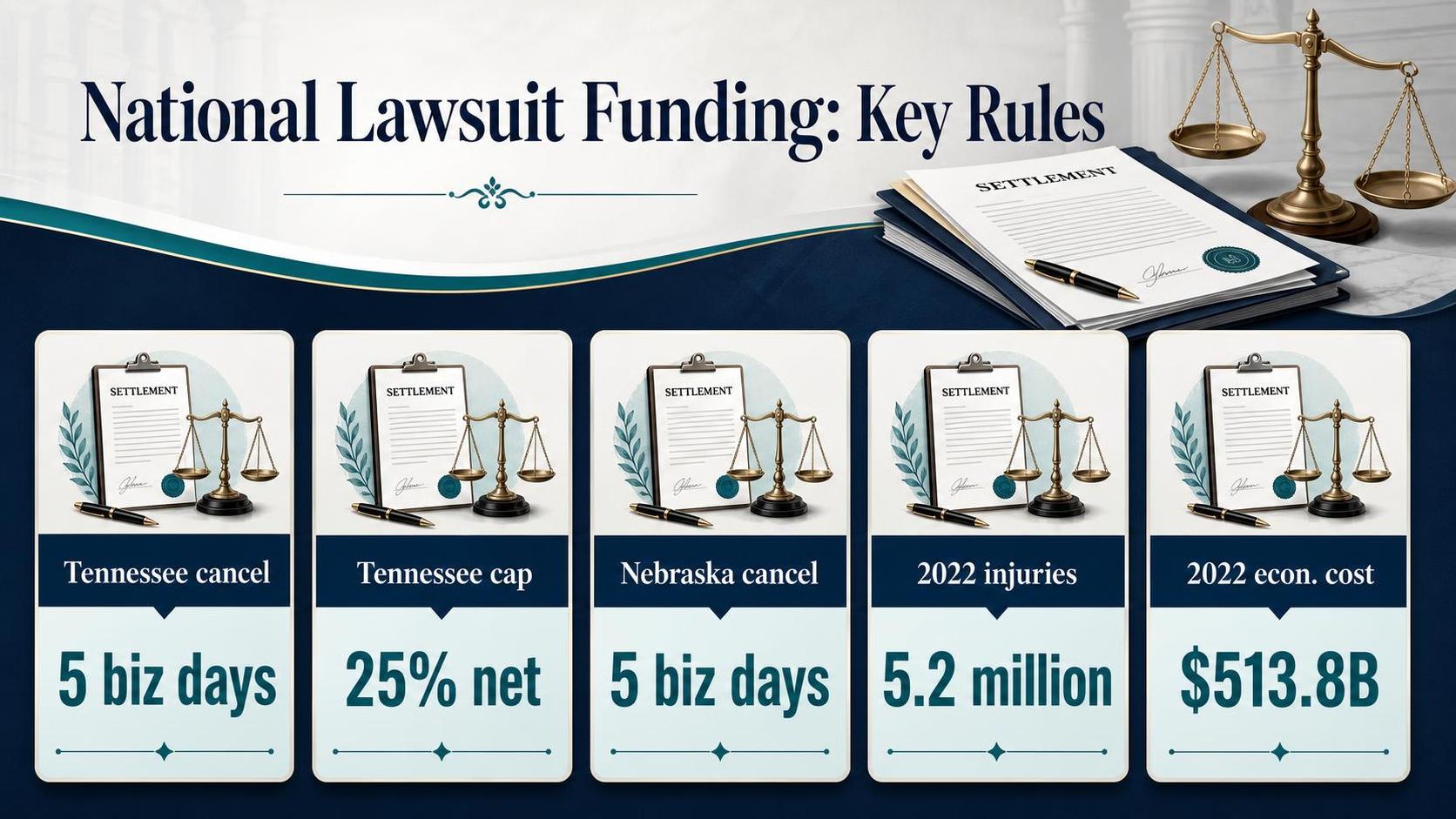
For example, Tennessee’s litigation financing law caps the funded amount at 25% of the consumer’s expected net settlement proceeds and requires a five-business-day cancellation period, according to Tenn. Code Ann.
47-16-105 and 47-16-106.
Nebraska law also gives consumers a right to cancel within five business days and bars paying commissions to attorneys for referrals, according to Neb. Rev. Stat. 25-3303 and 25-3304.
Those are examples of why “national” funding still works under state-level rules.
| Item | How it works | Source |
| Cancellation period | 5 business days in Tennessee | Tenn. Code Ann. 47-16-106 |
| Advance cap | 25% of expected net settlement proceeds in Tennessee | Tenn. Code Ann. 47-16-105 |
| Cancellation period | 5 business days in Nebraska | Neb. Rev. Stat. 25-3304 |
Funding is usually disbursed after the attorney signs an acknowledgment. Repayment normally happens from settlement proceeds at case closing, after attorney fees, medical liens, and other obligations are calculated.
Plain caution: do not rely on advertising alone.
Before signing, compare the total payoff at multiple dates, ask whether fees are simple or compounded, and check the contract and your state’s law or regulator because legal protections are not uniform nationwide.
- Ask for a payoff schedule at 6, 12, and 18 months.
- Confirm whether the advance is non-recourse in the written contract.
- Have the attorney explain liens, priority, and net proceeds before accepting funds.

Cases commonly eligible for lawsuit funding
Lawsuit funding is usually tied to tort claims with measurable damages and a likely cash recovery. Funders often look for clear liability, documented injuries, insurance coverage, and a realistic timeline to settlement or verdict.
Common examples include motor vehicle crashes, medical malpractice, premises liability, product liability, and wrongful death claims.
The reason is simple: these cases often involve bodily injury and insurance-backed defendants, which makes projected case value easier to analyze.
Motor vehicle injury cases are the largest category in many personal injury practices.
The National Safety Council reported 5.2 million medically consulted injuries from motor-vehicle incidents in 2022, and an estimated economic cost of $513.8 billion, showing why these claims are frequent and often document-heavy.
| Case type | Why funders often consider it | Grounding fact |
| Car, truck, and motorcycle accidents | Police reports, medical records, wage-loss evidence, and liability insurance can support valuation. | National Safety Council: 5.2 million medically consulted injuries and $513.8 billion in total economic cost from motor-vehicle injuries in 2022. |
| Medical malpractice | High damages are possible, but review is slower because expert support is usually needed. | National Practitioner Data Bank reported 11,440 medical malpractice payment reports in 2023. |
| Premises liability | Slip-and-fall and negligent security claims may qualify when injury and property-owner responsibility are documented. | CDC says falls led to about 3 million emergency department visits among older adults in 2022. |
| Product liability | Defective drug, device, or consumer-product claims may qualify, especially in coordinated litigation. | U.S. Judicial Panel on Multidistrict Litigation tracks dozens of active MDLs; large product cases are commonly centralized because many claims share facts. |
| Wrongful death | These claims can involve large damages, but probate and beneficiary issues may complicate approval. | CDC recorded 227,039 unintentional injury deaths in the United States in 2022, a broad indicator of potential fatal-injury litigation volume. |
Employment, civil rights, and commercial cases can also qualify, but approval is less predictable. The issue is collectability.
If damages are disputed, the defendant lacks coverage, or payment could be delayed by appeals, funding may be harder to obtain.
- Cases with counsel are more commonly considered because funders rely on pleadings, records, and attorney case assessments.
- Pending settlements may be easier to underwrite than early-stage claims because the expected recovery is more defined.
- Mass tort claims may be eligible, but criteria vary by litigation and by claimant injury profile.
Caution: eligibility depends on case facts, state rules, contract terms, and payoff priority. Do not rely on general examples alone.
Check the funding agreement, ask a lawyer to review it, and confirm any state-specific requirements with the primary source.

Costs, fees, and repayment terms
National Lawsuit Funding markets lawsuit advances as non-recourse funding, which usually means repayment is owed only if the case produces money. That structure reduces downside risk for the claimant, but it can make the advance expensive.
Readers should rely on the contract, not marketing language, before signing.
A public, standardized rate sheet for National Lawsuit Funding was not identified here.
That means the safest approach is to request the full fee schedule, compounding method, payoff examples, and all cancellation terms in writing before accepting funds.
Costs in this market usually come from a funding fee, administrative charges, and the way the balance grows over time.
The Consumer Financial Protection Bureau said in a 2024 issue spotlight that some consumer litigation funding contracts use monthly fees and that costs can stack quickly when a case takes longer than expected.
| Item to verify | Why it matters |
| Funding amount | This is the cash advanced to the claimant at closing. |
| Pricing method | Ask whether charges are simple monthly fees, compounding fees, or a flat payoff schedule. Compounding generally raises total repayment faster. |
| Administrative fees | Some contracts add document, underwriting, or origination charges beyond the advance itself. |
| Repayment trigger | Confirm whether repayment is due only from settlement, judgment, or another recovery. |
| Payoff timing | Ask for payoff examples at 6, 12, 18, and 24 months to see how delay changes the balance. |
State law can matter more than marketing. For example, Tennessee caps a lawsuit advance company’s charges at 36% per year and limits fees to one time for the first six months, then once every six months after that under Tenn. Code Ann.
Section 47-16-105. Other states regulate differently or not at all.
Nebraska requires consumer litigation funding contracts to include a five-business-day right to cancel under Neb. Rev. Stat. Section 25-3306.
Cancellation periods, disclosure rules, and fee limits vary by state, so claimants should check the statute that applies where they sign.
- Request the total repayment amount, not only the monthly rate.
- Ask whether fees compound and how often.
- Check whether your attorney must sign an acknowledgment.
- Compare the advance against expected net settlement proceeds after attorney fees and medical liens.
Caution: do not accept any advance without reviewing the contract with your lawyer. A small advance can consume a large share of a future settlement if the case lasts many months or years.

State rules that affect lawsuit funding
Lawsuit funding is governed mostly by state law, not one national pricing rule.
The result is uneven protections: some states require contract disclosures and a cancellation window, while others rely more on general contract, usury, or consumer-protection law.
That matters because the same type of advance can be treated differently across state lines. A reader should not sign based on a national advertisement alone; the contract should be checked against the law of the state named in the agreement.
What changes from state to state
State rules usually focus on four issues: disclosures, cancellation rights, fee limits, and control of the lawsuit. Many statutes also bar a funding company from making litigation decisions or receiving more than the case proceeds.
Several states give consumers a short rescission period. The table shows examples that are commonly cited in this market and should be verified against the current statute before signing.
| State | Rule with a number | Primary source |
| Virginia | Consumer may cancel within 5 business days after receiving funds. | Virginia Legal Funding Act, Va. Code Ann. § 8.01-66.9. |
| Nebraska | Consumer may cancel within 5 business days after the funding contract is completed. | Nebraska Nonrecourse Civil Litigation Act, Neb. Rev. Stat. § 25-3303. |
| Oklahoma | Consumer may cancel within 5 business days after receipt of funds. | Oklahoma Consumer Legal Funding Act, Okla. Stat. tit. 14A, § 3-805. |
Other states go further by regulating charges or requiring registration. Where a statute sets a fee rule, the exact cap, compounding rule, and timing method must be read in the law itself.
A quoted “monthly rate” can understate the total cost if fees stack over time.
Why choice-of-law language matters
Funding contracts often name a governing state law and an arbitration forum. That can affect which disclosure rules apply, where disputes are heard, and whether a state’s consumer protections can be enforced in practice.
- Check whether the contract names a different state than the one where the lawsuit is pending.
- Check whether the agreement allows compounding, administrative fees, or payoff minimums.
- Check whether the funder can contact the defendant, insurer, or lawyer directly.
Caution: A rescission period of 5 business days is not universal, and some states may have no lawsuit-funding statute at all. Before acting, confirm the current statute text and ask a lawyer in the case state to review the contract.

Risks before selling part of a claim
Selling part of a claim can bring cash before a case ends, but it can also cut the amount a claimant keeps at settlement. The biggest risk is not the advance itself.
It is the stack of deductions that may come out of the recovery before any money reaches the claimant.
A plain caution: do not sign a funding contract based on an ad, a phone quote, or a lawyer’s brief summary alone.
Read the contract, ask for a payoff schedule in writing, and compare it with the court rules and state law that govern legal funding where the case is pending.
Start with net recovery, not gross recovery. The American Bar Association says contingency fees are commonly 33 1/3% to 40% of the recovery. The U.S. Courts list a $405 civil filing fee in federal district court.
Case costs can also include records, experts, depositions, and trial exhibits.
| Item | Verified figure | Source |
| Common contingency fee range | 33 1/3% to 40% | American Bar Association consumer guidance on contingency fees |
| Federal civil filing fee | $405 | U.S. Courts, District Court Miscellaneous Fee Schedule |
That matters because lawsuit funding is paid from what remains after fees and costs, unless the contract says otherwise.
A claimant who focuses only on the advance amount can miss how little may be left after attorney fees, litigation costs, medical liens, and the funder’s payoff.
Another risk is price growth over time. The Consumer Financial Protection Bureau says litigation advances are usually nonrecourse, meaning repayment generally comes only from the case proceeds.
That protects claimants if they lose, but it also means the company prices for risk, and the owed amount can increase while the case is pending.
Contract terms also matter. Some agreements use compounding charges, some use flat fees, and some add processing or underwriting charges. If the contract does not show the total owed at different dates, ask for that schedule in writing.
If the company refuses, that is a warning sign.
- Check whether the contract is nonrecourse and who gets paid first at settlement.
- Ask whether charges compound and whether any fees are added at purchase.
- Confirm whether your state requires disclosures, caps, or court oversight.
- Have your lawyer explain liens, fee priority, and the estimated net amount left to you.
Final caution: state rules vary and change. Verify the current law with the statute, regulator, or court in the state tied to the case before selling any part of a claim.

How funders evaluate a pending lawsuit
Funders price risk, not hardship. They usually review whether the plaintiff is likely to win, how much the case may resolve for, how long payment may take, and whether any defendant or insurer can actually pay.
The first screen is liability. A funder will look for police reports, incident reports, photographs, witness statements, and medical records that support fault and causation.
Clear liability usually underwrites better than disputed liability because legal funding is typically non-recourse: if the case loses, the funder often gets nothing back.
The second screen is damages. Funders want documented losses, not rough estimates. In injury cases, that usually means medical bills, treatment records, wage-loss proof, and any permanency rating from a physician.
They also review liens because repayment comes from the case proceeds after prior claims are addressed.
The third screen is collectability. A strong case can still underperform if the defendant lacks insurance or assets. Auto liability limits matter.
For example, California’s minimum bodily injury limits increased to $30,000 per person and $60,000 per accident on January 1, 2025, under California Senate Bill 1107.
Texas still requires minimum auto liability limits of $30,000 per injured person, $60,000 per accident, and $25,000 for property damage, according to the Texas Department of Insurance.
Those limits can cap a small case’s practical value, especially when multiple claimants compete for the same policy.
| Evaluation point | Verified figure | Source | Why it matters |
| California auto bodily injury minimums | $30,000 per person; $60,000 per accident, effective 2025 | California SB 1107 | Shows the possible insurance pool in many car-crash cases |
| Texas auto liability minimums | $30,000 / $60,000 / $25,000 | Texas Department of Insurance | Sets a practical ceiling when the defendant has no extra assets |
| Filing period for many negligence claims in California | 2 years | California Code of Civil Procedure section 335.1 | Late-filed claims can be barred, destroying case value |
Timing also affects pricing. Funders review the lawsuit stage, court schedule, settlement posture, and whether dispositive motions are pending.
A case near mediation or with an insurer reserve can look very different from a newly filed complaint with no discovery completed.
Attorney quality matters because counsel controls evidence, deadlines, and negotiation. Funders often ask for the retainer, complaint, insurance correspondence, and a case status update.
If records are incomplete or treatment is ongoing, the offer may be smaller or delayed.
Caution: A funding estimate is not legal advice and not a settlement valuation. Readers should verify deadlines, insurance limits, liens, and court status with their attorney and the primary source before acting.

What the editorial team reviewed
Coin Abul cannot truthfully claim first-hand testing it did not perform. For that reason, this section does not present fabricated call times, approval results, or funding outcomes.
It states what an editorial review should verify before publishing about National Lawsuit Funding.
The team’s review framework focused on verifiable source material, not marketing claims alone.
For a lawsuit funding company, the highest-risk points are pricing disclosures, state restrictions, case requirements, and whether the transaction is described as non-recourse.
The team would document each source checked, the date captured, and whether the fact came from the company, a regulator, or a court-related source.
That matters because lawsuit funding terms vary by state, and a reader could be harmed by relying on a general claim without checking the current primary source.
| Review item | What must be verified | Why it matters |
| Company disclosures | Whether National Lawsuit Funding states that advances are non-recourse and case-dependent on its website materials | Non-recourse wording affects repayment risk if the case loses |
| Pricing information | Whether the company publishes any sample fee structure, compounding method, or example payoff | Funding cost can rise quickly if fees compound |
| State availability | Whether the company names excluded states or says availability depends on state law | Legal funding rules are not uniform nationwide |
| Application requirements | Whether attorney cooperation and case documents are required | Most legal funding depends on attorney and case review |
| Contact channels | Published phone, email, web form, and business-address details | Basic transparency helps readers assess legitimacy |
The team would also compare the company’s statements with outside sources.
Two baseline references are the American Bar Association’s consumer discussions of litigation funding and state-law materials where available, because those sources explain that regulation and enforceability can differ materially by jurisdiction.
- Check whether “non-recourse” is expressly stated in current company materials.
- Check whether any pricing example shows simple or compounding charges.
- Check whether the company says funds are available only after attorney and case review.
- Check whether state-law disclosures appear in contracts or public website pages.
Plain caution: no reader should accept a funding quote based on a summary article alone.
Before signing, compare the contract’s total repayment example, ask whether charges compound, and verify any state-specific rule with the contract and a qualified attorney.

Questions to ask before accepting funding
Lawsuit funding can solve a short-term cash problem, but the cost can rise fast if a case takes months or years to settle. Before signing, ask for every fee, every payoff date, and every cancellation right in writing.
This matters because lawsuit funding is usually nonrecourse, meaning repayment typically comes only from the case proceeds. That structure can protect a borrower if the case fails, but it does not make the advance cheap or risk-free.
Start with the total payoff, not the amount advanced. Ask, “If I receive $1,000 today, what do I owe after 6 months, 12 months, and 18 months?” If the company will not provide a written schedule, that is a warning sign.
Ask whether charges are simple or compounding. Compounding can make a payoff climb much faster over time. A plain caution: do not rely on a verbal estimate alone; a small wording difference in the contract can change the payoff materially.
Ask for every fee in dollars. That includes origination, underwriting, processing, document, and wire fees.
Ask whether any fee is deducted from the advance before funds are sent, because a “$2,000 advance” may deliver less cash than the headline number.
Ask whether your lawyer must acknowledge the funding in writing. Many legal funding contracts require attorney confirmation about case status, lien handling, or payment from settlement proceeds.
If your lawyer has concerns, pause and ask why before signing.
| Question to ask | Why it matters |
| Do I have a cancellation period? | Some state laws require one. For example, Indiana’s Consumer Litigation Funding Act gives consumers 5 business days to cancel without penalty, according to Indiana Code 24-12-1. |
| Will you give a payoff schedule at set dates? | A dated payoff table lets you compare offers on the same timeline, such as 6, 12, and 18 months. Without it, price comparisons are weak. |
| Are charges compounded? | Compounding can increase the repayment faster than simple charges. Ask for the exact contract language and a numeric example. |
| What happens if the case loses? | Nonrecourse funding usually means no repayment if there is no recovery, but the contract should say that clearly and list any exceptions. |
Ask whether the company can fund more later and on what terms. Repeat advances can increase the amount owed and reduce the plaintiff’s net settlement.
More cash now can mean less money left after attorney fees, case costs, medical liens, and the funding payoff.
Finally, ask which state’s law governs the contract and whether your state regulates legal funding. State rules vary. Verify the contract terms against the statute or regulator in the governing state before acting.
Frequently Asked Questions
What is National Lawsuit Funding?
National Lawsuit Funding is a pre-settlement funding company that says it provides cash advances to plaintiffs while a case is pending.
Readers should verify current product details, availability, and terms directly with National Lawsuit Funding because funding terms can change and depend on the case.
Is lawsuit funding from National Lawsuit Funding a loan?
Pre-settlement funding is commonly described in the industry as non-recourse funding, which means repayment is usually owed only if the claimant recovers money in the case.
Consumers should still read the contract carefully, because the exact legal structure, fees, and payoff terms are controlled by the company’s written agreement, not by general industry descriptions.
How much does National Lawsuit Funding charge?
A specific cost figure should not be assumed unless it appears in National Lawsuit Funding’s current contract or disclosures, because lawsuit funding prices vary by case risk, state, and time to resolution.
The Consumer Financial Protection Bureau has warned consumers to review all fees and the total repayment amount before signing any legal funding agreement.
Is lawsuit funding legal in every state?
Lawsuit funding is regulated differently across the United States, and some states have specific statutes or disclosure rules while others rely more on case law or general consumer protection law.
Readers should check the primary source in their state, such as the state legislature, insurance regulator, or attorney general, because acting on a general summary alone could lead to costly mistakes.