

In short: How much is the apartment depends on location, size, condition, amenities, lease terms, and local market demand.
A studio in a lower-cost area may rent for hundreds per month, while a luxury city apartment may cost several thousand. Check current listings, fees, deposits, utilities, and lease rules before deciding.
How Much Is The Apartment is answered first by location: the U.S. median asking rent was $1,373 in Q4 2024, according to the U.S. Census Bureau’s Housing Vacancies and Homeownership report.
Buying is different: the National Association of Realtors reported a $407,500 median existing-home price in 2024.
The trade-off is flexibility versus equity. Renting can lower upfront cash needs, while buying may build wealth if prices rise. The downside case is real: Freddie Mac reported a 6.72% average 30-year fixed mortgage rate on Aug.
22, 2024, and repairs, insurance, taxes, or job loss can strain a budget. Verify local prices before acting.
What an apartment costs in 2025
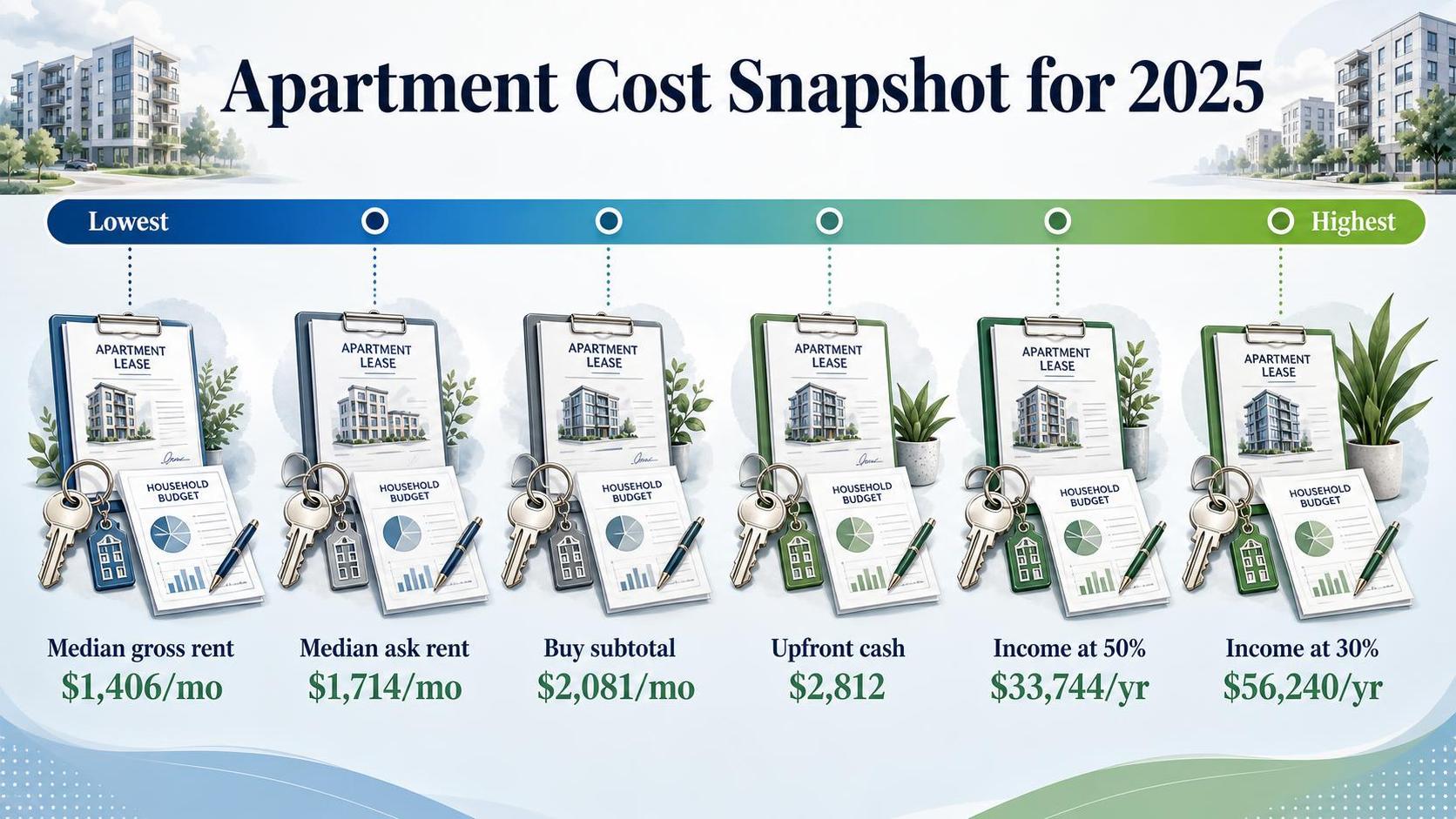
For 2025 budgeting, the safest national benchmark is still the U.S. Census Bureau’s latest full-year nationwide number: median gross rent of $1,406 in the 2023 American Community Survey. “Gross rent” includes contract rent plus estimated utilities,.
So it is closer to a real monthly housing bill than rent alone.
That national median is only a starting point. Actual apartment costs vary sharply by city, unit size, building age, parking, pet rules, and whether utilities are included.
A renter should verify local listings, lease fees, and utility terms before signing.
HUD and the Census Bureau generally define a household as cost-burdened when it spends more than 30% of income on housing, and severely cost-burdened above 50%.
Using the Census median gross rent of $1,406, the income needed to stay within those limits looks like this.
| Benchmark | Monthly housing cost | Annual gross income needed | Source |
| National median gross rent | $1,406 | $56,240 to stay at 30% of income | U.S. Census Bureau, 2023 ACS; income threshold calculated from HUD/Census 30% standard |
| National median gross rent | $1,406 | $33,744 at 50% of income | U.S. Census Bureau, 2023 ACS; severe-burden threshold calculated from HUD/Census 50% standard |
The downside case matters. At the same $1,406 monthly cost, a renter earning $45,000 a year would spend about 37.5% of gross income on housing.
That is above the standard affordability line before groceries, insurance, transportation, childcare, or debt payments.
Move-in costs also raise the cash needed. Many landlords require the first month’s rent and a security deposit.
If the deposit equals one month of gross rent, a renter using the national median would need about $2,812 upfront before application fees, pet fees, parking, or utility deposits.
The trade-off is simple. A cheaper unit can lower rent burden but may increase commuting, utility, or maintenance costs. A newer or better-located unit may save time and transportation money but can leave less room for emergency savings.
A renter should compare the full monthly cost, not headline rent alone.

Rent versus buy apartment math
Rent-versus-buy math is a cash-flow problem first and a wealth problem second. A renter usually faces one visible monthly bill, while a buyer takes on mortgage interest, property tax, insurance, repairs, and often HOA dues that can change over time.
For a simple baseline, Freddie Mac said the average 30-year fixed mortgage rate was 6.78% for the week ending July 25, 2024. Realtor.com said the U.S. median asking rent was $1,714 in June 2024.
Those figures show why buying can feel expensive even before taxes and fees.
Using a $350,000 apartment purchase as an example, a 20% down payment leaves a $280,000 mortgage. At 6.78% for 30 years, principal and interest are about $1,818 a month by standard amortization math.
Property tax adds more. The Tax Foundation reported the average effective property tax rate on owner-occupied homes was 0.90% nationally in 2022. On a $350,000 apartment, that is about $3,150 a year, or about $263 a month.
| Item | Monthly amount | Source |
| Median asking rent | $1,714 | Realtor.com, June 2024 Rent Report |
| Mortgage principal and interest on $280,000 at 6.78% | About $1,818 | Calculated using Freddie Mac 30-year fixed rate, week ending July 25, 2024 |
| Property tax on $350,000 at 0.90% | About $263 | Tax Foundation average effective property tax rate, 2022 |
| Buying subtotal before insurance, HOA, maintenance | About $2,081 | Sum of above items |
That subtotal is already about $367 above the June 2024 median asking rent, and it still excludes condo insurance, utilities a landlord may cover, maintenance, and HOA dues.
HOA charges can materially change the math, so buyers should read the association budget, reserve study, and fee history before acting.
The upside is equity and possible price appreciation. The downside is concentration risk and transaction cost.
Zillow says sellers typically pay about 8% to 10% of the sale price in closing costs and commissions, so a short ownership period can erase gains fast.
- Renting preserves flexibility and caps repair risk.
- Buying can build equity, but only if the owner can hold long enough to spread upfront and exit costs.
- If cash is tight, a renter may avoid being “house poor” even when buying looks attractive on paper.
Caution: national averages do not price a specific apartment. Before signing a lease or purchase contract, check the actual mortgage quote, local property tax bill, insurance quote, HOA documents, and closing disclosures.
Upfront cash needed for an apartment
Upfront apartment costs are usually much higher than one month of rent. In many cases, a renter needs cash for rent, a deposit, screening fees, and moving costs before getting the keys.
A useful baseline is the national median gross rent. The U.S. Census Bureau’s 2023 American Community Survey reported median gross rent of $1,406 for occupied U.S. housing units, which includes contract rent and utilities where applicable.
If a landlord asks for first month’s rent plus a security deposit equal to one month, that baseline becomes about $2,812 before any other charges.
That is a common planning estimate, not a legal rule, because deposit limits vary by state and by property type.
| Upfront item | Verified figure | Source |
| National median gross rent | $1,406 | U.S. Census Bureau, 2023 American Community Survey |
| Two months at that rent | $2,812 | Calculated from Census median gross rent |
| Zillow application fee | $35 | Zillow Rentals pricing page |
| TransUnion SmartMove screening fee | $47.95 | TransUnion SmartMove pricing page |
Application fees are smaller than rent or deposits, but they add up fast. Two rejected applications at $35 each cost $70. Two at $47.95 each cost $95.90, based on the published prices above.
State law can sharply change the cash requirement. In California, for most unfurnished rentals, a security deposit is limited to one month’s rent under California Civil Code 1950.5.
In Texas, statewide law does not set a numeric cap in Chapter 92 of the Texas Property Code.
That creates a trade-off. A lower advertised rent can still require more cash if the landlord wants a large deposit, last month’s rent, or nonrefundable fees. A slightly higher-rent unit with a lower deposit can be easier to afford at move-in.
The downside case is running short after approval. A renter who uses all available cash on move-in may still face utility setup charges, truck rental, furniture, or time off work.
The Consumer Financial Protection Bureau advises comparing all move-in charges, not rent alone.
Caution: Do not rely on averages by themselves before signing. Ask for a written breakdown of every charge, confirm whether any fee is refundable, and check current state or local landlord-tenant rules from the primary source.

Monthly apartment costs beyond rent
Rent is only the starting number. A renter’s real monthly housing cost often includes utilities, internet, renters insurance, parking, and pet fees, and those items can add well over $200 a month depending on the building and city.
The exact bill varies by lease. Before signing, check the lease and the property’s fee schedule, because an advertised rent can look affordable while the full monthly cost is not.
| Cost item | Typical figure | Source |
| Electricity, gas, water, trash | $253 per month average household utility bill | Move.org, citing U.S. utility cost data, 2024 |
| Internet | $78 per month average | J.D. Power, 2024 U.S. Residential Internet Service Provider Satisfaction Study |
| Renters insurance | $148 per year, about $12.33 per month national average | National Association of Insurance Commissioners, 2021 data released 2024 |
| Parking | Often extra; amount varies by property and market | No consistent national standard; check the lease and local listings |
| Pet rent | Usually charged monthly where allowed; amount varies | No reliable national legal standard; check the lease and local law |
Utilities are the biggest wildcard. Move.org reported the average U.S. household pays about $253 a month for electricity, natural gas, water, sewer, trash, and recycling in 2024. In an older building or a hot climate, the total can be higher.
Internet is another regular bill. J.D. Power reported the average monthly price for residential internet service was $78 in 2024. If the apartment requires a specific provider, there may be fewer low-cost options.
Renters insurance is cheaper than most add-ons, but it still counts. The National Association of Insurance Commissioners reported average renters insurance premiums of $148 a year, or about $12 a month, based on 2021 data.
Some landlords require proof of coverage.
Fees can also change the math. Application fees, amenity fees, package fees, parking, storage, and pet charges are common, but there is no single verified national average for all of them.
Read the lease line by line and ask for a full monthly breakdown in writing.
The downside case is simple: a unit that fits the rent budget can still strain cash flow after utilities and fees. Do not rely on an ad alone. Use the signed lease, insurer quote, and utility estimates from the provider before making a decision.

How location changes apartment prices
Location changes apartment cost faster than almost any other factor. The same two-bedroom can be priced very differently because local wages, zoning limits, land scarcity, taxes, and commute patterns all change by market.
A useful benchmark is fair market rent. The National Low Income Housing Coalition’s Out of Reach 2024, using U.S. Department of Housing and Urban Development fair market rent data, shows how widely state-level costs can differ.
| State | 2024 two-bedroom fair market rent | Hourly “housing wage” needed | Source |
| California | $2,594 | $49.88 | NLIHC Out of Reach 2024 |
| New York | $2,182 | $41.96 | NLIHC Out of Reach 2024 |
| Texas | $1,556 | $29.92 | NLIHC Out of Reach 2024 |
| Florida | $1,754 | $33.73 | NLIHC Out of Reach 2024 |
| Mississippi | $1,150 | $22.12 | NLIHC Out of Reach 2024 |
Those gaps matter for budgeting. NLIHC reports a national two-bedroom fair market rent of $1,606 and a national housing wage of $30.94 in 2024. A market above that level can strain a budget even when the apartment itself looks average.
Inside the same metro, prices also change by neighborhood. Apartments near large job centers, transit lines, universities, or limited waterfront land often command more because demand is concentrated and supply is harder to expand quickly.
The cheaper location is not always the cheaper life. A longer commute can add transportation costs that erase rent savings. AAA’s Your Driving Costs 2024 estimates the average cost to own and operate a new vehicle at 83 cents per mile.
That downside case matters. Saving $200 a month on rent can disappear if the move adds hundreds of driving miles, more parking, or a second car. Utility costs, local taxes, and insurance can also vary by place and raise total housing expense.
- Compare rent with commute cost, not rent alone.
- Check neighborhood-level listings, not only city averages.
- Use current local data before signing. Asking rents and concessions can change quickly.
Caution: state and metro averages are not a quote for a specific unit. Before acting, verify the exact apartment, lease terms, fees, and local market data from the landlord, listing platform, or public source.

Downside risks of stretching your budget
Stretching for a higher apartment payment can leave too little room for essentials, savings, and surprise bills.
The risk is not abstract: federal housing agencies, labor data, and banking regulators all use measurable thresholds that show when housing costs start to crowd out the rest of a budget.
The basic warning sign is cost burden. The U.S. Department of Housing and Urban Development defines a household as “cost burdened” when it spends more than 30% of gross income on housing, and “severely cost burdened” above 50%.
If rent pushes a budget past those marks, one setback can force hard trade-offs.
The Consumer Financial Protection Bureau advises consumers to compare total housing costs with other fixed obligations and keep a cash buffer, because late payments, overdrafts, and high-cost borrowing can follow when cash flow gets tight.
| Housing-cost share of gross income | What the threshold means | Source |
| 30% | Cost-burdened household | U.S. Department of Housing and Urban Development |
| 50% | Severely cost-burdened household | U.S. Department of Housing and Urban Development |
| 3 to 6 months | Emergency savings many households are advised to hold | Consumer Financial Protection Bureau |
| $1,563 | Average annual household spending on utilities, fuels, and public services in 2023 | U.S. Bureau of Labor Statistics, Consumer Expenditures |
Utilities are a common downside case. The U.S. Bureau of Labor Statistics reported average 2023 household spending of $1,563 for utilities, fuels, and public services.
A renter who chooses an apartment at the top of the budget may underestimate electric bills, gas, water, trash, parking, or internet.
Food and transportation are harder to cut than many renters expect. The Bureau of Labor Statistics reported average 2023 household spending of $9,985 on food and $13,174 on transportation.
Those categories can absorb far more of take-home pay than a renter plans for on move-in day.
Credit risk also rises when housing eats most of the paycheck. The Federal Reserve Board’s 2024 Report on the Economic Well-Being of U.S. Households found that 37% of adults would cover a $400 emergency expense exclusively using cash or its equivalent, down from 50% in 2021.
That matters because apartment costs are sticky. Rent, lease-break fees, deposits, pet charges, and moving costs are not easy to reverse. By contrast, a cheaper apartment can preserve flexibility for job loss, medical bills, or a car repair.
- Check the full monthly cost, not base rent alone.
- Compare the apartment payment with HUD’s 30% and 50% benchmarks.
- Keep an emergency fund before stretching for location or amenities.
- Read the lease for fees, renewals, and utility responsibility.
Caution: affordability depends on local taxes, debt payments, household size, and lease terms. Verify current fees and utility estimates with the landlord, and use primary sources if a budgeting decision could affect housing stability.
What Coin Abul reviewed independently
Apartment cost is not one number. It is monthly housing payment, upfront cash, utilities, and the risk that a rent or mortgage payment rises faster than income. Coin Abul reviewed recent federal and market data to separate those costs.
The first benchmark is national rent. Zillow reported a typical U.S. market rent of $2,100 in June 2024 in its Observed Rent Index. That figure is useful for trend context, but local rents can differ sharply by ZIP code and unit size.
| Measure reviewed | Figure | Source |
| Typical U.S. market rent | $2,100, June 2024 | Zillow Observed Rent Index |
| Median asking rent | $1,711, December 2024 | Realtor.com Monthly Rental Report |
| Median existing-home sale price | $407,500, September 2024 | National Association of Realtors |
| 30-year fixed mortgage average | 6.88%, week ending September 26, 2024 | Freddie Mac Primary Mortgage Market Survey |
| Share of renter households cost-burdened | 50%, 2022 | Harvard Joint Center for Housing Studies, America’s Rental Housing 2024 |
For buyers, the price-to-payment jump matters more than listing price alone. A $407,500 home with 20% down leaves a loan near $326,000 before taxes and insurance.
At Freddie Mac’s 6.88% average rate, the principal-and-interest payment is materially higher than it would be at the sub-4% rates seen in 2021.
For renters, the downside is cash flow pressure. Harvard’s Joint Center for Housing Studies said 50% of renter households were cost-burdened in 2022, meaning they spent more than 30% of income on housing.
Severe burden means more than 50% of income, which leaves less room for debt, emergencies, and moving costs.
- Upfront renter costs can include application fees, a security deposit, and utility setup. Those charges vary by state and property, so the lease and local law are the primary source to check.
- Owner costs add property taxes, homeowners insurance, repairs, and HOA dues. Those items can turn a seemingly cheaper monthly payment into a higher all-in housing cost.
- Market averages can mislead. Studio rents, family-size units, and high-cost metros often sit far from the national median.
Act carefully before signing a lease or purchase contract. Use the exact unit rent, utilities, insurance quote, taxes, and fees for the property under consideration, because national averages do not predict what one apartment will cost.
Frequently Asked Questions
How much does an apartment cost in the U.S. on average?
There is no single national purchase price for “an apartment” because U.S. housing data is usually reported as home values, condo/co-op values, or rents by market.
For renting, Zillow reported the typical U.S. asking rent at $1,850 in June 2024 in its Zillow Observed Rent Index, while the U.S. Census Bureau reported a $1,406 median monthly gross rent for renter-occupied housing units in the 2023 American Community Survey.
Check current local listings and official local data before making a decision, because prices vary sharply by city, building type, and unit size.
How much is a one-bedroom apartment in major cities?
One-bedroom rents differ widely by market and by the source’s methodology.
Zumper’s July 2024 National Rent Report listed median one-bedroom asking rents at $4,500 in New York, $3,100 in San Francisco, and $2,520 in Boston; those are listing-based medians, not guaranteed lease prices.
Use the latest local listing data and confirm whether utilities, parking, and fees are included before signing, because the advertised rent may understate the full monthly cost.
What costs matter besides the monthly apartment rent?
The rent is only part of the housing cost.
The U.S. Bureau of Labor Statistics reported that housing made up 32.9% of average household spending in 2023 in the Consumer Expenditure Survey, and that category includes more than base rent, such as utilities, furnishings, and household operations.
Ask for a full fee sheet in writing and compare total move-in cash, because application fees, security deposits, parking, pet charges, and utility bills can materially change affordability.
Related Reading
- Top 10 Brilliant Money Saving Tips – What You Need to Know
- Why Personal Finance Is Important?
- How To Price Furniture When Selling A House?
- Where To Buy Appliances Cheap?
- How Much Bank Statement For Canada Student Visa?
- Which Furniture Stores Offer Financing?
- Creative Ways To Save Money – What You Need to Know
- When Does Apartment Prices Go Down?
- Price Of Apartment In Manhattan
- All Blog Guides
Sources & References:
- U.S. Census Bureau, American Community Survey (2023)
- U.S. Bureau of Labor Statistics, Consumer Expenditure Surveys (2024)
- U.S. Department of Housing and Urban Development, Fair Market Rents (2024)
- Harvard Joint Center for Housing Studies, The State of the Nation’s Housing (2024)
- Federal Reserve Bank of St. Louis, Median Asking Rent in the United States (2024)
- Zillow Observed Rent Index (2024)
- National Low Income Housing Coalition, Out of Reach (2024)