
Key takeaway: How much home appraisal cost: typically $300 to $700 for a standard single-family home appraisal, according to common lender and industry ranges. Larger, rural, luxury, or complex properties can cost more.
The borrower usually pays the fee as part of mortgage closing costs. Check the lender’s Loan Estimate for the exact charge.
How Much Home Appraisal Cost is typically $300 to $700 for a U.S. home loan, according to the Consumer Financial Protection Bureau’s Your Home Loan Toolkit.
The fee buys an independent value opinion, not a guarantee that the contract price is safe or that the home has no defects.
The trade-off is leverage versus risk. An appraisal can help a lender limit over-borrowing, but the borrower usually pays even if the value comes in low and the deal fails.
The CFPB says appraisal fees are closing costs; buyers should check the Loan Estimate and state rules before relying on any quoted price.
What a home appraisal typically costs
For a U.S. home purchase or refinance, a standard appraisal often costs a few hundred dollars, but the bill can move higher fast with larger, rural, or unusual properties.
The exact charge usually depends on the loan type, location, home complexity, and whether the lender can use a standard appraisal or needs something more specialized.
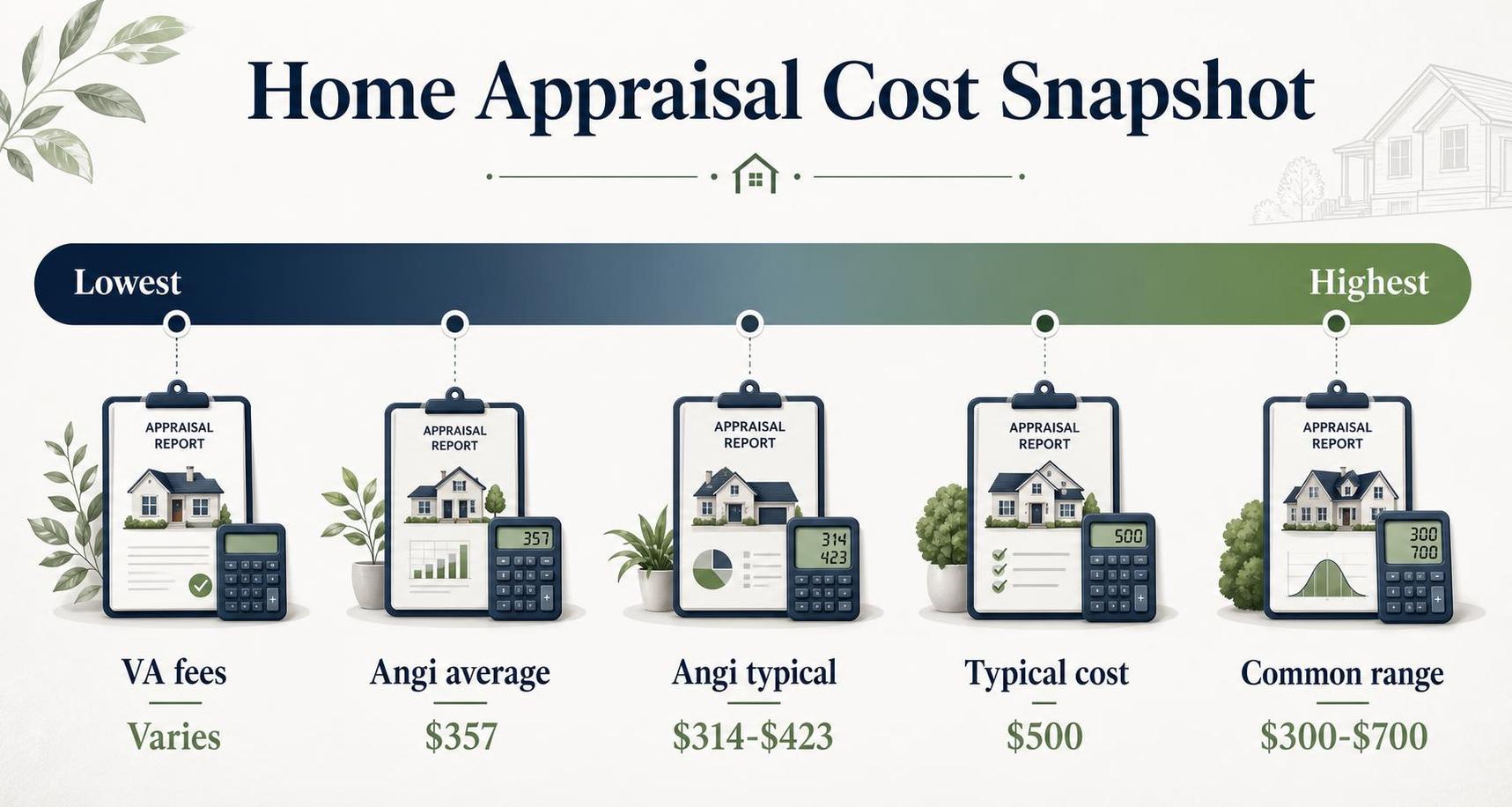
A useful baseline comes from the Consumer Financial Protection Bureau. The CFPB’s “Your Home Loan Toolkit” says an appraisal “will probably cost around $500,” though costs vary by market and property.
That $500 figure is a midpoint, not a guarantee. Other published estimates run above and below it, which shows why shoppers should expect a range rather than one fixed national price.
| Source | Published figure | What it refers to |
| Consumer Financial Protection Bureau, Your Home Loan Toolkit | $500 | Typical home appraisal cost cited for mortgage borrowers |
| Fannie Mae, Closing Costs and Fees | $300 to $700 | Typical appraisal fee range listed among mortgage closing costs |
| U.S. Department of Veterans Affairs, VA Appraisal Fee Schedules | Varies by state and property type | VA appraisal fees are set on a schedule rather than purely market-priced |
Fannie Mae’s $300 to $700 range is useful because it captures what many borrowers actually see at closing. A straightforward suburban single-family home may fall near the lower end.
A multi-unit, luxury, waterfront, acreage, or remote property often lands higher.
Loan type also matters. For VA loans, the Department of Veterans Affairs publishes maximum appraisal fees by state and region.
That means a VA borrower may face a different charge than a conventional borrower in the same area, because the fee follows the VA schedule.
Refinances are not automatically cheaper. If the lender requires a full interior appraisal, the cost can be similar to a purchase appraisal.
Some borrowers pay less only when the lender receives an appraisal waiver, but waivers are not available on every loan.
The downside case is simple: a low appraisal can cost more than the fee itself. If the appraised value comes in below the contract price, a buyer may need to bring more cash, renegotiate, or lose the deal.
Paying for an appraisal does not guarantee the value needed for approval.
- Ask the lender whether the quote covers a full appraisal or another valuation method.
- Ask if the fee can rise for a complex, rural, or multi-unit property.
- Check the official loan estimate before paying, because appraisal fees are lender-disclosed closing costs.
Caution: appraisal pricing and rules can change by lender, state, and loan program. Before acting, verify the fee on the lender’s Loan Estimate and, for VA loans, check the current VA appraisal fee schedule.
Why appraisal prices vary by property
Appraisal prices are not fixed because the appraiser is pricing time, complexity, and local market work. A simple tract home usually needs less research than a custom house, a rural property, or a multi-unit building.
Published estimates show the baseline is already broad. Angi says the national average home appraisal cost is $357, with a typical range of $314 to $423, while the Consumer Financial Protection Bureau says a home appraisal often costs around $500.
| Source | Published figure | What it shows |
| Angi | $357 average; $314-$423 typical range | Routine single-family appraisals often cluster in the mid-hundreds |
| Consumer Financial Protection Bureau | About $500 | Borrowers should expect many lender-ordered appraisals to price higher than bargain quotes |
Size changes the fee because larger homes take longer to measure, photograph, and compare.
Fannie Mae’s Selling Guide requires appraisers to analyze the site, improvements, condition, and comparable sales; more square footage and more features mean more work, not only a bigger number on the report.
Property type matters too. A detached single-family home in a subdivision often has many recent comparable sales.
A condo with litigation issues, a 2- to 4-unit property, a mixed-use building, or a log home can require harder adjustments and fewer usable comps, which raises the fee.
Location can increase cost even when the house itself is ordinary. Rural properties may require longer drive time and a wider search for comparable sales.
In thin markets, the appraiser may have to go farther back in time or farther out in distance to support value.
Condition and legal complexity also affect price. Homes with accessory dwelling units, extensive additions, unusual acreage, waterfront influences, or deferred maintenance often need more analysis.
If public records do not match the actual improvements, the appraiser may need extra verification work.
The downside is that a higher fee does not guarantee a higher value or a faster closing.
A complex property can cost more to appraise and still come in below the contract price, which can force renegotiation, a larger down payment, or a canceled deal.
Do not rely on a national average alone when budgeting. Ask the lender for the specific appraisal quote and whether the property type, acreage, or location could trigger a higher charge, then verify the final fee on the Loan Estimate.
Who pays the appraisal fee
In most U.S. home purchase and refinance transactions, the borrower pays the appraisal fee. The lender usually orders the appraisal, but the cost is commonly charged to the borrower because it is part of the loan’s closing costs.
The Consumer Financial Protection Bureau says closing costs typically run about 2% to 5% of the home’s purchase price. The appraisal is one item within those costs, usually shown on the Loan Estimate under services the borrower pays for.
Who writes the check can still vary. Some lenders collect the appraisal fee upfront when the appraisal is ordered. Others charge it at closing.
In either case, the borrower is usually the party economically responsible unless the seller, lender, or another party covers it through a credit.
| Scenario | Who usually pays | What the rule or source says |
| Standard purchase mortgage | Borrower | CFPB says appraisal is a common closing cost paid as part of the mortgage process; total closing costs are typically 2% to 5% of the purchase price. |
| Purchase with seller credit | Seller can offset borrower cost | Fannie Mae allows interested-party contributions up to 3%, 6%, or 9%, depending on occupancy and loan-to-value. HUD allows FHA seller concessions up to 6%. |
| VA purchase loan | Buyer or seller, depending on contract and credits | VA Pamphlet 26-7 caps seller concessions at 4% of the loan amount, and sellers may also pay certain customary closing costs. |
| Refinance | Borrower | The appraisal fee is usually paid by the homeowner as part of refinance closing costs, unless the lender waives the appraisal or gives a lender credit. |
A seller credit does not make the appraisal free. It shifts the cost. That can help cash flow at closing, but it may reduce the seller’s net proceeds or affect the negotiated purchase price.
Lender credits can also offset appraisal charges. The trade-off is important: a credit often comes with a higher interest rate.
Consumers should compare the Loan Estimate’s rate, lender credits, and total closing costs side by side before choosing.
The downside case is simple. If the deal falls apart after the appraisal is completed, the borrower often still owes the fee because the appraiser already performed the work. Refund rules depend on the lender’s policy.
Caution: Do not assume the seller or lender will pay this cost. Check the signed purchase contract, the Loan Estimate, and program rules from CFPB, Fannie Mae, HUD, or VA before relying on a credit.

Appraisal costs for refinancing and home equity
For a refinance or home equity loan, the appraisal line item can range from $0 to several hundred dollars. The biggest cost driver is not the loan name. It is whether the lender can use a waiver, automated valuation, or a full interior appraisal.
If a full appraisal is required, HomeAdvisor says the national average home appraisal cost is $357, with a typical range of $314 to $423.
That market survey is broad, not loan-specific, so borrowers should treat it as a benchmark and confirm the lender’s written fee estimate.
| Loan or option | Appraisal cost impact | Source |
| Conventional refinance with appraisal waiver | $0 for a full appraisal if the loan receives a Fannie Mae or Freddie Mac waiver; lender fees can still apply | Fannie Mae Value Acceptance; Freddie Mac ACE appraisal waiver |
| FHA Streamline Refinance | $0 for a new appraisal because no appraisal is required by the program | HUD FHA Streamline Refinance program rules |
| VA IRRRL | $0 for a new appraisal because the VA says no appraisal is required | U.S. Department of Veterans Affairs, IRRRL |
| Refinance or HELOC needing full appraisal | HomeAdvisor says $314 to $423 typical, $357 average nationally | HomeAdvisor national cost data |
The trade-off is speed versus certainty. A waiver or automated valuation can cut cash costs and shorten closing.
Fannie Mae and Freddie Mac both allow eligible conventional loans to skip a traditional appraisal, but eligibility depends on the property, loan data, and the automated underwriting result.
The downside case matters more on cash-out refinances and home equity borrowing. If the lender orders a full appraisal and the value comes in low, the loan-to-value ratio rises.
The CFPB warns that a lower appraised value can reduce refinance proceeds or stop the loan unless the borrower brings cash to closing.
Home equity products also vary by lender. Some HELOCs use automated valuations or desktop products, while others require a full appraisal.
A lender may advertise low upfront costs but recover them through a higher rate, annual fee, or early-closure fee, so compare the Loan Estimate or equivalent disclosure line by line.
Caution: do not assume a waiver until the lender issues it in writing. Appraisal rules change by loan type, property type, occupancy, and state. Check the program’s current agency rules and the lender’s formal disclosures before acting.

When a cheaper appraisal can backfire
A lower appraisal fee can save money upfront. It can also create a larger bill later if the report is not accepted, misses important property details, or comes in low because the scope was too limited.
The key trade-off is simple: a cheaper product may involve less inspection time or a narrower data set. That can be fine when a lender specifically allows it, but risky when the property is unusual, rural, heavily renovated, or hard to compare.
Price alone does not decide the right appraisal.
Fannie Mae says desktop appraisals are allowed only in certain transactions and only when the lender receives that option through its underwriting system, not because a borrower prefers the cheaper format.
| Item | Typical cost | Source |
| Traditional home appraisal | $314 to $423; national average $357 | Angi home appraisal cost guide |
| Desktop appraisal | $75 to $200 | Rocket Mortgage appraisal guide |
| Drive-by or exterior-only appraisal | $200 to $400 | Rocket Mortgage appraisal guide |
The backfire scenario is straightforward. If a borrower pays $75 to $200 for a desktop appraisal, but the lender or investor later requires a full interior appraisal, the borrower may end up paying again.
There is also a valuation risk. The Consumer Financial Protection Bureau says an appraisal is an opinion of value and may be lower or higher than the contract price.
A cheaper format with no interior visit can miss condition problems or upgrades that affect value.
That matters because a low appraisal can force a cash gap. If a buyer agrees to pay $400,000 and the appraisal is $380,000, the $20,000 difference may need to be covered by the buyer, renegotiated with the seller, or the deal can fail.
Appraisal problems are not rare. The National Association of Realtors reported in its REALTORS Confidence Index that appraisal issues were one of the common causes of contract delays and terminations in recent existing-home transactions.
- Cheaper formats may not be available for the loan program.
- Unique homes often need a full interior appraisal with strong local comparable sales.
- A second appraisal, rate-lock extension, or lost deal can cost more than the initial savings.
Caution: A borrower should confirm appraisal type, lender acceptance, and who pays for a second appraisal before ordering anything. Acting on price alone can delay closing or increase out-of-pocket costs.

What to do after a low appraisal
A low appraisal can delay or derail a home purchase because most mortgage lenders base the loan amount on the appraised value, not the contract price.
In a purchase, that can force the buyer to bring in more cash, renegotiate, dispute the report, or walk away if the contract allows it.
The Federal Reserve says lenders generally order an appraisal to estimate market value before approving a mortgage.
The Consumer Financial Protection Bureau warns that if the appraisal comes in low, the lender may not approve the full amount the buyer expected to borrow.
Start by reading the appraisal for factual errors. Check square footage, bedroom and bathroom count, lot size, upgrades, and the comparable sales used.
Fannie Mae says borrowers can ask the lender for a reconsideration of value, but the request usually must be supported by specific mistakes or better comparable sales.
Move quickly. Purchase contracts often set short deadlines for financing and appraisal contingencies.
Missing those dates can cost the buyer earnest money, so a reader should verify deadlines in the contract and ask a licensed real estate attorney or agent about state-specific consequences before acting.
| Option after low appraisal | What changes | Source-backed fact |
| Renegotiate the price | Seller lowers the contract price toward appraised value | The National Association of Realtors reported 8% of contracts had appraisal issues in its Realtors Confidence Index, February 2024. |
| Pay the gap in cash | Buyer covers the difference between price and appraised value | CFPB says a low appraisal can require the buyer to pay more out of pocket because the lender may reduce the loan amount. |
| Challenge the appraisal | Buyer asks lender for reconsideration of value | Fannie Mae permits reconsideration requests supported by market data and corrected property facts. |
| Cancel under contingency | Buyer exits if contract allows | NAR’s 2024 Profile of Home Buyers and Sellers says 14% of buyers waived the appraisal contingency. |
A simple example shows the risk. If a buyer agrees to pay $400,000 and plans a 20% down payment, the expected loan is $320,000. If the home appraises at $380,000, a lender using 80% loan-to-value may lend about $304,000, leaving a $16,000 gap.
If the report appears wrong, ask the lender about its formal dispute process. CFPB says borrowers have a right to receive copies of appraisals promptly. That copy is the document to review line by line and compare against recent nearby sales.
If the value is accurate, reassess the deal, not only the payment. Overpaying can hurt resale flexibility and leave less cash for repairs or reserves.
Freddie Mac says appraisal waivers are available on some loans, but they are not guaranteed and depend on eligibility and automated underwriting results.
The safest next step is to compare the revised cash needed, monthly payment, and contingency deadlines before deciding.
For legal rights, financing consequences, and state contract rules, check the lender’s disclosures, the purchase agreement, and the primary guidance from CFPB, Fannie Mae, and state regulators.

What Coin Abul reviewed for this guide
This guide reviewed primary mortgage and housing sources, not lead-generation pages. The goal was to anchor home appraisal cost in figures that come from regulators, government-backed mortgage programs, and lender rulebooks readers can verify.
It also reviewed the downside case. A low appraisal can force a larger down payment, price renegotiation, or a cancelled deal, and a paid appraisal fee is usually not refunded because the appraiser still completed the work.
Primary sources and figures reviewed
Coin Abul reviewed the Consumer Financial Protection Bureau, Fannie Mae, Freddie Mac, the U.S. Department of Veterans Affairs, and the Federal Housing Administration.
Those sources explain both what the appraisal does and where cost pressure comes from.
| Source | Figure or rule reviewed | Why it matters |
| Consumer Financial Protection Bureau (CFPB) | Appraisal fees often run about $500, according to the CFPB’s explainer on mortgage closing costs. | Sets a baseline for a standard U.S. mortgage appraisal cost. |
| CFPB | The CFPB says closing costs typically total 2% to 5% of the loan amount. | Shows appraisal cost is only one part of total upfront borrowing costs. |
| Department of Veterans Affairs (VA) | VA appraisal fees are capped by state or market fee schedules rather than set nationally at one price. | Explains why VA borrowers may see different appraisal charges by location. |
| Fannie Mae Selling Guide | Appraisers must be state-licensed or state-certified. | Licensing standards affect who can perform the work and local pricing. |
| Freddie Mac | Some loans may qualify for an appraisal alternative or waiver, but not every property or borrower does. | A waiver can reduce cost, but readers should not assume eligibility. |
Trade-offs Coin Abul checked
A cheaper fee is not always the better outcome. Rural properties, multi-unit homes, unusual construction, and complex comparable-sale searches can raise the cost because the assignment takes more time and may require a specialist appraiser.
An appraisal waiver can save money, but it removes an independent value check. That can matter if a buyer is stretching on price or if market conditions are changing quickly. Readers should confirm waiver terms directly with the lender.
A low appraisal creates the main downside risk. Fannie Mae and Freddie Mac rules allow value reconsideration processes in some cases, but that does not guarantee a higher value.
Buyers and homeowners should review the appraisal, the comparable sales used, and any lender deadlines before acting.
- CFPB was used for consumer-facing closing-cost figures.
- Agency guides were used for appraisal rules and waiver limits.
- Program-specific fees should be checked on the current lender estimate and, for VA loans, the current VA fee schedule.
Frequently Asked Questions
How much does a home appraisal usually cost?
Home appraisal costs vary by property type, size, location, and loan program.
Fannie Mae states the borrower typically pays the appraisal fee, but the amount can differ by market, so borrowers should review the lender’s Loan Estimate for the specific charge.
Federal disclosure rules under the Consumer Financial Protection Bureau require lenders to provide estimated closing costs.
Do not rely on a national average alone for budgeting because rural properties, multifamily homes, and complex properties often cost more.
Who pays for the home appraisal in a mortgage transaction?
In most purchase and refinance transactions, the borrower pays the appraisal fee as part of closing costs, according to Fannie Mae’s consumer guidance.
The fee is usually collected upfront or included in closing disclosures, but lender credits or seller concessions can sometimes offset it; borrowers should confirm the final allocation in the Loan Estimate and Closing Disclosure required by the CFPB.
Why can one home appraisal cost more than another?
Appraisal pricing often rises when the assignment takes more time or expertise, such as for large homes, unique properties, acreage, condominiums with limited comparable sales, or properties in remote areas.
The Appraisal Institute explains that appraisal fees reflect the scope of work and market conditions, so a simple suburban single-family appraisal may cost less than a complex valuation.
Readers should ask the lender or appraisal management company what factors are driving the fee before agreeing.
Can a low-cost or waived appraisal still happen?
Yes. Fannie Mae and Freddie Mac both use automated underwriting tools that may allow an appraisal waiver in some cases, but eligibility depends on the loan file and property data, not the borrower’s preference.
A waiver can reduce upfront cost, yet it is not guaranteed and may not be available for every transaction, so borrowers should verify with the lender and avoid making financial decisions based on the assumption that no appraisal will be required.
Related Reading
- How Much Is The Apartment? What You Need to Know
- How To Open A Restaurant With No Money?
- Why Are New Car Prices So High?
- Extreme Frugal Living – What You Need to Know
- What Bank Is Cash App On Plaid?
- Why Personal Finance Is Important?
- When Do Kitchen Appliances Go On Sale?
- What Price Apartment Can I Afford?
- All Blog Guides