

Quick answer: What Price Apartment Can I Afford: a common rule is to keep rent at or below 30% of gross monthly income, or total housing costs near 28% if buying. Subtract debts, insurance, utilities, savings, and moving costs first.
Do not rely on this alone; verify affordability with your budget and a qualified adviser.
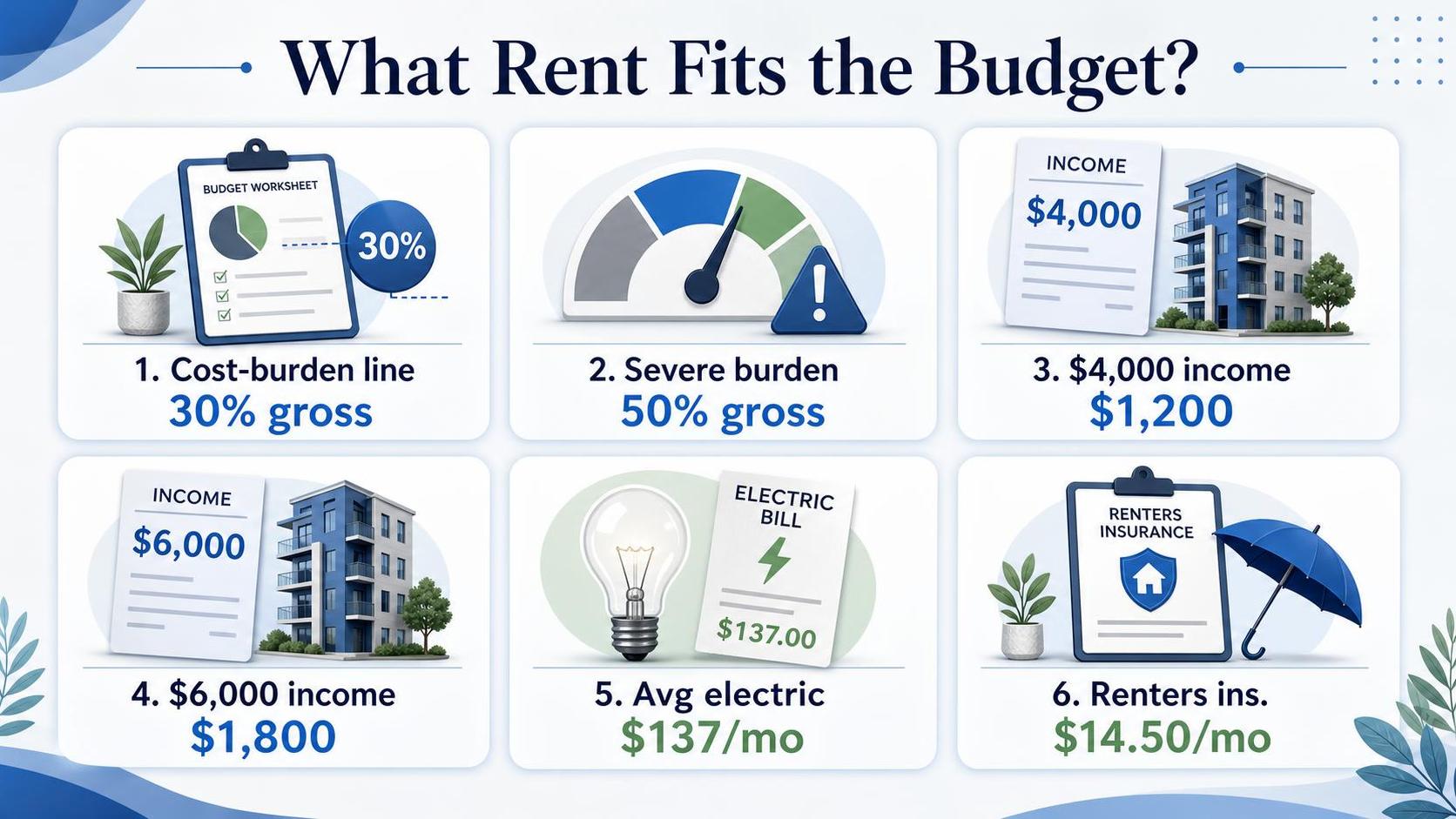
What Price Apartment Can I Afford is answered by a cash-flow test: HUD classifies households spending over 30% of income on housing as cost-burdened and over 50% as severely cost-burdened.
That rule is only a starting point. The U.S. Census Bureau reported median gross rent of $1,406 in 2023, while the Bureau of Labor Statistics estimated average 2023 consumer spending at $77,280 per household.
The trade-off is location, space and commute versus savings and debt payments. Downside caution: do not sign a lease from this rule alone; verify utilities, insurance, deposits, fees and job stability before committing.
What apartment price your income supports
For a rental apartment, start with gross income, not the advertised “luxury” price.
The U.S. Department of Housing and Urban Development says households spending more than 30% of income on housing are cost-burdened, and more than 50% are severely cost-burdened.
That 30% line is not a guarantee of comfort. It is a screening benchmark; taxes, debt, childcare, medical bills, car costs and savings goals can make a lower rent necessary.
| Annual gross income | Monthly gross income | 30% housing-cost ceiling | 50% severe-burden line |
| $40,000 | $3,333 | $1,000 | $1,667 |
| $60,000 | $5,000 | $1,500 | $2,500 |
| $80,000 | $6,667 | $2,000 | $3,333 |
| $100,000 | $8,333 | $2,500 | $4,167 |
The table uses HUD’s 30% and 50% thresholds and simple arithmetic from annual gross income. It treats “apartment price” as monthly rent plus required housing costs, not as discretionary spending.
- At $40,000 a year: A $1,000 apartment is already at the HUD cost-burden threshold. Utilities, renters insurance and parking can push the real housing cost above that line.
- At $60,000 a year: $1,500 is the 30% ceiling. A $2,000 rent may be possible only if other obligations are unusually low.
- At $80,000 a year: $2,000 fits the benchmark, but student loans or a car payment can make a cheaper unit safer.
- At $100,000 a year: $2,500 fits the benchmark, but high-tax cities and high utility costs can still strain cash flow.
The downside case is real. Harvard’s Joint Center for Housing Studies reported in America’s Rental Housing 2024 that 22.4 million U.S. renter households were cost-burdened in 2022, including 12.1 million severely burdened households.
A safer test is to price the apartment after fixed bills. Add rent, utilities, insurance, parking, debt payments, transportation, groceries and minimum savings.
If the result leaves no emergency cushion, the apartment is not affordable even if it passes a landlord’s income screen.
Caution: Do not sign a lease based on the 30% rule alone. Check the actual lease, local fees, utility history, state security-deposit rules and your after-tax paycheck before committing.

Rent limits lenders and landlords use
Apartment affordability is usually tested two ways: rent as a share of income and total debt payments as a share of income. These rules are screening tools, not guarantees that a rent is safe for a specific household.
A common benchmark is the federal “cost burden” standard: the U.S. Department of Housing and Urban Development says housing costs above 30% of income are cost-burdened, and above 50% are severely cost-burdened.
| Test | Common limit | What it means | Source |
| HUD rent burden | 30% of income | Above this level, a renter is generally considered housing cost-burdened. | U.S. Department of Housing and Urban Development |
| HUD severe burden | 50% of income | Above this level, a renter is generally considered severely cost-burdened. | U.S. Department of Housing and Urban Development |
| Landlord income screen | Often 3 times monthly rent | A $2,000 apartment may require about $6,000 in gross monthly income. | Common property-management underwriting practice; verify with the specific landlord |
| FHA mortgage DTI reference | 31% housing expense and 43% total debt | These FHA benchmark ratios show how lenders often compare housing costs with income. | U.S. Department of Housing and Urban Development, FHA Single Family Housing Policy Handbook |
| Qualified mortgage DTI reference | 43% total debt-to-income | The Consumer Financial Protection Bureau identifies 43% as the general DTI limit for many qualified mortgages. | Consumer Financial Protection Bureau |
Landlords usually focus on gross monthly income before taxes. A “3 times rent” rule means rent should be no more than one-third of gross income, but it ignores taxes, health costs, childcare, transportation and irregular earnings.
Lenders look more broadly. Debt-to-income ratios count housing plus recurring debt such as car loans, student loans, credit cards and other obligations. A renter with low rent but heavy debt may still have little room for emergencies.
- Example: At $6,000 gross monthly income, the 30% HUD benchmark equals $1,800 for housing costs.
- Example: A landlord using 3 times rent may approve up to $2,000 monthly rent on the same $6,000 income.
- Trade-off: The landlord screen is looser than the HUD burden benchmark in this example.
The downside case matters. If rent is set near the maximum a landlord allows, one job loss, medical bill or car repair can make the lease unaffordable even if the application was approved.
Caution: Do not rely on a single ratio before signing a lease. Check the lease, utility estimates, renter’s insurance, parking, pet fees, local taxes and move-in charges, and compare them with take-home pay and an emergency fund.

Upfront apartment costs beyond monthly rent
The affordable apartment price is not just the rent on the listing. A renter may need several rent-linked payments before move-in, so a $1,500 apartment can require thousands of dollars upfront.
Caution: Do not sign a lease or pay a nonrefundable fee based on a rule of thumb alone. State law, local ordinances, and the lease control what can be charged.
| Upfront item | Typical rule or real legal figure | Example at $1,500 rent |
| First month’s rent | Commonly due before keys are released; amount equals one month of rent. | $1,500 |
| Security deposit | New York caps most residential security deposits at one month’s rent, according to New York General Obligations Law § 7-108. | Up to $1,500 in that example |
| California security deposit | California Civil Code § 1950.5 generally limits security deposits to one month’s rent for most tenancies beginning July 1, 2024, with a limited small-landlord exception. | Usually up to $1,500 |
| Application fee | New York Real Property Law § 238-a caps rental application fees at $20 and requires a copy of the background or credit check and receipt. | Up to $20 in New York |
| Renters insurance | The National Association of Insurance Commissioners reported the U.S. average renters insurance premium was $170 per year in its 2021 data. | About $14 per month if paid monthly, before fees |
Some markets also require last month’s rent upfront. In Massachusetts, Mass.gov says a landlord may collect first month’s rent, last month’s rent, a security deposit up to one month’s rent, and the cost of a new lock and key.
That Massachusetts structure can make a $1,500 apartment cost about $4,500 before any moving costs, because first month, last month, and a one-month security deposit are each tied to rent.
The lock and key charge is additional and must reflect the actual cost.
- Broker fees: These can be substantial in broker-heavy markets, but rules vary by city and lease structure. Check the written fee agreement and local housing agency guidance before paying.
- Utility deposits: Electric, gas, water, and internet providers may require deposits based on credit, payment history, or local tariff rules. Verify amounts directly with the utility or state public utility commission.
- Moving costs: Truck rental, movers, elevator reservations, parking permits, and storage can turn an otherwise affordable lease into a cash-flow problem.
The downside case is losing liquidity right before move-in. If an emergency fund is wiped out by deposits and fees, a job interruption, medical bill, or car repair can lead to late rent and possible penalties.

How debts change your affordable rent
Debt payments reduce the apartment price you can safely afford because rent is only one part of your monthly fixed obligations.
A landlord may focus on income, but your budget must also survive student loans, auto loans, credit cards, child support and other required payments.
A common starting point is the housing-cost benchmark used by the U.S. Department of Housing and Urban Development.
Households paying more than 30% of income for housing are “cost burdened.” The Consumer Financial Protection Bureau defines debt-to-income ratio as monthly debt payments divided by gross monthly income.
| Example: gross monthly income | Monthly debt payments | 30% housing benchmark | Rent left if total debts stay at 43% of income | More cautious rent ceiling |
| $6,000 | $0 | $1,800 | $2,580 | $1,800 |
| $6,000 | $300 | $1,800 | $2,280 | $1,800 |
| $6,000 | $700 | $1,800 | $1,880 | $1,800 |
| $6,000 | $1,200 | $1,800 | $1,380 | $1,380 |
The 43% figure in the table comes from the CFPB’s explanation of qualified mortgage ability-to-repay rules, where 43% was a key debt-to-income threshold.
It is not a rental law, but it shows how lenders view heavy fixed-payment loads as riskier.
In the example, $1,200 of monthly debt cuts the cautious rent ceiling from $1,800 to $1,380.
That $420 gap can be the difference between qualifying comfortably and relying on credit cards when utilities, insurance, parking, medical bills or car repairs arrive.
- Credit cards: Use the required minimum payment, but budget for more if you are carrying a balance. Minimums can rise when balances or interest rates rise.
- Student loans: Use the actual billed payment under your repayment plan. If the payment is temporarily paused or reduced, check what it will become later.
- Auto loans: Include the full monthly payment, plus insurance and fuel separately, because the loan alone understates car cost.
- Buy-now-pay-later and personal loans: Treat them as debt if payments are required during the lease term.
Caution: Do not sign a lease based only on a percentage rule.
Verify your take-home pay, required debts, local utilities, renter’s insurance, deposits and emergency savings before committing, and check any landlord’s actual screening criteria.

Trade-offs when stretching for an apartment
Choosing a higher-priced apartment can buy a shorter commute, safer building features, or better schools.
The trade-off is that rent is a fixed monthly obligation, so the downside shows up quickly if income falls, utilities rise, or a car repair hits.
A common benchmark is that housing becomes “cost-burdened” above 30% of income, a threshold used by the U.S. Department of Housing and Urban Development.
It is not a guarantee of affordability, especially in high-cost cities or for borrowers with debt.
| Monthly gross income | Rent at 30% of income | Rent at 40% of income | Extra cash used by stretching |
| $4,000 | $1,200 | $1,600 | $400 per month |
| $6,000 | $1,800 | $2,400 | $600 per month |
| $8,000 | $2,400 | $3,200 | $800 per month |
Those differences are before utilities, renters insurance, parking, deposits, pet fees, and moving costs.
The U.S. Bureau of Labor Statistics reported that consumer units spent an average of $25,436 on housing in 2023, the largest category in the Consumer Expenditure Surveys.
- Less emergency cushion: The Federal Reserve’s 2023 Survey of Household Economics and Decisionmaking found 63% of adults said they would cover a $400 emergency expense with cash or its equivalent. Stretching rent can move a household out of that group.
- Higher risk from income disruption: Rent is due even when hours are cut. The U.S. Bureau of Labor Statistics reported the median duration of unemployment was 9.6 weeks in 2023, enough to strain a renter with little savings.
- Debt trade-off: A larger rent payment can crowd out credit-card payoff. The Federal Reserve reported the average credit-card interest rate on accounts assessed interest was 22.75% in November 2023, making carried balances expensive.
- Mobility trade-off: A better apartment may reduce commuting costs. But if the lease is unaffordable, breaking it can create fees, unpaid rent claims, or collection risk depending on the lease and state law.
Caution: Do not rely on the 30% rule alone. Before signing, test the rent against take-home pay, actual debts, utilities, insurance, transportation, medical costs, and a realistic emergency fund.

Downside risks if income falls
An apartment that looks affordable at signing can become unaffordable quickly after a layoff, reduced hours, illness or breakup with a roommate. The main risk is that rent is fixed by the lease while income can fall immediately.
Use the affordability test as a stress test, not just a target. The U.S. Department of Housing and Urban Development defines housing cost burden as paying more than 30% of income for housing, and severe burden as more than 50%.
| Scenario | Monthly gross income | Monthly rent | Rent share of income | Risk level |
| Lease signed at 30% rule | $5,000 | $1,500 | 30% | At HUD cost-burden line |
| Income falls 20% | $4,000 | $1,500 | 37.5% | Cost burdened |
| Income falls 40% | $3,000 | $1,500 | 50% | At HUD severe-burden line |
| Income falls 60% | $2,000 | $1,500 | 75% | High default risk |
This table uses simple arithmetic on a $5,000 gross monthly income and $1,500 rent. It shows why a rent that is “affordable” at move-in can become dangerous after one lost job, unpaid leave period or reduction in commissions.
Emergency savings matter because income shocks are common.
The Federal Reserve’s 2023 Survey of Household Economics and Decisionmaking reported that 63% of adults said they would cover a $400 emergency expense with cash, savings or a credit card paid off at the next statement.
The same Federal Reserve report said 54% of adults had emergency savings sufficient to cover three months of expenses.
That means many renters may have little time to recover before rent, utilities, insurance, transportation and food compete for the same dollars.
Job searches can also last longer than one rent cycle. The U.S. Bureau of Labor Statistics reported a median unemployment duration of 8.9 weeks in 2023 annual averages, meaning the typical unemployed worker was out of work for about two months.
- Lease liability: A 12-month lease usually does not shrink when income falls. Early termination fees, unpaid rent, court costs or collection activity depend on the lease and state law.
- Credit damage: Missed rent sent to collections can affect credit reports. The Consumer Financial Protection Bureau advises consumers to dispute inaccurate collection information with the credit bureaus.
- Cash-flow squeeze: Rent above 30% can crowd out car repairs, medical bills and minimum debt payments, increasing reliance on credit cards or payday-style borrowing.
- Roommate risk: If a roommate stops paying, a joint-and-several lease may make each tenant responsible for the full rent, depending on the contract and state law.
Caution: Do not rely on a general affordability percentage alone. Before signing, read the lease, verify local tenant rules with the state housing agency or legal aid office, and test whether rent is still payable after a realistic income drop.

What Coin Abul independently reviewed
Coin Abul independently reviewed federal housing-cost benchmarks, renter-burden data and household budget figures to frame what apartment price may be affordable.
The review treats “affordable” as a cash-flow question, not simply whether a landlord approves an application.
A common starting point is the 30% rent-to-income rule. The U.S. Department of Housing and Urban Development defines households paying more than 30% of income for housing as “cost burdened,” and more than 50% as “severely cost burdened.”.
| Gross monthly income | 30% housing cap | 50% severe-burden line |
| $4,000 | $1,200 | $2,000 |
| $6,000 | $1,800 | $3,000 |
| $8,000 | $2,400 | $4,000 |
Those figures are arithmetic based on HUD’s 30% and 50% thresholds. They are not a guarantee of approval or safety. A renter with high taxes, debt payments, childcare, medical costs or variable income may need a lower rent ceiling.
The downside case is important.
Harvard’s Joint Center for Housing Studies reported in America’s Rental Housing 2024 that 22.4 million renter households were cost burdened in 2022, including 12.1 million that were severely cost burdened, using U.S.
Census Bureau American Community Survey data.
Coin Abul also reviewed household spending data. The U.S. Bureau of Labor Statistics’ Consumer Expenditures 2023 reported average annual consumer expenditures of $77,280, with housing at $25,436.
That means housing represented about 33% of average spending, before considering local rent differences.
- Approval is not affordability: Landlords may screen for income multiples, credit, deposits and rental history, but those tests may not protect a renter’s emergency savings.
- Upfront cash matters: First month’s rent, security deposits, application fees, moving costs and utility setup can make an otherwise affordable apartment risky.
- Location changes the math: A higher rent near work may reduce transportation costs, while cheaper rent farther away can raise commuting costs and time.
- Variable income needs a buffer: Freelancers, commission workers and hourly workers should stress-test rent against a weak month, not an average month.
Caution: Readers should not sign a lease based only on a percentage rule. Compare the proposed rent with take-home pay, fixed debts, insurance, utilities and a cash reserve, and verify local tenant rules through state or city housing agencies.
Frequently Asked Questions
How much apartment price can I afford?
A common starting point is to keep total housing costs within 28% of gross monthly income and all debt payments within 36%, a benchmark used in mortgage underwriting and consumer guidance by sources such as the CFPB.
This is only a screening rule; taxes, HOA fees, insurance, utilities, and local lending standards can change the safe price significantly.
What monthly payment should I use to estimate affordability?
Include principal, interest, property taxes, homeowners insurance, mortgage insurance if required, and condo or co-op fees.
The Federal Reserve notes that mortgage payments depend heavily on loan size, interest rate, and term, so a small rate change can materially affect the apartment price a buyer can afford.
How much down payment is usually needed for an apartment?
Conventional loans often allow down payments below 20%, but the CFPB explains that private mortgage insurance is commonly required when the down payment is under 20%.
Condo and co-op buildings may also impose stricter down-payment or reserve requirements, so buyers should verify rules with the lender and building before relying on an affordability estimate.
Should rent affordability use the same rule as buying?
For renting, many landlords use an income test such as gross monthly income being about three times the rent, but this is a market practice rather than a universal law.
The U.S. Department of Housing and Urban Development defines households spending more than 30% of income on housing as cost-burdened, which is a useful caution line for renters.
Related Reading
- Why Is Furniture So Expensive? Answer From Expert
- How Much Home Appraisal Cost?
- What Insurance Does Walgreens Accept?
- When Do Kitchen Appliances Go On Sale?
- Top 10 Brilliant Money Saving Tips – What You Need to Know
- How Much Does Furniture Cost? Get Answer Now
- How To Open A Restaurant With No Money?
- All Blog Guides