

Quick answer: Lawsuit Loans With Low Interest Rates are uncommon; pre-settlement funding is typically nonrecourse cash advances with fees that vary by company, case risk, and state rules. Compare written payoff terms, not just advertised rates.
Caution: funding can sharply reduce your settlement, so consult your attorney before signing.
Lawsuit Loans With Low Interest Rates are pre-settlement funding products with comparatively lower fees than typical lawsuit advances, but costs vary by funder, case risk and state rules.
Because repayment usually comes from a future settlement, readers should compare written funding agreements, ask how charges compound and consult an attorney before signing. Acting on rate claims alone can be financially harmful.
How low interest lawsuit loans work
“Lawsuit loans” are usually pre-settlement funding, not traditional bank loans. A funding company advances cash against an expected legal recovery and is repaid from the settlement or judgment if the case succeeds.
Low-interest lawsuit funding works by reducing the funding charge, slowing how often charges accrue, or using simple rather than compound pricing. The contract language matters more than the advertised phrase “low rate.”.
Core mechanics
- Nonrecourse repayment: The American Legal Finance Association describes consumer legal funding as nonrecourse, meaning repayment is generally limited to case proceeds and the consumer owes nothing if there is no recovery.
- Attorney participation: Funders usually require case information from the plaintiff’s attorney, including liability facts, damages, insurance coverage and expected timeline. The attorney does not guarantee repayment.
- Assignment of proceeds: The contract typically gives the funder a lien or assignment against a portion of future settlement proceeds, paid before the client receives the remaining net recovery.
- Fees instead of APR: Many contracts state a monthly, semiannual or annual funding fee. Because these products are often structured as purchases of proceeds, state law may not treat them like consumer loans.
Why “low interest” depends on the formula
A lower stated rate can still become expensive if the case takes years. The main variables are the advance amount, the rate, the accrual period, whether charges compound, and any origination or servicing fees.
| Example term | Simple fee | Compounded fee |
| $5,000 advance for 18 months | $6,500 payoff at 10% every 6 months | $6,655 payoff at 10% every 6 months |
| Source of figures | Arithmetic example: $5,000 + 3 periods × $500 | Arithmetic example: $5,000 × 1.10 × 1.10 × 1.10 |
This example shows why a “10%” charge is incomplete without the time period and compounding rule. Three six-month periods equal 18 months, so the payoff grows even when no new cash is advanced.
Contract items to compare
- Total payoff schedule: Ask for the dollar payoff at 6, 12, 18 and 24 months, not just the advertised rate.
- Compounding: Simple charges grow more slowly than charges added to principal each period.
- Minimum payoff: Some contracts require a minimum return even if the case resolves quickly.
- State disclosures: Some states regulate consumer litigation funding disclosures and fees. Check the state statute or attorney general guidance before signing.
Caution: A low-rate lawsuit funding offer can still reduce a settlement substantially. Plaintiffs should have their attorney review the agreement and should not rely on rate advertising alone.

Typical costs beyond the interest rate
A “low interest rate” is only one part of the price of pre-settlement funding. The total payoff can also include setup charges, broker compensation, document fees, and the effect of compounding while the lawsuit is unresolved.
Because lawsuit funding is often structured as nonrecourse financing, it may not be treated like a traditional consumer loan. A reader should not sign based on the advertised rate alone; the contract payoff schedule is the controlling document.
| Cost item | What to check | Why it matters |
| Origination or processing fee | Whether it is added to the funded amount or paid separately | If a fee is financed, the customer may pay charges on the fee as well as on the cash received. |
| Underwriting or document fee | Whether the charge applies even if the case settles quickly | Flat fees can make a short-term advance expensive even when the stated rate looks low. |
| Broker or referral fee | Whether the funder, broker, or marketing company is being compensated | Some contracts build acquisition costs into the payoff rather than listing them as “interest.” |
| Compounding charge | Whether charges accrue monthly, semiannually, or only at settlement | Compounding increases the payoff faster than simple interest at the same stated monthly rate. |
| Minimum payoff period | Whether a minimum number of months is charged | A case that settles early may still trigger several months of charges. |
The Consumer Financial Protection Bureau describes an annual percentage rate as a way to compare credit costs, but many lawsuit-funding contracts are not advertised with a standard APR.
That makes the payoff table more important than the headline rate.
| Illustrative payoff | Source of figure | Amount |
| Cash advanced | Hypothetical example amount | $5,000 |
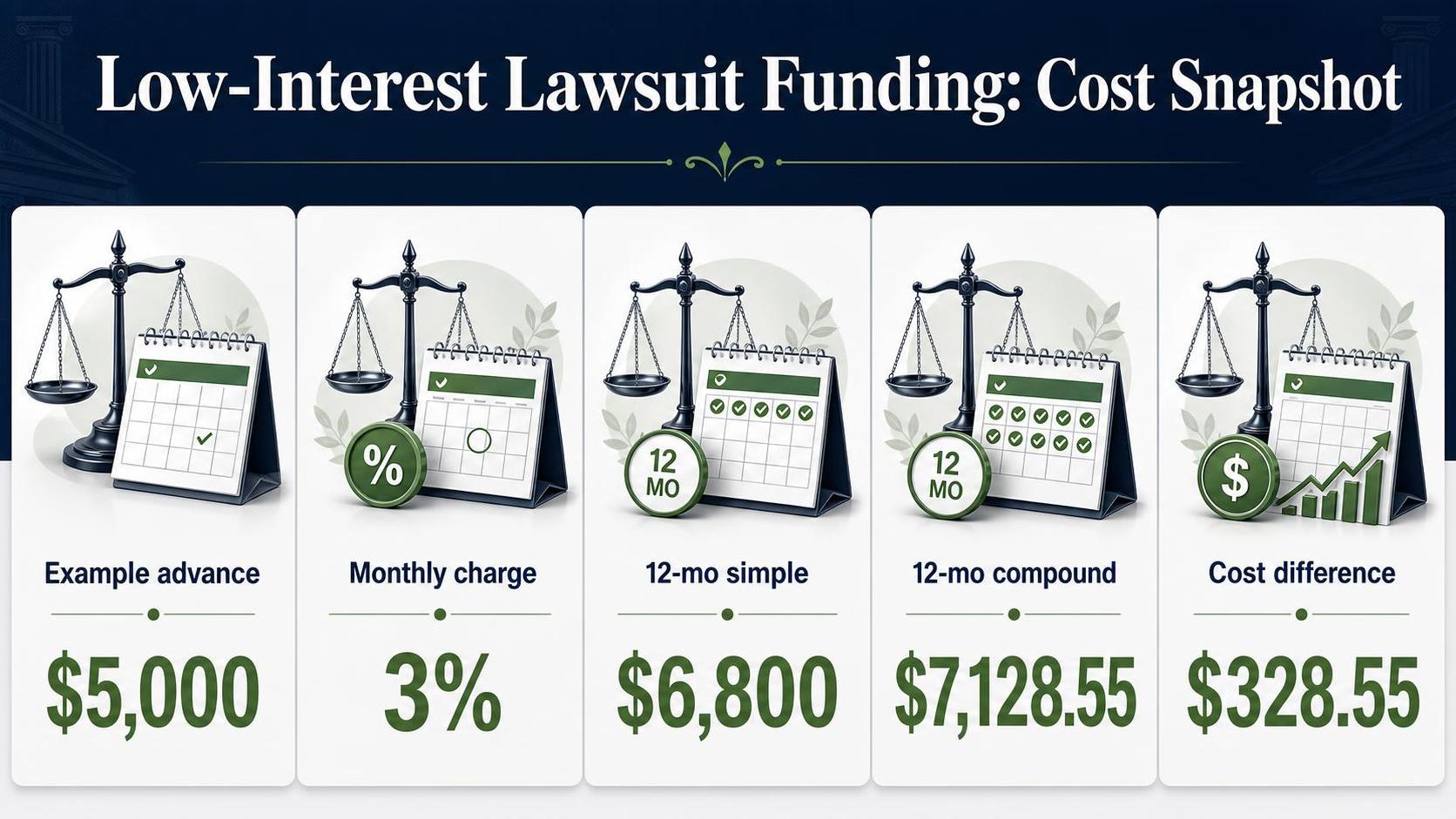
| 3% monthly simple charge for 12 months | Coin Abul calculation: $5,000 × 3% × 12 | $1,800 in charges; $6,800 payoff |
| 3% monthly compounded for 12 months | Coin Abul calculation: $5,000 × 1.03^12 | $2,129 in charges; about $7,129 payoff |
| Difference from compounding | Coin Abul calculation: $7,129 minus $6,800 | About $329 more |
This example is not a market quote. It shows why two contracts with the same monthly rate can produce different payoffs depending on the accrual method, fees, and settlement date.
- Ask for a dated payoff schedule showing the amount due at 6, 12, 18, and 24 months.
- Confirm whether fees accrue charges or only the cash advanced does.
- Ask whether the funding is nonrecourse and what happens if the plaintiff loses or recovers less than expected.
- Have the plaintiff’s attorney review the contract before signing, because funding can affect settlement negotiations and net recovery.
Caution: Acting on advertised “low interest” language alone can reduce a plaintiff’s final recovery. Compare the total dollar payoff, not just the rate, and verify state-law requirements with the applicable statute or regulator.

How to compare pre settlement funding offers
Pre-settlement funding is usually nonrecourse, meaning repayment is typically owed only if the case produces a recovery. That protection does not make the money cheap, so compare offers by payoff amount, not by the advertised rate alone.
Plain caution: Lawsuit funding can materially reduce a future settlement.
A plaintiff should review any contract with their attorney before signing, because state law, attorney liens, medical liens and case expenses can change the net amount received.
- Ask for the total payoff schedule. Request written payoff amounts at 6, 12, 18 and 24 months, including fees. A low monthly rate can become expensive if it compounds.
- Identify the rate type. Simple interest is calculated on the original advance. Compounded interest adds unpaid charges to the balance, so future charges are calculated on a larger amount.
- Separate fees from interest. Compare origination, underwriting, document, wire, servicing and minimum-use fees. A provider with a lower rate but high fixed fees may cost more.
- Check whether repayment is capped. Some contracts limit repayment to a percentage of the settlement. Others allow the balance to keep growing until resolution.
- Confirm attorney control of disbursement. Reputable funders generally require attorney acknowledgment and are paid from settlement proceeds, not directly from a consumer’s bank account.
| Example cost comparison | After 12 months | After 24 months |
| $10,000 advance at 36% simple annual interest | $13,600 | $17,200 |
| $10,000 advance at 3% compounded monthly | $14,258 | $20,328 |
Source for the table: Coin Abul calculations using the standard simple-interest formula and monthly compound-interest formula. The example assumes no separate fees, no partial repayments and exactly 12 or 24 monthly periods.
Use the table to test real offers. If one company quotes a monthly percentage and another quotes an annual figure, convert both into dollar payoff amounts for the same settlement dates.
Also compare the contract terms, not just the price. Look for language on case loss, appeal, dismissal, attorney withdrawal, settlement below expectations and whether the funder can demand updates from counsel.
State rules are not uniform. Before relying on any rate or disclosure, check the primary source for the state involved, such as the state attorney general, consumer finance regulator or statute database.

State rules that can affect pricing
“Low interest” in lawsuit funding depends heavily on state law because pre-settlement advances are regulated differently across the United States.
Some states cap charges directly, while others focus on licensing, disclosures, cancellation rights, or general consumer-protection rules.
A reader should not rely on an advertised rate alone. Before signing, compare the contract against the current statute in the state governing the agreement and ask a licensed attorney to review the payoff formula.
| State or authority | Rule that can affect price | Source |
| Indiana | Consumer litigation funding fees may not exceed 36% annually, calculated as simple interest. | Indiana Code § 24-12-4-5 |
| Nebraska | The annual fee rate is capped at 36%, and the amount owed may not keep increasing after 42 months. | Nebraska Revised Statutes § 25-3304 |
| Colorado | The Colorado Supreme Court held that certain nonrecourse litigation finance contracts were “loans” under the Colorado Uniform Consumer Credit Code, making consumer-credit regulation relevant to pricing. | Oasis Legal Finance Group, LLC v. Coffman, 361 P.3d 400 (Colo. 2015) |
These examples show why the same cash advance can carry different economics in different states. A 36% simple annual cap is not the same as monthly compounding, and a time limit on fee growth can materially reduce the final payoff in a slow case.
- Fee caps: Some statutes limit the annual rate or total charge. Where a cap exists, the contract should show how the company calculates the charge.
- Compounding rules: A quoted monthly rate can become expensive if fees compound. Ask whether charges are simple, compounded, or based on scheduled payoff tiers.
- Time limits: Nebraska’s 42-month limit is important because personal-injury cases can take years to settle or reach trial.
- Licensing and disclosures: States may require registration, written contracts, attorney acknowledgments, cancellation rights, and payoff disclosures.
State law can change, and court decisions can alter how a funding contract is treated. The safest approach is to check the state attorney general, financial regulator, or current statute before assuming a rate is lawful or competitive.
Caution: Lawsuit funding is usually nonrecourse, but it can still consume a large share of a settlement. Do not sign based only on the advance amount; review the maximum payoff, timing assumptions, and attorney fees first.

Risks of choosing the lowest rate
The lowest advertised rate on a lawsuit loan may not produce the lowest payoff. Pre-settlement funding contracts can add origination fees, underwriting fees, minimum repayment amounts, or compounding that materially changes the cost.
Plain caution: do not choose funding based on a headline rate alone. A plaintiff should review the full contract with their attorney, because repayment usually comes from the settlement and can reduce the net recovery.
Small rate differences can grow over time
Lawsuit funding is typically nonrecourse, meaning the funder is repaid only if the case produces proceeds.
The U.S. Government Accountability Office described consumer litigation funding as often repaid from a plaintiff’s recovery, with pricing that may include fees and interest-like charges.
| Example on $10,000 funded for 18 months | Amount owed before attorney fees or medical liens | Source of figure |
| 2% monthly simple charge | $13,600 | Arithmetic: $10,000 + ($10,000 × 2% × 18) |
| 2% monthly compounded charge | About $14,282 | Arithmetic: $10,000 × 1.02^18 |
| 2% monthly compounded charge plus 10% upfront fee added to principal | About $15,710 | Arithmetic: $11,000 × 1.02^18 |
This table is illustrative, not a quote. It shows why a “low” monthly rate can be misleading if the charge compounds or if fees are financed into the balance.
- Compounding can defeat the headline rate. A 2% monthly charge equals about 26.8% effective annual growth if compounded monthly, using the standard formula 1.02^12 – 1.
- Fees may make comparisons unfair. A contract with a lower rate but large origination or processing fees can cost more than a higher-rate contract with no added fees.
- Long cases increase the risk. Personal injury cases can take months or years. If litigation, appeals, lien negotiations, or insurer delays extend the timeline, the payoff may rise substantially.
- Minimum repayment clauses matter. Some agreements require a minimum return even if the case resolves quickly, which can make a short-term advance expensive.
- Low rates may come with tighter terms. A funder may offer a lower rate only for a smaller advance, stronger liability facts, lower medical liens, or attorney cooperation requirements.
- State law varies. Some states regulate consumer litigation funding disclosures or fees, while others treat the product differently. Readers should check their state statute or attorney general guidance before signing.
The safest comparison is the total payoff at several case-resolution dates: 6 months, 12 months, 18 months, and 24 months.
Ask for those figures in writing and compare them against the expected settlement after attorney fees, case costs, medical liens, and taxes where applicable.

What the editorial team independently reviewed
We independently reviewed lawsuit-funding “low interest rate” claims against primary legal sources, regulator materials, and contract-disclosure practices.
We focused on what a reader can verify before signing, because pre-settlement funding costs can compound quickly and may not be described as a traditional loan.
Our review was limited to information available without submitting a legal claim, medical record, or attorney contact. Readers should not rely on marketing language alone; a lawyer should review any funding contract before signature.
| What we reviewed | Quantity and source | Why it mattered |
| U.S. jurisdictions checked for lawsuit-funding rules | 51 jurisdictions: 50 states plus the District of Columbia, using state code websites and the U.S. Census Bureau’s state count | State treatment varies, and some laws regulate disclosures, fees, licensing, or contract wording. |
| Federal consumer-credit baseline | Truth in Lending Act, 15 U.S.C. §§ 1601–1667f, and Regulation Z, 12 C.F.R. Part 1026 | These sources helped us distinguish traditional consumer-credit APR rules from non-recourse legal funding disclosures. |
| Federal unfair-practices baseline | Federal Trade Commission Act, 15 U.S.C. § 45 | We used it as a baseline for evaluating misleading “low rate” advertising claims. |
| Contract-cost checks | 3 separate review passes: advertised rate, compounding method, and payoff timing | The same headline rate can produce different payoffs depending on whether charges are simple, monthly, or compounded. |
We separated “interest rate” from total cost. In lawsuit funding, the contract may use terms such as funding fee, use fee, origination fee, underwriting fee, or minimum return instead of interest.
- We checked whether the stated rate was monthly, semiannual, annual, or described without a time period.
- We checked whether charges stopped at settlement, at disbursement, or only after the funder was paid.
- We checked whether the funder claimed repayment was required only from case proceeds, a key feature of non-recourse funding.
- We checked whether attorney acknowledgment was required before funding.
We also compared advertisements against the Consumer Financial Protection Bureau’s general warning that borrowing costs should be evaluated by total dollar cost, not only by a payment or rate label.
Important caution: a “low” advertised rate can still be expensive if the case lasts years, fees compound, or the contract includes minimum charges.
A reader should request a written payoff schedule for 6, 12, 18, and 24 months before agreeing.

Questions to ask before signing
“Low interest” can mean very different things in lawsuit funding because many contracts are non-recourse advances, not traditional loans. Before signing, ask for the payoff in dollars at several dates, not just a monthly rate.
Plain caution: do not rely on a verbal quote. Have the written agreement reviewed by the attorney handling the case, because the payoff can affect settlement decisions and the client’s net recovery.
| Question | Why it matters |
| Is the advance non-recourse? | In non-recourse funding, repayment is usually owed only from case proceeds. If the case is lost, the contract should say whether nothing is owed. |
| Is the rate simple or compounded? | A 3% monthly simple charge equals 36% per year before fees. With monthly compounding, $10,000 grows to $14,257 after 12 months and $20,328 after 24 months, using the standard compound-interest formula. |
| What is the exact payoff at 6, 12, 24 and 36 months? | Personal injury cases can take years. The Bureau of Justice Statistics reported that civil jury trials in state courts often involve long timelines, so short payoff examples may understate the real cost. |
| Are there document, underwriting, wire, broker or servicing fees? | Fees can raise the effective cost even when the stated rate looks low. Ask whether each fee is charged upfront, added to principal or owed only from recovery. |
| Is there a payoff cap? | Some contracts limit the total repayment to a multiple of the advance. If there is no cap, ask for the maximum possible payoff in writing. |
- Ask whether the company is licensed or registered where required. Regulation differs by state. For example, Colorado regulates consumer litigation funding under its consumer credit laws and requires disclosures; readers should check the Colorado Attorney General or state statutes for current requirements.
- Ask who controls settlement decisions. A funding company should not be able to force acceptance or rejection of a settlement. The lawyer’s professional duties run to the client, not the funder.
- Ask what happens if the recovery is smaller than expected. The agreement should explain priority among attorney fees, medical liens, case costs and the funder’s payoff.
- Ask for the annual percentage cost, if available. Lawsuit funding contracts may not be subject to the same Truth in Lending Act APR rules as conventional consumer loans, so the comparable annual cost may not appear unless requested.
- Ask about cancellation rights. Some states require a short rescission period for consumer litigation funding. If the contract does not clearly state one, verify the rule with the state regulator or an attorney.
Plain caution: a lower rate is not automatically the best deal. A smaller advance, a written payoff cap, and no added fees may leave more money from the settlement than a larger “low-rate” advance.
Frequently Asked Questions
Are “lawsuit loans” actually loans?
Often, no: many lawsuit “loans” are non-recourse pre-settlement funding, meaning repayment is usually owed only if the plaintiff wins or settles.
The Consumer Financial Protection Bureau describes lawsuit funding as a cash advance tied to expected case proceeds, so readers should review the contract carefully and ask an attorney before signing.
What counts as a low interest rate for lawsuit funding?
There is no single nationwide “low” rate because pricing depends on the funder, case type, expected settlement value, and state law.
A safer comparison is the total payoff amount at 6, 12, 18, and 24 months, because compounding fees can make a seemingly low monthly rate expensive over time.
Do states cap lawsuit loan interest rates?
Some states regulate consumer litigation funding, but rules vary widely and may address disclosures, fees, licensing, or contract terms rather than a simple interest-rate cap.
Because state law changes, readers should verify current rules with the state attorney general, financial regulator, or a licensed attorney before relying on any rate claim.
How can someone compare lawsuit funding offers?
Compare the annual percentage rate if disclosed, whether charges are simple or compound, the application or origination fees, and the maximum repayment amount.
The Federal Trade Commission warns consumers generally to understand finance charges before borrowing, and the same caution applies here because legal funding can reduce the final settlement received.
Can a lawyer negotiate a lower lawsuit funding rate?
A plaintiff’s attorney may be able to help estimate case value, identify unreasonable contract terms, or request changes from a funding company, but the attorney does not guarantee approval or a lower cost.
Do not sign based only on advertising language such as “low interest”; ask for a written payoff schedule and independent legal guidance first.
What happens if the plaintiff loses the case or recovers less than expected?
Pre-settlement funding is usually nonrecourse. The article says repayment is generally limited to case proceeds, and the consumer owes nothing if there is no recovery.
The contract typically gives the funder a lien or assignment against part of future settlement proceeds, paid before the client receives the remaining net recovery.
Ask whether the funding is nonrecourse and what happens if the plaintiff loses or recovers less than expected, then have the attorney review the contract before signing.
Related Reading
- Settlement Loan Companies
- Oasis Financial Login
- JG Wentworth Pre Settlement Funding
- Oasis Financial Locations
- Best Pre Settlement Loan Companies
- Sunrise Lawsuit Funding Reviews
- National Lawsuit Funding Reviews
- Pre Settlement Loans Near Me
- All Blog Guides
Sources & References:
- U.S. Government Accountability Office (2022)
- Consumer Financial Protection Bureau (2017)
- Legal Information Institute, Cornell Law School (2022)
- Maine Legislature (2023)
- American Bar Association Formal Opinion 484 (2018)
- New York City Bar Association Formal Opinion 2011-2 (2011)
- Westfleet Advisors Litigation Finance Market Report (2024)