

In short: Structured Settlement Loans are usually not true loans; they typically involve selling some future structured settlement payments to a funding company for a discounted lump sum.
In many U.S. states, transfers require court approval under structured settlement protection laws. Caution: review costs, rights, and legal advice before agreeing.
Structured Settlement Loans are usually not traditional loans; they are cash advances or factoring deals that sell future structured settlement payments for a discounted lump sum, often requiring court approval.
Because these transactions can permanently reduce guaranteed income, compare the discount rate, fees, tax effects and state approval rules before signing.
The National Association of Settlement Purchasers says transfers are governed by state structured settlement protection acts.
Caution: Do not rely on an online estimate alone. A judge, independent professional adviser, or attorney may need to review whether selling payments is in the seller’s best interest.
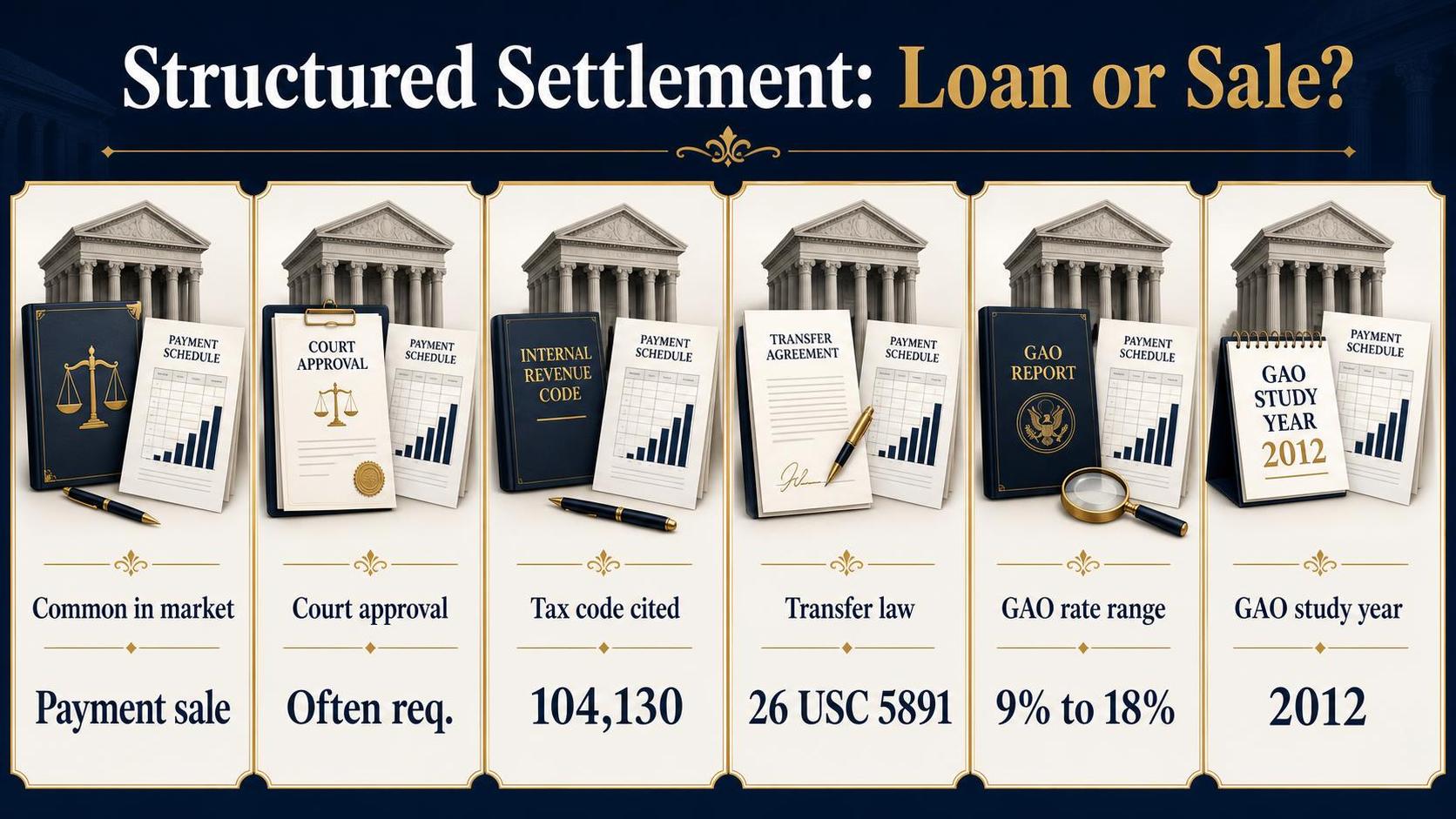
How structured settlement loans actually work
A “structured settlement loan” is usually not a loan. In most cases, it is a sale of the right to receive future structured settlement payments to a factoring company for a discounted lump sum.
The buyer pays less than the face value of the future payments because it must wait to collect them. A court generally must approve the transfer before the annuity issuer will redirect payments.
The basic process usually works like this:
- Quote: The factoring company estimates a lump-sum price for some or all future payments, using a discount rate, fees, timing, and the payment schedule.
- Disclosure: State structured settlement protection laws typically require written disclosure of the gross amount sold, net amount paid, fees, and effective discount rate.
- Court petition: The company files for approval in the court specified by state law. The judge reviews whether the transfer is in the seller’s best interest.
- Notice: Interested parties, such as the annuity issuer and structured settlement obligor, usually receive notice before the hearing.
- Payment redirect: If approved, the annuity issuer pays the purchased payments to the buyer, not the original recipient.
| Item | Example | What it means |
| Future payments sold | $50,000 | Total scheduled payments transferred |
| Lump sum paid | $35,000 | Cash received before considering any separate obligations |
| Difference | $15,000 | Economic cost of getting money early |
| Percentage of face value received | 70% | $35,000 divided by $50,000 |
This table is only arithmetic, not a market quote. Actual offers vary by payment dates, court requirements, fees, risk, and the buyer’s pricing model. A reader should not rely on an example as a fair-value estimate.
Federal tax law is a key reason court approval matters. Internal Revenue Code Section 5891 imposes a 40% excise tax on the factoring discount unless the transfer is approved in advance by a “qualified order.”.
That tax is imposed on the factoring company, but it strongly shapes the transaction. Buyers generally will not complete a transfer unless a judge signs an order meeting Section 5891 and the applicable state structured settlement protection act.
Tax treatment also depends on the original settlement. Internal Revenue Code Section 104(a)(2) excludes damages received for personal physical injuries or physical sickness from gross income, but tax facts can change.
A tax professional should review the settlement documents.
The practical tradeoff is liquidity versus guaranteed future income. Selling payments can solve an urgent cash need, but it may reduce long-term financial security, public-benefit eligibility, or protection intended by the original settlement.
Caution: A structured settlement transfer is a legal and financial decision, not just a cash advance.
Before signing, the recipient should read the court disclosures, compare multiple written offers, and consider independent legal, tax, or financial advice.

Structured settlement advances versus legal loans
“Structured settlement loans” is a common phrase, but two different products are often being compared.
A structured settlement advance is usually a sale of future annuity payments, while a legal loan is usually pre-settlement funding tied to a pending lawsuit.
The distinction matters because the legal rules, court oversight, costs and risks are different.
A reader should not sign either type of agreement based on advertising language alone; an attorney or independent financial adviser should review the contract.
| Feature | Structured settlement advance | Legal loan / pre-settlement funding |
| Typical timing | After a case has settled and future periodic payments exist. | Before a lawsuit or claim is resolved. |
| What is transferred | Some or all rights to future structured settlement payments. | A right to be repaid from lawsuit proceeds, if there is a recovery. |
| Federal tax rule | Internal Revenue Code § 5891 imposes a 40% excise tax on certain transfers unless statutory requirements, including a qualified court order, are met. | No equivalent federal 40% structured-settlement transfer tax rule applies merely because litigation funding is used. |
| Court involvement | Generally required under state Structured Settlement Protection Acts and IRC § 5891 for a valid transfer. | Not uniformly required; regulation depends on state law and the funding contract. |
| If the case is lost | Not applicable in the same way; the settlement payments already exist. | Often marketed as nonrecourse, meaning repayment is due only from a recovery, but contract terms control. |
For structured settlement advances, the key legal safeguard is court approval.
IRC § 5891 defines a “qualified order” as one finding that the transfer is in the payee’s best interest, taking into account dependents’ welfare, and complies with applicable state law.
State protection acts commonly require written disclosures before a hearing. These disclosures may include the gross amount of payments being sold, the discounted present value, the amount paid to the seller and fees.
Exact requirements vary by state, so the primary statute and court order should be checked.
Legal loans are different because the recovery is uncertain. Many contracts are described as nonrecourse advances, not traditional loans, because the funder may receive nothing if the plaintiff loses.
However, fees can compound or accumulate in ways that materially reduce a later settlement.
- Best use of the term “advance”: Selling fixed future settlement payments at a discount.
- Best use of the term “legal funding”: Receiving money against a pending claim before resolution.
- Main structured settlement safeguard: Court approval under state law and IRC § 5891.
- Main legal funding risk: High contractual cost if the case takes months or years.
Plain caution: both products can permanently reduce money available for medical care, housing or family support.
Before agreeing, compare the written net amount, all fees, the effective cost over time and any alternatives such as hardship programs or conventional credit.

Court approval and state law requirements
Structured settlement “loans” are usually structured settlement transfers: a buyer purchases some or all future payments at a discount.
In most cases, the transfer is not valid unless a court approves it under a state Structured Settlement Protection Act.
Federal tax law is the main reason court approval matters nationwide.
Internal Revenue Code Section 5891 imposes a 40% excise tax on the factoring discount from a structured settlement transfer unless the transfer is approved in a “qualified order.”.
| Source | Requirement or fact |
| Internal Revenue Code Section 5891 | Applies a 40% excise tax to the factoring discount if the transfer does not receive a qualified court or administrative order. |
| Internal Revenue Code Section 5891(b)(2) | A qualified order must find the transfer is in the payee’s best interest, considering the welfare and support of dependents. |
| Internal Revenue Code Section 5891(b)(3) | The order must not contravene any federal or state statute, court order, or government order. |
State law supplies the procedure. Most states require a petition, disclosures, notice to interested parties, and a hearing before a judge.
The judge may deny the transaction if the discount is excessive, the seller does not understand the deal, or dependents could be harmed.
Examples show why readers must check the law in their own state before signing anything.
| State example | Specific rule |
| New York General Obligations Law Section 5-1703 | The transferee must provide a written disclosure statement at least 10 days before the payee signs the transfer agreement. |
| California Insurance Code Section 10139.5 | Court approval is required, and notice of the proposed transfer and hearing materials generally must be filed and served at least 20 days before the hearing. |
| Internal Revenue Code Section 5891 | Federal tax consequences apply across states, even though court procedures vary by state law. |
- Disclosure statements commonly show the gross payment amount being sold, the amount paid to the seller, fees, and the effective discount rate.
- Interested parties often include the annuity issuer, structured settlement obligor, and sometimes dependents or prior court-appointed representatives.
- Best-interest review is not a rubber stamp. Courts can ask why the money is needed and whether alternatives exist.
Caution: Do not rely on a buyer’s statement that approval is “routine.” Missing notices, incomplete disclosures, or unfavorable state-law findings can delay or block a transfer.
A seller should read the petition and consult an independent attorney or financial professional before agreeing.

Costs, discounts and long-term tradeoffs
Structured settlement “loans” are usually not loans. They are factoring transactions: the recipient sells some or all future payment rights for a discounted lump sum, typically after court approval under state law.
The main cost is the discount rate, not an interest rate. A lower lump sum today can mean giving up far more in guaranteed future payments, so readers should not rely on examples alone before signing documents.
How the discount changes the deal
| Future payment sold | Lump sum received today | Implied annual discount rate | Source of figure |
| $100,000 due in 10 years | $50,000 | About 7.18% | Coin Abul calculation using standard present-value math |
| $100,000 due in 10 years | $40,000 | About 9.60% | Coin Abul calculation using standard present-value math |
| $100,000 due in 10 years | $30,000 | About 12.79% | Coin Abul calculation using standard present-value math |
These examples show why the quoted “purchase price” matters less than the net amount paid to the seller and the payments surrendered. A transaction can look helpful in a cash emergency but still be expensive over time.
- Discount rate: The buyer’s pricing for waiting to collect future payments and taking transaction risk.
- Fees and costs: Court filing costs, legal review, administrative charges, or broker compensation may reduce the net amount. Check the purchase agreement and court disclosures.
- Tax penalty risk: Internal Revenue Code Section 5891 imposes a 40% federal excise tax on the factoring discount unless the transfer is approved by a “qualified order.”
- Lost protection: Future structured settlement payments may have been designed to cover medical care, rent, disability-related expenses, or retirement income.
State structured settlement protection acts generally require a judge to find that the transfer is in the seller’s best interest, but standards and disclosure forms vary by state.
The court’s approval does not guarantee that the deal is financially optimal.
Compare the lump sum with alternatives such as hardship programs, negotiated medical bills, payment plans, or a smaller partial sale. A partial transfer may preserve some future income, but it still requires careful review.
Caution: Selling payment rights can permanently reduce guaranteed income. Before signing, review the contract, net proceeds, discount rate, state court order, and tax treatment with an independent attorney or financial professional.

What Coin Abul independently reviewed
Coin Abul independently reviewed the “structured settlement loan” market as an information publisher, not as a funder, broker, insurer, or law firm.
The review focused on how cash-advance offers are described, what courts typically must approve, and which public sources explain the legal risks.
The main finding is that many “structured settlement loans” are not loans in the ordinary sense. They are usually structured settlement factoring transactions, meaning a payee sells some future payment rights for a discounted lump sum.
| Item reviewed | Specific fact checked | Primary source named |
| Federal tax rule | Internal Revenue Code Section 5891 imposes a 40% excise tax on an “acquisition of structured settlement payment rights” unless the transfer receives a qualified court or administrative order. | Internal Revenue Code, 26 U.S.C. § 5891 |
| Court-approval requirement | A qualified order must find the transfer is in the payee’s “best interest,” taking into account the welfare and support of the payee’s dependents. | Internal Revenue Code, 26 U.S.C. § 5891(b)(2) |
| State-law framework | Most states have enacted structured settlement protection acts requiring disclosures and judicial approval before payment rights can be transferred. | National Association of Insurance Commissioners, Structured Settlement Model Act materials |
| Consumer-risk category | The Federal Trade Commission warns consumers to understand fees, compare offers, and consider alternatives before selling future payments. | Federal Trade Commission consumer guidance on structured settlements |
Coin Abul reviewed public consumer warnings, model-law materials, federal tax provisions, court-approval concepts, and company marketing language.
The review did not verify any individual consumer’s eligibility, contract value, discount rate, or likely court outcome.
- Whether advertisements clearly distinguish a sale of payment rights from a conventional loan.
- Whether the content explains that a judge may reject a transfer.
- Whether the buyer discloses the gross amount assigned, net cash paid, fees, and discount rate.
- Whether readers are warned that selling guaranteed future income can affect long-term financial security.
- Whether claims about “fast cash” are balanced with the legal requirement for approval.
A plain caution is necessary: a person should not sell structured settlement payments based only on an article, advertisement, or calculator.
The transaction can permanently reduce future income, and the legal standard depends on state law and the payee’s circumstances.
Readers should check the petition, disclosure statement, annuity contract, settlement agreement, and state structured settlement protection act.
Independent legal or financial advice is especially important before assigning payments meant for medical care, housing, disability support, or dependents.

Risks before selling future payments
Companies often advertise “structured settlement loans,” but most transactions are sales of future payments at a discount, not loans.
The main risk is permanent: once a court-approved transfer closes, the seller usually gives up those future checks for less than their total face value.
Caution: Do not rely on advertising language alone. Read the transfer agreement, independent professional advice disclosure, and court petition, then verify requirements with the state court or a licensed attorney.
Key risks to weigh
- Large discount to face value: Buyers price future payments using a discount rate, fees, and timing risk. A lower lump sum can look attractive today but may remove guaranteed income needed for rent, medical care, or retirement.
- Court approval is required: Internal Revenue Code Section 5891 imposes a 40% excise tax on the factoring discount if a transfer is not approved by a “qualified order.” That federal rule is why state Structured Settlement Protection Acts require judicial review.
- Best-interest review is not financial planning: judges commonly consider whether the transfer is in the seller’s best interest and the interests of dependents, but approval does not mean the deal is optimal or low-cost.
- Loss of tax-favored payments: Personal physical-injury structured settlement payments are generally excluded from gross income under Internal Revenue Code Section 104(a)(2). Selling rights can change the economics, so tax advice matters.
- Dependents may be affected: Selling payments can reduce household income years later. This is especially risky when payments were designed to cover long-term medical costs, disability needs, or a minor’s support.
How discounting changes the payout
| Illustration | Total scheduled payments | Approximate present value |
| $1,000 per month for 10 years, discounted at 10% annually | $120,000 | $75,168 |
| $1,000 per month for 10 years, discounted at 18% annually | $120,000 | $55,679 |
The table is an illustration using the standard monthly present-value formula; it is not a quote. The scheduled payments total $120,000, but higher discount rates sharply reduce the lump sum.
Before signing, compare the buyer’s net offer, all fees, the effective discount rate, and the exact payments being transferred. If any number is unclear, ask the company and check the court filing before the hearing.
Safer alternatives to settlement funding
Settlement funding can be expensive, and selling structured settlement payments usually requires court approval under state structured settlement protection acts.
Before assigning future payments, compare options that preserve more of the settlement’s long-term value.
Caution: Structured settlement payment rights are legal and financial assets. Do not rely on a website article alone; review the annuity contract, court order and tax terms with a qualified attorney or financial professional.
Options to consider first
- Use an emergency budget cut. The U.S. Bureau of Labor Statistics reported average annual consumer expenditures of $72,967 for U.S. consumer units in 2022, including $9,343 for transportation and $8,289 for food. Temporary reductions may avoid selling guaranteed payments.
- Negotiate medical bills directly. The Consumer Financial Protection Bureau says medical bills are often complex and may contain errors. Ask providers for itemized bills, financial assistance screening, charity care policies or interest-free payment plans.
- Ask about public benefits. Supplemental Security Income, Medicaid, SNAP and housing assistance can be affected by settlement payments. The Social Security Administration states the 2024 federal SSI benefit rate is $943 for an individual and $1,415 for a couple, before state supplements.
- Consider a credit union small-dollar loan. Federal credit unions may offer Payday Alternative Loans. The National Credit Union Administration caps PAL I loans at $200 to $1,000, with terms of 1 to 6 months and an application fee limited to $20.
- Seek nonprofit credit counseling. The U.S. Department of Justice maintains a list of approved credit counseling agencies for bankruptcy purposes. A counselor may help prioritize debts without assigning settlement payments.
Cost and risk comparison
| Alternative | Specific fact | Main protection |
| Federal credit union PAL I | NCUA: $200-$1,000; 1-6 month term; application fee up to $20 | Regulated loan terms and capped fees |
| SSI planning review | SSA: 2024 federal SSI rate is $943 individual, $1,415 couple | Helps avoid benefit disruption |
| Medical bill negotiation | CFPB: patients should request itemized bills and dispute suspected errors | May reduce debt without selling payments |
| Structured settlement transfer | IRC Section 5891 imposes a 40% excise tax unless a qualified court order approves the transfer | Court review is required, but value may still be discounted |
Some needs are urgent, but speed should not decide the issue alone. A smaller loan, hardship program or negotiated bill may cost less than transferring years of future tax-favored settlement income.
If a transfer is still being considered, compare multiple written quotes, the discount rate, all fees and the net amount paid.
State courts generally must find the transfer is in the payee’s best interest, but that standard does not make every offer financially wise.
Frequently Asked Questions
Can you get a loan against a structured settlement?
In most cases, companies do not make traditional “loans” secured by structured settlement payments; they purchase some or all future payments at a discount through a court-approved factoring transaction.
A plain caution: selling future payments can reduce long-term income, so review the transfer agreement, discount rate, fees and alternatives before relying on the cash offer.
Is court approval required to sell structured settlement payments?
Yes, structured settlement transfers are generally subject to state Structured Settlement Protection Acts, which require a judge to decide whether the transfer is in the seller’s best interest.
The National Association of Insurance Commissioners notes that these laws are designed to protect payees from abusive factoring transactions, so readers should check their state statute and court requirements.
Are structured settlement payments taxable if they are sold?
Many personal-injury structured settlement payments are tax-free under Internal Revenue Code Section 104(a)(2), but tax treatment can depend on the settlement type and how the transfer is structured.
A plain caution: do not assume a sale is tax-free without reviewing the original settlement documents and asking a qualified tax professional.
How much does it cost to sell structured settlement payments?
The cost is usually reflected in the discount rate, meaning the company pays less than the total future payments it buys.
Because pricing varies by company, payment schedule, state law and court review, readers should compare written disclosures and verify all fees rather than relying on an advertised lump-sum figure.
Related Reading
- Structured Settlement Debt Collector
- Structured Settlement Payout
- Structured Settlement Sale
- Best Structured Settlement Companies
- Structured Settlement Annuity Companies
- Purchasing Structured Settlement
- Prudential Structured Settlement – What You Need to Know
- Structured Settlement Buyer – What You Need to Know
- Cash For Structured Settlement Payments
- All Blog Guides
- Consumer Financial Protection Bureau (2024)
- U.S. Government Publishing Office, 26 U.S.C. § 5891 (2022)
- Legal Information Institute, Cornell Law School, 26 U.S.C. § 5891 (2024)
- Florida Legislature, Fla. Stat. § 626.99296 (2024)
- New York State Department of Financial Services (2024)
- National Association of Insurance Commissioners (2024)
- Internal Revenue Service, Structured Settlement Factoring Transactions Audit Technique Guide (2017)