

In short: Structured Settlement Collection Agency: this usually means a company seeking payment from a structured settlement recipient,.
But legitimate structured settlement payments are generally made by an annuity issuer and protected by court-approved terms.
Be cautious: selling, assigning, or redirecting payments often requires court approval under state structured settlement protection laws.
Structured Settlement Collection Agency is a debt-collection business that pursues unpaid obligations connected to structured settlement payments, such as assigned rights, court-approved transfers, or disputed payment streams.
These agencies may contact payees, purchasers, insurers, or annuity issuers when a payment obligation is alleged to be past due.
Collection activity can affect credit, legal rights, and access to future payments. Federal Trade Commission guidance says debt collectors must follow the Fair Debt Collection Practices Act, including limits on harassment and false statements.
Do not act on a collection notice alone; verify the debt, review court orders, and consult a licensed attorney or state regulator before paying or assigning settlement income.
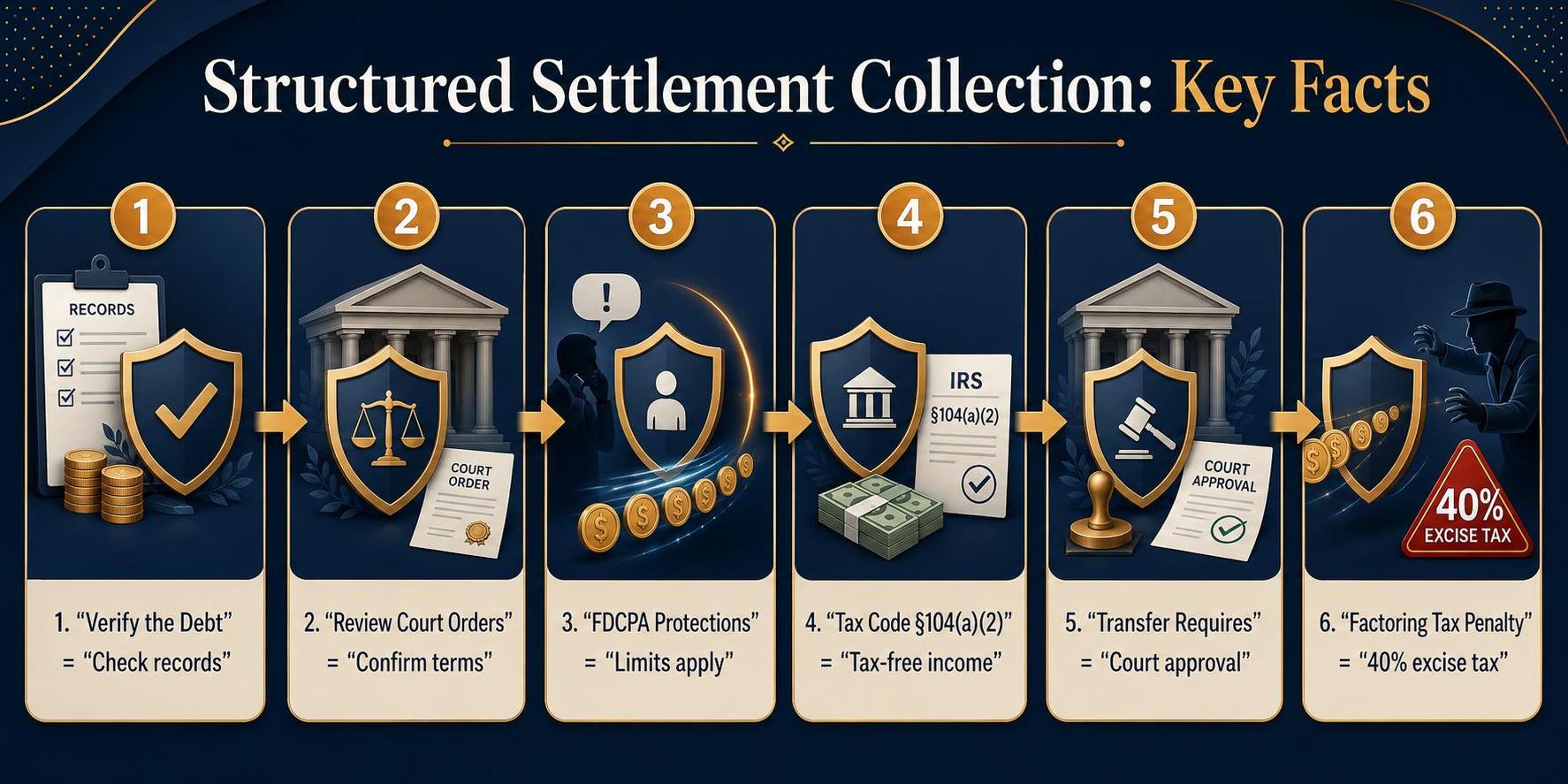
How structured settlement collections work
A structured settlement usually pays a claimant through scheduled annuity payments instead of one lump sum. Collection activity depends on the problem: a missed payment is handled differently from a sale of future payment rights.
In a typical structure, the defendant or its insurer funds an annuity through a qualified assignment company, and the annuity issuer sends payments on the schedule in the settlement documents.
The tax framework comes from Internal Revenue Code Sections 104(a)(2), 130, and 5891.
If a payment is late or missing, the first step is document review. The payee checks the settlement agreement, qualified assignment, annuity contract, and payment history to confirm the exact due date, payee name, and amount.
Next, the payee usually contacts the annuity issuer or obligor in writing and asks for the reason for nonpayment.
Common issues include address changes, banking changes, death-benefit questions, garnishment orders, or competing claims after divorce or probate.
If the dispute is not resolved, a lawyer may pursue enforcement against the party legally obligated to pay.
A third-party collection agency is not a substitute for court approval, probate advice, or legal enforcement when title to the payment is disputed.
A different process applies when someone wants cash now by assigning future payments to a factoring company. That is not ordinary debt collection.
It is a transfer of structured settlement payment rights, and state structured settlement protection laws usually require a court order before the transfer is effective.
| Rule or figure | What it means in practice | Source |
| Section 104(a)(2) | Certain damages for personal physical injuries or physical sickness can be excluded from gross income, which is why many structured settlement payments are received tax-free. | Internal Revenue Code, 26 U.S.C. §104(a)(2) |
| Section 130 | Allows a qualified assignment, commonly used so an assignment company takes on the periodic payment obligation and funds it with an annuity. | Internal Revenue Code, 26 U.S.C. §130 |
| 40% | A federal excise tax applies to a structured settlement factoring transaction unless it meets the qualified-order rules. | Internal Revenue Code, 26 U.S.C. §5891(a) |
Because of that 40% tax rule, buyers of payment rights usually seek a court order finding the transfer is in the payee’s best interest and meets state law. Without that order, the transaction can fail even if the payee signed a contract.
Readers should not rely on a collection letter alone when a structured settlement is involved.
Check the annuity issuer, the assignment company, and the court papers, because selling or enforcing payment rights can affect taxes, benefits, and ownership.
- Missed payment: verify documents, then demand payment from the legally obligated party.
- Proposed sale of payments: expect disclosures, a court process, and judicial review.
- Disputed ownership, estate issues, or garnishment: get state-specific legal advice before signing anything.

When a collection agency gets involved
A collection agency usually appears when there is an alleged unpaid debt connected to the settlement recipient, not because the agency “takes over” the structured settlement itself.
In most cases, the dispute is about a separate consumer debt, a medical bill, or a contract tied to a failed sale or advance.
That distinction matters. Future structured settlement payments are often protected by contract terms and state court approval rules, so readers should not assume a collector can simply redirect those payments without legal process.
For consumer debts, the main federal rule is the Fair Debt Collection Practices Act, or FDCPA. It covers debts incurred primarily for personal, family, or household purposes under 15 U.S.C. 1692a(5), and it restricts what third-party collectors can say and do.
A collector generally must send a written validation notice within 5 days after the initial communication unless the information was given in that first contact, according to 15 U.S.C. 1692g(a).
That notice must state the amount of the debt and the consumer’s dispute rights.
| Rule or deadline | What it means | Source |
| 5 days | Collector must send validation notice after initial communication, unless included at first contact | 15 U.S.C. 1692g(a) |
| 30 days | Consumer can dispute the debt in writing after receiving the validation notice | 15 U.S.C. 1692g(a) |
| 7 calls | Calls more than 7 times within 7 consecutive days about one debt are presumed to violate federal rule | CFPB Regulation F, 12 CFR 1006.14(b)(2) |
| 7 days | After a telephone conversation about a debt, a collector is presumed to violate the rule if it calls again within 7 days | CFPB Regulation F, 12 CFR 1006.14(b)(2) |
| 40% | Federal excise tax can apply to a structured settlement transfer that lacks required court approval | 26 U.S.C. 5891(a) |
If the alleged debt involves selling payment rights, court approval is central.
Under 26 U.S.C. 5891, a transfer that does not meet the statute’s qualified-order requirements can trigger a 40% federal excise tax on the factoring company, which is one reason approved transfers are handled through state court procedures.
A collector still may sue on an alleged contract debt.
If it wins a judgment, state law may allow bank-account levy or wage garnishment, but whether structured settlement payments themselves can be reached depends on the settlement documents, state exemption law, and any court orders.
- Ask for the validation notice and compare the balance to the original contract.
- Keep copies of settlement documents, transfer orders, and payment records.
- Check whether the debt is consumer debt covered by the FDCPA.
- Do not ignore a court summons. Deadlines are set by state law and missing them can cause a default judgment.
Caution: collection, garnishment, and exemption rules vary by state. Before acting, verify the debt and check the court file, settlement contract, and state statutes or get advice from a qualified consumer attorney.

Your rights under federal collection law
If a structured settlement payment is being collected by a third-party debt collector, federal law may limit how that collector can contact and pressure the payee. The main rule is the Fair Debt Collection Practices Act, or FDCPA, 15 U.S.C. 1692 et seq.
The FDCPA generally applies to third-party debt collectors, not every original creditor.
The Consumer Financial Protection Bureau, or CFPB, enforces the law and says collectors cannot harass, lie, or use unfair practices when collecting a consumer debt.
One important timing rule is the CFPB’s “limited-content message” and call-frequency framework in Regulation F, 12 C.F.R. Part 1006.
Under the CFPB rule, a collector is presumed to violate the FDCPA if it places more than 7 telephone calls within 7 consecutive days about a particular debt.
The CFPB also says a collector generally cannot call again within 7 consecutive days after having a telephone conversation with the consumer about that same debt. These are rebuttable presumptions, not absolute safe harbors.
Readers should verify the current rule text at CFPB and eCFR sources.
| Federal right or limit | Specific rule | Primary source |
| Call frequency | More than 7 calls in 7 consecutive days about one debt creates a presumption of a violation | CFPB Regulation F, 12 C.F.R. 1006.14(b)(2) |
| Repeat calls after speaking | A call within 7 consecutive days after a telephone conversation about that debt creates a presumption of a violation | CFPB Regulation F, 12 C.F.R. 1006.14(b)(3) |
| Debt validation information | Collectors must provide validation information at or near the first communication, with details including the debt amount and consumer protections | CFPB Regulation F, 12 C.F.R. 1006.34 |
| Time to dispute in writing | 30-day validation period | FDCPA, 15 U.S.C. 1692g(a) |
| Private lawsuit deadline | 1 year from the date of the violation | FDCPA, 15 U.S.C. 1692k(d) |
The validation notice matters. Under 15 U.S.C. 1692g, a collector must give the amount of the debt, the current creditor’s name, and notice of the consumer’s right to dispute the debt within 30 days.
If the debt is disputed in writing, collection must generally stop until verification is mailed.
The law also restricts communication channels. The CFPB says collectors cannot contact consumers at unusual or inconvenient times, generally presumed to mean before 8 a.m. or after 9 p.m. local time, unless the consumer agrees otherwise.
Collectors also cannot discuss the debt with most third parties, use obscene language, threaten action they cannot legally take, or falsely imply government affiliation. Those prohibitions appear in 15 U.S.C. 1692b, 1692c, 1692d, 1692e, and 1692f.
Caution: federal rights depend on whether the obligation is a “consumer debt” and whether the company qualifies as a “debt collector” under federal law.
Structured settlement disputes can also involve court orders, assignment laws, or contract issues. Check the FDCPA text, CFPB guidance, and a qualified attorney for case-specific advice.

State rules that may affect collections
Collection activity is shaped by state law as much as by the federal Fair Debt Collection Practices Act.
For structured-settlement-related disputes, the main variables are whether a collector must hold a state license, post a bond, follow extra notice rules, or sue within a state filing deadline.
Readers should not act on a state-law summary alone. Collection rules change, and a structured settlement may also be controlled by a court transfer order, annuity contract, or insurer payment terms that need primary-source review.
Licensing is a major threshold issue. In some states, a company cannot lawfully collect covered debts without first registering or obtaining a license.
Bonding rules also matter because they are a condition of operating, and regulators can suspend or revoke authority for noncompliance.
| State | Rule that may affect collections | Figure | Source |
| California | Collection agencies must obtain a license under the California Debt Collection Licensing Act. | $25,000 bond for each licensee | California Department of Financial Protection and Innovation; Cal. Fin. Code, Division 25 |
| Texas | Third-party debt collectors and credit bureaus must file a bond before engaging in covered activity. | $10,000 surety bond | Texas Finance Code Chapter 392; Texas Secretary of State |
| Maryland | A person collecting consumer claims for another generally needs a collection agency license. | License required; bond amount depends on regulator requirements | Maryland Collection Agency Licensing Board; Md. Business Regulation Title 7 |
| Nevada | Collection agencies must be licensed by the state. | $35,000 bond for each office | Nevada Financial Institutions Division; Nev. Rev. Stat. Chapter 649 |
Time limits to sue are also state-specific.
For example, New York reduced the statute of limitations for many consumer credit transactions from 6 years to 3 years in the Consumer Credit Fairness Act, according to the New York State Senate and N.Y. CPLR 214-i.
That kind of deadline can decide whether a lawsuit is timely.
State consumer-protection laws can add extra restrictions beyond federal law.
California’s Rosenthal Fair Debt Collection Practices Act covers many collection practices and applies rules similar to the federal FDCPA, according to the California Legislative Information service.
- Check the state regulator where the collector operates, not only where the consumer lives.
- Verify whether the claim involves consumer debt, commercial debt, or enforcement of a court-approved transfer order.
- Confirm the filing deadline in the current statute text before paying or responding to a lawsuit.
If money or legal rights are at stake, review the actual state statute, the court order, and any annuity or settlement documents. Small wording differences can change who may collect, how they may contact a person, and whether a lawsuit can proceed.

What Coin Abul independently reviewed
Coin Abul reviewed primary-source material to clarify what a “structured settlement collection agency” usually is in practice.
In most cases, the term points to a company that buys future structured-settlement payment rights, not a debt collector collecting overdue checks.
That distinction matters because different laws apply. A reader should verify any company’s exact role, licenses, court process, and fee disclosures before signing, because selling payment rights can permanently reduce long-term income.
The review started with the federal definition of a structured settlement.
The Internal Revenue Code, 26 U.S. Code Section 5891, governs transfers of structured-settlement payment rights and imposes a 40% federal excise tax on a transfer unless the sale is approved in advance under a state structured settlement protection act.
Coin Abul also checked how often courts are involved.
The National Structured Settlements Trade Association states that all 50 states have enacted structured settlement protection laws requiring court or administrative approval before a transfer can be completed.
| Item reviewed | Specific fact | Why it matters |
| 26 U.S. Code Section 5891 | 40% excise tax applies to non-approved transfers. | Shows why legitimate purchasers usually require formal approval. Source: U.S. Code, Cornell Legal Information Institute. |
| State protection laws | 50 states have enacted structured settlement protection laws. | Confirms transfers are regulated nationwide. Source: National Structured Settlements Trade Association. |
| FTC cooling-off rule | The FTC’s Cooling-Off Rule gives a 3-day cancellation right for certain sales made at home, work, or temporary locations. | Helps readers avoid assuming it automatically applies to every structured-settlement sale. Source: Federal Trade Commission. |
Coin Abul reviewed consumer-protection guidance next. The Consumer Financial Protection Bureau warns consumers to understand fees, discounts, and alternatives before entering complex financial transactions.
That caution is relevant here because purchasers typically pay less than the total face value of future payments.
The review also looked at financial-stability data, because payment security affects transfer decisions.
The U.S. life/annuity industry held about $8.4 trillion in admitted assets at year-end 2023, according to the American Council of Life Insurers’ 2024 Life Insurers Fact Book.
That figure does not measure transfer-company quality. It does show why the original annuity issuer, and not a “collection agency,” is often central to payment reliability.
- Company role: purchaser, broker, lead generator, lawyer, or debt collector.
- Approval process: court filing, hearing requirements, and state-specific disclosures.
- Economic terms: gross advance, fees, net amount, and total payments being sold.
- Payment source: annuity issuer name and settlement obligor identity.
Readers should check the court order requirement in their state and the original settlement documents. Acting on marketing language alone can cause irreversible loss of future income.

Warning signs of abusive collection tactics
Abusive collection tactics often follow the same pattern: pressure, confusion, and threats.
In the United States, the Fair Debt Collection Practices Act, or FDCPA, limits what third-party debt collectors can do, and the Consumer Financial Protection Bureau, or CFPB, enforces related federal rules.
If a company claims it can collect a structured-settlement-related debt, verify whether the debt is real, whether the collector is licensed where required, and whether the conduct fits federal law.
Acting on threats alone can cause financial harm, so check the original notice and primary documents first.
One major warning sign is contact at legally restricted times. Under the FDCPA, debt collectors generally may not contact a consumer before 8 a.m. or after 9 p.m. local time, according to the CFPB’s summary of federal debt collection rules.
Another red flag is repeated calling intended to harass.
The CFPB’s Regulation F also limits telephone contact by presumptively treating more than 7 calls within 7 consecutive days about a particular debt as unlawful harassment, and it bars calls within 7 days after a telephone conversation about that debt.
| Rule or limit | Figure | Source |
| Earliest routine contact time | 8 a.m. | CFPB, FDCPA summary |
| Latest routine contact time | 9 p.m. | CFPB, FDCPA summary |
| Presumptive call limit | More than 7 calls in 7 consecutive days | CFPB Regulation F |
| Post-conversation waiting period | 7 days | CFPB Regulation F |
| Private federal statutory damages cap | Up to $1,000 | 15 U.S.C. § 1692k |
Threats are another warning sign. Collectors generally cannot threaten arrest, jail, wage garnishment, or lawsuits they do not actually intend to pursue or cannot legally pursue, according to the Federal Trade Commission and CFPB guidance.
False statements about who they are also matter. A caller who pretends to be from a court, government agency, law firm, insurer, or settlement administrator may be violating federal law if that representation is false or misleading.
- Refusing to send a written validation notice. The FDCPA generally requires certain debt information in writing within 5 days of the initial communication, unless that information was provided in the first communication.
- Demanding payment by gift card, wire transfer, or cryptocurrency. The FTC repeatedly warns that these payment methods are common in fraud schemes.
- Contacting employers, relatives, or friends beyond narrow location-information rules. Broad disclosure of a debt can violate federal law.
If any of these signs appear, pause payment and verify the debt directly with the original creditor, court order, or settlement paperwork.
For legal rights or state-specific collection rules, check the CFPB, FTC, your state attorney general, or a qualified attorney.
Steps before paying or disputing
If a company says it is collecting on a structured settlement-related debt, pause before sending money.
Structured settlements are usually paid under a court-approved transfer or an annuity contract, so the first step is to verify exactly what obligation the collector claims exists.
Act quickly because federal debt-collection deadlines are short. A mistake can lead to payment on a debt that is not owed, is time-barred, or is being collected by the wrong company.
1. Confirm the debt in writing
Under the Fair Debt Collection Practices Act, a debt collector generally must send a written validation notice within 5 days after the initial communication, unless the information was provided in that first communication.
The notice must state the amount of the debt and the creditor’s name, according to the Consumer Financial Protection Bureau and 15 U.S.C. § 1692g.
If the notice is missing, ask for it before paying. If the claim involves a structured settlement transfer, compare the collector’s papers with the court order, transfer agreement, payment schedule, and any annuity issuer correspondence.
2. Use the federal dispute window
The CFPB states that a consumer has 30 days from receiving the validation notice to dispute the debt in writing. Send the dispute by certified mail and keep copies, because the date matters if collection activity continues.
| Action | Federal timeline | Source |
| Collector sends validation notice after first contact | Within 5 days | FDCPA, 15 U.S.C. § 1692g; CFPB |
| Consumer disputes the debt | Within 30 days of receiving notice | FDCPA, 15 U.S.C. § 1692g; CFPB |
| Credit bureau completes most disputes | Usually within 30 days | Fair Credit Reporting Act; FTC and CFPB guidance |
3. Check credit reporting and ownership
Pull credit reports from Equifax, Experian, and TransUnion through AnnualCreditReport.com. Federal law allows free weekly online reports from each nationwide bureau, according to AnnualCreditReport.com.
Match the account number, balance, and date against the collector’s notice. If the collector reports incorrect information, dispute with both the collector and the credit bureau.
The FTC says credit bureaus generally must investigate within 30 days under the FCRA.
4. Verify state-law issues before paying
State rules can affect interest, licensing, and how long a debt can be sued on. Do not rely on a generic limitation period because the deadline varies by state and by contract type.
Check the state attorney general, state financial regulator, or a qualified consumer attorney.
- Ask for the original creditor’s name and full payment history.
- Request proof the collector has authority to collect.
- Do not give bank access until documents match the court order or contract.
- If the debt involves a lawsuit threat, get legal advice fast because court deadlines can be shorter than 30 days.
Caution: paying even a small amount can have legal consequences in some states. Verify the debt first, then decide whether to pay, negotiate, or dispute based on primary documents and state-specific advice.
Frequently Asked Questions
Can a structured settlement collection agency collect unpaid structured settlement payments?
In most cases, a structured settlement payee does not have a typical “account” that a private collection agency can collect like a credit card debt.
Payments are usually governed by a settlement agreement and often funded through an annuity issued by a life insurer, so disputes usually involve the insurer, annuity issuer, or court-approved transfer documents rather than ordinary debt collection.
Readers should verify the original settlement papers and annuity contract before acting.
Who actually sends structured settlement payments?
Structured settlement payments are commonly funded through an annuity issued by a life insurance company, according to the National Association of Settlement Purchasers and the National Structured Settlements Trade Association.
Both of which describe structured settlements as long-term periodic payments often backed by annuities.
The entity sending the money may be the annuity issuer or an assigned obligor, not a “collection agency,” so the payment source should be confirmed from the settlement and annuity documents.
What should someone do if a structured settlement payment is late or missing?
The first step is to review the settlement agreement, annuity contract, and any court order approving the payment structure or a transfer.
Then contact the annuity issuer or obligor named in those documents and keep records of dates, notices, and amounts.
Because the Consumer Financial Protection Bureau advises consumers to document financial disputes carefully when dealing with payment problems.
Do not sign new transfer or financing papers based only on a phone call or informal demand.
Can debt collectors garnish or seize structured settlement payments?
Whether a creditor can reach structured settlement payments depends on state law, the type of debt, and how the payment rights are held, so no single national rule fits every case.
Many states have Structured Settlement Protection Acts regulating transfers, but those laws do not automatically answer creditor-collection questions.
A reader should check state statutes and get legal advice before relying on any claim that payments are fully protected or fully reachable.