

Quick answer: Structured Settlement Quotes are estimates showing how much a factoring company may pay for some or all future structured settlement payments.
They usually reflect payment dates, total payments sold, discount rate, fees, and court-approval requirements. Quotes are not final offers; compare multiple companies and consult an attorney or financial adviser before selling.
Structured Settlement Quotes are written purchase estimates showing how much a factoring company may pay for future structured settlement payments today.
Quotes usually depend on payment timing, payment amount, court-approval requirements, state law, company fees and the discount rate used to convert future payments into a present lump sum.
Because selling payments can permanently reduce long-term income, readers should treat any quote as a starting point, not a promise.
Compare disclosures, check state requirements, and consider independent legal or financial advice before signing anything.
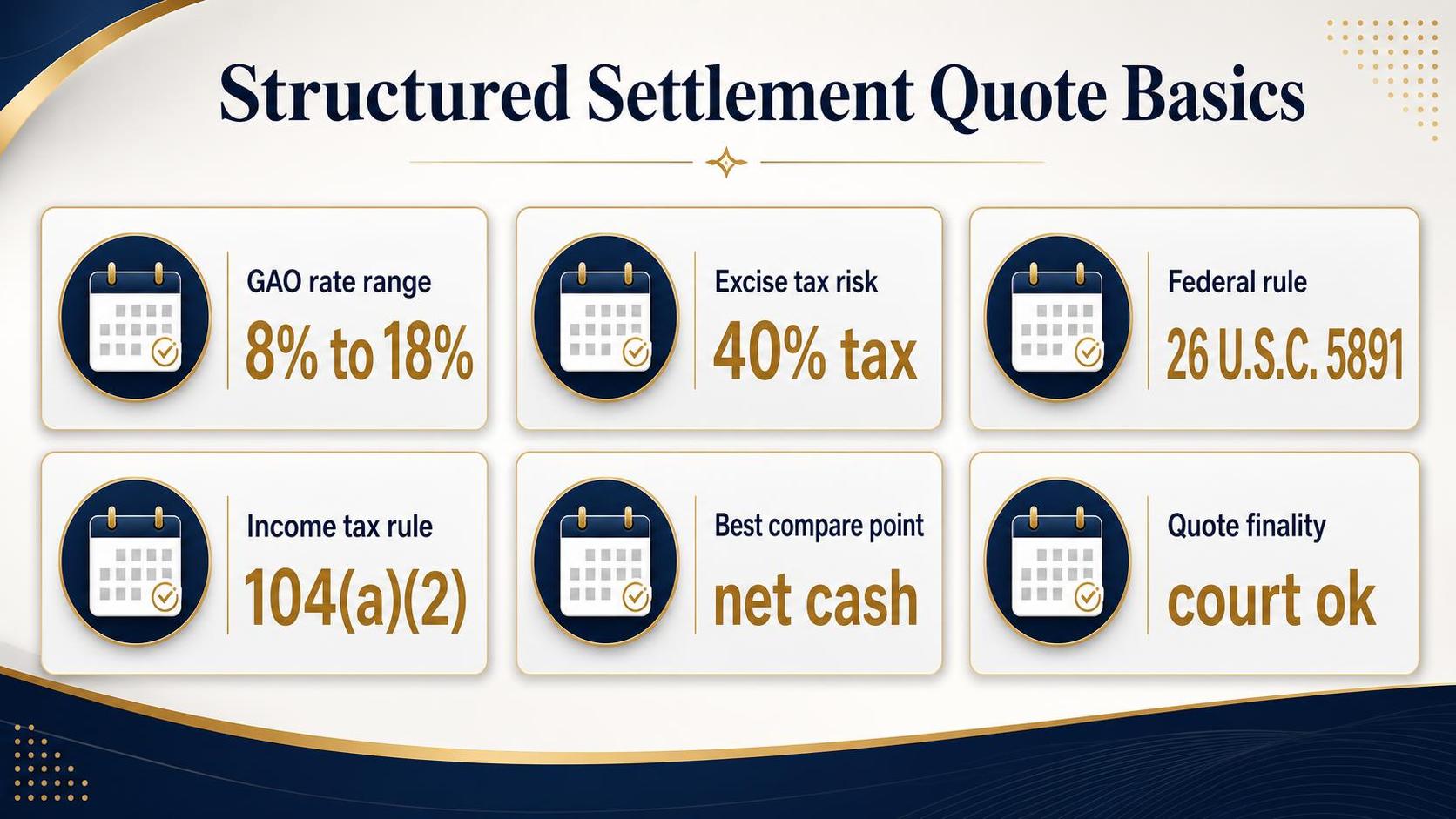
What structured settlement quotes mean
A structured settlement quote is an estimate of how much a purchasing company may pay today for the right to receive some or all future settlement payments.
It is not the face value of the payments; it is a present-value offer reduced for time, risk, profit and transaction costs.
For example, $120,000 scheduled over 10 years is not the same as $120,000 in cash today.
A quote converts future payments into today’s dollars using a discount rate, then subtracts any disclosed fees or costs to show the net amount payable to the seller.
A serious quote should identify the exact payments being transferred, the gross purchase price, the annual discount rate, any administrative or legal fees, and the estimated net proceeds.
Readers should not rely on a verbal number alone; the written transfer agreement controls.
| Example item | What it means |
| $1,000 monthly for 120 months | $120,000 total scheduled payments before discounting |
| 8% annual discount rate | About $82,435 present value using a standard monthly present-value formula |
| 12% annual discount rate | About $69,701 present value using the same formula |
| 18% annual discount rate | About $55,480 present value using the same formula |
The table is an arithmetic illustration, not a market quote. The present values use the ordinary annuity formula with monthly compounding: $1,000 paid monthly for 120 months, discounted at the stated annual rate divided by 12.
The discount rate is the key number because it shows the cost of receiving money early. A higher discount rate means a lower cash offer.
Two companies can quote the same payment stream and produce very different net proceeds if their discount rates or fees differ.
Structured settlement transfers are also legal transactions.
Under Internal Revenue Code Section 5891.
A nonqualified structured settlement factoring transaction can trigger a 40% federal excise tax on the factoring discount unless the transfer receives required court approval under a state structured settlement protection act.
For injury settlements, Internal Revenue Code Section 104(a)(2) generally excludes damages received on account of personal physical injuries or physical sickness from gross income.
Selling payment rights can raise separate tax and legal issues, so sellers should confirm treatment with a qualified tax professional.
- Gross purchase price: The amount offered before deductions.
- Net proceeds: The estimated cash after disclosed costs.
- Effective discount rate: The annualized rate used to price future payments.
- Transferred payments: The exact monthly, annual or lump-sum payments the buyer would receive.
Caution: A structured settlement quote can materially affect long-term income, public benefits, taxes and court rights.
Do not sell payment rights based only on an online estimate; compare written disclosures and ask the court, an attorney or a financial professional about the consequences.

How quote amounts are calculated
A structured settlement quote is usually a present-value calculation. The company estimates what future annuity payments are worth today, then subtracts its required return, risk costs, administrative expenses and any approved transaction charges.
The biggest driver is the discount rate. A higher discount rate produces a lower cash offer, even when the payment stream is identical.
- Payment amount and schedule: Monthly payments, lump sums, cost-of-living increases and guaranteed periods are valued differently.
- Timing: Payments due soon are worth more than payments due years later, because the buyer waits less time to recover capital.
- Discount rate: The quoted rate reflects the buyer’s target return and transaction risk. It is not always the same as a consumer-loan APR.
- Court-approval risk: Internal Revenue Code Section 5891 imposes a 40% excise tax on a structured settlement factoring transaction unless it meets statutory requirements, including a qualified court order.
- State-law requirements: Most transfers require a judge to find that the sale is in the payee’s best interest, often with written disclosures before the hearing.
| Example payment stream | Assumed annual discount rate | Approximate present value before fees |
| $1,000 per month for 60 months | 12% | $44,955 |
| $1,000 per month for 60 months | 18% | $39,380 |
| $1,000 per month for 60 months | 24% | $34,760 |
These examples use the standard monthly present-value formula for an ordinary annuity. The figures assume the first $1,000 payment is one month away and use monthly compounding based on the stated annual discount rate.
Actual quotes may be lower than the table because buyers may deduct filing costs, attorney review costs, servicing costs or other charges where allowed. Some states restrict or require disclosure of these amounts.
Tax treatment also matters. IRS Publication 525 states that damages received for personal physical injuries or physical sickness are generally excluded from income, but selling payment rights can raise separate legal and tax questions.
Caution: Do not rely on a quote alone to decide whether to sell. A lower cash price may still be legally approved, and a higher headline offer may include costs or terms that reduce the net amount received.
Readers should compare the net amount, effective discount rate, payment dates sold and court documents. For state-specific requirements, check the structured settlement protection act in the applicable state or ask an independent attorney.

Documents needed before requesting quotes
Before requesting structured settlement quotes, gather the documents that prove the payment stream, ownership, and legal restrictions.
Buyers use these records to calculate a discount rate and decide whether a transfer can be approved by a state court.
A quote based only on memory can be misleading. A judge, not the funding company, must usually approve a transfer under state structured settlement protection acts.
| Document | Why it matters for a quote |
| Settlement agreement and release | Shows the original lawsuit or claim resolution, the payee, and any anti-assignment language that may affect whether payments can be sold. |
| Structured settlement annuity contract or benefits letter | Identifies the annuity issuer, payment dates, payment amounts, cost-of-living adjustments, and whether payments are life-contingent or guaranteed. |
| Most recent payment stub or bank deposit record | Confirms that payments are being made as scheduled and helps verify the current recipient and payment frequency. |
| Court order approving the original settlement, if any | Important for minors, wrongful-death claims, workers’ compensation cases, or settlements already supervised by a court. |
| Government-issued photo ID and proof of address | Used to verify identity and reduce fraud risk before a buyer spends money on underwriting and court filings. |
| Divorce decree, child-support order, bankruptcy papers, or liens, if applicable | May reveal competing claims to the payments or legal limits that could reduce or block a transfer. |
Federal tax law gives buyers a strong reason to require complete paperwork. Internal Revenue Code Section 5891 imposes a 40% excise tax on the factoring discount unless the transfer is approved in a “qualified order.”.
The National Association of Insurance Commissioners’ Model State Structured Settlement Protection Act also centers on court review and required disclosures.
Many states adopted their own versions, so the exact filing package and notice rules vary by state.
- List each payment you want quoted: amount, due date, and whether it is monthly, annual, lump-sum, or a combination.
- Ask the annuity issuer for a written benefits confirmation if the original annuity contract is missing.
- Keep copies of prior transfer orders if any payments were sold before; repeat transfers require careful review.
- Do not sign a blank authorization or transfer agreement just to “get a quote.” A preliminary quote should not require giving up legal rights.
Caution: Selling structured settlement payments can permanently reduce future income and may affect public benefits, divorce obligations, creditor issues, or tax treatment.
Do not rely on a quote alone; check the court file, state protection act, annuity issuer records, and qualified legal or financial advice before signing.

Comparing offers from settlement purchasing companies
Structured settlement quotes can look similar while producing very different cash outcomes. Compare the net cash paid, the effective discount rate, court costs, and which future payments are being transferred before signing anything.
A quote is not just a headline lump sum. It is a proposed sale of court-protected future payments, and most states require a judge to find the transfer is in the seller’s best interest.
| Comparison item | What to check | Why it matters |
| Gross purchase price | The total lump sum before deductions. | A higher gross price can still lose if fees are larger. |
| Net amount to seller | The exact dollars paid after fees, liens, and court costs. | This is the number that affects the seller’s budget. |
| Effective discount rate | The annualized rate used to convert future payments into cash today. | Small rate differences can change the quote by thousands of dollars. |
| Payments transferred | Each payment date and amount being sold. | Selling fewer payments may preserve long-term income. |
| Fees and costs | Attorney, filing, administrative, lien-search, and service fees. | Some costs may be deducted even if the quoted price looks competitive. |
| Court approval | Whether the company explains the required approval process. | Internal Revenue Code section 5891 imposes a 40% excise tax on certain factoring transactions without a qualified court order. |
Ask each purchasing company to put the offer in the same format. The comparison should show gross price, net proceeds, discount rate, all fees, and the exact payment stream being purchased.
- Get at least three written quotes before agreeing to exclusivity or signing a transfer agreement.
- Compare net proceeds, not advertising claims such as “highest payout” or “fast cash.”
- Ask whether the company will pay court filing fees, independent professional advice costs, or attorney review fees.
- Confirm whether the quote expires and whether the buyer can reduce it before the hearing.
- Check whether the company is licensed or registered if the seller’s state requires it.
The National Association of Insurance Commissioners notes that structured settlement protection laws generally require disclosure and court approval for transfers.
State rules differ, so sellers should read the statute and court forms for their own state.
Caution: Selling future settlement payments can permanently reduce income that may have been designed for medical care, housing, or disability support.
Do not rely on a quote alone; consult an attorney or financial adviser familiar with structured settlement transfers.

What Coin Abul independently reviewed
Coin Abul independently reviewed the quote factors that usually determine how much cash a structured settlement seller may receive.
The review focused on legal disclosures, discounting math, court-approval requirements and consumer-risk warnings, not on promoting any funding company.
A structured settlement quote is not the same as the face value of future payments.
It is an offer to buy payment rights at a discount, and the final transaction generally requires a judge to find that the transfer is in the seller’s best interest.
| Reviewed item | Source checked | Specific fact | Why it matters for quotes |
| Federal tax penalty for nonapproved transfers | Internal Revenue Code §5891 | Unapproved structured settlement factoring transactions can trigger a 40% excise tax on the factoring discount. | Legitimate quotes are typically structured around court approval because the tax penalty can make a transfer economically unworkable. |
| Tax treatment of injury settlements | Internal Revenue Code §104(a)(2) | Damages received for personal physical injuries or physical sickness are generally excluded from gross income. | Sellers should understand that selling payment rights can affect cash-flow planning even when the original settlement had favorable tax treatment. |
| Qualified assignment structure | Internal Revenue Code §130 | Qualified assignments are the tax mechanism commonly used to fund structured settlement annuities. | The annuity issuer and assignment company can affect transfer paperwork, verification timing and court filings. |
| New York disclosure timing | New York General Obligations Law §5-1703 | Required disclosures must be provided at least 10 days before the seller signs a transfer agreement. | Quote timing matters; a fast verbal estimate is not a substitute for the written statutory disclosure. |
Coin Abul also reviewed how quotes typically present “present value,” “discount rate,” “gross advance amount,” fees and net proceeds.
These terms are often more important than the headline cash offer because two quotes with similar cash payouts can carry different implied costs.
- Payment schedule: The number, timing and dollar amount of future payments being sold.
- Discount rate: The rate used to reduce future payments to today’s cash value.
- Fees and deductions: Court costs, administrative charges or other deductions that may reduce net proceeds.
- Court outcome risk: A quote can change or fail if the judge rejects the proposed transfer.
Caution: A structured settlement sale is a legal and financial decision.
Readers should not rely on a quote article alone; they should review the court disclosure, check the applicable state statute and consider independent legal or financial advice before signing.

Court approval and state law risks
Structured settlement quotes are not final cash offers until a judge approves the transfer.
Under federal tax law, most transfers must comply with a state structured settlement protection act and receive a “qualified order” to avoid a 40% excise tax.
That 40% tax comes from Internal Revenue Code Section 5891, enacted as part of Public Law 107-134 in 2002. The risk usually falls on the factoring company, but a failed approval can delay or cancel the sale.
| Legal checkpoint | Why it matters to a quote | Source |
| Court approval | A judge must find the transfer is in the payee’s best interest under the applicable state act. | National Conference of Insurance Legislators model act; state structured settlement protection acts |
| 40% federal excise tax | A nonqualified transfer can trigger a tax equal to 40% of the factoring discount. | Internal Revenue Code Section 5891 |
| Disclosure before hearing | States commonly require written disclosure of the present value, discount rate, fees, and net amount payable. | State structured settlement protection acts; NCOIL model disclosures |
| Independent professional advice | Some states require or allow the court to consider whether the seller received independent legal, tax, or financial advice. | State structured settlement protection acts |
State rules vary, so two identical payment streams can produce different court outcomes. A quote that looks attractive may be rejected if the discount rate, fees, or hardship explanation does not satisfy the judge.
- Best-interest findings: Courts usually review the seller’s age, dependents, financial need, and intended use of funds before approving a transfer.
- Notice requirements: Insurers, annuity issuers, beneficiaries, and other interested parties may have to receive advance notice before the hearing.
- Cooling-off or cancellation rights: Some state laws give the seller time to cancel before approval or before funds are disbursed.
- Prior transfers: A judge may scrutinize repeat sales because they can reduce long-term income originally designed for medical care or living expenses.
Caution: A structured settlement quote is not legal advice and should not be treated as guaranteed cash. Before signing, compare the written disclosure with the petition filed in court and verify the governing state statute.
Readers should also check whether the proposed sale affects means-tested benefits, child support, bankruptcy obligations, or injury-related medical plans. These issues are fact-specific and may require an independent attorney or tax professional.

Questions to ask before accepting
A structured settlement quote is not the same as cash in hand. Before accepting, compare the net amount, the discount rate, court requirements and the long-term value of the payments being sold.
Plain caution: selling payment rights can permanently reduce future income. Do not rely on a quote alone; review the petition, purchase agreement and state approval rules with an independent attorney or financial professional.
- What is the effective discount rate? Ask for the annual discount rate used to convert future payments into today’s lump sum. The Consumer Financial Protection Bureau has warned consumers to compare offers because small rate differences can materially change the cash received.
- How much money is being sold, and how much is being kept? Request a schedule listing every payment affected: due date, payment amount and whether the entire payment or only part of it is being transferred. This matters if the settlement is intended to cover medical care, housing or dependents.
- What is the exact net amount after all deductions? The quote should separate the gross purchase price from legal fees, filing fees, administrative charges, broker compensation, lien payoffs or other deductions. If a fee is not fixed in writing, ask whether it can change before closing.
- Has a court approved the transfer? Most structured settlement transfers require court approval under state structured settlement protection acts. Federal tax law also matters: Internal Revenue Code Section 5891 imposes a 40% excise tax on a factoring discount unless the transfer is approved in a “qualified order.”
- Does the judge have to find that the transfer is in the seller’s best interest? Many state laws require a best-interest finding and disclosure of key terms. Because rules differ by state, check the applicable statute, the court notice and any required independent professional advice provisions.
- What happens if the quote changes? Ask whether the quoted price is guaranteed, when it expires and whether changes in payment dates, insurer confirmation, court timing or underwriting can reduce the amount. Do not sign blank or incomplete transfer documents.
- Who is buying the payments? Identify the purchaser, any assignee and the company that will receive payments from the annuity issuer. Ask whether the purchaser is registered or licensed where required, and verify the business name with state records.
- What alternatives were considered? Compare the sale with using emergency savings, negotiating medical bills, nonprofit credit counseling, a lower-cost loan or selling fewer payments. A quote may solve a short-term cash problem while creating a larger future income gap.
Frequently Asked Questions
What is a structured settlement quote?
A structured settlement quote is an estimate of how much a factoring company may pay today in exchange for some or all future structured settlement payments.
The quote is not the final amount; transfers of structured settlement payment rights generally require court approval under state Structured Settlement Protection Acts, and the judge may reject a deal that is not in the seller’s best interest.
Why do structured settlement quotes vary between companies?
Quotes vary because companies use different discount rates, fees, underwriting assumptions, payment schedules and risk assessments.
The Consumer Financial Protection Bureau has warned that selling future payments can be expensive, so readers should compare written offers and avoid relying on one quote alone.
What information is usually needed to get a structured settlement quote?
A company typically needs the payment schedule, payment amounts, dates, annuity issuer, whether the payments are guaranteed, and how much cash the seller wants.
Do not sign transfer paperwork based only on an informal quote; the final disclosure should be reviewed carefully, and legal or financial advice may be appropriate.
Are structured settlement quotes legally binding?
Most initial quotes are not legally binding because pricing can change after document review, underwriting and court-required disclosures.
The National Association of Insurance Commissioners explains that structured settlements are designed to provide scheduled future payments, so selling them should be evaluated carefully before any binding agreement is signed.
How can someone compare structured settlement quotes safely?
Compare the net amount paid to the seller, the discount rate, itemized fees, court costs, timing, and whether only the needed payments are being sold.
A lower headline discount rate is not always the better deal if fees are higher, so readers should review the full written disclosure and check their state court requirements before proceeding.
Related Reading
- Buy Structured Settlement – What You Need to Know?
- Structured Settlement Annuity Companies
- Best Structured Settlement Companies
- Structured Settlement Buyer – What You Need to Know
- Structured Settlement Broker
- Vanguard Immediate Annuity Rates
- Structured Settlement Payout
- All Blog Guides
- IRS Publication 4345 (2024)
- U.S. Code § 5891, Cornell Legal Information Institute (2024)
- Consumer Financial Protection Bureau Ask CFPB (2024)
- Florida Statutes § 626.99296 (2024)
- Texas Insurance Code Chapter 141 (2024)
- National Association of Insurance Commissioners Consumer Glossary: Structured Settlement (2024)
- National Structured Settlements Trade Association Structured Settlements FAQ (2024)