
In short: What Bank Is Cash App On Plaid: Cash App is not a bank. For Plaid linking, Cash App accounts are commonly associated with Sutton Bank for the Cash App Card and Lincoln Savings Bank for direct deposit banking services.
Availability can vary, so confirm inside Cash App or Plaid before linking.
What Bank Is Cash App On Plaid is usually Sutton Bank for Cash App Card routing details; Cash App says it is not a bank, and its banking services are provided by partners including Sutton Bank and Wells Fargo Bank, N.A.
Plaid says its network connects to 12,000+ financial institutions, so linking can speed transfers and account verification.
The trade-off is data access: Plaid’s U.S. privacy notice says it may collect account balances, transactions, routing numbers, and identifiers.
The downside case matters. Cash App says eligible balances may receive FDIC pass-through insurance through Wells Fargo Bank, N.A., up to $250,000, but coverage depends on account status and program rules.
Verify details in Cash App, Plaid, and FDIC disclosures before relying on protection.
Cash App’s bank names on Plaid
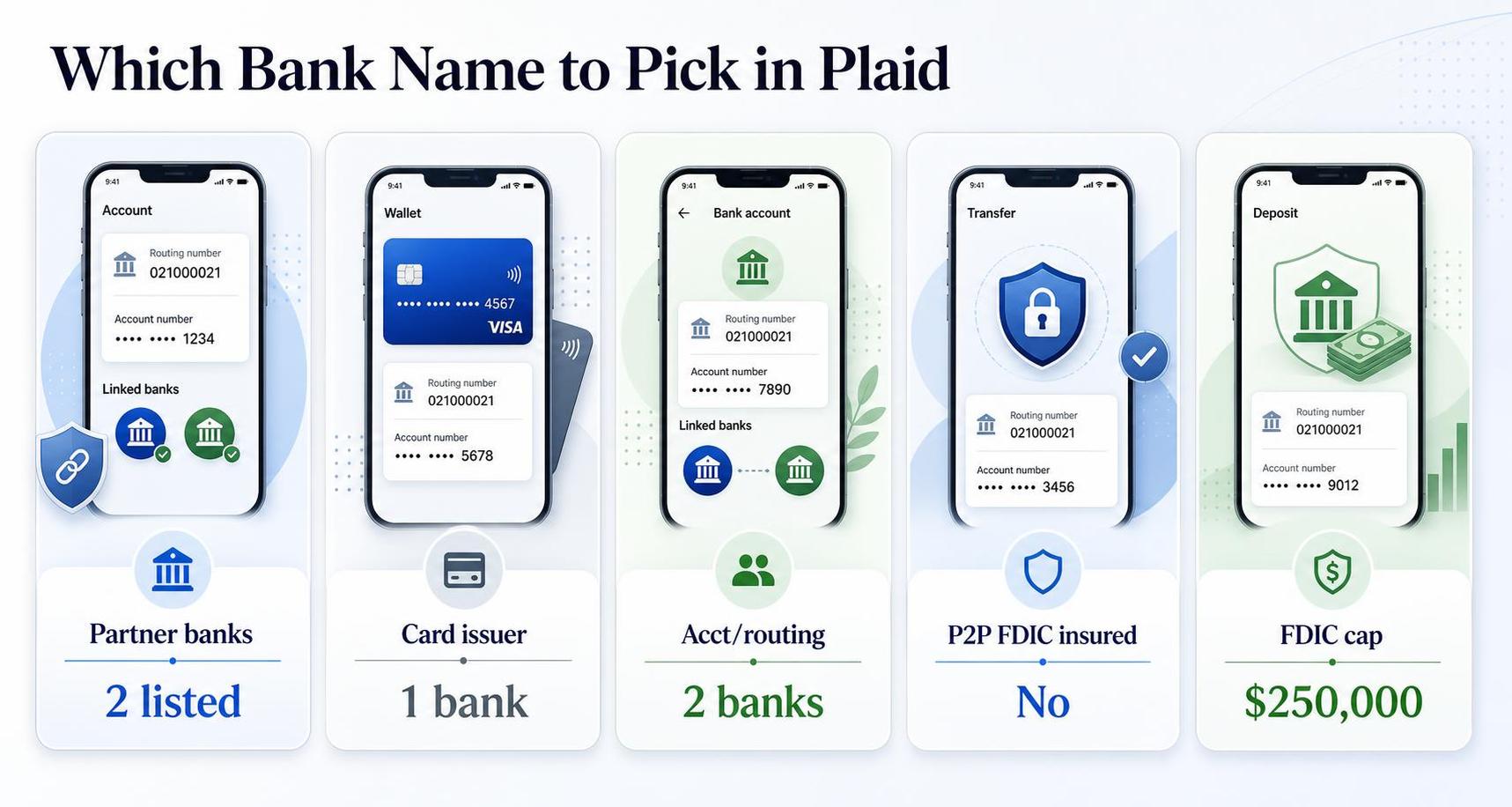
There is no single bank name for Cash App on Plaid. Cash App uses more than one bank partner, and the right Plaid option depends on what a person is trying to link: the app itself, a debit card, or account and routing details.
The safest move is to match the name shown inside Cash App’s banking tab or direct deposit screen.
If the name in Plaid does not match Cash App’s current disclosure, stop and verify inside the app, because choosing the wrong institution can cause failed linking or misdirected transfers.
Two bank names appear most often in Cash App’s own disclosures. Cash App states that the Cash App Visa Debit Card is issued by Sutton Bank, Member FDIC.
Cash App also states that banking services are provided by Cash App’s bank partner(s), and account and routing numbers have commonly been tied to Lincoln Savings Bank or Sutton Bank, depending on the customer setup and product.
| Name | What it is tied to | Source |
| Sutton Bank | Issuer of the Cash App Visa Debit Card | Cash App Card disclosures |
| Lincoln Savings Bank | Commonly associated with some Cash App direct deposit and ACH details | Cash App direct deposit/account disclosures shown to users |
| Cash App | May appear as its own institution in some Plaid-powered flows | Plaid-supported institution experience varies by app and integration |
The trade-off is convenience versus certainty. If Plaid shows “Cash App,” that can be the fastest route because it may connect the wallet directly.
If it does not, users often try Sutton Bank or Lincoln Savings Bank based on the exact routing and account details shown in Cash App.
The downside case matters. Cash App says peer-to-peer payments are not themselves FDIC-insured.
Cash App also says funds are eligible for pass-through FDIC insurance up to $250,000 per depositor through partner banks only if the customer has a Cash App Card or a sponsored account.
The $250,000 figure comes from the FDIC’s standard deposit insurance limit and Cash App’s disclosures.
- Check the routing number inside Cash App first.
- Match that detail to the bank name shown in Cash App’s own disclosure.
- If Plaid only shows one partner bank, confirm with Cash App Support before transferring money.
Do not guess based on old forum posts. Cash App can change partners, and Plaid menus can differ by app, so the current in-app disclosure is the primary source to trust.
Why Plaid may show Lincoln Savings
If Plaid shows Lincoln Savings when a person tries to connect Cash App, that usually reflects Cash App’s underlying bank partner, not a mistake.
Cash App states that it is “not a bank” and that banking services are provided by partner banks.
The key detail is Cash App’s own disclosure: direct deposit account and routing numbers are issued by Lincoln Savings Bank or Sutton Bank, both Members FDIC, according to Cash App Help.
That is why Plaid may label the connection as Lincoln Savings instead of Cash App.
Plaid identifies accounts through the financial institution that actually holds or issues the account details.
If a Cash App balance or direct deposit setup uses an account number issued by Lincoln Savings Bank, Plaid may surface Lincoln Savings because that is the bank tied to the routing information.
Cash App makes this distinction explicit.
In its disclosures, Cash App says prepaid debit cards are issued by Sutton Bank, Member FDIC, while direct deposit account and routing numbers are issued by Lincoln Savings Bank or Sutton Bank, Members FDIC.
Source: Cash App Help, “Cash App and Plaid” and related banking disclosures.
| What a user may see | What it usually means | Source |
| Lincoln Savings in Plaid | Cash App account or routing details may be issued through Lincoln Savings Bank | Cash App Help banking disclosures |
| Sutton Bank in Cash App materials | Cash App Card issuance is handled by Sutton Bank; some account/routing numbers may also be issued by Sutton Bank | Cash App Help banking disclosures |
| Cash App is not listed as a bank | Cash App is a financial platform, while bank functions sit with partner institutions | Cash App Help |
This can create confusion. A person may expect Plaid to show the app brand, but Plaid often shows the chartered bank behind the account. That is common when a fintech relies on sponsor banks for FDIC-insured deposit features.
The downside is practical. If a person selects the wrong institution or assumes every Cash App feature runs through the same bank, transfers can fail or account verification can stall.
Check the routing and account numbers inside Cash App before linking. Do not rely on memory.
For context, Plaid says its network connects with more than 12,000 financial institutions across the United States, Canada, Europe, and the United Kingdom. Source: Plaid company materials. Large networks still depend on correct institution matching.
If the name mismatch affects a payment, verify the bank name directly in Cash App’s official help center or the receiving bank’s instructions before moving money.
That caution matters because a wrong link can delay deposits or withdrawals.
When Sutton Bank appears instead
If Sutton Bank appears in Plaid while linking Cash App, it usually points to the bank partner behind part of the Cash App setup, not a separate checking account opened directly at a Sutton branch.
Cash App states that the Cash App Card is issued by Sutton Bank, Member FDIC, under a license from Visa.
That matters because Plaid connects to financial institutions by the underlying bank relationship.
Plaid says consumers can connect to more than 12,000 financial institutions in the US, Canada, UK, and Europe, so the name shown is often the partner bank, not the app brand.
In practice, Sutton Bank showing up can mean Plaid is recognizing the bank tied to the Cash App Card program. It does not automatically mean every Cash App feature, balance, transfer, or direct deposit function runs only through Sutton Bank.
| Figure | What it shows | Source |
| 12,000+ | Plaid says it supports connections to more than 12,000 financial institutions. | Plaid, company website |
| $250,000 | Standard FDIC insurance limit per depositor, per insured bank, per ownership category. | Federal Deposit Insurance Corporation (FDIC) |
The main upside is simple account discovery. If Plaid recognizes Sutton Bank, a budgeting app or payment app may still be able to verify account ownership or pull transaction data tied to the Cash App relationship.
The downside is confusion. Cash App is a financial app, while Sutton Bank is a chartered bank partner.
A user may expect to find every Cash App balance or feature through Plaid, then see missing data, a failed connection, or only partial account details.
That limitation matters before moving money. Do not assume a Plaid connection confirms that ACH transfers, direct deposit details, or card transactions will all behave the same way.
Check the exact account and routing details shown inside Cash App before sending payroll or bill payments.
- Cash App identifies Sutton Bank as the issuer of the Cash App Card in its card disclosures.
- FDIC insurance applies through the insured bank structure, but coverage depends on how funds are held and titled. Verify current disclosures in Cash App and the FDIC’s own guidance.
- If Plaid shows Sutton Bank and the connection fails, the safest next step is to relink using the details displayed in Cash App or check Plaid’s institution list and Cash App support materials.
The short version: Sutton Bank appearing in Plaid is usually normal for the Cash App Card side of the product.
It is useful for identification, but not a guarantee that every Cash App function will sync or transfer the way a traditional bank account does.
How routing numbers affect linking
Routing numbers matter because Plaid and bank transfer systems use them to identify the financial institution behind an account.
With Cash App, that detail can change the linking result because Cash App has used partner banks including Sutton Bank and Lincoln Savings Bank for different features, according to Cash App’s support materials.
The key point is simple: use the routing and account numbers shown inside the Cash App app, not numbers copied from old screenshots or third-party websites.
A wrong routing number can cause Plaid to reject the link or send a transfer request to the wrong institution.
In the US, a routing number is a nine-digit code used to identify a bank or credit union in payment systems, according to the American Bankers Association.
Plaid relies on that information during account matching, especially when a user links manually instead of signing in through online banking credentials.
Cash App says customers can find their routing and account numbers by opening the app and viewing the Money tab details for direct deposit.
Cash App also states that banking services and debit cards are provided through its bank partners, including Sutton Bank and, for some services, Lincoln Savings Bank. That matters because Plaid may recognize one partner differently from another.
| Fact | Why it affects linking | Source |
| US routing numbers are 9 digits | Plaid and ACH systems expect a valid nine-digit ABA number | American Bankers Association |
| Micro-entry verification amounts must be less than $1 | Manual linking may use small trial deposits to confirm ownership | Nacha Micro-Entry Rule |
| Cash App displays routing and account numbers in-app | The in-app numbers are the current identifiers tied to that account | Cash App Support |
The trade-off is speed versus certainty. If Plaid supports an instant connection for the underlying bank partner, linking can be faster.
If not, manual entry may still work, but verification can take longer and may depend on micro-deposits, which Nacha governs as entries under $1.
The downside case is failed transfers or delayed funding. If a user enters an outdated routing number, the account may not verify, or an ACH transfer can be returned.
Cash App also does not operate like a traditional full-service bank account in every context, so some institutions may limit or decline links even when the numbers are valid.
- Check the routing number inside Cash App immediately before linking.
- Match the account type exactly if the other platform asks.
- If Plaid fails, ask the receiving platform whether it accepts manual ACH verification.
- Do not send money based on this section alone; verify current routing details with Cash App support and the receiving institution.
Trade-offs of connecting through Plaid
Connecting Cash App through Plaid can be faster than entering bank details manually.
Plaid says its network connects with more than 12,000 financial institutions in the United States, Canada, United Kingdom, and Europe, which helps many users link accounts quickly.
The trade-off is data sharing, limited institution support, and the risk of failed connections. Before linking any account, check what data the app requests and confirm the account shown in Plaid matches the one intended.
Speed is the main upside. Plaid describes its product as a way to let users connect financial accounts without waiting for manual micro-deposit verification, which can take one to three business days at many financial firms.
That can make setup easier when an app supports Plaid.
| Factor | Plaid connection | Manual verification |
| Institution reach | 12,000+ institutions, per Plaid | Varies by app and bank |
| Possible setup time | Often immediate if supported, per Plaid product description | Often 1-3 business days for micro-deposits, common industry practice disclosed by many banks and fintechs |
| Data involved | Login and account data may be shared through Plaid, subject to app permissions and Plaid Privacy Policy | Usually routing/account numbers only, depending on the method |
Privacy is the biggest downside for some users. Plaid’s Privacy Policy says it may collect identifiers, account balances, transaction data, and information shared by the app using Plaid.
The exact data depends on the institution, the app, and the permissions requested.
Another trade-off is uneven compatibility. Cash App supports linked banks and debit cards, but some users look for Cash App in Plaid and do not find it as a standard bank option.
Cash App is a financial app, not a traditional chartered bank, so availability inside Plaid can depend on the specific integration.
Security cuts both ways. Plaid says it uses encryption and monitors for fraud, but account-linking still creates another connection point. If credentials are entered into a spoofed screen or the wrong app is authorized, the risk shifts to the user.
- Review the data access screen before approving. Plaid and the receiving app determine what is shared.
- If Plaid fails, ask whether manual account verification is available.
- Check Cash App disclosures directly for limits, fees, and supported account actions, because those can change.
Caution: do not assume every Cash App feature works through every Plaid-powered app. Confirm support in the app itself and in Cash App’s current help materials before moving money.
What Coin Abul independently checked
Cash App is not a bank. For Plaid connections, the brand a user sees is often “Cash App,” while the regulated banking pieces sit behind it with partner institutions and program banks.
That distinction matters because card issuance, direct deposit details, and deposit insurance can come from different entities.
Coin Abul checked Cash App’s own disclosures, Plaid’s institution-level behavior, and FDIC rules. The key finding: there is no single “Cash App bank” that covers every function a user may connect or rely on.
| Item checked | What the source says | Source |
| Cash App Card issuer | The Cash App Card is issued by Sutton Bank, Member FDIC. | Cash App legal/disclosure pages |
| Deposit insurance limit | FDIC insurance is generally up to $250,000 per depositor, per insured bank, per ownership category. | FDIC |
| Cash App stored-balance coverage | Cash App says funds are eligible for up to $250,000 in FDIC insurance through partner banks for eligible customers. | Cash App disclosures |
| Plaid connection naming | Plaid commonly lists fintechs by consumer-facing brand rather than only by the sponsor bank name. | Plaid institution-linking behavior and support materials |
The practical answer for most users is that Plaid may support Cash App under the Cash App brand, not under a single permanent bank name.
That is why searching only “Sutton Bank” or another partner bank can produce inconsistent results across apps.
The downside case is confusion. A user may assume the bank behind a Cash App Card is also the bank behind ACH transfers or balance storage.
That assumption can lead to failed linking, wrong account verification steps, or mistaken expectations about statement availability.
- Cash App’s card relationship and deposit relationship are not always the same product layer.
- Plaid availability can vary by the app using Plaid, because each app decides which connection methods it supports.
- FDIC coverage depends on eligibility and program structure, not on the Cash App brand name alone.
Readers should verify the exact routing and account details inside the Cash App app before linking anything. If an app asks for a bank name, check whether it supports “Cash App” directly through Plaid instead of guessing the partner bank.
Caution: do not move payroll, tax refunds, or bill payments based on a generic bank-name assumption.
Check Cash App’s current disclosures and the receiving app’s Plaid flow first, because partner-bank arrangements and connection options can change.
Frequently Asked Questions
What bank does Cash App use on Plaid?
On Plaid, Cash App may appear as Cash App rather than a traditional bank name.
Cash App says its Cash App Card is issued by Sutton Bank, Member FDIC, and Cash App direct deposit details are provided through banking partners.
So users should verify the exact institution name shown inside Plaid or inside the Cash App app before linking an account.
Why does Cash App not always show Sutton Bank in Plaid?
Plaid connects to the institution name it supports for that product, and Cash App operates as a financial app with partner banks behind the scenes.
Cash App names Sutton Bank for card issuance, but account and routing details can depend on the feature being used, so relying on an old forum post instead of the current app details could cause transfer errors.
Can a Cash App balance be linked to Plaid like a checking account?
Sometimes yes, but it depends on whether Plaid and the receiving service currently support Cash App account connections.
Plaid support explains that available institutions and connection methods can change, so a failed link does not always mean the Cash App account is invalid; it can mean the service only accepts traditional checking accounts.
Is Cash App’s routing and account number the same as Sutton Bank?
Not necessarily in every context.
Cash App provides routing and account numbers for certain features such as direct deposit, but users should copy those numbers directly from the app because sending money based only on the card issuer name, Sutton Bank, may route funds incorrectly.
Related Reading
- How To Price Furniture When Selling A House?
- Where To Buy Appliances Cheap?
- Extreme Frugal Living – What You Need to Know
- When Do Kitchen Appliances Go On Sale?
- How Much Does It Cost To Open A Coffee Shop?
- What Price Apartment Can I Afford?
- When Does Apartment Prices Go Down?
- All Blog Guides
- Cash App Legal Disclosures (2024)
- Sutton Bank: Cash App (2024)
- Consumer Financial Protection Bureau: Should You Worry About Money in Payment Apps? (2022)
- Federal Deposit Insurance Corporation BankFind Suite: Sutton Bank (2025)
- Federal Deposit Insurance Corporation BankFind Suite: Lincoln Savings Bank (2025)
- U.S. Securities and Exchange Commission: Block, Inc. Annual Report on Form 10-K (2024)