
Quick answer: Price Of Apartment In Manhattan: As of 2024, Manhattan apartment prices commonly range from about $750,000 for a studio or one-bedroom to several million dollars for larger condos or luxury units.
Median sale prices often sit around $1 million to $1.2 million, but costs vary sharply by neighborhood, building type, size, and amenities.
Price Of Apartment In Manhattan is about $1.15 million for a median sale, based on Douglas Elliman’s Q3 2024 Manhattan report; the average sale price was $2.04 million.
StreetEasy reported a $1.65 million median asking price in Manhattan in September 2024, showing listing prices can run above closed-sale data.
The trade-off is access to jobs, transit, and scarce housing, but buyers face high monthly payments, co-op rules, maintenance fees, taxes, and resale risk. The downside case is buying before prices or rates soften.
Do not act on averages alone; verify building financials, comps, loan terms, and closing costs with primary documents.
Current Manhattan apartment price benchmarks
Manhattan apartment prices sit far above most U.S. housing markets, but the headline number depends on which metric a buyer uses.
Median price, average price, and price per square foot can point to different realities, especially in a borough where luxury closings can distort the top line.
For a practical benchmark, closed-sale data is more useful than asking prices.
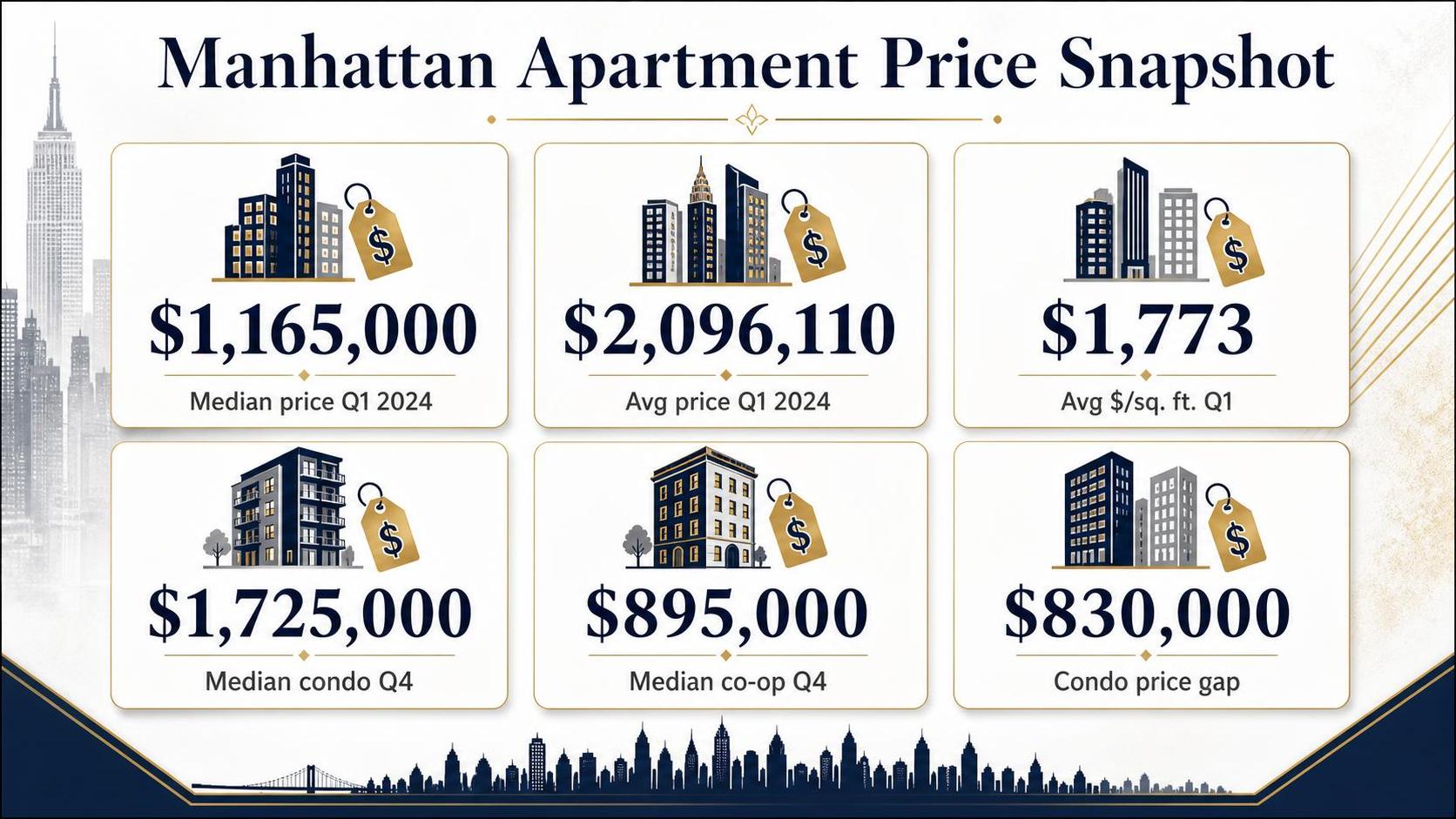
Miller Samuel and Douglas Elliman reported that Manhattan’s median apartment sale price was $1,165,000 in Q1 2024, while the average sale price was $2,096,110 and the average price per square foot was $1,773.
| Benchmark | Figure | Source |
| Median sale price, Manhattan apartments, Q1 2024 | $1,165,000 | Miller Samuel / Douglas Elliman, Manhattan Sales Report Q1 2024 |
| Average sale price, Manhattan apartments, Q1 2024 | $2,096,110 | Miller Samuel / Douglas Elliman, Manhattan Sales Report Q1 2024 |
| Average price per square foot, Q1 2024 | $1,773 | Miller Samuel / Douglas Elliman, Manhattan Sales Report Q1 2024 |
| Closed sales, Q1 2024 | 2,560 | Miller Samuel / Douglas Elliman, Manhattan Sales Report Q1 2024 |
| Listing inventory, Q1 2024 | 7,049 | Miller Samuel / Douglas Elliman, Manhattan Sales Report Q1 2024 |
The median is often the cleaner starting point for personal finance planning. It marks the midpoint of actual closings, while the average can jump when a few very expensive deals close in the same quarter.
That gap is large in Manhattan. In Q1 2024, the average sale price of $2.10 million was about 80% higher than the median of $1.165 million, based on the same Miller Samuel and Douglas Elliman report.
That spread shows how strongly luxury sales can pull averages upward.
Price per square foot also needs caution. A $1,773 average does not mean every apartment trades near that figure.
Smaller units, newer condos, and buildings with doormen or extensive amenities often command higher per-foot prices than older co-ops or apartments needing renovation.
The downside case is straightforward: a buyer who budgets off borough-wide averages can overestimate what is affordable after monthly costs.
Manhattan ownership often includes mortgage payments, property taxes, and building charges such as common charges or co-op maintenance, which can materially change the real cost of ownership.
Use closed-sale benchmarks to set expectations, then verify the building-level costs before acting. A borough average is a starting point, not a safe budget on its own.
How condo and co-op prices differ
In Manhattan, condos usually cost more than co-ops for a similar apartment. The gap reflects ownership rights, financing flexibility, and investor demand, not only square footage or building age.
Douglas Elliman and Miller Samuel reported that, in fourth-quarter 2024 Manhattan sales, the median condo sale price was $1,725,000 and the median co-op sale price was $895,000. That is a price gap of $830,000, or about 93%.
That headline gap does not mean every condo is a better buy. It means buyers are paying extra for a property type with fewer board restrictions and wider resale demand.
| Metric | Manhattan condo | Manhattan co-op | Source |
| Median sale price, Q4 2024 | $1,725,000 | $895,000 | Douglas Elliman / Miller Samuel, Manhattan Sales Q4 2024 |
| Median price per square foot, Q4 2024 | $1,894 | $995 | Douglas Elliman / Miller Samuel, Manhattan Sales Q4 2024 |
| Share of all Manhattan apartment sales, Q4 2024 | 46.3% | 53.7% | Douglas Elliman / Miller Samuel, Manhattan Sales Q4 2024 |
Condos trade at a premium because the buyer owns real property. That structure usually allows easier subletting, easier purchases by LLCs or trusts, and fewer board hurdles.
Those features matter to investors, pied-a-terre buyers, and higher-income households.
Co-ops are usually cheaper because the buyer purchases shares in a corporation and receives a proprietary lease. Boards often screen buyers closely and may limit financing, gifting, sublets, or post-closing liquidity.
Those limits can shrink the buyer pool.
The lower co-op price can improve affordability, but monthly costs need scrutiny. Co-op maintenance often includes building staff, taxes, and underlying mortgage costs. Condo owners usually pay common charges plus a separate property-tax bill.
The cheaper purchase price can be offset by higher ongoing obligations.
The downside case is resale and approval risk. A co-op can take longer to buy or sell if board standards are strict. A condo can be easier to resell, but the buyer may be taking on a much larger mortgage and more interest-rate exposure.
- Choose a condo for flexibility, easier renting, and broader resale demand.
- Choose a co-op for lower entry pricing, if the building rules fit the buyer’s plans.
- Check the building’s financial statements, sublet rules, and flip taxes before acting.
Prices and rules vary by building and neighborhood. A buyer could be harmed by relying on borough-wide averages alone, so the next step is to review the specific building’s offering plan, board package requirements, and latest closed sales.
Monthly costs beyond the purchase price
In Manhattan, the purchase price is only the entry cost. The ongoing bill can be large, variable, and harder to predict than the down payment.
The U.S. Census Bureau’s 2023 American Community Survey reported median selected monthly owner costs in New York County of $4,303 for owners with a mortgage and $1,957 for owners without a mortgage.
That measure includes more than the loan payment alone.
| Cost | Real figure | Source | Why it matters |
| Property tax | New York City FY 2025 tax rate for Class 2 property: 12.500% | NYC Department of Finance, FY 2025 Tax Rates | Most Manhattan condos and co-ops fall into Class 2, but the bill is based on assessed value, not the purchase price. Two apartments sold for the same amount can have very different tax bills. |
| Electricity | New York residential average retail electricity price: 24.37 cents per kWh in 2023 | U.S. Energy Information Administration | A 500 kWh month would equal about $121.85 before building-specific fees or taxes. Older buildings and electric heating can push usage much higher. |
| Condo/co-op unit insurance | Average U.S. HO-6 premium: $531 per year in 2021 | National Association of Insurance Commissioners | That is about $44.25 per month as a national benchmark, but Manhattan premiums depend on deductible choice, coverage limits, and whether the building requires extra loss-assessment coverage. |
| Owner costs, all-in median | $4,303 with a mortgage; $1,957 without a mortgage | U.S. Census Bureau, 2023 ACS, New York County | This is the clearest reality check. Even after the mortgage is gone, taxes, fees, insurance, and utilities can remain substantial. |
One major trade-off is condo versus co-op.
Fannie Mae says co-op maintenance commonly includes the building’s real estate taxes and underlying mortgage interest, while condo common charges generally do not include the unit owner’s property tax.
That means a condo owner may face a lower monthly common charge but still pay a separate tax bill. A co-op can look expensive each month even when part of that bill covers costs a condo owner pays elsewhere.
- Check the offering plan and latest budget. Building fees can rise if insurance, labor, fuel, or reserve needs increase.
- Ask whether there is a tax abatement. Some condo tax benefits expire, and the monthly payment can jump when they do.
- Review assessment history. A temporary special assessment can add hundreds or thousands per month.
- Do not rely on a listing estimate alone. Confirm taxes, maintenance, common charges, and insurance with the building, lender, and official city records before committing.

Neighborhood price gaps across Manhattan
Manhattan apartment prices vary sharply by neighborhood. A buyer comparing Tribeca with Washington Heights is not looking at a small spread but a different budget category, tax bill, and monthly carrying-cost profile.
The cleanest way to see the gap is by median sale price. PropertyShark’s 2024 NYC residential sales data shows the top Manhattan neighborhoods selling for several times the median in northern Manhattan neighborhoods.
| Neighborhood | Median sale price | Source |
| Tribeca | $4.2 million | PropertyShark, 2024 NYC sales rankings |
| SoHo | $3.2 million | PropertyShark, 2024 NYC sales rankings |
| Upper West Side | $1.45 million | PropertyShark, 2024 NYC neighborhood sales data |
| Upper East Side | $1.3 million | PropertyShark, 2024 NYC neighborhood sales data |
| Harlem | $835,000 | PropertyShark, 2024 NYC neighborhood sales data |
| Washington Heights | $650,000 | PropertyShark, 2024 NYC neighborhood sales data |
| Inwood | $515,000 | PropertyShark, 2024 NYC neighborhood sales data |
That means Tribeca’s median was about 8.2 times Inwood’s median, based on those PropertyShark figures. For a personal-finance decision, that difference changes far more than the down payment.
Monthly ownership costs also diverge. A higher purchase price usually means a larger mortgage, higher closing costs, and often higher common charges or maintenance, especially in full-service downtown condo buildings.
The cheaper neighborhood is not automatically the better deal. Lower-priced areas can offer more space per dollar, but buyers may accept longer commutes, fewer luxury amenities, older building systems, or a co-op structure with stricter board rules.
The expensive neighborhood is not automatically safer financially either. A buyer stretching to enter Tribeca or SoHo may face concentration risk if bonuses fall, rates stay high, or resale demand cools at the top end of the market.
Inventory type matters too. Manhattan neighborhoods with many co-ops can show lower median prices than condo-heavy areas, but co-ops may add financing limits, renovation restrictions, and higher post-closing liquidity requirements.
- Check whether the neighborhood median reflects mostly co-ops, condos, or townhouses.
- Review maintenance or common charges before comparing monthly costs.
- Verify building-level taxes and financing rules in the offering plan or co-op package.
Caution: neighborhood medians are a starting point, not a quote.
Before acting, check current building-level listings, recent closed sales, and board or condo documents because one block, one building, or one property type can change the math materially.

Renting versus buying in Manhattan
Renting usually costs less up front in Manhattan, while buying can build equity over time. The trade-off is that Manhattan ownership costs are high, and the monthly payment can exceed rent by a wide margin at current prices and mortgage rates.
Douglas Elliman and Miller Samuel reported Manhattan’s median sale price at $1,100,000 in the fourth quarter of 2024.
In the same quarter, the median condo sale price was $1,725,000 and the median co-op sale price was $850,000, showing how much the property type changes the math.
| Metric | Figure | Source |
| Manhattan median sale price, Q4 2024 | $1,100,000 | Douglas Elliman / Miller Samuel Manhattan Sales Report, Q4 2024 |
| Manhattan median co-op sale price, Q4 2024 | $850,000 | Douglas Elliman / Miller Samuel Manhattan Sales Report, Q4 2024 |
| Manhattan median condo sale price, Q4 2024 | $1,725,000 | Douglas Elliman / Miller Samuel Manhattan Sales Report, Q4 2024 |
| Manhattan median apartment rent, Feb. 2025 | $4,500 per month | Douglas Elliman / Miller Samuel Manhattan Rentals Report, February 2025 |
| 30-year fixed mortgage average, week ending Mar. 6, 2025 | 6.63% | Freddie Mac Primary Mortgage Market Survey |
Renting is simpler when flexibility matters. A renter can usually move after a lease term, avoid repair risk, and keep cash liquid instead of tying it up in a down payment, closing costs, and reserves required by many Manhattan co-op boards.
Buying can make sense for a long stay, but the downside case is real.
At Freddie Mac’s 6.63% average 30-year rate, principal and interest on a $880,000 mortgage after a 20% down payment on a $1.1 million purchase is roughly $5,600 a month before property taxes, insurance, and building charges.
That means the ownership payment can run well above the $4,500 median rent once common charges or co-op maintenance are added.
The New York City Department of Finance also levies annual property tax, and condos generally add monthly common charges, while co-ops charge maintenance fees.
- Renting reduces market risk if prices stall or fall.
- Buying adds transaction costs. Sellers in New York often face broker commissions, transfer taxes, and legal fees.
- Co-ops can be cheaper to buy than condos, but board approval and sublet limits reduce flexibility.
Caution: Manhattan costs vary sharply by building, neighborhood, and financing terms. Before acting, check the building’s financial statements, monthly charges, tax history, and current mortgage offers from primary sources.

Downside risks of buying in Manhattan
Buying in Manhattan can build long-term equity, but the downside case is expensive and hard to reverse.
The main risks are high closing costs, high borrowing costs, ongoing building charges, and resale limits that do not exist in many lower-cost markets.
The first problem is entry cost. In New York City, several taxes and recording charges apply at closing, and some start at relatively low price points.
A buyer should review the building type, financing plan, and current tax rules before relying on any estimate.
| Cost item | Rule or rate | Example on a $1.5 million Manhattan condo | Source |
| New York State transfer tax | 0.4% of consideration | $6,000 | New York State Department of Taxation and Finance |
| New York City Real Property Transfer Tax | 1.425% above $500,000 | $21,375 | NYC Department of Finance |
| New York State mansion tax | 1% at $1 million to under $2 million | $15,000 | New York State Department of Taxation and Finance |
| Mortgage recording tax for NYC residential mortgages of $500,000 or more | 1.925% of mortgage amount | $19,250 on a $1 million mortgage | NYC Department of Finance |
Using those published rates, that example buyer could face $61,625 in transfer and recording taxes alone.
That total excludes title insurance, lender fees, attorney fees, appraisal costs, move-in charges, and prepaid items, so real cash needed at closing can be much higher.
Financing risk is the second problem. Freddie Mac reported the average 30-year fixed mortgage rate was 6.78% for the week ending May 9, 2024.
At 6.78%, principal and interest on a $1 million 30-year loan is about $6,490 a month before property taxes, insurance, and building charges.
Monthly carrying costs can also rise after closing. Condos usually have common charges, and co-ops usually have maintenance; both can increase if labor, insurance, utilities, or capital repairs get more expensive.
In a co-op, the board can also reject a buyer, which can narrow the future resale pool.
- Liquidity risk: Homes are costly to sell, so a short holding period can turn even a small price drop into a real loss.
- Building risk: Special assessments can hit owners when façades, elevators, roofs, or local-law work need funding.
- Market risk: Luxury and high-cost urban markets can swing more sharply when rates stay high or finance and tech hiring slows.
Caution: Manhattan purchases are highly fact-specific. Before acting, check the current tax schedules with NYC and New York State, and ask a qualified attorney, tax adviser, and lender to model the full downside case for the exact unit.
What Coin Abul independently reviewed
Coin Abul reviewed recent Manhattan apartment pricing against the costs that can turn a “buyable” listing into a strained budget.
The review focused on sale prices, transfer taxes, financing limits, and the co-op versus condo split because those factors directly affect cash needed at closing.
For market pricing, Coin Abul reviewed the Douglas Elliman and Miller Samuel Manhattan Sales report for fourth quarter 2024.
That report put the Manhattan median sale price at $1,175,000, with the median condo sale price at $1,822,500 and the median co-op sale price at $895,000.
Those figures matter because Manhattan buyers do not pay the contract price alone.
New York State charges a 0.4% transfer tax, and New York City charges 1.425% on residential sales above $500,000 up to $3 million, then 2.625% above $3 million, according to the New York City Department of Finance.
New York’s mansion tax starts at 1% for purchases of $1 million or more and rises to 3.9% at $25 million or more, under the New York State Department of Taxation and Finance schedule.
That means crossing $1 million changes the cash math immediately.
| Example purchase price | NY State transfer tax | NYC transfer tax | Mansion tax | Total listed taxes |
| $895,000 co-op median | $3,580 | $12,754 | $0 | $16,334 |
| $1,175,000 Manhattan median | $4,700 | $16,744 | $11,750 | $33,194 |
| $1,822,500 condo median | $7,290 | $25,971 | $18,225 | $51,486 |
Financing is another pressure point. The Federal Housing Finance Agency set the 2025 high-balance conforming loan limit for one-unit properties in high-cost areas at $1,209,750.
A buyer above that level may need a jumbo loan, which can mean stricter reserve, income, and underwriting standards.
The downside case is not limited to rates. Many Manhattan apartments are co-ops, and co-op boards can impose liquidity, debt-to-income, and post-closing reserve requirements that go beyond lender rules.
Buyers should verify the building’s financial requirements in the board package before relying on any online affordability estimate.
Another trade-off is tax treatment at closing.
Co-op purchases generally avoid the mortgage recording tax because buyers purchase shares rather than real property, while financed condo purchases in New York City can trigger mortgage recording tax, according to the New York City Department of Finance.
That can make a lower-priced co-op materially cheaper to close than a condo.
Frequently Asked Questions
What is the average apartment price in Manhattan right now?
There is no single official “average” because Manhattan sales mix co-ops, condos, studios, and luxury units.
For a grounded benchmark, Douglas Elliman and Miller Samuel reported a Manhattan median sale price of $1,175,000 in their Q1 2024 market report, while the average sale price was $2,157,103.
Readers should treat the median as the more stable snapshot because a small number of luxury deals can skew the average.
How much do condos cost compared with co-ops in Manhattan?
Condos usually cost more than co-ops because they tend to allow more flexible ownership and financing.
In the Douglas Elliman and Miller Samuel Q1 2024 Manhattan report, the median condo sale price was $1,725,000 and the median co-op sale price was $850,000, but building rules, location, and renovation condition can change the gap sharply.
Which Manhattan neighborhoods have the highest apartment prices?
Luxury-heavy neighborhoods such as Tribeca, SoHo, and parts of the West Village and Upper East Side regularly rank among the most expensive, but rankings vary by quarter and by whether the data tracks listing prices or closed sales.
For example, Realtor.com’s market data has often shown Tribeca among Manhattan’s highest-priced areas by median listing price, but buyers should verify current neighborhood-level figures directly on Realtor.com, StreetEasy.
Or a brokerage market report before making decisions.
Are Manhattan apartment prices going up or down?
Prices can rise in one segment and soften in another, so the trend depends on whether the market is measured by median price, average price, signed contracts, or inventory.
According to the Douglas Elliman and Miller Samuel Q1 2024 report, Manhattan’s median sale price rose 5.7% year over year to $1,175,000, but acting on one quarterly figure alone can be risky because interest rates, inventory.
And luxury closings can quickly change the picture.
What other costs should buyers add to the purchase price of a Manhattan apartment?
The purchase price is only part of the budget because buyers may also face monthly maintenance for co-ops, common charges for condos, property taxes, closing costs, mortgage costs, and renovation expenses.
The New York State Department of Taxation and Finance confirms that New York State imposes a Real Estate Transfer Tax, and New York City imposes a Real Property Transfer Tax.
So buyers should check the current city and state schedules and building financials before relying on any estimate.
Related Reading
- Why Personal Finance Is Important?
- How Much Is The Apartment? What You Need to Know
- How To Open A Restaurant With No Money?
- Which Furniture Stores Offer Financing?
- Top 10 Brilliant Money Saving Tips – What You Need to Know
- How Much Does It Cost To Open A Coffee Shop?
- Why Are New Car Prices So High?
- All Blog Guides
- NYC Department of Finance — Annualized Sales Update (2024)
- NYC Open Data — Rolling Sales Data (2025)
- U.S. Census Bureau — QuickFacts: New York County, New York (2024)
- NYU Furman Center — State of New York City’s Housing and Neighborhoods (2023)
- StreetEasy — Manhattan Market Reports (2025)
- Douglas Elliman / Miller Samuel — Manhattan Sales Reports (2025)