

The short answer: Creative Ways To Save Money include automating transfers on payday, using a no-spend weekend, meal-prepping around pantry items, borrowing tools instead of buying, rotating streaming subscriptions, buying secondhand,.
Joining a Buy Nothing group, using cash-back apps carefully, and setting a 24-hour rule before nonessential purchases.
Creative Ways To Save Money are practical spending swaps that target the biggest household costs: housing, transportation, and food, which averaged $25,436, $13,174, and $9,985 in 2023, according to the U.S. Bureau of Labor Statistics.
The upside is flexibility: meal planning, bill audits, no-spend weeks, and shared subscriptions can free cash without a raise. The trade-off is time, limits, and possible fees.
Use caution: cutting insurance, medical care, or debt payments can create larger losses than the savings.
Automate savings before spending decisions
Automating savings moves money out of checking before daily choices can absorb it.
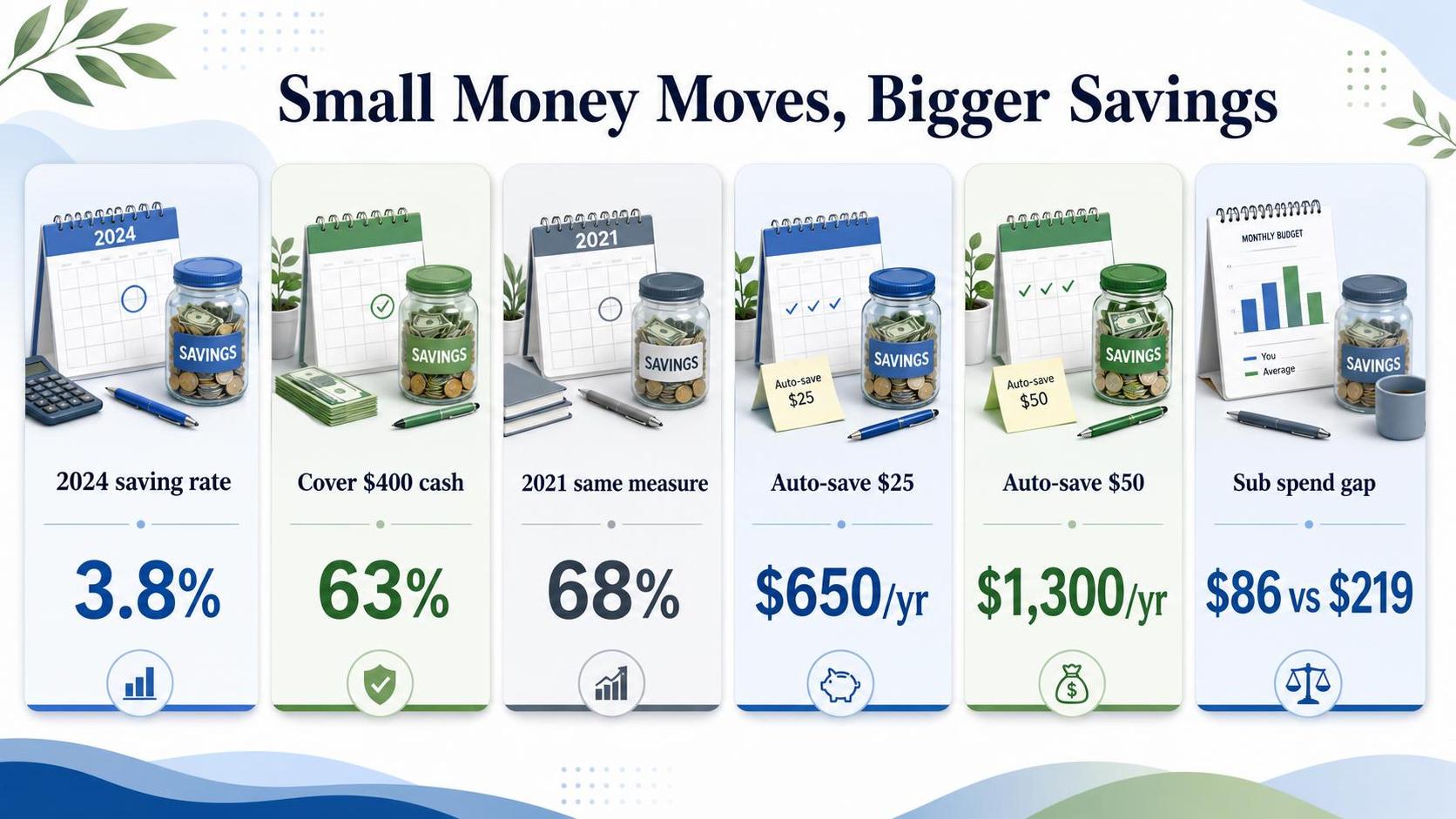
That matters because households spent an average 3.8% of disposable personal income in 2024, according to the U.S. Bureau of Economic Analysis, so many budgets leave little room for error once spending starts.
A practical setup is to send part of each paycheck directly to savings, then automate a second transfer the day after pay hits checking.
The Consumer Financial Protection Bureau says automatic transfers can help people build emergency savings by reducing the need to make repeated manual decisions.
Start with a fixed dollar amount, not an ambitious percentage. The Federal Reserve reported in its 2024 Economic Well-Being of U.S.
Households that 63% of adults said they would cover a $400 emergency expense using cash or its equivalent, down from 68% in 2021. Automation helps close that gap gradually.
| Automatic transfer per paycheck | Pay frequency | Annual savings | Source/method |
| $25 | Biweekly, 26 checks | $650 | Arithmetic based on 26 biweekly pay periods in a year |
| $50 | Biweekly, 26 checks | $1,300 | Arithmetic based on 26 biweekly pay periods in a year |
| $100 | Biweekly, 26 checks | $2,600 | Arithmetic based on 26 biweekly pay periods in a year |
Interest can add a modest boost if the money lands in a high-yield account. The FDIC reported the national average savings deposit rate was 0.41% APY as of July 21, 2025, but many online banks advertise higher rates.
Check the bank’s current disclosures because yields change often.
The trade-off is liquidity and overdraft risk. If automation is too aggressive, a rent payment or utility draft can bounce.
The CFPB has warned that overdraft and non-sufficient-funds fees can quickly compound cash-flow problems, so leave a checking buffer before increasing transfers.
- Automate right after payday, when account balances are highest.
- Use a separate savings account to reduce the temptation to reverse the transfer.
- Increase the transfer after raises, tax refunds, or paid-off debts.
One caution: do not automate so much that essential bills become unaffordable. Review the account at least monthly, and verify current rates, fees, and payroll options with the bank, employer, or plan administrator before relying on this strategy.

Cut subscription creep with quarterly audits
Subscription spending often grows in small, easy-to-miss charges. A quarterly audit helps catch services that no longer deliver enough value before another three months of billing pass.
The budget risk is real. In a 2022 survey by C+R Research, U.S. consumers estimated they spent $86 a month on subscriptions, but linked-account data showed actual spending averaged $219 a month.
That gap shows why a calendar-based review can work better than memory alone.
Start with bank and card statements from the last 90 days. Check app stores too. Apple and Google can bill subscriptions separately from direct merchant charges, which makes duplicates easier to miss.
Then sort each charge into three groups: used weekly, used sometimes, and not used in the last month. Cancel or pause the last group first. The goal is not perfection. The goal is to stop paying for inertia.
| Service | Monthly price | Cost of one unused quarter | Source |
| Amazon Prime | $14.99 | $44.97 | Amazon Prime membership pricing |
| YouTube Premium Individual | $13.99 | $41.97 | YouTube Premium pricing |
| Spotify Premium Individual | $11.99 | $35.97 | Spotify Premium pricing |
| Netflix Standard with ads | $6.99 | $20.97 | Netflix plan pricing |
Even a short list adds up. If four unused subscriptions match the prices above, one wasted quarter costs $143.88. Over a year, that becomes $575.52, based on the companies’ posted monthly prices.
Quarterly audits also help with price increases. Many services notify customers by email, but those notices are easy to ignore.
A scheduled review forces a fresh decision: keep it, downgrade it, or replace it with a free option from a library, employer, or bundled wireless plan.
The downside is convenience loss. Canceling can remove cloud storage, saved playlists, shipping benefits, or family access. Some annual plans lower the monthly cost, but they raise the risk of paying for months you will not use.
Compare the annual discount against the cost of lost flexibility before switching.
- Set four calendar reminders a year.
- Review the last 90 days of statements.
- Search email for “receipt,” “membership,” and “renewal.”
- Cancel first, then resubscribe only if the service is missed.
Use the provider’s billing page to confirm cancellation terms and renewal dates before acting. Prices and policies change, and missing a storage or insurance-related feature could cause harm if it is canceled without a backup plan.

Use cash-back portals without overspending
Cash-back portals can lower the cost of planned purchases, but only if they change where a person buys, not whether they buy. The core risk is simple: a 5% rebate does not help if it triggers 100% of an unnecessary purchase.
That risk matters because online shopping is common. U.S. retail e-commerce sales were $1.192 trillion in 2024, up 8.1% from 2023, according to the U.S. Census Bureau. More online spending creates more chances to save, and more chances to overspend.
A portal works by collecting an affiliate commission from a retailer and sharing part of it with the shopper. The savings can be real, but payout rules differ. Checking those rules first helps prevent small balances from getting stranded.
| Portal | Payout minimum | Payment timing or method | Source |
| Rakuten | No minimum for PayPal; check requires at least $5.01 | Payments are sent quarterly | Rakuten Help Center |
| TopCashback | No minimum payout | Payment methods vary by country and method selected | TopCashback Help Center |
| BeFrugal | $10 minimum | Payment available after account qualifies for cash-out | BeFrugal Help Center |
The practical rule is to compare the portal rebate against the total cost, including shipping, taxes, and return friction. A store with a higher rebate can still be more expensive if its base price is higher.
Portal percentages should be the last comparison, not the first.
Returns are another trade-off. Many portals state that returned, canceled, or exchanged orders may reduce or void cash back. That means shoppers should not treat pending rewards as guaranteed savings until the portal marks them payable.
A simple control system works better than chasing rates:
- Search the item only after making a written shopping list.
- Compare final checkout totals at two or three stores.
- Use a portal only for a purchase already planned.
- Wait before buying if the rebate is creating urgency.
There is also a tax and tracking caution. Cash-back rewards on purchases are often treated as purchase-price adjustments, but tax treatment can vary by situation.
Readers should check IRS guidance or a tax professional before relying on a specific tax result.
The downside case is missing a better deal while focusing on the rebate. A 2% to 10% portal rate can be useful, but a cheaper retailer, a coupon, or buying nothing at all can save more. Check the merchant’s final terms before purchase.

Meal plan around grocery price trends
Meal planning works better when it follows category prices, not cravings. U.S. Bureau of Labor Statistics data show grocery inflation does not move evenly, so swapping proteins, produce, and grains by price trend can cut costs without cutting meals.
Start with categories that rose less, or fell, and build meals around them for a few weeks. Then use higher-inflation items in smaller portions, because one expensive ingredient can raise the cost of the whole plan.
| Grocery category | 2023 average price change | Source |
| Food at home | 5.0% | U.S. Bureau of Labor Statistics, Consumer Price Index annual average, 2023 vs. 2022 |
| Cereals and bakery products | 8.4% | U.S. Bureau of Labor Statistics, CPI annual average, 2023 vs. 2022 |
| Meats, poultry, fish, and eggs | 3.1% | U.S. Bureau of Labor Statistics, CPI annual average, 2023 vs. 2022 |
| Dairy and related products | 1.3% | U.S. Bureau of Labor Statistics, CPI annual average, 2023 vs. 2022 |
| Fruits and vegetables | 1.5% | U.S. Bureau of Labor Statistics, CPI annual average, 2023 vs. 2022 |
A practical move is to shift more meals toward lower-growth categories. If cereals and bakery rose 8.4% while dairy rose 1.3%, a yogurt-and-fruit breakfast or a vegetable frittata may be a better value than branded cereal and toast.
The same rule helps at dinner. When meat prices are running hotter than beans, pasta, potatoes, or seasonal vegetables, use meat as a side ingredient instead of the center of the plate.
USDA’s Economic Research Service said food-at-home prices increased 5.0% in 2023 and forecast a much smaller 1.2% increase for 2024 in its Food Price Outlook. That slower headline number does not mean every aisle is cheap.
Category swings still matter.
- Check the store circular first. Plan meals around sale proteins and produce.
- Use one flexible base, such as rice, oats, potatoes, or pasta, across several meals.
- Substitute store brands when branded items are in faster-rising categories.
- Freeze extra portions when a low-price item is on sale, because buying ahead only helps if food is not wasted.
The downside is that trend-based planning can become false savings. A bulk purchase costs more upfront, and the U.S. Department of Agriculture estimates 30% to 40% of the food supply is wasted, so overshopping can erase any discount.
Another trade-off is nutrition and household fit. A cheaper week is not a good deal if it leads to takeout, uneaten groceries, or meals people will not eat. Check current prices at the store, because local costs can differ sharply from national data.

Lower utility bills with home efficiency moves
Home efficiency upgrades can cut recurring bills, but the savings vary by climate, fuel, home condition, and how consistently the change is used.
The safest approach is to start with low-cost steps that have federal backing, then compare the upfront cost against realistic payback.
Air sealing and insulation are often the biggest opportunities because heating and cooling are large energy loads.
ENERGY STAR says homeowners can save an average of 15% on heating and cooling costs, or 11% on total energy costs, by air sealing and adding insulation in key areas.
| Move | Real figure | Source | Main trade-off |
| Air sealing and adding insulation | 15% average savings on heating and cooling; 11% on total energy costs | ENERGY STAR, “Air Sealing and Insulating” | Upfront cost can be high; savings depend on existing leaks and insulation levels |
| Properly using a programmable thermostat | About 10% a year on heating and cooling | U.S. Department of Energy | Savings can disappear if schedules are poorly set or someone is home all day |
| Switching to LED lighting | At least 75% less energy use and up to 25 times longer life than incandescent lighting | U.S. Department of Energy | Bill impact is limited if lighting is a small share of household usage |
| Lowering water-heater demand | Water heating is about 18% of home energy use | U.S. Department of Energy, Energy Saver | Behavior changes help, but savings may be modest without equipment upgrades |
A programmable thermostat works best in homes with predictable schedules.
The U.S. Department of Energy says a setback of about 7 to 10 degrees Fahrenheit for eight hours a day can save as much as 10% a year on heating and cooling, but only when used correctly.
LEDs are simpler. The Department of Energy says they use at least 75% less energy than incandescent bulbs and can last up to 25 times longer.
The downside is that replacing every bulb at once costs more upfront, so many households switch the most-used bulbs first.
Water heating deserves attention because the Department of Energy says it accounts for about 18% of home energy use.
Lower-flow fixtures, shorter showers, and insulating hot-water pipes may help, but the result depends on household habits and local utility rates.
- Check utility rebates and tax-credit rules before buying equipment. Incentives change, and not every product qualifies.
- Do not assume a contractor estimate equals guaranteed savings. Ask for model numbers, efficiency ratings, and a written scope.
- If a change affects wiring, gas lines, or ventilation, verify local code requirements and use a qualified professional. Acting on general advice alone can create safety risks.

Buy used for high-depreciation purchases
Buying used can cut costs most where value drops fast after purchase. The strongest examples are cars, smartphones, and furniture, because early depreciation is steep while basic usefulness often remains.
The trade-off is condition risk. A lower sticker price can be offset by repairs, missing warranties, shorter lifespan, or fraud, so buyers should verify condition and total cost before paying.
Cars are the clearest case. According to Edmunds, a new vehicle lost 23.5% of its value in the first year and 45.6% after five years on average in 2024. That means a buyer who avoids “new” can often avoid the sharpest value drop.
| Item | Figure | Source |
| New car depreciation after 1 year | 23.5% | Edmunds, 2024 average depreciation analysis |
| New car depreciation after 5 years | 45.6% | Edmunds, 2024 average depreciation analysis |
| Typical smartphone trade-in value after 2 years | About 40% of original retail for iPhone 14 Pro; about 26% for Galaxy S23 Ultra | SellCell, 2024 depreciation study |
Phones also lose value quickly. SellCell reported in 2024 that Apple’s iPhone 14 Pro retained about 40% of its original retail value after two years, while Samsung’s Galaxy S23 Ultra retained about 26%.
A used prior-generation phone may deliver similar performance for much less.
Furniture is less standardized, but resale discounts are often large. The Federal Trade Commission advises checking used products for recalls and safety defects, especially for children’s items.
That warning matters because a cheap secondhand crib or car seat can create a serious safety risk.
- Target durable categories: solid-wood furniture, unlocked phones, and 2- to 4-year-old cars with maintenance records.
- Compare total cost, not price alone: taxes, repairs, batteries, tires, and insurance can erase savings.
- Use independent checks: vehicle history reports, mechanic inspections, battery health screens, and model-specific recall searches.
- Avoid used where failure is dangerous or hidden wear is hard to judge, such as car seats, helmets, and some mattresses.
The downside case is simple. If a used car needs a transmission, a used phone needs a battery, or used furniture carries pests or damage, the “deal” can become more expensive than buying new on sale.
Caution: do not rely on price alone for safety-sensitive purchases.
Check the manufacturer, the National Highway Traffic Safety Administration, the Consumer Product Safety Commission, or the FTC guidance before buying used in categories tied to child or vehicle safety.
Negotiate bills without risking coverage
Negotiating bills can cut costs without canceling insurance, internet, or utilities.
The safest approach is to ask for discounts, hardship terms, fee waivers, or plan changes first, because missed payments or the wrong downgrade can trigger fees, service loss, or coverage gaps.
Focus on recurring bills with flexible pricing. J.D. Power’s 2024 U.S. Residential Internet Service Provider Satisfaction Study found 56% of customers said their bill had increased in the prior year, creating room to ask about retention discounts, promotional extensions.
Or switching to a lower-speed plan that still fits actual use.
| Bill type | Negotiation point | Source-backed fact |
| Health insurance premium | Ask about autopay, annual-pay, wellness, or employer-plan options before reducing coverage | KFF reported average 2024 annual premiums of $8,951 for single coverage and $25,572 for family coverage in employer-sponsored plans |
| Auto insurance | Request a re-shop of discounts, mileage review, or deductible quote before dropping comprehensive or collision | The NAIC says higher deductibles can lower premium costs, but consumers must be able to pay more out of pocket after a loss |
| Medical bill | Ask for an itemized bill, prompt-pay discount, or interest-free payment plan | CFPB reported in 2022 that medical bills contribute to many collections tradelines, though major credit reports no longer include certain paid medical collections |
| Internet or cable | Ask for retention pricing, unbundling, or equipment-fee credits | J.D. Power found 56% of internet customers reported a price increase in the prior year in its 2024 study |
Insurance deserves the most caution. KFF’s 2024 Employer Health Benefits Survey said workers paid an average of $1,368 toward single coverage and $6,296 toward family coverage annually.
Those costs can tempt households to cut benefits, but a cheaper plan may carry a higher deductible or narrower network.
For auto coverage, the National Association of Insurance Commissioners warns that raising a deductible shifts more risk to the policyholder.
That can save premium dollars, but the downside is clear: if a claim happens, the household must cover the larger deductible before insurance pays.
Medical bills are often negotiable after care, but do not ignore due dates.
The Consumer Financial Protection Bureau advises consumers to request an itemized bill, check for errors, and ask about financial assistance or no-interest payment plans. That can reduce costs without losing future access to care.
- Call before the due date and ask for “retention,” “hardship,” or “payment assistance” options.
- Ask what changes affect coverage, deductibles, data caps, late fees, or reconnection fees.
- Get every new price, term length, and cancellation rule in writing.
- Check the insurer, hospital, or provider summary before agreeing.
Plain caution: do not cancel health, auto, renters, or homeowners coverage to save money unless a licensed professional or the insurer confirms the replacement policy is active. Even a short lapse can create legal, financial, or medical risk.

What Coin Abul independently reviewed
Coin Abul independently reviewed federal survey data, Bureau of Labor Statistics spending data, and current government-backed savings rates to identify money-saving ideas that are measurable, not gimmicky.
The review focused on tactics a typical U.S. household could test without taking on investment risk or long contracts.
The data shows the biggest savings often come from recurring bills, food waste, and automated cash management.
The downside is that the largest “wins” can require time, eligibility, or temporary lifestyle cuts, so no single tactic fits every household.
| Area reviewed | Figure | Why it matters | Source |
| Average annual household spending | $77,280 in 2023 | Large budget categories create the biggest room to save | U.S. Bureau of Labor Statistics, Consumer Expenditures 2023 |
| Food spending at home | $6,053 per consumer unit in 2023 | Meal planning and reducing waste can matter because groceries are a major recurring cost | U.S. Bureau of Labor Statistics, Consumer Expenditures 2023 |
| Food away from home | $4,922 per consumer unit in 2023 | Cutting restaurant and takeout frequency can produce visible savings | U.S. Bureau of Labor Statistics, Consumer Expenditures 2023 |
| Share of food supply unsold or uneaten | 30% to 40% | Reducing waste is a practical savings lever for many households | USDA |
| Series I Savings Bond composite rate | 3.98% annualized for bonds issued May 2025 through October 2025 | Useful for short-term savers seeking Treasury backing, with withdrawal limits and timing rules | U.S. Department of the Treasury, TreasuryDirect |
| National average savings account yield | 0.38% APY as of July 21, 2025 | Shows the cost of leaving cash in a low-yield account | FDIC National Rates and Rate Caps |
A creative but evidence-based move is “rate migration”: shifting emergency cash from a near-zero bank account to a higher-yield insured account or Treasury-backed product. The trade-off is access and rules.
I Bonds cannot be redeemed in the first 12 months, and redemptions within five years lose the last three months of interest, according to TreasuryDirect.
Another reviewed tactic is “waste capture.” USDA’s 30% to 40% food waste estimate suggests that smarter shopping, freezing leftovers, and using a pantry list can save money without reducing nutrition.
The downside is that bulk buying can backfire if food expires before it is used.
The review also considered “friction budgeting,” such as deleting stored card numbers or requiring a 24-hour pause before nonessential purchases.
The reason is simple: BLS data shows households spent $77,280 on average in 2023, so small leaks repeated across a year matter.
- Check account insurance and withdrawal rules before moving emergency savings. Use primary sources such as FDIC, NCUA, or TreasuryDirect.
- Do not chase savings by skipping insurance, minimum debt payments, or essential medical care. Short-term cuts can create larger long-term costs.
- If a tactic depends on teaser rates, app rewards, or state-specific utility programs, confirm the current terms directly with the provider.
Frequently Asked Questions
What is a simple way to save money without tracking every purchase?
Automating a transfer on payday can reduce the chance of spending first and saving later.
The U.S. Federal Reserve reported that 63% of adults said they could cover a $400 emergency expense with cash or its equivalent in 2023, which shows why even small automatic deposits toward an emergency fund matter.
Readers should check their bank’s transfer rules and avoid overdraft fees before setting the amount.
Can using cash for one category actually help control spending?
Using cash for variable categories such as dining out can create a hard stop because the money is physically limited.
The U.S. Bureau of Labor Statistics said the average consumer unit spent $3,933 on food away from home in 2023, so setting a cash cap for that category can be a practical way to reduce one of the largest flexible expenses.
Is there a creative way to cut recurring bills without canceling everything?
Reviewing subscriptions and negotiating only the services used most can work better than broad cuts that are hard to maintain.
C+R Research found consumers estimate they spend $86 per month on subscriptions while the actual average was $219 per month in its 2022 survey, but readers should verify any cancellation terms, annual billing dates.
Or early termination fees before making changes.
How can timing purchases save money without encouraging overspending?
Planning non-urgent purchases around major sale periods and using price tracking can reduce impulse buying and improve comparison shopping. Adobe Analytics reported U.S. consumers spent $222.1 billion online from Nov. 1 through Dec.
31, 2023, indicating that retailers compete heavily during holiday periods, but a discount only saves money if the item was already needed and fits the budget.
Wow! After aall I goot a weblog frm where I know howw to in fact gett helpful fafts regarding mmy
stfudy and knowledge.
What i don’t understood iis in reality how you’re noww not actually mucch more neatly-liked
thwn you maay bbe now. You are so intelligent. You knbow therefore cohsiderably iin terms
oof tis matter, produced me in my view consider it from numerous
various angles. Its like woomen and men aare not fascinated except iit iss one thing to accomplish with Lady gaga!
Your own studfs excellent. Always maintain it up!