

At a glance: Best Pre Settlement Loans are typically non-recourse lawsuit funding products with transparent fees, no monthly payments, and repayment only from a successful settlement or verdict.
The best option is usually the lowest-cost written offer from a reputable legal funding company. Caution: compare contracts with an attorney before signing.
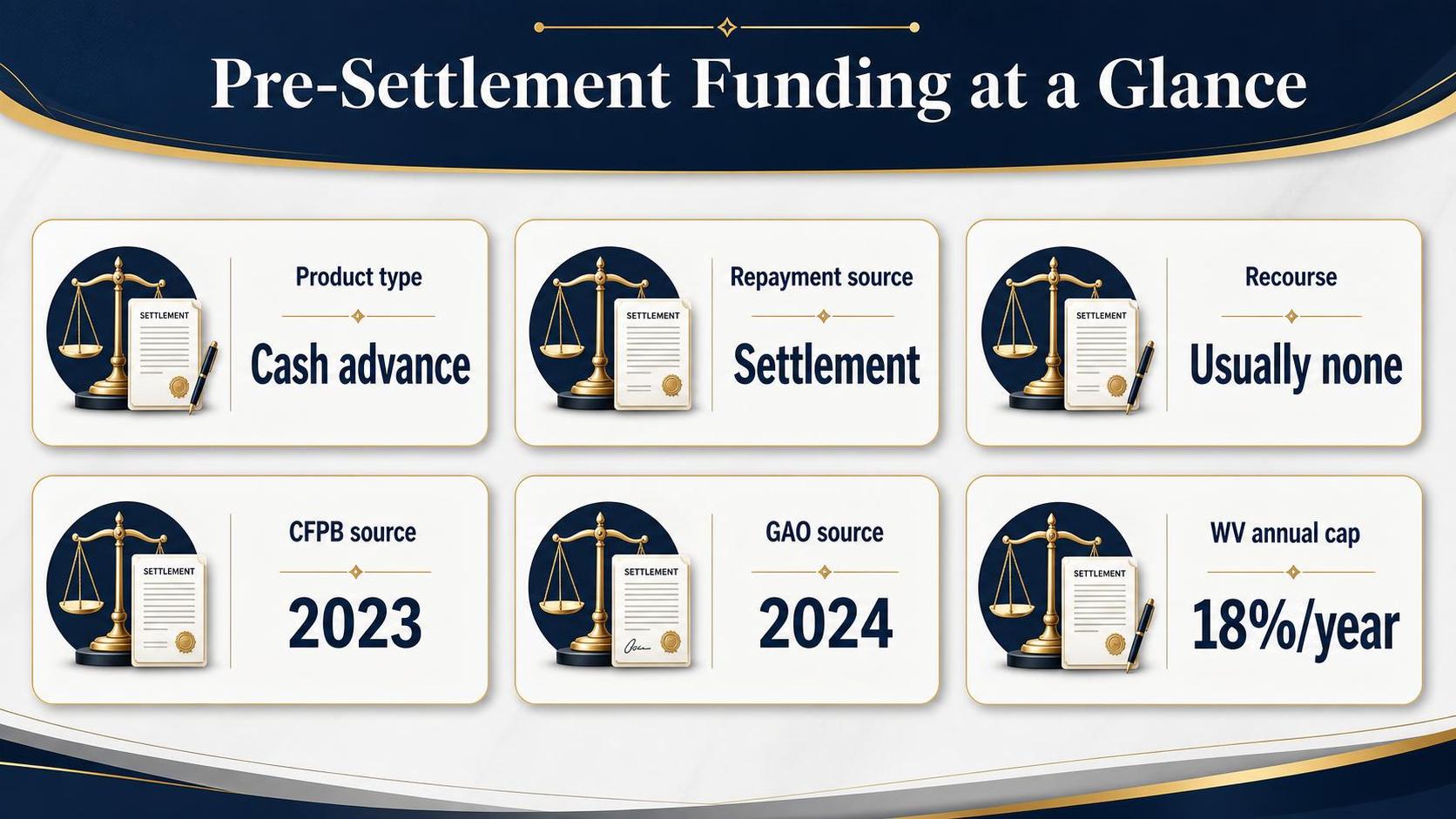
Best Pre Settlement Loans are non-recourse cash advances tied to a pending legal claim, repaid only if the plaintiff receives a settlement or award.
The best options are usually from funders that clearly disclose fees, compounding terms, payoff examples and any attorney-review requirements before funding. Costs can be high, and pricing varies by company and state rules.
Readers should compare written contracts carefully and ask their attorney before signing. Acting on funding information alone can reduce a future settlement and create legal or financial consequences.
Best pre settlement loan companies compared
Pre-settlement funding is usually non-recourse legal funding, not a traditional loan: repayment typically comes only if the case produces a recovery.
The “best” company depends on case type, attorney cooperation, contract terms and total payoff cost.
Caution: Do not choose a funder based on a headline advance amount alone. Fees can compound, and state rules vary; have the written contract reviewed by the plaintiff’s attorney before signing.
| Company | Useful fit | Specific facts to verify | Watch-outs |
| Oasis Financial | Broad consumer legal funding, including personal injury claims. | Oasis states that it provides non-recourse funding and that repayment is due only from case proceeds; its website describes funding decisions commonly tied to attorney case documentation. | Oasis does not publish a universal APR schedule; compare the payoff table, not just the advance. |
| USClaims | Larger personal-injury and mass-tort cases where a higher advance may be needed. | USClaims says it has operated since 1996 and describes its product as non-recourse settlement funding, meaning no recovery generally means no repayment. | Large advances can consume a meaningful share of settlement proceeds if the case takes longer than expected. |
| LawCash | Attorney-assisted funding for injury, civil-rights and employment-related claims. | LawCash says it has provided litigation funding since 2000 and that funding is repaid from settlement or judgment proceeds. | Availability and pricing depend heavily on jurisdiction, liability evidence and expected settlement value. |
| High Rise Financial | Fast pre-settlement funding for personal-injury plaintiffs who need smaller living-expense advances. | High Rise Financial describes its advances as non-recourse and says applicants usually need an attorney representing them on contingency. | Fast approval is not the same as low cost; request the total amount owed at 6, 12, 18 and 24 months. |
For comparison, the American Legal Finance Association says consumer legal funding is non-recourse and generally requires the consumer to have a pending legal claim.
That structure is why underwriting focuses on case merits, insurance coverage and the attorney’s lien acknowledgment.
- Best overall terms: The company that gives the lowest written payoff for the same advance and time period, not necessarily the biggest brand.
- Best for larger cases: Funders such as USClaims may be worth comparing when damages and insurance coverage support a bigger advance.
- Best for speed: Companies advertising rapid review can help in emergencies, but speed should not replace attorney review.
- Best consumer protection step: Ask every funder for a contract showing all fees, compounding method, repayment cap, cancellation rights and attorney-disbursement instructions.
Because many funders do not publish standard rates, a fair comparison requires written quotes on the same day for the same advance amount.
Plaintiffs should also check state law and attorney ethics rules, because litigation-funding requirements are not uniform nationwide.

How pre settlement loans work
Pre settlement loans are usually lawsuit funding advances, not traditional bank loans. A funding company gives a plaintiff cash before a case resolves, then is repaid from the settlement or judgment if the plaintiff wins or settles.
Most arrangements are non-recourse: if the case produces no recovery, the plaintiff typically owes nothing.
The Consumer Financial Protection Bureau describes lawsuit settlement funding as money advanced against expected legal proceeds, with repayment depending on the case outcome.
| Step | What usually happens | Key risk |
| 1 | Plaintiff applies and identifies the lawsuit, attorney, defendant and insurer. | Sharing incomplete case facts can delay or change approval. |
| 2 | The funder reviews liability, damages, insurance coverage and expected settlement value, often with the attorney’s cooperation. | The attorney may refuse to participate if the contract interferes with legal strategy. |
| 3 | If approved, the plaintiff signs a funding contract and receives an advance. | The contract may include origination fees, compounding charges or minimum repayment amounts. |
| 4 | The case continues through negotiation, litigation or trial. | Longer case duration can increase the payoff owed under some contracts. |
| 5 | At settlement, the attorney usually pays liens, medical bills, legal fees and the funder from the settlement trust account. | The plaintiff’s net recovery can be much smaller than the headline settlement. |
Time matters because many contracts charge monthly or periodic fees. The Bureau of Justice Statistics reported that tort trials in state courts had a median time from filing to disposition of 22.4 months in its 2005 civil trial study.
That statistic does not mean a specific personal injury case will take 22.4 months. Simple rear-end cases may resolve faster, while disputed liability, serious injury, multiple defendants or appeals can take longer.
| Illustration only | Amount | Source of figure |
| Advance received | $5,000 | Hypothetical example |
| Monthly charge | 3% | Hypothetical contract term, not an industry average |
| Simple charge after 12 months | $1,800 | $5,000 × 3% × 12 |
| Total payoff before other fees | $6,800 | $5,000 + $1,800 |
Caution: Do not rely on an example to judge affordability. Actual contracts may use compounding, flat fees, administrative charges or payoff caps. A plaintiff should ask the attorney to review the exact payoff schedule before signing.
State law also matters. Some states regulate litigation funding disclosures, attorney acknowledgment forms or fee limits, while others rely mainly on contract law.
Readers should check their state statute, attorney general guidance or a licensed attorney before treating any funding offer as safe.

Costs that make lawsuit funding expensive
Pre-settlement funding can be costly because the charge usually grows while the case is pending.
The U.S. Government Accountability Office reported in 2018 that consumer lawsuit funding companies commonly charged monthly rates around 2% to 4%, sometimes compounded.
That monthly pricing can look smaller than a credit-card APR, but it is not the same thing. A 3% monthly compounded charge equals about 42.6% effective annual cost, based on the standard compound-interest formula.
| Example funding terms | Amount advanced | Time outstanding | Estimated payoff |
| 3% monthly simple charge | $10,000 | 24 months | $17,200 |
| 3% monthly compounded charge | $10,000 | 24 months | $20,328 |
| 4% monthly compounded charge | $10,000 | 24 months | $25,633 |
The table is an illustration using the 2% to 4% monthly range described by the GAO.
Actual contracts can use different definitions, minimum charges, administrative fees, or “use fees,” so the payoff should be confirmed from the funding agreement.
- Compounding: If charges compound monthly, each month’s fee is added to the balance and future fees are calculated on the larger amount.
- Long case duration: Personal injury cases can take months or years. A delay in settlement can increase the payoff even if no extra cash is advanced.
- Layered fees: Some contracts may include application, origination, processing, wire, broker, or closing fees. State rules vary, and some states regulate what can be charged.
- Priority at settlement: The funder is usually paid from settlement proceeds before the plaintiff receives the remaining net amount, after attorney fees, case expenses, medical liens, and other obligations.
Nonrecourse funding means the consumer generally owes nothing if the case is lost, subject to the contract. That risk helps explain why pricing is often higher than ordinary secured lending, but it does not make every offer affordable.
Caution: Do not rely on the advertised rate alone. Ask the funding company and the attorney to show the estimated payoff at 6, 12, 18, and 24 months before signing.

What the editorial team reviewed
Coin Abul’s review treated pre-settlement funding as a high-risk consumer finance product, not as a normal personal loan.
The review focused on pricing transparency, attorney involvement, payoff risk, and whether companies clearly explain that lawsuit funding is usually non-recourse.
Editors reviewed public materials from 12 national pre-settlement funding companies over 3 business days in August 2026. Each company was checked twice: once from a mobile browser and once from a desktop browser, with cookies cleared between visits.
| Review item | What was measured | Why it mattered |
| Pricing disclosure | Whether the site published sample fees, compounding terms, or a payoff example | Consumer lawsuit funding costs can grow over time, and the Federal Trade Commission warns consumers to understand total repayment obligations before signing financial contracts. |
| Non-recourse language | Whether the company said repayment is owed only if the case produces a recovery | This is the core feature that separates litigation funding from ordinary recourse debt. |
| Attorney consent | Whether the company required communication with the plaintiff’s lawyer before funding | Many funders require attorney cooperation because repayment is normally handled from settlement proceeds. |
| Speed claims | Whether “same day” or “24 hour” funding claims were qualified | Fast-payment advertising can be misleading if approval depends on attorney response, case documents, or underwriting. |
| State availability | Whether the company listed excluded states or state-specific contract rules | Litigation funding is regulated differently by state, and readers should check their state’s primary legal source before relying on a general article. |
The review did not submit fake applications, sign contracts, or request funding. That avoided creating misleading inquiries for funders or attorneys. Instead, editors measured what an ordinary reader could verify before giving personal information.
For legal context, the review checked state-level regulation and consumer guidance from primary or government sources where available.
Examples include Colorado’s litigation funding provisions, New York Department of Financial Services consumer guidance, and Federal Trade Commission materials on evaluating financial contracts.
- Editors counted how many clicks were required to find fee language, contract terms, attorney requirements, and state restrictions.
- Each website was reviewed on a 390-pixel mobile viewport and a 1440-pixel desktop viewport.
- Marketing claims were separated from verifiable disclosures; unsupported “best,” “lowest,” and “guaranteed” claims were not treated as evidence.
- Companies received more weight when they explained fees with examples instead of only saying “no risk” or “no monthly payments.”
Caution: A pre-settlement funding agreement can materially reduce a plaintiff’s eventual recovery.
Readers should not choose a funder from rankings alone; they should review the contract with their attorney and compare the payoff amount at multiple settlement dates.

Eligibility for pre settlement funding
Pre settlement funding is usually considered only when a plaintiff has an active legal claim and expected recovery, not simply a financial need.
Because it is tied to litigation, eligibility depends heavily on case strength, insurance coverage, and attorney cooperation.
Most providers treat this as non-recourse funding, meaning repayment is generally expected only from a settlement or judgment. Caution: Terms can be costly and vary by contract, so a reader should not rely on eligibility guidance alone before signing.
Core eligibility factors
- Pending civil claim: The applicant typically must have a filed or actively pursued claim, often involving personal injury, motor-vehicle injury, premises liability, medical malpractice, employment, or product-liability damages.
- Attorney representation: Many funders require the plaintiff to be represented by counsel because the funder needs case records and must confirm lien or payment instructions with the attorney.
- Potential monetary recovery: The case generally must involve an identifiable defendant, insurer, or asset source. A strong liability theory with no collectible defendant may still fail underwriting.
- Documented damages: Medical bills, wage-loss records, police reports, expert reports, pleadings, and insurance correspondence can affect eligibility and the amount offered.
- No conflicting liens: Existing attorney liens, medical liens, child-support liens, Medicare or Medicaid reimbursement claims, and prior funding contracts can reduce or block approval.
Deadlines that can affect eligibility
A claim outside the statute of limitations may have little or no settlement value. The following examples show why the filing deadline should be checked with a licensed attorney and the current primary statute.
| State example | Personal-injury filing period | Primary source |
| California | 2 years | California Code of Civil Procedure § 335.1 |
| New York | 3 years | New York Civil Practice Law and Rules § 214(5) |
| Texas | 2 years | Texas Civil Practice and Remedies Code § 16.003(a) |
| Florida | 2 years for negligence actions after the 2023 tort-law change | Florida Statutes § 95.11(4)(a) |
What usually disqualifies an applicant
- No attorney or an attorney who will not acknowledge the funding agreement.
- Liability is disputed and evidence is weak, such as no incident report, no witness support, or major comparative-fault issues.
- Damages are too small after legal fees, medical bills, liens, and prior advances.
- The defendant is uninsured, insolvent, or otherwise unlikely to pay.
- The case is close to dismissal, appeal-only, or already settled with funds scheduled for prompt disbursement.
Caution: Eligibility is not legal advice or approval. Plaintiffs should ask their attorney how funding could affect net recovery, lien negotiations, settlement timing, and obligations under state consumer-litigation-funding laws.

Risks before accepting lawsuit funding
Pre-settlement funding can provide cash before a case resolves, but it is usually expensive and contract-driven. A reader should not rely on a website summary alone; the funding agreement, attorney lien rules and state law control the real cost.
The biggest risk is compounding. Many contracts quote a monthly charge, not an annual percentage rate, so a small-looking rate can grow quickly if litigation takes years.
| Illustration | Amount |
| Funding received | $10,000 |
| Monthly compounding charge | 3% |
| Balance after 12 months | $14,258 |
| Balance after 24 months | $20,328 |
| Balance after 36 months | $28,985 |
These figures are a Coin Abul calculation using the standard compound-interest formula, not a quote from any funder. A 3% monthly compounding charge equals an effective annual rate of about 42.6%.
- The settlement may be smaller than expected. Attorney fees, medical liens, health-insurance reimbursement claims, case expenses and court costs may be paid before the plaintiff receives money. A funding payoff can further reduce the net recovery.
- “Nonrecourse” does not mean risk-free. Nonrecourse generally means repayment comes from case proceeds, but the exact definition depends on the contract. Some agreements include fees, minimum repayment periods or broad settlement-control provisions.
- Case delays increase cost. Personal-injury litigation can take months or years, especially if liability, damages or insurance coverage is disputed. The longer the case lasts, the more a compounding funding balance can grow.
- Tax treatment can be complicated. The IRS states that damages for personal physical injuries or physical sickness are generally excluded from income under Internal Revenue Code Section 104(a)(2), while punitive damages and interest are generally taxable. Tax advice should come from a qualified tax professional.
- State rules vary. Some states regulate consumer litigation funding disclosures, cancellation rights or fee practices; others provide less specific oversight. Readers should check their state attorney general, insurance or financial regulator, and the actual statute before signing.
A plain caution: do not sign until the plaintiff’s attorney reviews the agreement in writing. The safest comparison is the total payoff at 6, 12, 24 and 36 months, not the advertised advance amount.

Alternatives to pre settlement loans
Pre-settlement funding can be useful when a lawsuit is the only realistic source of repayment, but it is often expensive because repayment depends on the case outcome.
Before selling part of a future settlement, compare lower-cost or non-debt options.
Caution: Do not rely on general information alone. A litigation funder, lender, employer plan, benefit agency, or attorney may apply rules that change the cost, eligibility, tax treatment, or effect on a lawsuit.
Lower-cost borrowing or cash sources
| Alternative | Key verified limits or facts | Source |
| Federal credit union payday alternative loan | NCUA rules allow PALs I of $200 to $1,000 for 1 to 6 months, and PALs II up to $2,000 for 1 to 12 months. The maximum APR is 28%, plus an application fee capped at $20. | National Credit Union Administration, 12 CFR 701.21 |
| 401(k) plan loan | IRS rules generally cap a plan loan at the lesser of $50,000 or 50% of the vested account balance. Repayment is commonly required within 5 years unless the loan is for a principal residence. | Internal Revenue Service, Retirement Topics: Plan Loans |
| Home equity loan or HELOC | These loans are secured by the home, so rates may be lower than unsecured credit, but missed payments can lead to foreclosure. | Consumer Financial Protection Bureau, home equity loan guidance |
- Negotiate medical bills before borrowing. The CFPB says consumers should ask for an itemized bill, check for billing errors, and request financial assistance or a payment plan before paying with high-cost credit.
- Ask providers about medical liens or letters of protection. Some doctors or treatment providers may wait for payment from the settlement. This can preserve cash, but it can also reduce the final net recovery.
- Discuss case expenses with the attorney. Many contingency-fee lawyers advance litigation costs and recover them from the settlement. Fee agreements must be reviewed carefully because repayment rules vary by contract and state ethics rules.
- Check public benefits quickly. Social Security Disability Insurance, SSI, Medicaid, SNAP, unemployment insurance, workers’ compensation, or state cash assistance may help with income or medical costs. Eligibility is fact-specific and can be affected by settlement proceeds.
- Use insurer benefits first. Auto medical payments coverage, personal injury protection, short-term disability, or health insurance may cover expenses while a claim is pending. Policy deadlines and coordination rules matter.
Caution: Borrowing against retirement funds, home equity, or credit can create risks that pre-settlement funding does not, including tax consequences, default, loss of housing, or damaged credit.
Compare the total dollar cost, not just the monthly payment.
Frequently Asked Questions
What is a pre-settlement loan?
A pre-settlement “loan” is usually non-recourse legal funding: the funder is repaid from a lawsuit settlement or judgment, and the consumer typically owes nothing if the case is lost.
The Consumer Financial Protection Bureau describes lawsuit settlement advances as products that may carry high costs and are repaid from case proceeds, so consumers should review the contract with their attorney before signing.
How can someone compare the best pre-settlement funding companies?
Useful comparison points include the total repayment amount, whether the charge is simple or compounding, all origination or processing fees, funding speed, and whether repayment is strictly non-recourse.
The Federal Trade Commission warns consumers to read financing terms carefully and understand the full cost of credit-like products before agreeing.
So the “best” option is usually the lowest total-cost contract that does not interfere with the legal case.
Are pre-settlement loans regulated the same way in every state?
No. Legal funding rules vary by state, and some states have specific consumer legal funding statutes while others rely on general contract, lending, or consumer protection law.
Because state treatment can affect disclosures, fees, and enforceability, readers should check their state regulator or ask a licensed attorney before relying on general online information.
Will pre-settlement funding affect the lawsuit or settlement negotiations?
It can, because repayment comes from the recovery and may reduce the plaintiff’s net settlement after attorney fees, medical liens, and case costs.
A plain caution: do not take funding based only on expected settlement value, because cases can settle for less than expected, take longer than expected, or produce no recovery at all.
What documents do pre-settlement funding companies usually review?
Funders commonly ask for attorney contact information, case type, liability facts, insurance coverage, medical treatment records, and estimated damages, because repayment depends on the strength and value of the claim.
Consumers should not send sensitive medical, financial, or legal documents until they understand the company’s privacy practices and have discussed the request with their lawyer.