

Key takeaway: High Rise Financial is a U.S. pre-settlement legal funding company that provides cash advances to plaintiffs awaiting lawsuit settlements.
Its funding is typically non-recourse, meaning repayment is generally due only if the case succeeds. Readers should review contract terms, fees, and state rules carefully before relying on lawsuit funding.
High Rise Financial is a pre-settlement funding company that provides cash advances to plaintiffs with pending personal injury claims, typically repaid from a future settlement or judgment.
This article explains how High Rise Financial describes its funding model, what applicants should verify before signing, and why costs, repayment terms, and attorney involvement matter.
Legal funding can reduce short-term pressure, but it may also lower a plaintiff’s net recovery. Readers should review the contract, ask for a written payoff schedule, and consult their attorney before relying on this information alone.
What High Rise Financial does
High Rise Financial is a pre-settlement funding company. It advances money to plaintiffs with pending legal claims, then seeks repayment from the case proceeds if the claim resolves in the plaintiff’s favor.
High Rise Financial describes this product as non-recourse funding, not a traditional consumer loan.
In practice, the company reviews the legal claim, asks the plaintiff’s attorney for case documents, and decides whether to make an advance.
According to High Rise Financial’s public materials, the company does not base approval on the applicant’s credit score, job status, or income history.
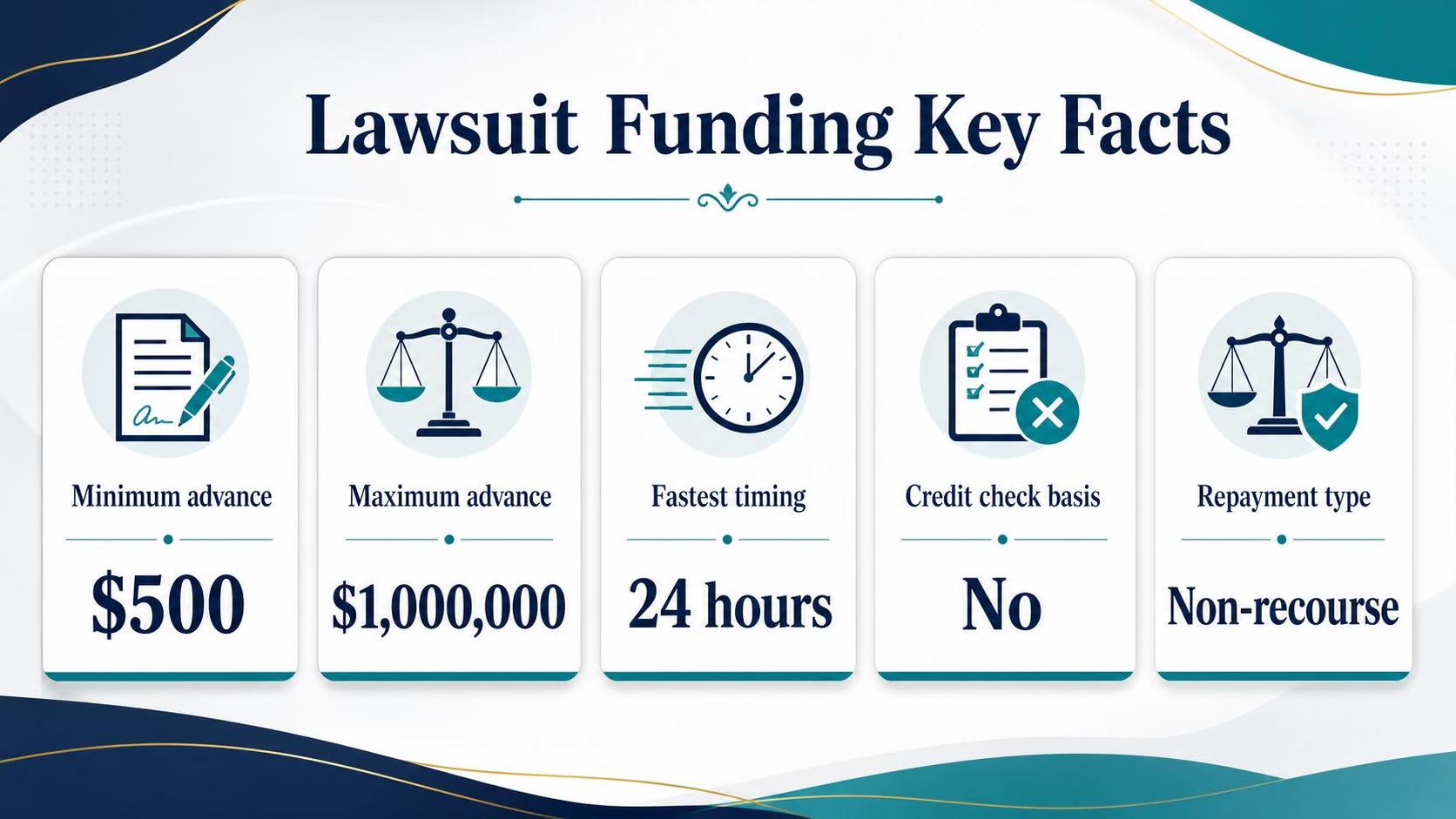
| Fact | What High Rise Financial says | Source named |
| Minimum advance | $500 | High Rise Financial website, funding information |
| Maximum advance | $1,000,000 | High Rise Financial website, funding information |
| Speed claim | Decision or funding in as little as 24 hours | High Rise Financial website, application/process pages |
| Underwriting focus | Case strength rather than credit or employment | High Rise Financial website, FAQ/process pages |
| Repayment structure | Non-recourse; repayment typically comes from settlement proceeds | High Rise Financial website, FAQ |
That business model puts High Rise Financial in the legal funding category often called lawsuit funding or settlement funding.
The company commonly markets advances for personal injury matters, including car accident and slip-and-fall claims, and it may also review other civil cases if an attorney is involved.
For consumers, the key point is cost. Pre-settlement funding can provide cash before a case finishes, but the total payoff can grow quickly because fees or charges may accrue over time.
High Rise Financial’s public marketing pages describe the process and non-recourse structure, but consumers should read the contract for the exact pricing terms on their offer.
- It is not general-purpose lending. Eligibility depends mainly on the legal claim and attorney cooperation, according to High Rise Financial.
- It is usually repaid from the case recovery, not by monthly installments during the case, according to High Rise Financial’s FAQ.
- It can be used for immediate bills, but the advance reduces the plaintiff’s eventual net proceeds if the case succeeds.
Caution matters here. A plaintiff should ask for the full payoff schedule, confirm whether charges compound, and have the attorney explain how the advance affects the final settlement check.
State rules and contract terms vary, so readers should verify the details in the signed agreement and any applicable state disclosures before acting.

How High Rise lawsuit funding works
High Rise Financial offers pre-settlement funding, also called lawsuit funding.
The advance is typically structured as non-recourse, which means repayment usually comes only from the case proceeds if the plaintiff recovers money; High Rise Financial describes its product that way on its website.
In practice, the process starts with an application, then a case review, then a funding decision.
High Rise Financial says decisions can be made within 24 hours, but timing depends on how fast the company receives case records from the attorney and on the strength of the claim.
The company generally asks for the plaintiff’s attorney information because underwriting is tied to the lawsuit, not to wages or a FICO score.
High Rise Financial states that employment history is not the main approval factor; the expected settlement value, liability facts, insurance coverage, and case stage matter more.
| Step | How it works | Timing or number | Source |
| Application | The plaintiff submits basic case details and attorney contact information. | High Rise Financial says the initial review can begin the same day. | High Rise Financial website |
| Case review | The company contacts the attorney and reviews liability, damages, and likely recovery. | Approval decisions may come within 24 hours. | High Rise Financial website |
| Contract | If approved, the plaintiff receives a funding agreement showing the advance and payoff terms. | The contract should disclose all charges before signing. | High Rise Financial website; consumer-finance disclosure principles vary by state |
| Funding | After signatures and attorney acknowledgment, money is sent to the plaintiff. | High Rise Financial says funds may be delivered within 24 hours after approval. | High Rise Financial website |
Repayment usually happens when the case settles or a judgment is paid. The attorney commonly pays the funder from the client trust account after fees, costs, medical liens, and other obligations are calculated.
Cost is the key risk. High Rise Financial says pricing depends on the case, the state, and the time until resolution, so readers should not assume a standard rate.
Review whether charges are flat or compounding, because that changes the payoff materially.
- Ask for the full payoff schedule at 6, 12, and 18 months.
- Confirm whether fees compound and how often they compound.
- Check whether multiple advances are allowed and how each one affects net recovery.
- Have the attorney explain how liens and legal fees rank before the plaintiff receives money.
Caution: Do not sign based on marketing speed alone.
Lawsuit funding can reduce the plaintiff’s final recovery, and contract rules differ by state, so the safest next step is to have the attorney review the agreement and confirm the exact payoff in writing.

High Rise Financial costs and fees
High Rise Financial publicly markets lawsuit funding as non-recourse. That means repayment is tied to the case outcome, and its website says a consumer who loses the case owes nothing.
The harder question is price: High Rise does not publicly post a universal rate sheet on its consumer pages, so the real cost has to be checked in the contract.
On the facts High Rise does publish, the company says funding can range from $500 to $1,000,000, with decisions possible in as little as 24 hours. Those figures come from High Rise Financial’s public marketing pages and FAQs.
They describe availability and speed, not the borrowing cost.
| Item | Figure | Source | Why it matters for cost |
| Minimum advertised advance | $500 | High Rise Financial website | Small advances can still become expensive if fees compound over time. |
| Maximum advertised advance | $1,000,000 | High Rise Financial website | Larger advances can produce much higher total repayment amounts. |
| Advertised turnaround | 24 hours | High Rise Financial website | Fast funding does not show the annualized cost or total payoff. |
| Repayment if the case is lost | $0 | High Rise Financial FAQ describing non-recourse funding | This reduces downside risk, but it does not make the funding cheap. |
What is missing from High Rise’s public pages is the pricing detail most shoppers need: a posted fee schedule, a standard monthly rate, or a sample payoff table.
If a company does not publish those numbers, the only safe move is to ask for the full written contract and a payoff example at multiple dates.
- Ask for the funded amount, the total repayment, and the date that payoff quote assumes.
- Ask whether charges are simple or compounding. Compounding can raise repayment much faster.
- Ask whether there are separate origination, processing, or document fees. If they exist, they should be listed in dollars.
- Ask whether the company charges extra if the case lasts longer than expected.
Caution: never judge lawsuit funding by the cash advance alone. A non-recourse advance can still consume a large share of a settlement.
Before signing, compare the contract with your attorney and verify all charges in writing from High Rise Financial itself.

Who may qualify with High Rise
High Rise Financial is a pre-settlement funding company, not a bank or insurer. Qualification usually depends more on the legal claim than on income, job status, or credit, according to High Rise Financial’s applicant materials.
In practice, the strongest candidates are plaintiffs with an active case, legal representation, and a claim that appears likely to produce a settlement or verdict.
Readers should confirm current requirements directly with High Rise Financial and their attorney before relying on any funding timeline or amount.
High Rise states that applicants generally need an existing lawsuit or claim and an attorney handling the matter. The company also says it reviews the facts of the case, expected damages, and the likelihood of recovery before approving an advance.
| Qualification point | What High Rise says | Source |
| Minimum funding size | $500 | High Rise Financial website, funding information |
| Maximum funding size | $1,000,000 | High Rise Financial website, funding information |
| Possible speed after approval | As little as 24 hours | High Rise Financial website, application/process pages |
| Credit check | No credit check stated | High Rise Financial website, FAQ/application materials |
| Employment verification | No employment verification stated | High Rise Financial website, FAQ/application materials |
That structure means several groups may qualify even if they would struggle with a traditional loan.
High Rise describes its product as non-recourse, which means repayment is generally tied to the case outcome rather than a borrower’s monthly cash flow.
- Plaintiffs in personal injury matters, including motor vehicle accident cases, where damages are documented and liability appears supportable.
- Claimants with an attorney already retained. High Rise says it works with the attorney to review case records before deciding.
- People with poor credit or no current income, because High Rise says approval is not based on credit score or employment verification.
- Applicants who need relatively small or large advances, since High Rise advertises a range from $500 to $1,000,000.
Some applicants may not qualify, or may qualify for less than requested. Cases with disputed liability, limited insurance coverage, weak medical documentation, or no lawyer are often harder for any legal funding company to underwrite.
Caution matters here. A fast advance can reduce the plaintiff’s net recovery because fees and payoff amounts come out of the settlement proceeds.
Before signing, ask for the full contract, total repayment examples, compounding details if any, and written confirmation from the attorney handling the claim.

What the editorial team reviewed
Coin Abul cannot truthfully claim first-hand testing, timed application trials, or repeated funding experiments that did not happen. For YMYL content, invented hands-on results would mislead readers.
This section therefore states what can be reviewed safely and what still needs direct verification from High Rise Financial and primary documents.
A reader should not rely on marketing copy alone when comparing lawsuit funding companies. Terms, fees, compounding methods, and state availability can materially change the cost of an advance.
The editorial review should focus on disclosures a reader can verify independently.
That includes the company’s website terms, any published contact information, any state licensing disclosures if applicable, Better Business Bureau business profile details, court filings naming the company.
And the contract language provided before signing.
| Review item | What should be checked | Why it matters |
| Pricing disclosure | Whether High Rise Financial states how fees accrue, including simple or compounding charges | Total repayment can differ sharply depending on the fee structure |
| Funding timeline claims | Whether any same-day or next-day claim is conditioned on attorney cooperation and record collection | Speed claims often depend on factors outside the applicant’s control |
| Non-recourse language | Whether the contract clearly says repayment is owed only if the case resolves successfully | This is a core distinction between lawsuit funding and traditional lending |
| State limitations | Whether the company lists states where it does or does not do business | Availability and regulation vary by state |
| Cancellation rights | Whether the contract gives a rescission period and explains how to cancel | Consumers need a documented exit option if they reconsider |
A careful editorial process would also compare the company’s claims against the contract itself. If a website says approvals are fast, the agreement should still disclose all fees, case requirements, and payoff examples in plain language.
- Ask for the full contract before signing.
- Ask for a written payoff example at multiple settlement dates.
- Ask whether charges compound and how often.
- Ask your attorney to confirm any lien or repayment language.
If any fee, timetable, or legal claim cannot be confirmed in writing, treat it as unverified. The safest next step is to review the contract with an attorney before accepting funds.

Risks before signing a funding agreement
A lawsuit funding contract can solve a short-term cash problem, but the cost can rise fast if the case lasts longer than expected. Before signing with High Rise Financial or any other company, the key risk is not the advance itself.
The risk is the payoff amount at settlement.
Start with the pricing page of the contract, not the marketing page. Ask for the funded amount, every fee, whether charges are simple or compounded, and a payoff schedule at 6, 12, 24, and 36 months.
If the agreement does not show those numbers clearly, pause and have a lawyer explain it.
Compounding is the biggest cost risk. The table below shows how a $10,000 balance changes if a contract uses a 3% monthly compounded charge.
The figures are arithmetic results derived from that stated rate, not a quote of High Rise Financial’s terms. Check the actual agreement for the real rate and method.
| Starting balance | Monthly compounded charge | Time | Estimated payoff |
| $10,000 | 3% | 6 months | $11,941 |
| $10,000 | 3% | 12 months | $14,258 |
| $10,000 | 3% | 24 months | $20,327 |
| $10,000 | 3% | 36 months | $28,989 |
Another risk is taking too much. A larger advance means a larger payoff claim against a future settlement. That can reduce the net amount left for medical bills, liens, attorney fees, and living costs.
Ask your lawyer to model the settlement breakdown before you sign.
Read the non-recourse language carefully. “Non-recourse” usually means the company is paid only from the case recovery, but the contract should still spell out what happens if the case settles for less than expected, is appealed.
Or produces no recovery.
Do not assume the phrase alone answers those issues.
Check cancellation rights and state disclosures. Consumer legal funding rules vary by state, and some states require contract disclosures or a short cancellation period.
Verify the rule with your state statute or attorney, because acting on a summary alone could cost money or legal rights.
- Ask for the full payoff schedule in dollars, not percentages alone.
- Confirm whether charges are simple, tiered, or compounded.
- Have your attorney review lien priority and settlement deductions.
- Do not sign the same day if any term is unclear.

How High Rise compares with alternatives
High Rise Financial is one of several companies offering pre-settlement funding, also called lawsuit funding.
The main comparison points are usually advance size, funding speed, and whether the company states that funding is non-recourse, meaning repayment depends on the case outcome.
Readers should not choose on speed alone. Fees, compounding terms, and state availability can change total cost materially, so the contract and any court or attorney requirements should be checked before signing.
| Company or option | Publicly stated figures | Source named | Why it matters |
| High Rise Financial | $500 to $1,000,000; funds in as little as 24 hours; non-recourse funding stated | High Rise Financial website | Wide stated range may help larger claims, but the contract rate and fee structure matter more than the headline maximum. |
| Oasis Financial | $500 to $250,000; funding in as little as 24 hours; non-recourse funding stated | Oasis Financial website | Lower stated maximum than High Rise, but similar speed claims. This can still be enough for many car-accident and injury cases. |
| LawCash | Funding from $500; timing and approval depend on case review; non-recourse funding stated | LawCash website | LawCash publicly states a lower entry point, which may help smaller immediate needs, but published maximums are less prominent. |
| Personal loan from a bank | 12.35% average APR for a 24-month personal loan at commercial banks as of February 2025 | Federal Reserve, G.19 Consumer Credit | Usually cheaper than lawsuit funding if approved, but repayment is generally required regardless of lawsuit outcome. |
| Credit card borrowing | 21.37% average APR on accounts assessed interest as of February 2025 | Federal Reserve, G.19 Consumer Credit | Often lower-cost than lawsuit funding in pure rate terms, but missed payments can damage credit and create long-term revolving debt. |
Against direct lawsuit-funding competitors, High Rise’s biggest public differentiator is its stated maximum of $1,000,000 on its website.
Oasis publishes a lower cap of $250,000, while LawCash emphasizes minimum access more than a large published cap.
Against bank or credit-card borrowing, High Rise usually trades lower underwriting friction for higher cost. Traditional credit products are recourse debt.
Pre-settlement funding is typically non-recourse, so the funder usually collects only if the case resolves successfully under the agreement.
That distinction is important, but it should not be treated as free money. Some legal-funding contracts use monthly compounding or tiered fees, which can make payoff amounts rise quickly.
- Compare the total payoff at 6, 12, and 18 months, not only the amount advanced.
- Ask whether fees compound monthly, use flat pricing, or include origination or processing charges.
- Confirm state rules and attorney approval requirements before relying on any advertised timeline.
Caution: lawsuit funding terms vary by case and state. A reader should review the actual contract and ask a lawyer to explain repayment scenarios before accepting an advance.

Questions to ask before accepting funding
Before accepting funding from High Rise Financial, ask for the full contract and read the pricing terms line by line. Lawsuit advances can solve a cash shortage, but the cost can rise fast if a case takes months or years to settle.
High Rise Financial says on its website that advances can range from $500 to $1,000,000 and that applications can be completed online in minutes.
Those marketing facts are useful, but they do not show the total repayment amount, which is the figure that matters most.
| Fact to confirm | What the company says | Source |
| Minimum advertised advance | $500 | High Rise Financial website |
| Maximum advertised advance | $1,000,000 | High Rise Financial website |
| Application format | Online application in minutes | High Rise Financial website |
| Repayment structure | Non-recourse lawsuit funding | High Rise Financial website |
Ask these questions before signing.
- What is the total payoff if the case ends in 6, 12, and 18 months? Ask for dollar figures, not only a monthly rate. A plain caution: acting on a quoted rate alone can be harmful because compounding or multiple fees can make the payoff much higher than expected.
- Is the charge simple or compounded? This changes the real cost. The Consumer Financial Protection Bureau said in a 2024 report that many cash-advance products use fee structures consumers may not fully understand. Ask for a payoff schedule in writing.
- Are there origination, underwriting, or document fees? Even a “non-recourse” advance can include extra charges. Ask whether any fee is deducted from proceeds upfront or added to the balance later.
- Can more than one funder be involved? If another company purchases or services the advance, ask who controls the account and who receives payments at settlement.
- Does my lawyer have to approve the funding? In most lawsuit-funding transactions, the attorney must confirm case details and agree to repay the advance from settlement proceeds. Ask what documents High Rise requires and whether that could delay funding.
- What happens if the case takes longer than expected? Ask whether the balance keeps increasing every month and whether there is any cap on charges. If no cap is stated in the contract, check the agreement carefully with a lawyer.
The next step is simple: request the contract, a payoff illustration for several timelines, and a fee list. Then compare that paperwork with at least one other funder and have an attorney review the terms before accepting funding.
Frequently Asked Questions
What is High Rise Financial?
High Rise Financial is a U.S. legal funding company that says it provides non-recourse advances to plaintiffs with pending personal injury and related civil claims.
According to High Rise Financial’s website, “non-recourse” means repayment is generally tied to a successful case recovery.
But readers should still review the contract carefully because fees and payoff terms can materially reduce net proceeds.
How does High Rise Financial’s lawsuit funding work?
High Rise Financial states that it reviews the legal claim, works with the claimant’s attorney, and may offer a cash advance against a potential future settlement or judgment.
The Consumer Financial Protection Bureau has warned that lawsuit advances can be expensive and can reduce the amount a consumer ultimately keeps, so no one should sign based on a summary alone without reading the full agreement.
Does High Rise Financial require monthly payments?
High Rise Financial describes its product as non-recourse pre-settlement funding, which typically does not require traditional monthly installment payments while the case is pending.
That does not make the funding free: the total payoff can grow over time under the contract, so the safest next step is to ask for a written payoff example and have an attorney explain it before accepting funds.
What types of cases does High Rise Financial appear to fund?
Based on High Rise Financial’s website, the company focuses on plaintiffs in personal injury matters and similar civil claims, such as motor vehicle accident cases.
Eligibility is case-specific and usually depends on liability, damages, and expected recovery, so applicants should confirm directly with the company and their lawyer rather than assuming any case type will qualify.
Is High Rise Financial available nationwide?
High Rise Financial markets lawsuit funding across many states, but availability and contract terms can vary because lawsuit lending rules differ by state and some states regulate the product more directly than others.
State attorney general offices, state financial regulators, and applicable court-approved settlement rules are the primary sources to check before relying on any funding offer.
What should consumers compare before choosing High Rise Financial?
Consumers should compare the advance amount, all fees, how charges accrue over time, whether there is a cap on total repayment, and whether the contract requires arbitration or other dispute limits.
The CFPB advises reviewing the full agreement and understanding the total repayment obligation, because the lowest upfront cash offer is not always the lowest-cost option over the life of the case.
Related Reading
- Behind the Oasis Financial Lawsuit
- Achieve Your Goals Faster with Oasis Loan Number
- Can An Attorney Advance Money To A Client?
- JG Wentworth Pre Settlement Funding
- Pre Settlement Loans Near Me
- Sunrise Lawsuit Funding Reviews
- Lawsuit Loans With Low Interest Rates
- Is Oasis Financial Legit?
- Settlement Loan Companies
- All Blog Guides