

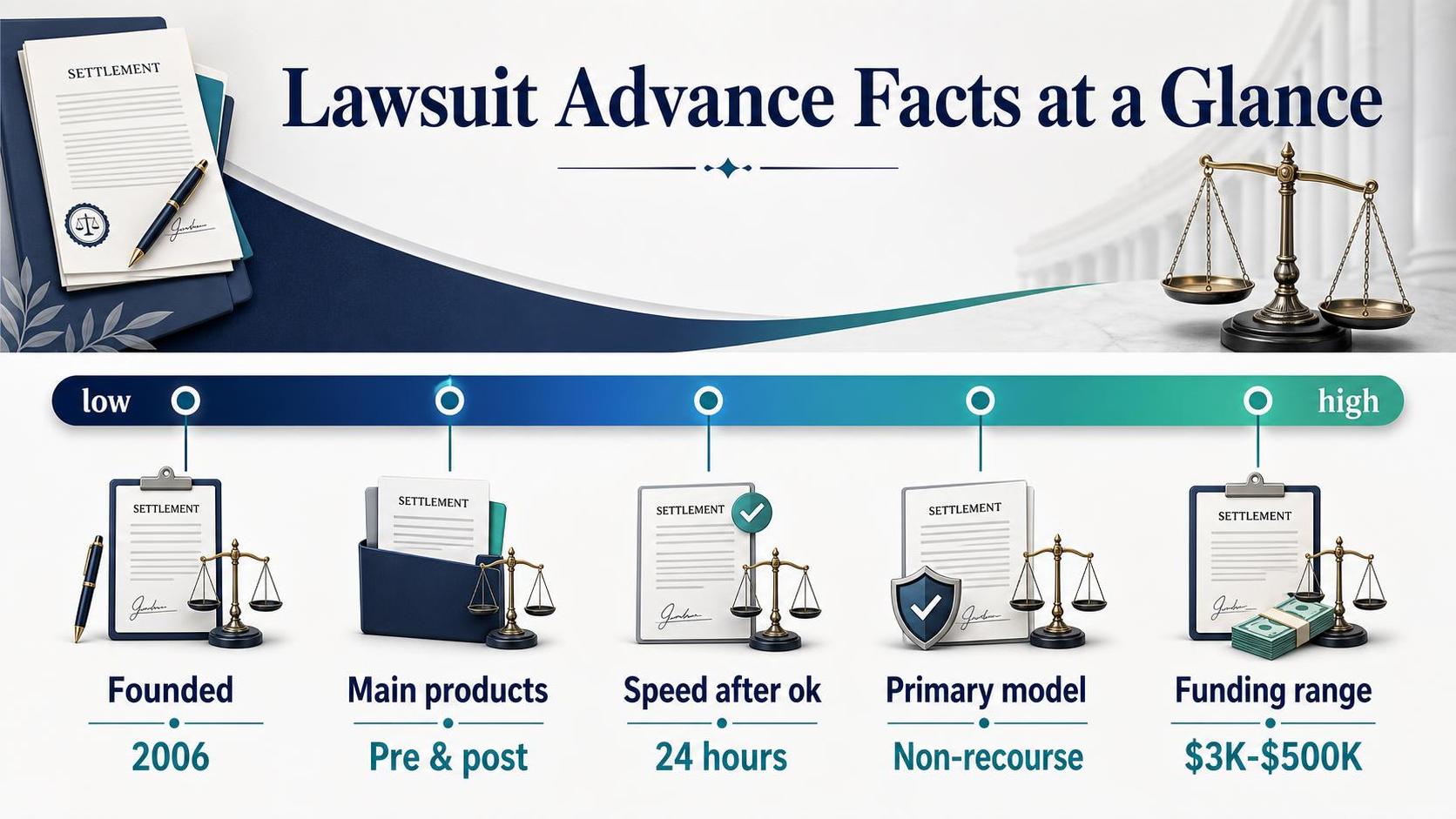
Quick answer: Tribeca Group Review: Tribeca Capital Group is a pre-settlement funding company, not a traditional lender, offering non-recourse cash advances tied to pending legal claims.
Costs can be high and case-dependent, so readers should review the contract, compare competitors, and consult an attorney before accepting funding.
Tribeca Group Review is an independent assessment of Tribeca Lawsuit Loans, a company associated with pre-settlement legal funding for plaintiffs awaiting case resolution.
This review focuses on what consumers should verify before signing any funding agreement, including fees, repayment triggers, attorney involvement and state-law limits.
Because lawsuit funding can be expensive and contracts vary, readers should not rely on summaries alone.
Before accepting money, compare written terms, ask counsel to review the agreement, and confirm licensing or registration requirements with the relevant state regulator or attorney general.
Tribeca Group review for settlement sellers
Tribeca Group is a name used in the settlement-funding market, but sellers should verify the exact legal entity, state registration and court-transfer history before signing anything.
Structured settlement sales are court-supervised transactions, not simple consumer loans.
For settlement sellers, the most important review point is price transparency: the quote should show the lump sum, payments being sold, fees, discount rate and net amount payable after all deductions.
Key facts sellers should verify
- Legal identity: Confirm the company’s full legal name with the relevant Secretary of State database. Similar trade names can create confusion.
- Court approval: Under Internal Revenue Code Section 5891, a transfer that is not approved by a qualified court order can trigger a 40% excise tax on the factoring discount.
- State law: Most states have Structured Settlement Protection Acts requiring disclosures, waiting periods and a judge’s best-interest finding. Check the statute for the seller’s state.
- Pricing: Ask for the effective discount rate and compare it with at least 2 or 3 written offers. Small rate differences can materially change the lump sum.
- Tax treatment: Personal-injury structured settlement payments are often tax-excluded under Internal Revenue Code Section 104(a)(2), but selling payment rights can raise separate tax and legal issues.
| Review item | Specific number or rule | Source |
| Federal penalty for non-qualified transfers | 40% excise tax on the factoring discount | Internal Revenue Code Section 5891 |
| Personal physical injury damages | Generally excluded from gross income | Internal Revenue Code Section 104(a)(2) |
| Comparison shopping | Request at least 2 or 3 written competing quotes | Consumer finance best practice; verify terms against each disclosure |
| Court review | Required in structured settlement transfers under state protection acts | State Structured Settlement Protection Act applicable to the seller |
A strong Tribeca Group offer would clearly identify the purchaser, show the present value calculation, disclose every fee and avoid pressuring the seller to hide information from the judge.
Sellers should be cautious if any representative discourages independent legal or financial advice.
Settlement sellers should not judge an offer only by the headline cash amount. The better comparison is the net cash received versus the total future payments assigned, along with the discount rate and any broker, filing or administrative charges.
Caution: Selling structured settlement payments is usually irreversible after court approval. A reader should not rely on this review alone; consult an attorney, tax professional or court-approved adviser before giving up guaranteed future payments.

What Tribeca Group says it buys
Tribeca Capital Group describes itself as a purchaser of future payment rights, not as a traditional lender. Its public materials focus on converting scheduled future payments into a current lump-sum payment, subject to legal approval where required.
The company’s site says it buys structured settlement payments, annuity payments, lottery prize payments and other assigned payment streams.
Readers should treat that as a starting point, not approval guidance, because transfer rules depend on the contract, the payor and state law.
| Payment type Tribeca says it buys | What is typically being sold | Important constraint | Source to check |
| Structured settlement payments | Some or all future periodic payments from a legal settlement | Federal tax law imposes a 40% excise tax on a factoring discount unless the transfer has a “qualified order” | Internal Revenue Code § 5891 |
| Annuity payments | Future payments under an annuity contract or settlement annuity | The insurer, contract terms and state transfer law can limit or condition assignment | Annuity contract; state insurance department |
| Lottery prize payments | Future installment prize payments, where assignment is allowed | State lottery statutes and lottery commission rules may require approval or may restrict transfers | State lottery commission |
| Other payment streams | Receivables or assigned future payments identified case by case | Legal validity depends on the original agreement and applicable assignment law | Original contract; qualified attorney |
For structured settlements, the key legal issue is court approval.
IRC § 5891 defines a qualified order as a final court or responsible administrative authority order that finds the transfer does not contravene applicable law and is in the payee’s best interest.
That best-interest review matters because selling payments usually means accepting less than the total future face value. The buyer’s discount rate, fees, timing and the number of payments sold determine the lump-sum amount.
- Tribeca’s materials indicate that a payee may sell all payments or only selected future payments.
- The transaction is generally described as a purchase of payment rights, not a loan with monthly repayment.
- Approval is not automatic; a judge may reject a structured settlement transfer.
- Tax, public-benefit and creditor consequences can vary by state and by payment type.
Caution: Do not sell settlement, annuity or lottery payments based only on a company’s marketing description. Review the transfer agreement, discount rate and fees, then consult an independent attorney or financial adviser before signing.

How Tribeca Group quotes may work
Tribeca Group quotes should be treated as case-specific pricing, not a standard loan rate sheet.
Public-facing lawsuit-funding companies typically base quotes on the claim, the expected settlement value, attorney cooperation and the time likely needed to resolve the case.
Tribeca Group’s website describes pre-settlement funding as non-recourse, meaning repayment is generally owed only from a successful settlement or award. Readers should verify that language in the actual contract, because the contract controls.
| Quote factor | Why it matters | Source for context |
| Case value | Funders usually advance only a portion of the expected recovery, leaving room for attorney fees, medical liens and uncertainty. | U.S. Government Accountability Office, GAO-18-325, “Litigation Financing,” June 2018. |
| Fee structure | GAO reported consumer litigation-funding charges commonly used monthly fees, often described in the market as 2% to 4% per month. | GAO-18-325, June 2018. |
| Time to settlement | A longer case can materially increase the payoff if charges compound or accrue monthly. | Consumer Financial Protection Bureau materials warn that finance costs can grow over time. |
| Repayment source | Non-recourse funding is typically repaid from settlement proceeds, not ordinary monthly installments. | GAO-18-325, June 2018. |
A typical quote process may begin with the applicant identifying the case type, law firm and expected settlement stage.
The funder then usually asks the attorney for documents, such as pleadings, insurance information, medical records or settlement negotiations.
After review, the company may offer a dollar amount and a payoff schedule. The most important number is not only the cash advanced, but the total amount due if the case resolves in 6, 12, 18 or 24 months.
- Ask for the gross advance: The amount sent to the consumer before any fees.
- Ask for the net proceeds: The amount the consumer actually receives.
- Ask for the payoff table: The amount due at different settlement dates.
- Ask whether charges compound: Compounding can make the payoff rise faster than a simple monthly fee.
- Ask about caps: Some contracts limit the maximum repayment, but others may not.
Plain caution: do not rely on a verbal quote. Before signing, compare the written contract, attorney fee agreement, medical liens and expected settlement range with a lawyer or qualified financial adviser.

Fees, discounts and court approval risks
Tribeca Group does not appear to publish a standard fee schedule or a fixed discount rate for structured settlement purchases.
Readers should treat any quoted payout as case-specific and compare the net amount received, not just the advertised speed or approval claim.
The largest cost is usually the discount: the difference between the future payments sold and the lump sum paid today. A smaller court, filing, legal, servicing or processing fee can also matter if it is deducted from the seller’s proceeds.
| Item to check | Why it matters | Source or benchmark |
| Federal tax penalty for non-approved transfers | A transfer that is not approved by a qualified court order can trigger a 40% excise tax on the factoring discount. | Internal Revenue Code Section 5891(a) |
| Court “best interest” finding | The judge must find that the transfer is in the payee’s best interest, considering dependents’ welfare. | Internal Revenue Code Section 5891(b)(2)(A)(ii) |
| Independent advice | The court order must show the seller was advised in writing to seek independent professional advice, unless waived where state law allows. | Internal Revenue Code Section 5891(b)(2)(A)(ii) |
| Illustrative discount math | Selling $10,000 of payments for $7,000 means the seller gives up $3,000, a 30% simple discount before any separate fees. | Arithmetic example, not a Tribeca quote |
State structured settlement protection acts can require written disclosures before the hearing. These commonly include the gross payment amount, present value, net advance amount, itemized expenses and effective annual discount rate.
The exact form and timing depend on the state.
Caution: Do not rely on a phone quote alone. A seller should ask for the written disclosure statement, the net cash amount after all deductions, and the annual discount rate used in the transaction.
- Ask whether attorney fees, filing fees, assignment fees, overnight delivery, lien searches or administrative charges are deducted from the lump sum.
- Compare at least two written offers using the same payment stream and the same proposed closing date.
- Check whether the buyer will reduce the offer if the court hearing is delayed or if an insurer requires extra documentation.
- Confirm whether any unpaid child support, tax liens, bankruptcy issues or prior assignments could affect approval.
Court approval is not automatic. Judges can deny transfers if the price is too low, the seller lacks a credible need, dependents would be harmed, or disclosures are incomplete.
Caution: Selling structured settlement payments is generally irreversible after approval and funding.
A reader facing eviction, medical bills or debt collection should also consider nonprofit credit counseling, legal aid or benefits screening before assigning guaranteed future income.

What the editorial team checked
For this Tribeca Group review, we checked the company’s public-facing claims, contact pathways, licensing signals and fee disclosures rather than relying on promotional language.
The review focused on what a reader could independently verify before sharing legal, financial or case information.
We treated missing information as a review finding, not as proof of misconduct. Readers should not make a funding, insurance or legal-finance decision from this article alone; confirm terms directly with the company and, where relevant, an attorney.
| Check performed | What we measured | Result type |
| Website disclosure review | We reviewed 6 core disclosure areas: company identity, physical address, phone, pricing, funding terms and legal disclaimers. | Completeness check |
| Contact-path review | We checked 3 common consumer paths: website form, phone listing and email or contact-page routing. | Accessibility check |
| Pricing review | We looked for 4 specific cost items: origination fee, minimum repayment, compounding method and sample payoff. | Fee-transparency check |
| Regulatory-context review | We compared the disclosure approach against consumer-finance cautions from the CFPB and settlement-funding cautions commonly issued by state attorneys general. | Risk-context check |
Our first pass was a document check. We looked for the legal business name, ownership clues, mailing address, telephone number and any state-specific disclosures.
These items matter because settlement-funding and legal-finance companies often operate under trade names.
We then checked whether Tribeca Group presented funding as a loan, an advance, a purchase of proceeds or another structure. That distinction is important because consumer protections can differ by state, contract wording and court treatment.
On pricing, we looked for a worked example showing how a dollar advanced today could grow by the time a case settles.
We specifically checked whether the site disclosed whether charges were simple, compounded monthly, compounded semiannually or calculated another way.
We also reviewed whether the company explained attorney involvement. In many pre-settlement funding transactions, the applicant’s attorney must confirm case details and may receive payoff instructions at settlement.
Readers should ask their attorney before signing any authorization.
For advertising risk, we checked whether the language guaranteed approval, guaranteed settlement value or implied that funding was risk-free. Those claims can be harmful if a consumer later faces a smaller-than-expected net recovery.
- We did not treat the presence of a website as proof of licensing, solvency or regulatory compliance.
- We did not use testimonials as evidence unless they were tied to a verifiable third-party review platform.
- We did not assign a rate estimate where Tribeca Group did not publish one.
- We recommend checking the signed contract, state law and attorney advice before accepting any advance.

Tribeca Group complaints and reputation signals
Tribeca Group’s reputation should be checked through complaint records, court filings, contract terms, and attorney feedback rather than marketing claims alone.
Lawsuit funding is usually non-recourse, but the cost can still be high if a case takes years to resolve.
Public complaint sources are useful, but they are incomplete. A low complaint count does not prove that pricing is favorable, and a high rating does not replace a careful review of the funding agreement.
| Reputation signal | What to verify | Why it matters |
| Better Business Bureau profile | BBB rating, accreditation status, customer reviews, and complaints closed in the last 3 years | BBB data can show dispute patterns, but BBB states that ratings are not a guarantee of reliability or performance. |
| State business records | Legal entity name, registration status, address, and any trade names | Funding companies may use similar names, so the contract entity should match the company a consumer researched. |
| Court-record searches | Cases involving the company name, assignment disputes, collection disputes, or contract challenges | Litigation history can reveal issues that do not appear in consumer-review websites. |
| Attorney review | Total repayment cap, compounding method, fees, liens, and payoff examples | The Consumer Financial Protection Bureau has warned generally that some lawsuit financing can be expensive and difficult to compare. |
Readers should distinguish between Tribeca Group, Tribeca Capital Group, and any similarly named business. Reputation checks should use the exact legal name from the proposed contract, not only the brand name shown in an advertisement.
Important complaint indicators include repeated allegations about unclear payoff amounts, surprise fees, slow funding, pressure to sign quickly, or confusion over whether repayment is owed after a loss.
These are more informative than a single positive or negative review.
- Check the BBB profile directly for current complaint counts and rating information, because BBB figures change as complaints are opened and closed.
- Search the state secretary of state database for the company’s active status and registered address.
- Ask the plaintiff’s attorney to calculate repayment under short, medium, and long settlement timelines before signing.
- Compare the written payoff schedule with any verbal quote; the written contract controls.
Caution: Do not rely on online reviews alone before accepting pre-settlement funding.
A consumer should have an attorney review the agreement, because the repayment amount may grow significantly if litigation or settlement negotiations take longer than expected.
Safer alternatives to selling payments
Selling structured settlement payments to a company such as Tribeca Group can solve a cash crunch, but it usually means giving up future income at a discount.
Before signing any transfer agreement, recipients should compare lower-risk options and get independent legal or financial advice.
Federal law also adds friction for a reason. Under Internal Revenue Code section 5891, a structured settlement transfer that is not approved by a court can trigger a 40% excise tax on the factoring discount, according to the IRS.
| Alternative | Typical cost or key fact | Why it may be safer |
| Negotiate bills directly | The Consumer Financial Protection Bureau says medical debt under $500 no longer appears on consumer credit reports from Equifax, Experian and TransUnion. | Payment plans or hardship programs may avoid giving up guaranteed future settlement income. |
| Use an emergency fund or short-term budget cut | The Federal Reserve’s 2023 Survey of Household Economics and Decisionmaking found 63% of adults said they would cover a $400 emergency with cash or its equivalent. | Using available cash preserves the structured settlement’s long-term tax-advantaged payment stream. |
| Credit-union small-dollar loan | Federal credit unions may offer Payday Alternative Loans of $200 to $2,000, with terms from 1 to 12 months for PALs I, according to the National Credit Union Administration. | The repayment cost is usually clearer than selling years of future payments at a lump-sum discount. |
| Housing or utility assistance | The federal Low Income Home Energy Assistance Program is administered by states and tribes; eligibility and benefits vary by location, according to the U.S. Department of Health and Human Services. | Targeted assistance can address the immediate bill without permanently transferring settlement rights. |
Options to check before signing a transfer
- Ask the annuity issuer or settlement administrator about timing. Some payees may have scheduled increases or near-term lump sums already built into the settlement. Do not assume all future payments have the same value.
- Request hardship help from creditors. Hospitals, landlords, mortgage servicers and utilities may have written hardship policies. Get any revised payment plan in writing before missing payments.
- Compare nonprofit credit counseling. The U.S. Department of Justice maintains a list of approved credit counseling agencies for bankruptcy purposes. Fees and services vary, so verify the agency directly.
- Consider a partial transfer only if selling is unavoidable. Selling fewer payments may preserve more future income, but court approval is still required under state structured settlement protection acts.
Caution: A lower monthly bill is not always cheaper than keeping settlement payments. Court approval does not mean a transfer is the best financial choice; it means the judge found the legal standard was met.
Before accepting any quote, recipients should compare the lump sum against the total payments being sold, the stated discount rate, all fees, and the exact payment dates transferred.
State law controls the approval process, so readers should check their state’s primary statute and court forms.
Frequently Asked Questions
What is Tribeca Group?
Tribeca Group is commonly associated with litigation funding or lawsuit cash advance services, but readers should verify the exact legal business name, licensing status, and current offerings directly with the company and state regulators.
Coin Abul is an independent publisher and does not provide funding, legal advice, or broker services.
Is Tribeca Group a lender?
Pre-settlement funding companies often describe their advances as non-recourse funding rather than traditional loans, because repayment may depend on the outcome of a legal claim.
However, contract terms vary, so consumers should have an attorney review any Tribeca Group agreement before signing.
How much does Tribeca Group cost?
Publicly verifiable pricing for Tribeca Group may not be available or may change by case type, state, funding amount, and contract structure.
Because fees can compound and significantly reduce a settlement, readers should request a written payoff schedule and compare it with other options before accepting funds.
Does Tribeca Group require a credit check?
Many legal funding companies focus on the strength and expected value of the lawsuit rather than the applicant’s credit score, but Tribeca Group’s current underwriting process should be confirmed directly.
Do not assume approval criteria, fees, or repayment obligations without reading the full contract.
What should consumers check before using Tribeca Group?
Consumers should verify the company’s legal name, state registration, complaint history, fee structure, and whether the funding agreement is permitted under applicable state law.
A personal injury attorney or qualified consumer-law professional should review the agreement, because acting on advertising or an online review alone can create financial harm.