
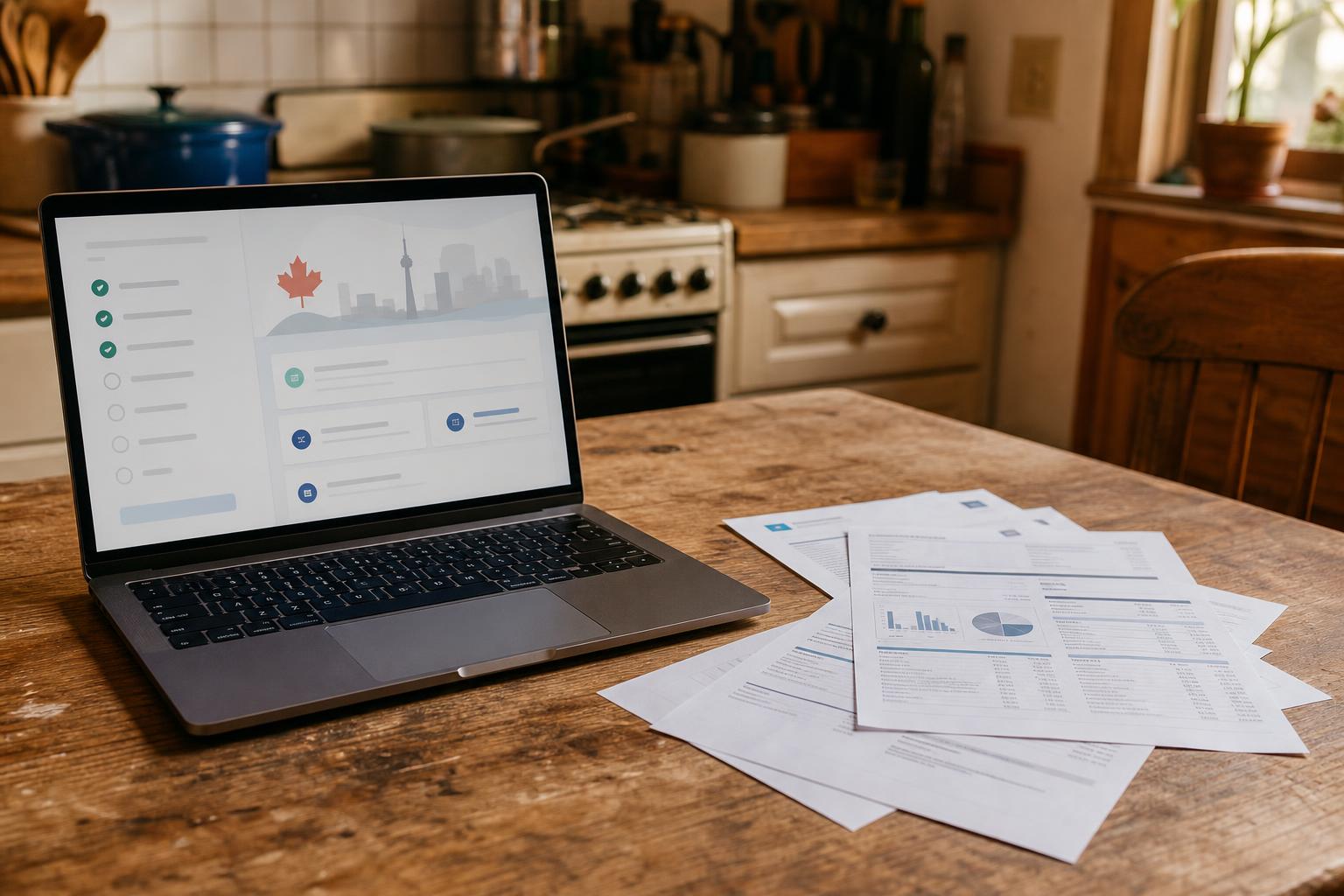
At a glance: How Much Bank Statement For Canada Student Visa: generally, show enough funds for first-year tuition, travel costs, and at least CAN$20,635 for living expenses for one student outside Quebec, according to IRCC’s 2024 requirement.
Quebec has separate amounts. Check the current IRCC proof-of-funds page before applying.
How Much Bank Statement For Canada Student Visa is at least C$20,635 for one student, plus first-year tuition and travel costs, for applications outside Quebec, according to Immigration,.
Refugees and Citizenship Canada’s 2024 study permit financial-support rule.
That figure is not a savings target; it is a minimum proof-of-funds threshold. IRCC says acceptable proof can include bank statements, a Guaranteed Investment Certificate, education loan documents, or scholarship letters.
Caution: weak documentation, unexplained deposits, or underfunding can still lead to refusal.
Canada student visa bank statement minimums
For a Canada study permit, the bank statement is not a fixed “visa fee” requirement. Immigration, Refugees and Citizenship Canada says most students must show enough money for first-year tuition, travel costs, and living expenses.
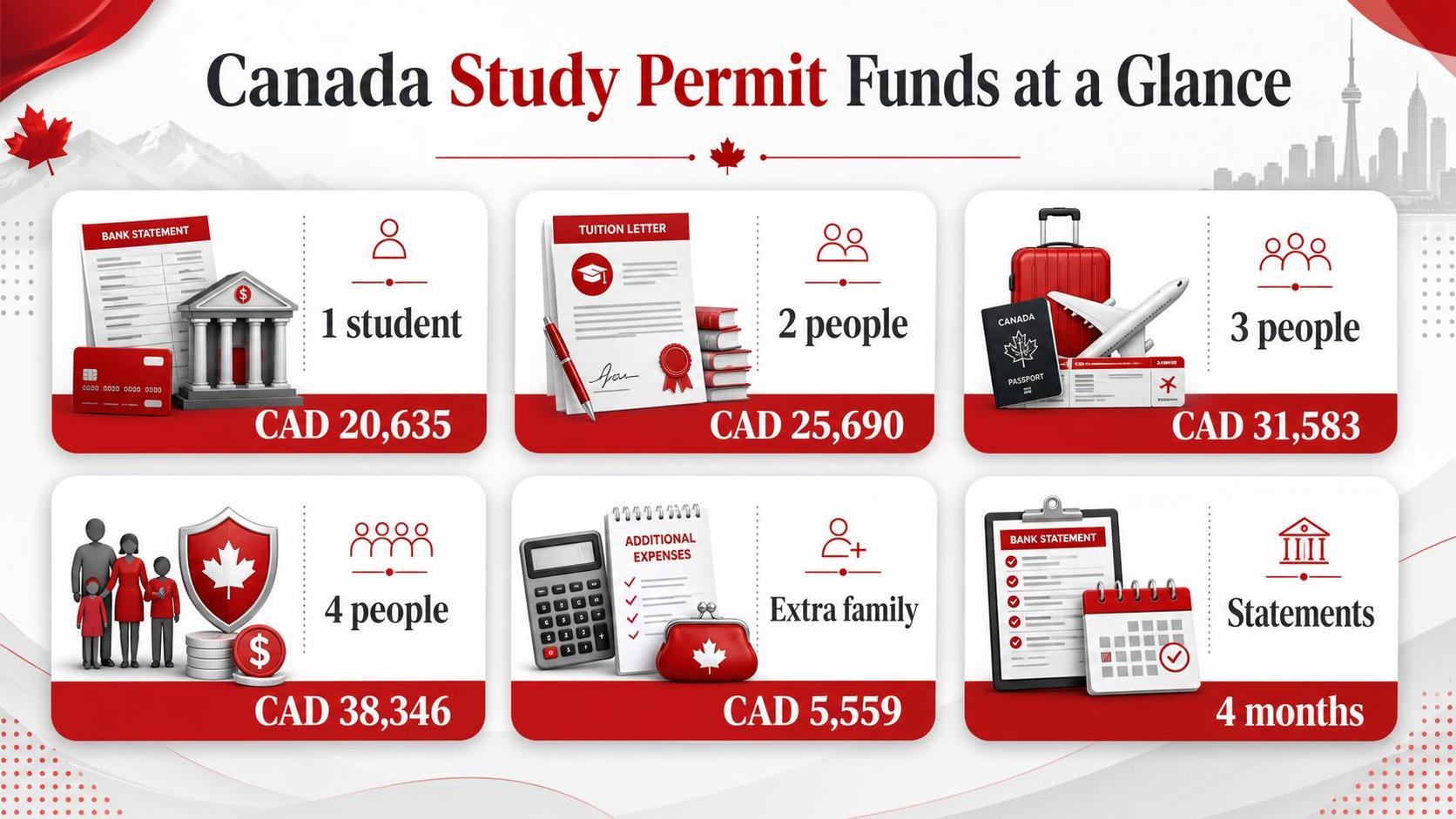
For applications received on or after January 1, 2024, IRCC increased the living-expense minimum for a single study permit applicant outside Quebec to CA$20,635, before tuition and travel.
IRCC says this amount is tied to 75% of Canada’s low-income cut-off.
| Applicant situation outside Quebec | Minimum living funds required by IRCC | What this excludes |
| Student only | CA$20,635 | First-year tuition and travel costs |
| Student plus 1 family member | CA$24,635 | First-year tuition and travel costs |
| Each additional family member | Add CA$3,000 | First-year tuition and travel costs |
Source: IRCC, “Study permit: Get the right documents,” proof of financial support table for applications received on or after January 1, 2024.
Quebec-bound students must check Quebec’s Ministère de l’Immigration, de la Francisation et de l’Intégration rules, because Quebec uses separate financial-capacity requirements.
A practical minimum is therefore first-year tuition plus CA$20,635 plus travel money for one student outside Quebec.
For example, if a designated learning institution lists first-year tuition at CA$18,000, the minimum documented funds would be at least CA$38,635 before airfare or other travel costs.
IRCC accepts several forms of proof, not only a checking-account statement.
Its examples include a Canadian bank account, a Guaranteed Investment Certificate, proof of an education or student loan, bank statements for the past four months, a bank draft, scholarship funding, or proof of paid tuition and housing.
- Trade-off: Showing more than the minimum may help demonstrate affordability, but it does not guarantee approval. IRCC can still refuse an application if the officer doubts the money is available, lawful, or sufficient for the full plan.
- Downside case: A last-minute lump-sum deposit can raise questions. Applicants should be ready to document the source, such as savings history, a loan approval, scholarship award, or sponsor income.
- Currency risk: U.S. applicants holding funds in U.S. dollars should allow room for exchange-rate movement, because IRCC’s thresholds are in Canadian dollars.
Caution: Do not rely on this summary alone when deciding how much to show. Minimums, Quebec rules, and document standards can change; check IRCC and the school’s official tuition estimate before submitting a study permit application.

New 2024 proof of funds amounts
Canada raised the minimum cost-of-living money for most study permit applicants on January 1, 2024. Immigration, Refugees and Citizenship Canada said the single-student amount increased to CA$20,635, before tuition and travel costs.
This is not simply “how much bank statement” is needed. IRCC says applicants must show enough money for first-year tuition, living expenses and return transportation, and the required living-expense amount depends on family size.
| Applicant situation | Minimum living-expense funds outside Quebec | Source |
| Student only | CA$20,635 | IRCC, “Proof of financial support,” effective January 1, 2024 |
| Student plus 1 family member | CA$24,635 total | IRCC: CA$20,635 for the student plus CA$4,000 for the first family member |
| Each additional family member | Add CA$3,000 | IRCC, “Proof of financial support” table for study permits outside Quebec |
| Tuition | Add first-year tuition shown by the school | IRCC says tuition must be covered; the exact figure comes from the designated learning institution’s letter |
| Travel | Add return transportation costs | IRCC lists transportation as part of required financial support |
The policy change was large.
IRCC’s December 7, 2023 announcement said the previous cost-of-living requirement for a single applicant was CA$10,000, unchanged since the early 2000s, and that the new CA$20,635 level equals 75% of Canada’s low-income cut-off.
For a U.S. reader budgeting in dollars, the safer approach is to calculate in Canadian dollars first. Exchange rates move, and IRCC assesses the Canadian requirement, not a fixed U.S.-dollar equivalent.
- Example: If first-year tuition is CA$18,000, a single student outside Quebec should be prepared to document at least CA$38,635 before travel: CA$18,000 tuition plus CA$20,635 living expenses.
- Family example: With one spouse, the living-expense minimum becomes CA$24,635, before tuition and travel.
- Bank statements: IRCC accepts several proof types, including bank statements, a Canadian bank account, a Guaranteed Investment Certificate, education loan documents, scholarship letters or proof of paid tuition and housing.
Caution: Do not rely on the minimum as a personal budget. Rent, deposits, health insurance, winter clothing, flights and exchange-rate losses can make the real cash need higher than the immigration threshold.
Quebec has separate financial-capacity rules, so applicants to Quebec schools should check the Quebec government and IRCC instructions directly before transferring money or submitting documents.

What bank statements must show
For a Canada study permit, bank statements are used to prove the student can pay tuition, living costs and return transportation.
Immigration, Refugees and Citizenship Canada states that proof of funds can include bank statements for the past 4 months, a Canadian bank account, a Guaranteed Investment Certificate, loan documents, or proof of paid tuition and housing.
The key point is not just the ending balance. Officers look for funds that are available, traceable and sufficient for the first year of study, with no unexplained last-minute deposits.
| Item IRCC expects to be covered | Minimum or evidence to show | Source |
| Living expenses for one student, outside Quebec | CAN$20,635 per year, effective Jan. 1, 2024 | Immigration, Refugees and Citizenship Canada study permit proof of financial support guidance |
| First-year tuition | The actual tuition shown on the Canadian school’s letter of acceptance or fee schedule | IRCC requires proof that the student can pay tuition fees |
| Return transportation | No fixed national dollar amount published by IRCC; show funds beyond tuition and living costs | IRCC says applicants must prove they can pay return transportation |
| Bank statement history | Past 4 months of bank statements may be used as proof | IRCC list of acceptable proof of financial support |
- Account holder and access: Statements should show the account holder’s name, account number, institution name and current balance. If a parent or sponsor owns the account, include a sponsor letter and evidence of the relationship.
- Stable funds: A steady balance is stronger than a sudden large deposit. If money recently moved in, provide proof of source, such as payroll records, a sale agreement, tax documents or a bank transfer trail.
- Currency clarity: U.S. applicants using U.S. dollar accounts should show the USD balance and, where helpful, a conservative CAD conversion. Exchange rates move, so keeping a cushion above the IRCC minimum reduces risk.
- Debt versus cash: A student loan can count if documented, but borrowed funds create repayment pressure. The downside is that approval evidence does not make the education affordable if tuition, rent or exchange rates rise.
- Quebec caution: Quebec-bound students have separate financial-capacity rules through Quebec immigration authorities, in addition to federal study permit requirements. Check the current Quebec government instructions before relying on the federal figure alone.
Caution: Do not rely on the minimum number alone. A weak explanation for deposits, missing tuition funds, or an unrealistic budget can still lead to refusal even when the ending balance appears high.

Acceptable alternatives to bank statements
Canada does not require bank statements as the only proof of funds for a study permit.
Immigration, Refugees and Citizenship Canada, or IRCC, lists several alternatives, but the evidence must still show enough money for tuition, travel and living costs.
For applications outside Quebec, IRCC raised the 2024 living-cost threshold to CAN$20,635 for a single student, before tuition and travel. That amount is separate from any school fees shown on the letter of acceptance.
| Alternative evidence | What it can prove | Key limitation |
| Guaranteed Investment Certificate, or GIC, from a Canadian financial institution | IRCC lists a GIC as acceptable proof of financial support. For 2024, the student must still meet at least CAN$20,635 in living costs outside Quebec. | Money may be locked and released in installments after arrival, so it may not cover upfront tuition or travel. |
| Proof of a student or education loan | IRCC accepts proof of a student loan from a bank as financial evidence. | A loan approval may not be enough if funds are conditional, not disbursed, or unclear about currency and amount. |
| Proof tuition and housing were paid | IRCC lists proof of paid tuition and accommodation as acceptable support documents. | Paid fees reduce the amount still needed, but they do not replace the separate living-cost requirement. |
| Scholarship, fellowship, assistantship or school funding letter | IRCC accepts proof of funding paid from within Canada, such as a scholarship or Canadian-funded educational program. | The letter should state the amount, duration and what costs are covered; vague awards may be discounted. |
| Bank draft in convertible currency | IRCC lists a bank draft that can be converted to Canadian dollars as acceptable proof. | Exchange-rate movements and fees can reduce the Canadian-dollar value before the visa officer reviews it. |
For families, IRCC’s 2024 amounts outside Quebec add CAN$4,000 for the first accompanying family member and CAN$3,000 for each additional family member. Tuition and travel costs still have to be shown separately.
- A sponsor letter can help, but it should be backed by evidence such as the sponsor’s income, assets or transfer records.
- A Canadian bank account can be used if money has already been transferred to Canada, according to IRCC’s proof-of-funds list.
- Quebec uses its own financial-capacity rules, so applicants to Quebec schools should check the Quebec government and IRCC instructions before relying on federal figures.
Caution: Do not assume one document is enough. A visa officer can refuse an application if the source, availability or total amount of money is unclear, even when the applicant has some funds.
Currency conversion risks for US applicants
US applicants usually prove funds in US dollars, but Immigration, Refugees and Citizenship Canada assesses the requirement in Canadian dollars.
That creates a timing risk: a balance that looks sufficient today can fall short if the US dollar weakens before the visa officer reviews the file.
For study permit applications outside Quebec, IRCC says a single student must show at least CAD 20,635 for living expenses, plus first-year tuition and travel costs, for applications received on or after January 1, 2024.
Quebec has separate financial-capacity rules.
| Exchange-rate assumption | USD needed for CAD 20,635 | Risk point |
| 1 USD = CAD 1.45 | USD 14,231 | Fewer US dollars are needed when the US dollar is stronger. |
| 1 USD = CAD 1.35 | USD 15,285 | A moderate move changes the required USD balance by more than USD 1,000. |
| 1 USD = CAD 1.25 | USD 16,508 | A weaker US dollar means the same Canadian-dollar requirement needs more US cash. |
Those figures are simple conversions of IRCC’s CAD 20,635 amount, not estimates of total study cost. A real application also needs tuition.
Statistics Canada reported average international undergraduate tuition of CAD 40,114 for 2024/2025, but actual tuition depends on the school and program.
Exchange rates used by banks are not the same as headline rates. The Bank of Canada says its exchange rates are indicative rates for statistical and analytical purposes, not transaction rates.
US banks and money-transfer firms may add spreads or fees.
- Build a buffer. If the minimum is CAD 20,635, holding only the exact USD equivalent leaves no margin for exchange-rate moves, bank fees, or delayed statement dates.
- Match the evidence date. A bank statement from weeks earlier may not reflect today’s exchange rate or current balance.
- Keep tuition separate. Proof of paid tuition or a school invoice can reduce ambiguity, but it does not replace IRCC’s living-expense requirement.
- Check Quebec separately. Quebec-bound students should verify current amounts with the Quebec government and IRCC before relying on any conversion.
Caution: Do not rely on currency conversion alone to decide whether an application is financially ready. Check IRCC’s current instructions, the school’s official tuition bill, and the exchange rate your bank will actually use.

Downside cases that can trigger refusal
Canada does not set a universal “three-month balance” rule for every study permit case.
Immigration, Refugees and Citizenship Canada says officers must be satisfied the student has enough available money for tuition, living costs and return transportation.
A bank statement can hurt the application if it shows money that is too low, unexplained, borrowed temporarily or hard to access. Treat this as general information, not legal advice; a refusal can affect future visa applications.
| Downside case | Why it matters | Source or figure |
| Balance below the minimum living-cost threshold | For study permit applications outside Quebec, the applicant generally must show first-year tuition, travel costs and living expenses. If the funds do not cover all three, the officer may find the student cannot support themself. | IRCC set the 2024 living-cost amount for one student outside Quebec at CAD 20,635, in addition to tuition and travel. |
| Only showing tuition, not living expenses | A paid tuition receipt is useful, but it does not replace proof of rent, food, transportation and other living costs. This is a common budgeting gap for U.S. families comparing Canadian tuition with total cost of attendance. | IRCC lists proof of funds as including money for tuition, living expenses and transportation to and from Canada. |
| Large recent deposits with no paper trail | A sudden transfer can look like “window dressing” unless the source is documented. Officers may question whether the funds are genuinely available to the student. | IRCC says acceptable proof may include bank statements for the past 4 months, bank drafts, education loans, scholarships or letters from financial supporters. |
| Relying on illiquid assets | Home equity, retirement accounts, crypto holdings or business inventory may not prove the student can pay immediate bills in Canada. Forced sales can also create tax or market-loss risks. | IRCC focuses on available financial resources; applicants should document liquid access, not just net worth. |
- Weak sponsor evidence: If a parent, relative or sponsor is paying, the file should show the sponsor’s identity, relationship, income, bank history and written commitment. A bare promise letter may not satisfy an officer.
- Currency and transfer risk: U.S. dollar accounts can be acceptable, but the amount should still clearly meet Canadian-dollar costs. Exchange-rate moves and wire delays can reduce available funds.
- Inconsistent story: A low-income sponsor funding expensive tuition, unexplained cash deposits, or a study plan that does not match career history can raise credibility concerns.
- Quebec programs: Quebec has separate financial-capacity rules through provincial authorities. Applicants should check the current MIFI and IRCC instructions before relying on any general Canada-wide number.
Plain caution: do not borrow money briefly just to inflate a statement. If the funds are not genuinely available for school and living costs, the application may be refused and the student may face a financial shortfall after arrival.
What Coin Abul independently reviewed
Coin Abul independently reviewed Immigration, Refugees and Citizenship Canada guidance on proof of financial support for a Canadian study permit.
The core finding is that a bank statement alone is not a fixed dollar test; IRCC looks for tuition, living costs, travel money, and credible documentation.
For study permit applications outside Quebec, IRCC says applicants must show enough money for first-year tuition, travel costs, and minimum living expenses.
Effective January 1, 2024, IRCC raised the living-expense amount for a single student from CAN$10,000 to CAN$20,635.
| Item reviewed | Amount or requirement | Source |
| Single student living expenses, outside Quebec | CAN$20,635, not including tuition | IRCC study permit financial support guidance, effective January 1, 2024 |
| First accompanying family member | Additional CAN$4,000 | IRCC proof of financial support table |
| Each additional family member | Additional CAN$3,000 | IRCC proof of financial support table |
| Bank-statement lookback commonly requested | Bank statements for the past 4 months are listed as acceptable proof | IRCC “proof of financial support” document examples |
| Currency comparison for U.S. readers | CAN$20,635 was about US$15,064 using the Bank of Canada 2024 annual average of 1 U.S. dollar = CAN$1.3698 | Bank of Canada annual exchange rates, 2024 |
The practical trade-off is liquidity versus credibility. A large last-minute deposit may increase the balance, but it can also raise questions if the source is unclear.
IRCC allows several proof types, including bank statements, a Canadian bank account, a Guaranteed Investment Certificate, education loan proof, scholarship letters, or proof of paid tuition and housing.
- Minimum does not equal safe budget: IRCC’s CAN$20,635 figure excludes tuition and travel. Many Canadian schools publish first-year international tuition that can exceed the living-expense minimum.
- Family members change the math: A student with a spouse would need living-expense proof of at least CAN$24,635 outside Quebec before tuition and travel.
- Quebec is different: Quebec-selected students must follow Quebec financial-capacity rules, so applicants should check Quebec’s immigration ministry and IRCC before relying on the federal outside-Quebec table.
- Exchange-rate risk matters: U.S. applicants funding in dollars should convert using a current bank or central-bank rate, because CAD/USD movement can reduce the apparent cushion.
Caution: Do not borrow money solely to create a temporary bank balance without understanding repayment risk and immigration consequences.
Applicants should verify the latest IRCC page, school cost of attendance, and any Quebec-specific rule before submitting financial documents.
Frequently Asked Questions
How much bank balance is needed for a Canada student visa?
For a study permit outside Quebec, Immigration, Refugees and Citizenship Canada says a single student must show enough money for first-year tuition, travel costs.
And at least CAN$20,635 for living expenses for applications received on or after January 1, 2024.
This figure is from IRCC’s “Study permit: Get the right documents” guidance; check IRCC before applying because proof-of-funds amounts can change.
How many months of bank statements are required for a Canada student visa?
IRCC lists “bank statements for the past 4 months” as one acceptable way to prove financial support for a study permit.
A visa officer may still assess the source, consistency, and credibility of the money, so do not rely on a sudden unexplained deposit without supporting documents.
Does the required bank statement amount include tuition fees?
Yes, the funds should cover tuition separately from living expenses and travel costs. For example, outside Quebec, IRCC’s CAN$20,635 living-expense figure for a single student is in addition to first-year tuition and transportation to Canada.
How much extra money is needed if family members come to Canada?
IRCC’s 2024 proof-of-funds table for study permits outside Quebec lists CAN$25,690 for a family of 2, CAN$31,583 for a family of 3, and CAN$38,346 for a family of 4, excluding tuition and travel.
Larger-family amounts are also listed by IRCC, so applicants should verify the current table before submitting documents.
Can a Canada student visa be approved with less money than the IRCC amount?
Generally, insufficient proof of funds can lead to refusal because IRCC requires evidence that the student can pay tuition, living costs, and travel without unauthorized work.
This is a high-stakes immigration decision, so applicants should check the official IRCC and, for Quebec, Quebec government requirements rather than relying on general online estimates.
Related Reading
- Which Furniture Stores Offer Financing?
- How Much Home Appraisal Cost?
- Why Personal Finance Is Important?
- How To Price Furniture When Selling A House?
- How Much Does A Warehouse Cost?
- What Insurance Does Walgreens Accept?
- What Insurance Company Covers Mounjaro?
- When Does Apartment Prices Go Down?
- Price Of Apartment In Manhattan
- All Blog Guides
Sources & References:
- Immigration, Refugees and Citizenship Canada (2024)
- Immigration, Refugees and Citizenship Canada News Release (2023)
- Immigration, Refugees and Citizenship Canada Program Delivery Instructions (2024)
- EduCanada, Government of Canada (2024)
- Gouvernement du Québec (2024)
- University of Toronto Centre for International Experience (2024)
- University of Waterloo Student Success Office (2024)