
At a glance: Furniture stores that offer financing include Ashley, Rooms To Go, La-Z-Boy, Bob’s Discount Furniture, Raymour & Flanigan, IKEA, Wayfair, and many local retailers.
Options commonly include store credit cards, promotional 0% APR plans, lease-to-own programs, or third-party financing through providers such as Synchrony, Wells Fargo, Affirm, or Bread Pay.
Which Furniture Stores Offer Financing are major chains such as IKEA, Ashley, Wayfair, Rooms To Go, Bob’s Discount Furniture, and La-Z-Boy, typically through store credit cards, lease-to-own, or “0% APR” promotional plans.
Federal Reserve G.19 data reported average credit-card interest at 21.47% APR in November 2024. CFPB says deferred-interest plans can charge retroactive interest if not paid in full.
Compare total cost, fees, credit impact, and cash prices before signing.
Furniture stores with financing options
Several large furniture retailers let shoppers split a purchase into installments or use a store card.
The details matter because a “0%” offer can be cheaper than a personal loan, but some plans carry deferred-interest or high-APR risk if the balance is not cleared on time.
Readers should verify current terms on the retailer’s checkout or credit page before buying. Financing partners, approval standards, and promo windows can change without notice.
| Store | Financing option | Key figures | Source |
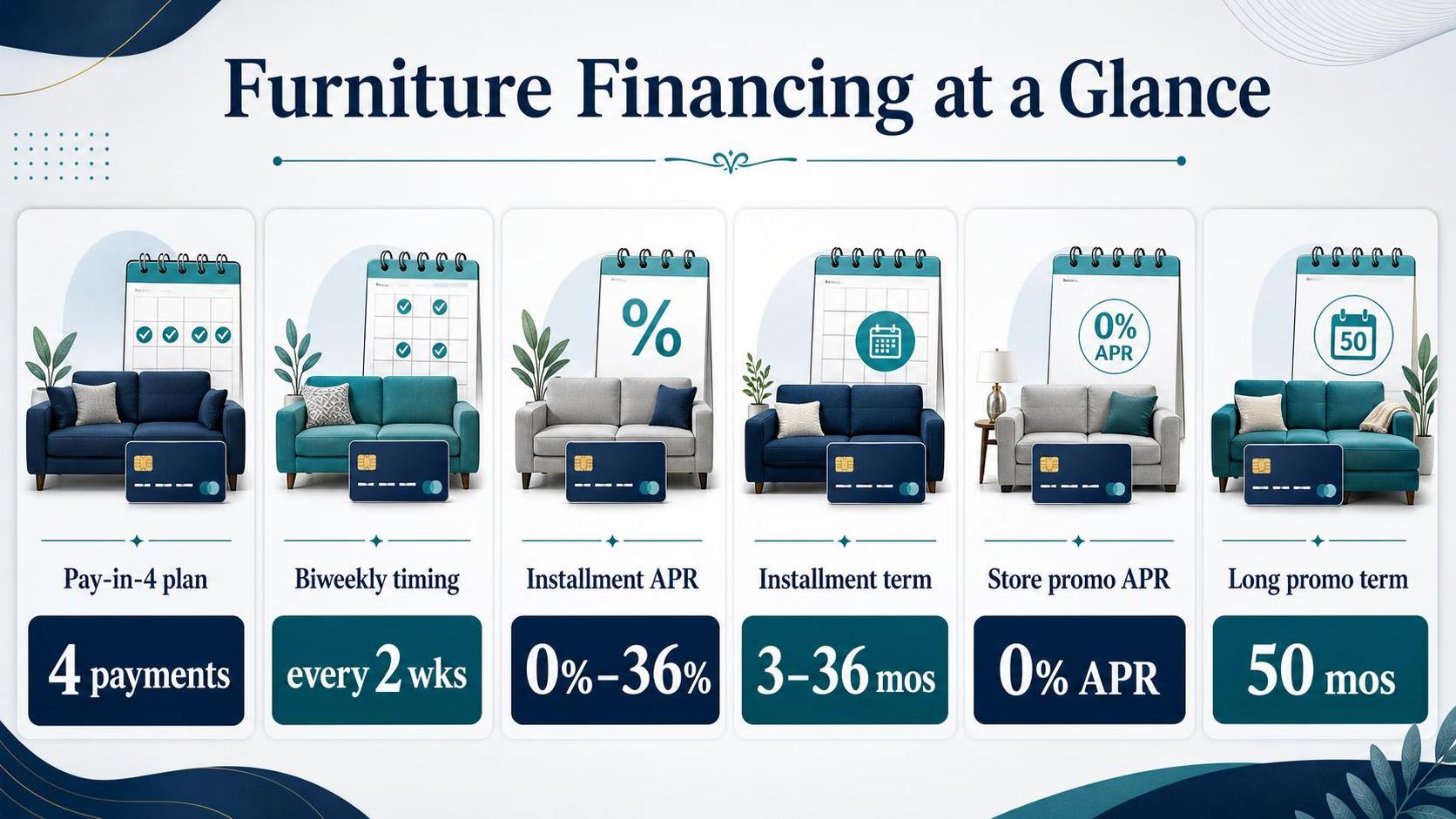
| IKEA | Klarna Pay in 4 | 4 interest-free payments; the remaining 3 payments are collected every 2 weeks. | IKEA financing page and Klarna Pay in 4 disclosures |
| Wayfair | Affirm monthly payments | APR can range from 0% to 36%; terms can range from 3 to 36 months; some plans require a down payment. | Wayfair financing page and Affirm consumer disclosures |
| West Elm | Affirm monthly payments | APR can range from 0% to 36%; payment term depends on purchase amount and eligibility. | West Elm financing page and Affirm consumer disclosures |
| Pottery Barn | Affirm monthly payments | APR can range from 0% to 36%; term length varies by transaction and credit profile. | Pottery Barn financing page and Affirm consumer disclosures |
IKEA also markets the IKEA Projekt credit card.
On IKEA’s U.S. financing page, the retailer discloses promotional 0% APR periods of 6 months on purchases of $500 to $999, 12 months on $1,000 to $2,499, and 24 months on $2,500 or more, subject to credit approval.
The trade-off is flexibility versus cost. Klarna’s Pay in 4 is short and predictable, but Klarna says missed-payment fees can apply, subject to state limits.
Affirm says it charges no late fees, but its disclosed APR can reach 36%, which is expensive if the purchase is stretched out.
Store cards can be useful for large rooms or full-home purchases, especially when a buyer can clear the balance inside the promo period. The downside is deferred-interest risk.
The Consumer Financial Protection Bureau warns that with deferred-interest promotions, failing to pay the full balance by the deadline can trigger interest from the original purchase date.
- Check whether the offer is true 0% APR or deferred interest.
- Compare the monthly payment against the cash price and total repayment.
- Avoid financing furniture if the payment would strain the household budget or outlast the furniture’s useful life.
How store financing usually works
Furniture financing usually comes in two forms: a store credit card or a fixed-payment installment loan. The appeal is speed and low upfront cost, but the risk is that missed terms can turn a “0%” offer into expensive debt.
Most store-card offers are “promotional financing,” not a permanent 0% rate.
The Consumer Financial Protection Bureau says deferred-interest promotions charge no interest only if the full balance is paid by the deadline; otherwise, interest is added from the purchase date, not from the end of the promo period.
| Example | How it works | Real figures | Source |
| Ashley Advantage Synchrony card | Revolving store card with promo financing | 0% APR for 12 months on qualifying purchases; 34.99% variable APR after that | Ashley Advantage credit card pricing and terms, issued by Synchrony |
| Rooms To Go credit card | Revolving store card with promo financing | 0% interest for 50 months on qualifying purchases; 29.99% APR after promo | Rooms To Go financing disclosures |
| IKEA Projekt card | Installment-style card for large purchases | 0% APR for 6, 12, or 24 months depending on purchase amount; 21.99% APR after promo | IKEA Projekt credit card disclosures, issued by Comenity Capital Bank |
With a revolving store card, the credit limit can affect credit-utilization ratios, which matter in FICO scoring. FICO says amounts owed, including utilization, make up 30% of a FICO Score.
Minimum payments are the main trap. A minimum payment may not retire the balance before the promotional deadline.
If the offer uses deferred interest, carrying even a small balance past the end date can trigger interest on the full original purchase amount, according to the CFPB.
Some retailers instead offer installment loans through firms such as Affirm or Progressive Leasing.
Those products can be easier to budget because payments are fixed, but the total cost may be higher, and lease-to-own agreements are not the same as a standard loan.
Read three items before signing: the regular APR, whether the offer is deferred interest or true 0% APR, and the exact payoff date. If the disclosure is unclear, stop and check the lender’s terms directly.
Acting on the headline offer alone can be costly.
Deferred interest and promotional APR risks
“No interest if paid in full” is not the same as a true 0% APR offer. In many furniture-store financing plans, interest is still accruing in the background, and it can be added back if the balance is not fully paid by the deadline.
The risk is simple: one small remaining balance can trigger months of retroactive interest.
The Consumer Financial Protection Bureau, or CFPB, says consumers should read whether the offer is a true promotional APR or a deferred-interest promotion before signing.
Key facts from federal rules and the CFPB are below.
| Fact | Figure | Source |
| Minimum length for a credit-card deferred-interest offer advertised as “no interest” | At least 6 months | Regulation Z, 12 CFR 1026.16(h) |
| Deferred-interest balances paid in full before promo end | More than 75% | CFPB, Data Point: Credit Card Deferred Interest Products (2015) |
| Active deferred-interest accounts assessed deferred interest in a year | More than 20% | CFPB, Data Point: Credit Card Deferred Interest Products (2015) |
The upside is obvious. If the balance is cleared on time, the borrower can avoid interest. The downside is harsher than many shoppers expect, because the backdated interest usually applies from the purchase date, not from the promo-end date.
The CFPB warns that deferred interest can be especially costly when buyers make only minimum payments. Minimum payments are often too low to retire the full promotional balance before expiration, even when every payment is made on time.
Late payment risk matters too. Card agreements can allow a penalty such as a late fee, and missing a payment can also damage credit scores.
The exact fee and APR depend on the issuer’s disclosure, so readers should check the card agreement before using store financing.
A plain caution: do not assume “0%” means free financing.
Check whether the offer says “0% APR” or “no interest if paid in full,” verify the deadline, and calculate the monthly payment needed to reach a zero balance before the promotion ends.
- Ask for the standard APR after the promotion.
- Ask whether unpaid interest is deferred and added back later.
- Ask whether one late payment can end the promotion.
- Keep the payoff schedule in writing.

Credit cards versus store payment plans
Furniture financing usually comes down to two tools: a general-purpose credit card or a store payment plan. The cheaper option depends on the rate, the deadline, and what happens if a balance remains after the promo period.
A plain credit card is more flexible. A store plan can be cheaper if it offers true 0% APR and the balance is cleared on time, but some promotions use deferred interest, which can become expensive fast.
General credit cards often carry high ongoing rates. The Federal Reserve reported the average APR for all credit card accounts assessed interest at 22.76% in February 2024. That matters if a furniture balance lasts longer than expected.
| Option | Verified figure | Source |
| General credit card | 22.76% average APR on accounts assessed interest, February 2024 | Board of Governors of the Federal Reserve System, G.19 Consumer Credit |
| IKEA Projekt credit card | 0% APR for 6 months on $500-$1,499; 12 months on $1,500-$4,999; 24 months on $5,000+ | IKEA / Comenity Projekt Card financing terms |
| IKEA Projekt credit card | 21.99% to 29.99% variable APR after promotional terms | IKEA / Comenity Projekt Card account terms |
| Ashley Advantage Synchrony card | 29.99% APR | Ashley Advantage Credit Card disclosures from Synchrony |
The upside of a general credit card is flexibility. The card can usually be used anywhere, rewards may apply, and many cards do not use deferred-interest language.
If a 0% introductory APR card is available, that can be safer than a store plan because interest is not typically added retroactively.
The downside is approval and cost after the intro period. If a balance rolls over at 22.76% or more, interest can erase any sale discount. A missed payment can also trigger fees and credit-score harm.
Store plans can fit large purchases because the payment schedule is tied to one transaction. Some furniture promotions offer equal monthly payments or 0% APR windows.
Others are deferred-interest offers, where unpaid interest from the purchase date is charged if the full balance is not paid by the deadline.
That structure is the main risk. The Consumer Financial Protection Bureau has warned that deferred-interest promotions can cost consumers more than expected if even a small balance remains at the end of the term.
- Check whether the offer says 0% APR or no interest if paid in full. They are not the same.
- Read the regular APR, late-fee terms, and minimum payment rules in the issuer’s disclosures.
- Do not rely on a monthly payment quote alone. Verify the full payoff date in the lender’s contract.
Caution: before signing, read the card agreement or retail installment contract from the issuer or store. Terms change, and acting on a promo without checking the primary disclosure can lead to retroactive interest or a much higher total cost.
Buy now pay later at furniture retailers
Buy now, pay later can make a sofa or mattress easier to fit into a monthly budget.
It can also raise the total cost fast if the plan charges interest, installment fees, or late fees, so shoppers should check the provider terms on the retailer’s checkout page before agreeing.
Furniture retailers often outsource BNPL to a lender or payment app. Common examples include Wayfair with Affirm, according to Wayfair’s financing page, and IKEA with Klarna, according to IKEA U.S. payment information.
| Provider | Typical structure | Published cost figures | Example furniture retailer |
| Affirm | Pay in 4 or monthly installments | APR from 0% to 36%; terms from 3 to 60 months, according to Affirm | Wayfair |
| Klarna | Pay in 4 or longer-term financing | Pay in 4 is interest-free; financing APR from 7.99% to 33.99%, according to Klarna | IKEA U.S. |
| Afterpay | 4 installments over 6 weeks | No interest; late fees are capped at 25% of the purchase price in most states, according to Afterpay | Varies by retailer |
| Zip | 4 installments over 6 weeks | $1 per installment fee, according to Zip; late fees may apply by state | Varies by retailer |
The main upside is cash-flow flexibility. A $1,200 bedroom set split into four equal payments would mean $300 at checkout and three more $300 payments.
That is simpler than revolving credit, but only if the plan is truly interest-free and the payments fit the budget.
The downside case is missed payments or choosing long-term financing.
The Consumer Financial Protection Bureau said in a 2022 report that BNPL lenders commonly used autopay and that consumers could face overdraft or nonsufficient fund fees if bank balances were short.
The CFPB also warned that borrowers may stack multiple BNPL loans across providers.
- Check whether the plan is a 0% “pay in 4” product or an installment loan with APR.
- Check for per-payment fees. Zip’s published $1 installment fee means four payments add $4 to the purchase price.
- Check late-fee rules and state disclosures. They differ by provider and state.
- Do not assume BNPL builds credit. Some providers report some loans to some bureaus, but not every product.
Caution: do not rely on a BNPL ad alone. Terms can change by merchant, state, and credit profile, so the final disclosure at checkout is the primary source to review before accepting the plan.

What the editorial team checked
We checked how a shopper would actually encounter furniture financing: on retailer financing pages, product pages, and checkout-linked lender disclosures.
We repeated each check on desktop and mobile, then matched the offer language against the lender’s own terms because store copy and issuer copy do not always say the same thing.
Our review focused on four decision points that can change the real cost: the APR, the repayment term, the minimum purchase required to qualify, and whether the offer used deferred interest.
That last point matters because the Consumer Financial Protection Bureau says deferred-interest promotions can charge interest from the purchase date if the balance is not paid in full by the deadline.
| What we checked | What we verified | Source |
| Installment lender terms | Affirm publishes APRs from 0% to 36% and repayment terms from 3 to 60 months. | Affirm |
| BNPL timing | Klarna’s Pay in 4 splits a purchase into 4 interest-free payments taken every 2 weeks. | Klarna U.S. |
| Late-fee cap | Klarna says late fees are capped at $7 per missed payment and never exceed 25% of the order value. | Klarna U.S. |
| Deferred-interest risk | The CFPB warns that if a deferred-interest balance is not fully repaid by the promo end date, interest may be owed from the original purchase date. | Consumer Financial Protection Bureau |
We also checked whether the furniture seller named the actual financing company. In practice, many furniture stores advertise “special financing” while the legal terms sit with a bank, card issuer, or BNPL provider.
If the issuer was not clearly named, we treated that as a transparency problem.
- We looked for a minimum-purchase threshold before any promo term applied.
- We checked whether a hard credit inquiry was disclosed before application.
- We checked whether the offer was a closed-end installment loan, a revolving store card, BNPL, or lease-to-own.
- We checked whether the promotion explained what happens after the intro period ends.
The downside case was part of the test, not an afterthought. A “0%” headline can still be expensive if it is deferred interest, and a short Pay in 4 plan can still strain cash flow if the purchase is large.
Readers should confirm the final Truth in Lending disclosures before applying because store promotions can change without notice.
Costs when payments are missed
Missing a payment on furniture financing can raise the cost fast. The risk is not only a late fee. Some store cards also carry very high regular APRs, so a missed payment can leave a balance growing at credit-card rates.
The exact cost depends on the issuer and promotion. Check the account-opening disclosure and promo terms before using any “no interest” offer, because one missed due date can be expensive and some plans have deferred-interest rules.
| Store financing example | Regular APR | Late fee | Source |
| Ashley Advantage Credit Card | 34.99% | Up to $41 | Ashley/Synchrony credit card disclosures |
| La-Z-Boy Furniture Galleries Platinum Credit Card | 34.99% | Up to $41 | La-Z-Boy/Synchrony credit card disclosures |
| Rooms To Go Synchrony financing | 34.99% | Up to $41 | Rooms To Go/Synchrony credit card disclosures |
Those figures matter because a high APR can outweigh the value of a promotion once a balance rolls over. At 34.99% APR, interest accrues at roughly 0.0959% per day, based on a 365-day year.
On a $2,000 balance, that is about $1.92 in interest per day.
Deferred-interest offers can be the bigger hazard.
The Consumer Financial Protection Bureau said deferred-interest promotions on private-label and retail cards can charge interest from the original purchase date if the full promo balance is not paid by the deadline.
That means the cost can be retroactive, not merely future interest.
The CFPB also reported in a 2015 study that more than 20% of consumers with deferred-interest promotions paid deferred interest. That is the downside case many shoppers miss when comparing “0%” offers with simple-installment plans.
- A missed payment can trigger a late fee immediately. In the examples above, the disclosed fee is up to $41.
- If a promotional balance is not paid in full on time, deferred interest may be added back to the purchase date, depending on the contract.
- Carrying any remaining balance after the promotion can expose the purchase to a regular APR of 34.99% in the disclosures above.
Caution: do not assume all “0%” furniture financing works the same way. Read the Schumer box, the promo expiration date, and the deferred-interest language in the primary disclosure before signing.
When furniture financing is worth avoiding
Furniture financing is often worth avoiding when the deal depends on deferred interest, a long payoff schedule, or a purchase that strains the household budget.
The low monthly payment can look manageable, but the cost can rise fast if the balance is not cleared exactly on time.
The main risk is that many store promotions are not the same as a true 0% APR loan.
The Consumer Financial Protection Bureau says deferred-interest promotions can charge interest retroactively from the purchase date if the balance is not paid in full by the end of the promo period.
That can turn a cheap-looking purchase into expensive revolving debt.
| Warning sign | Real figure | Source | Why it matters |
| Credit card balances are already expensive | 20.75% average APR for all credit card accounts assessed interest in Q4 2024 | Board of Governors of the Federal Reserve System, Consumer Credit report | If furniture financing converts to a standard card balance, the ongoing rate can be high. |
| Late fees can stack on top of interest | Up to $8 proposed cap for large card issuers was blocked; standard higher late-fee practices remain in place during the litigation | Consumer Financial Protection Bureau and federal court filings in 2024 | A missed payment can trigger fees and, on some promos, loss of the promotional terms. |
| Households are already carrying heavy card debt | $1.21 trillion in total U.S. credit card debt in Q4 2024 | Federal Reserve Bank of New York, Household Debt and Credit Report | Taking furniture financing on top of existing balances raises rollover risk. |
| Minimum-payment structures can keep debt around | The CFPB has repeatedly warned that minimum payments on revolving products can extend repayment for years | Consumer Financial Protection Bureau | A low required payment may fit the month, but not the budget over time. |
Avoid financing if the purchase is discretionary and the promotional deadline is tight. A six-, 12-, or 18-month offer only works if the buyer can divide the full purchase by the exact number of months and pay that amount every month without fail.
- Avoid it when income is variable. One missed month can erase the value of the promotion.
- Avoid it when the contract uses the phrase deferred interest instead of 0% APR.
- Avoid it when delivery fees, protection plans, or add-ons are being financed too, because interest may apply to the full bundled amount.
- Avoid it when cheaper options exist, such as saving first, buying used, or choosing a lower-cost item.
Plain caution: do not rely on the advertisement alone. Read the cardholder agreement, the promotional disclosure, and the late-payment terms before signing.
If the terms are unclear, check the issuer’s disclosure directly, because the downside can be costly and hard to reverse.
Frequently Asked Questions
Which furniture stores commonly offer financing?
Many large U.S. furniture chains advertise financing, including Ashley, Rooms To Go, Raymour & Flanigan, Bob’s Discount Furniture, Havertys, and La-Z-Boy, usually through a third-party lender or store credit card.
Terms change often, so readers should verify the current promotion, annual percentage rate, fees, and deferred-interest conditions on the retailer’s official financing page before applying.
Do furniture stores usually finance purchases directly?
Usually not.
In many cases, the store markets the offer, but the financing is issued by a bank or finance company such as Synchrony, Bread Financial, Wells Fargo, TD Bank, or Progressive Leasing.
So approval and contract terms come from that provider rather than the showroom.
What types of financing are most common at furniture stores?
The most common offers are promotional store credit cards, installment loans, lease-to-own agreements, and buy now, pay later plans.
A plain caution applies here: deferred-interest promotions can charge interest from the purchase date if the balance is not paid in full by the deadline.
So consumers should read the cardholder agreement and Truth in Lending disclosures before relying on the monthly payment shown in advertising.
Can someone with bad credit get furniture financing?
Some stores promote options for a wider credit range, often through lease-to-own providers or alternative installment lenders, but that usually means higher total cost than prime-credit promotional financing.
Because pricing and approval standards vary by provider and state, readers should compare the total of payments, any initial payment, late fees, and purchase-option terms on the provider’s contract, not only the store advertisement.
Are 0% interest furniture financing deals always interest-free?
No. Some offers are true 0% APR for a fixed term, while others are deferred-interest promotions where interest is waived only if the full balance is paid on time under the contract terms.
The Consumer Financial Protection Bureau warns consumers to understand deferred-interest offers because back interest can be added if the balance remains after the promotional period.
What should shoppers compare before using furniture store financing?
Shoppers should compare the APR, promotional period length, minimum monthly payment, late fees, deferred-interest rules, down payment, and total repayment amount across at least two or three options.
For cost and legal details, the safest step is to review the lender’s Truth in Lending disclosure, the retailer’s financing terms, and any state-specific leasing or credit notices before signing.
Related Reading
- How Much Home Appraisal Cost?
- How Much Does A Warehouse Cost?
- Creative Ways To Save Money – What You Need to Know
- How Much Bank Statement For Canada Student Visa?
- How To Open A Restaurant With No Money?
- How To Price Furniture When Selling A House?
- What Bank Is Cash App On Plaid?
- When Does Apartment Prices Go Down?
- Price Of Apartment In Manhattan
- All Blog Guides