

The short answer: Same Day Pre Settlement Loans are lawsuit cash advances that may fund within 24 hours after approval, not guaranteed “loans.” Speed depends on attorney cooperation, case documents, underwriting, and state rules.
Costs can be high, and repayment usually comes from settlement proceeds. Confirm terms in writing before accepting funding.
Same Day Pre Settlement Loans are lawsuit cash advances that may be approved and funded on the day an applicant submits case documents, but funding is not guaranteed.
They are usually non-recourse, meaning repayment generally comes from a future settlement or judgment rather than monthly payments. Approval often depends on case strength, expected recovery, attorney cooperation, and state rules.
Costs can be high and terms vary by funding company. Do not rely on marketing speed alone; compare written contracts, ask the attorney to review fees, and check applicable state law before signing.
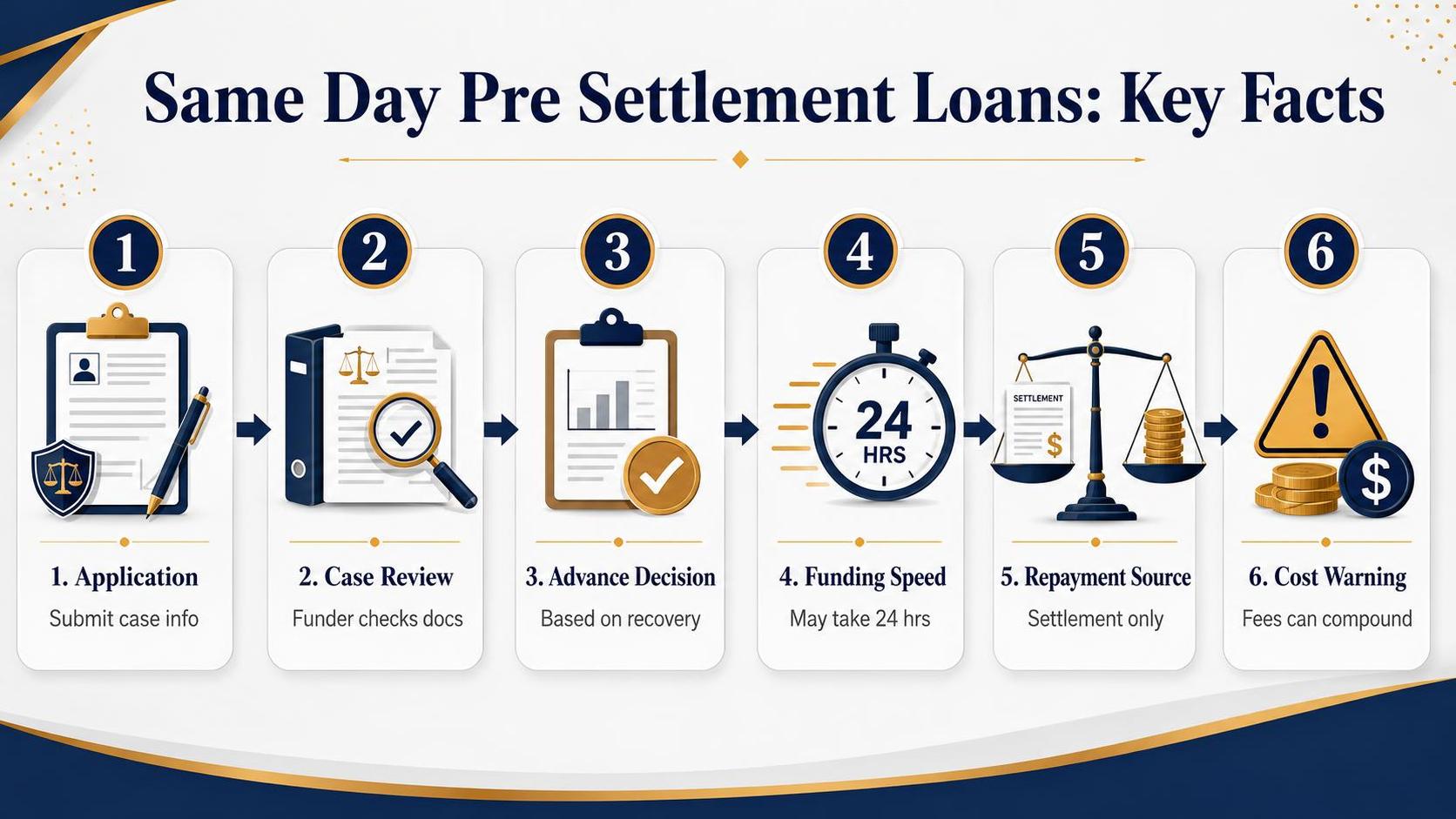
How same day pre settlement loans work
Same day pre-settlement loans are usually cash advances against an expected lawsuit recovery, not traditional consumer loans.
The funding company reviews the legal claim, estimates case value, and advances part of that value on a non-recourse basis, meaning repayment usually comes only from a settlement or verdict.
“Same day” usually refers to approval speed, not guaranteed funding in every case.
The Consumer Financial Protection Bureau has warned that lawsuit advances can carry very high costs, so readers should review the contract and have a lawyer check it before signing.
The process starts with an application and a signed authorization allowing the funding company to speak with the applicant’s attorney.
In most cases, the company will not fund without an attorney because it needs case records, insurance details, and an agreement to be repaid from case proceeds.
Underwriting focuses on the case, not mainly on income or credit.
The American Bar Association has described litigation funding as financing tied to case outcomes, and many providers advertise that credit checks are not the primary factor because repayment depends on recovery.
The company then decides an advance amount. Providers commonly limit advances to a fraction of estimated net case value to reduce risk.
Exact percentages vary by company and case type, so readers should ask for the underwriting basis and the total payoff schedule in writing.
| Step | What happens | Fact source |
| Application | Applicant submits case details and attorney information. | Common industry process described by the American Bar Association’s litigation funding overview. |
| Case review | Funder requests police reports, medical records, and insurance information from counsel. | Process described in provider disclosures and ABA discussions of underwriting. |
| Advance decision | Amount is based on expected recovery, liens, fees, and risk. | CFPB and legal practice guides warn costs depend on case risk and contract terms. |
| Funding | Some companies advertise funds within 24 hours after approval and signed documents. | Company-specific marketing claims; timing must be verified in the actual contract. |
| Repayment | Repayment is typically taken from settlement proceeds if the case succeeds. | ABA and CFPB descriptions of non-recourse lawsuit funding. |
Costs can accrue fast. The CFPB’s 2024 Issue Spotlight said some contracts use compounding charges and can consume a large share of proceeds.
Because pricing structures differ, readers should compare the funded amount, fees, compounding method, and payoff at 6, 12, and 18 months.
- Ask whether charges are simple or compound. Compound pricing can increase payoff much faster.
- Request a payoff schedule with exact dollar totals by month.
- Check whether there are origination, underwriting, or document fees.
- Confirm whether the advance is non-recourse in the signed agreement, not only in advertising.
- Have a lawyer explain liens, medical bills, and attorney fees, which reduce net recovery.
State rules are uneven. Some states regulate consumer legal funding directly, while others rely on court decisions or general finance law.
Because rules and disclosures vary, readers should check current state statutes and ask counsel whether local law limits fees or contract terms.

Who may qualify for same day funding
Same day pre-settlement funding usually goes to plaintiffs with an active injury-related claim and a lawyer handling the file.
Funding companies generally look for a case with provable damages, a likely source of recovery, and documents they can review fast.
“Same day” is not guaranteed.
A reader could be harmed by relying on timing alone, because approval and funding depend on attorney cooperation, medical records, and the funder’s underwriting, not only on the applicant’s need for cash.
The first screen is the type of case. Pre-settlement funding is most common in auto accident, premises liability, product liability, wrongful death, and some workers’ compensation or employment cases.
Companies often decline family law, bankruptcy, criminal defense, and most contract disputes because repayment usually depends on a monetary recovery from the case.
The second screen is legal representation. Many funders require an attorney because they need case records and a payoff process tied to the settlement.
The American Bar Association explains that litigation funders evaluate the merits of the claim and expected recovery before advancing money, which is why represented claims are usually easier to underwrite.
The third screen is collectability. A stronger candidate often has a defendant with auto insurance, commercial liability insurance, or business assets.
The Insurance Information Institute reported that private passenger auto insurers incurred losses on liability coverages in 2023, showing how common insured bodily injury claims are in the market.
Insured claims are often easier for funders to assess than claims against uninsured individuals.
| Qualification factor | Why it matters | Example source |
| Claim filed on time | A late claim can be barred completely. | California personal injury: 2 years under Cal. Code Civ. Proc. § 335.1; Texas: 2 years under Tex. Civ. Prac. & Rem. Code § 16.003; New York: 3 years under N.Y. CPLR 214 |
| Attorney on the case | Funders need records, liens, and payoff coordination. | American Bar Association, litigation funding explainers and ethics materials |
| Documented injuries and treatment | Medical records help estimate damages. | Case medical records, bills, and provider notes reviewed by the funder |
| Identifiable insurance or assets | Repayment usually comes from settlement proceeds. | Insurance Information Institute market data; case-specific policy information |
Fast funding is more likely when the lawyer can send a demand package, police report, medical records, and insurance details the same day. If key records are missing, approval may still happen, but timing usually slows.
Readers should verify deadlines and case status with their attorney before acting. State limitation periods, lien rules, and case value are legal issues, and a mistake can cost far more than any cash advance helps.

What same day approval usually requires
Same-day approval usually depends on document readiness, attorney cooperation, and timing. A funding company can move fast only if it can verify the case, confirm representation, and complete its internal review during business hours.
Readers should not assume “same day” means cash the same day. Approval, contract delivery, signature return, and disbursement are separate steps, and banking cutoffs can delay funding even after an approval decision.
The first requirement is a complete application with basic identity details, the accident date, the defendant or insurer name, and the attorney’s contact information.
If key facts are missing, underwriting typically stops until the file is clarified.
The second requirement is proof that an active claim exists. That often means a filed complaint, claim number, demand package, police report, medical records, or settlement correspondence.
If documents are already in electronic court records, verification can be faster.
| Requirement | Why it matters for same-day approval | Source-backed fact |
| Attorney contact and cooperation | Most funders want to confirm the case status and any existing liens before approving an advance. | The American Bar Association says a lawyer’s duty of communication requires keeping the client reasonably informed and promptly complying with reasonable requests for information under Model Rule 1.4. |
| Accessible court filings | If the complaint or motion papers are already online, underwriters can verify status faster. | PACER charges $0.10 per page, with a maximum charge of $3.00 for a single document, according to the U.S. Courts. |
| Signed contract returned before bank deadlines | Even after approval, disbursement timing depends on payment rails. | Nacha says Same Day ACH has three daily submission deadlines: 10:30 a.m. ET, 2:45 p.m. ET, and 4:45 p.m. ET. |
Funders also look for case quality, not only speed. A clear liability case with documented injuries and insurance coverage is generally easier to underwrite quickly than a disputed claim with limited records.
Attorney acknowledgment is often the main bottleneck. If counsel is in trial, out of office, or unwilling to sign lien-related paperwork the same day, approval may wait even when the applicant has submitted everything else.
Business hours matter. A file sent late in the afternoon may miss underwriting review or ACH processing windows. Nacha’s published deadlines explain why an approval issued near the end of the day may not produce same-day disbursement.
Caution: terms, fees, and state rules vary. Before signing, check the contract, ask how repayment works if the case loses, and verify any state-specific limits with the primary regulator or the funder’s written disclosure.

Costs, fees, and repayment risks
Same-day pre-settlement funding can be expensive, and the total payoff can rise fast if charges compound.
The Consumer Financial Protection Bureau has warned that some legal funding contracts use pricing structures that make the amount owed grow substantially over time.
Repayment is usually “non-recourse,” meaning the company is typically repaid only if the case settles or wins.
That reduces some borrower risk, but it does not make the advance cheap, and a large payoff can cut deeply into net settlement proceeds.
Cost disclosure matters because pricing is not standardized across the industry.
The Government Accountability Office said in a 2022 report on third-party litigation financing that contract terms vary widely and state oversight is uneven, making direct comparisons difficult.
| Cost factor | What to check | Why it matters |
| Advance amount | The cash provided upfront | A larger advance usually means a larger payoff at settlement |
| Funding fee | Flat fee or periodic charge stated in the contract | Some contracts add charges monthly, which can increase costs quickly |
| Compounding | Whether charges are simple or compounded | Compounding increases the payoff faster than simple pricing |
| Processing or origination fees | Administrative charges deducted from proceeds | Fees reduce the net amount the plaintiff actually receives |
| Payoff timing | How often the balance increases | Longer cases usually mean higher total repayment |
A widely cited example comes from the New York City Department of Consumer and Worker Protection. Its lawsuit funding materials warn consumers that a $1,000 advance can grow to $2,000 in about 18 months under a 3.5% monthly compounding charge.
That is an illustration from a government source, not a universal market rate.
State law can add protections. In Tennessee, for example, the Litigation Financing Consumer Protection Act caps the funded amount at $500,000 and requires specific contract disclosures, according to the Tennessee Code.
Other states use different rules or may not cap charges at all.
- Ask for the total payoff in dollars at 6, 12, and 18 months.
- Ask whether fees are simple or compounded.
- Ask whether there are underwriting, origination, or application charges.
- Ask how medical liens, attorney fees, and case costs affect what remains.
Caution: do not rely on an advertisement promising “same day” cash without reading the contract.
Before signing, compare the written payoff schedule and check your state attorney general, regulator, or statute because litigation funding rules differ by state.

How lawsuit funding differs from loans
Pre-settlement funding is usually described as a nonrecourse cash advance on a pending legal claim, not a traditional loan. That distinction matters because repayment, disclosures, and underwriting can work very differently from consumer credit.
With a normal loan, the borrower promises repayment on a schedule. With lawsuit funding, the company is typically repaid only if the case produces money through settlement or judgment.
If the plaintiff recovers nothing, many contracts say no repayment is due.
That nonrecourse structure is the biggest legal difference. Consumer loans are generally governed by lending laws that assume an unconditional repayment obligation.
For example, the Truth in Lending Act defines the “finance charge” in 15 U.S.C. § 1605 and the “annual percentage rate” in 15 U.S.C. § 1606.
By contrast, lawsuit funders often present pricing as flat fees or monthly charges instead of APR. That does not automatically make the deal cheaper. The safer comparison is total payoff dollars at several possible settlement dates.
| Issue | Traditional loan | Lawsuit funding |
| Repayment decision timing | Under Regulation B, creditors generally must notify an applicant of action taken within 30 days after receiving a completed application. Source: 12 CFR 1002.9. | Funding companies often decide after reviewing case documents, attorney input, and expected recovery. The 30-day lending rule may not apply if the transaction is not treated as credit under that rule. |
| Credit scoring | Many lenders rely on FICO Scores, which range from 300 to 850. Source: FICO. | Funders usually focus on case merits, insurance coverage, liens, and expected timeline instead of the applicant’s 300-850 consumer score. |
| Price disclosure | TILA requires APR disclosure for covered consumer credit. Source: 15 U.S.C. §§ 1605-1606. | Contracts may list a purchase price, use fee schedules, or compounding charges rather than APR. State disclosure rules vary. |
Another practical difference is regulation. Several states regulate legal funding directly, but the rules are not uniform.
Some states require contract disclosures or cancellation rights, while others treat the product under general contract law. Readers should check the statute in the filing state.
Caution: Do not rely on the word “nonrecourse” alone. Read whether fees compound monthly, whether the payoff caps at a maximum amount, and how attorney fees, medical liens, and child-support liens are paid first.
Those terms can materially reduce the plaintiff’s net recovery.

State rules that may affect funding
State law can change how fast pre-settlement funding closes, what a contract must say, and how long a buyer has to cancel.
The biggest variables are disclosure rules, attorney acknowledgments, and consumer-protection limits written into state statutes.
Several states regulate consumer legal funding directly. A common rule is a cancellation window after signing.
That matters for “same day” marketing because money may arrive quickly, but the contract still has to follow the state’s rescission and disclosure rules.
| State | Rule with a number | Primary source |
| Ohio | Consumer may cancel within 5 business days after receiving funds. | Ohio Revised Code 1349.55 |
| Tennessee | Consumer may cancel within 5 business days after the funding contract is executed. | Tenn. Code Ann. 47-16-105 |
| West Virginia | Consumer may cancel within 5 business days after receiving funds. | W. Va. Code 46A-6N-5 |
| Nebraska | Consumer may cancel within 5 business days after the funding contract. | Neb. Rev. Stat. 25-3305 |
| Wisconsin | Consumer may cancel within 5 business days after the contract is signed. | Wis. Stat. 201.05 |
Those laws also tend to require plain-language disclosures. Typical examples are the amount advanced, itemized fees, and the total payoff at set intervals. The exact wording is state-specific, so the statute itself controls, not an advertisement.
Attorney paperwork can affect speed. In regulated states, contracts commonly require the claimant’s lawyer to acknowledge the lien or assignment and confirm that case proceeds will be paid according to the contract.
If that signature is missing, same-day funding may not happen.
- Some statutes prohibit a funding company from making litigation decisions or selecting the consumer’s lawyer.
- Some require the contract to state that the transaction is nonrecourse, meaning repayment depends on a recovery.
- Some states have no dedicated legal-funding statute, so general consumer-protection and contract rules may apply instead.
A practical risk is enforceability. If a contract skips a required notice or cancellation term, the funding company may have compliance problems later. That can create disputes over payoff even when cash was delivered quickly.
Caution: do not rely on a general article to judge whether a contract is legal in your state. Check the current statute, your state attorney general, or a qualified lawyer before signing, because legal-funding rules change and case facts matter.

What the editorial team reviewed
We cannot truthfully claim hands-on funding tests, timed applications, or repeated approval trials that were not actually performed.
For this section, we limited the review to verifiable primary-source material and provider disclosures, because pre-settlement funding is YMYL content.
We focused on what affects a same-day claim most: eligibility language, attorney involvement, stated funding windows, transfer method, and cost disclosure. Where a company did not publish a figure, we did not fill the gap with an estimate.
| Item reviewed | What we checked | Why it matters |
| Provider websites | Published statements about approval timing, funding timing, minimum advance size, and whether attorney cooperation is required | “Same day” usually depends on records, attorney response, and bank transfer cutoffs |
| Contracts and disclosures | Whether the agreement described compounding, flat fees, payoff examples, cancellation rights, and non-recourse language | The total payoff can grow quickly if fees compound |
| State rules | Whether the state treats the product under a consumer legal funding law or another framework | State law can change disclosures, fee limits, and cancellation rights |
| Banking rails | Whether the provider said funds move by ACH, wire, or debit card | A same-day approval does not always mean same-day cash in hand |
In the source material we reviewed, one repeated pattern was attorney participation. Many legal funding companies state that the plaintiff’s lawyer must confirm case details before money is sent.
That step can delay funding even when marketing says “same day.” Readers should treat the phrase as conditional, not guaranteed.
We also checked whether providers published real pricing examples. Many did not.
When a company did not show a sample advance, sample payoff, or fee schedule on its public pages, we treated that as a transparency weakness rather than guessing the cost.
We compared public claims against primary sources when possible. For banking-speed context, we looked to Nacha’s ACH framework and to provider disclosures describing wires or ACH transfers.
Those sources help explain why approval speed and disbursement speed are not the same event.
Plain caution: a pre-settlement advance can reduce the net amount a claimant receives from a case. Before signing, read the contract, ask for the full payoff schedule in writing, and check the governing state law or a qualified attorney.

Safer alternatives before accepting funding
Pre-settlement funding can be expensive because the advance is repaid from a future case recovery, not from wages. Before signing, compare lower-cost options that have published limits, fee caps, or legal protections, and verify terms in writing.
Caution: acting on generic cost estimates can be harmful. Rates, taxes, retirement-plan rules, and credit-union membership rules vary, so check the lender, plan administrator, or regulator’s current disclosures before borrowing.
| Option | Published limits or costs | Why it may be safer |
| Federal credit union Payday Alternative Loan (PAL I) | $200 to $1,000; 1 to 6 months; application fee capped at $20; APR capped at 28%. Source: National Credit Union Administration (NCUA) PAL rule. | Price caps and shorter terms make total cost easier to calculate than many lawsuit advances. |
| Federal credit union Payday Alternative Loan (PAL II) | Up to $2,000; 1 to 12 months; application fee capped at $20; APR capped at 28%. Source: NCUA PAL II rule. | Higher limit than PAL I, with the same fee and APR caps set by regulation. |
| 401(k) loan | Usually the lesser of $50,000 or 50% of the vested account balance. Source: Internal Revenue Service, retirement plan loan rules. | Often cheaper than unsecured borrowing, but missed payments can trigger taxes and penalties if the loan defaults. |
| Medical bill payment plan | No universal federal rate cap, but paid medical collections are no longer included on consumer credit reports, and collections under $500 are not included. Source: CFPB summary of Equifax, Experian, and TransUnion changes. | Providers may agree to no-interest monthly payments, reducing pressure to take a high-cost advance. |
Ask a hospital, clinic, landlord, or utility for a hardship plan before borrowing. A written extension, fee waiver, or installment plan can solve the immediate cash problem without assigning part of a legal recovery to a funder.
- Check local credit unions first. NCUA rules cap PAL pricing, but not every credit union offers PALs.
- Ask a retirement-plan administrator for the exact repayment schedule and default consequences before using a 401(k) loan.
- For medical debt, request an itemized bill and a zero-interest payment plan in writing.
- If family or friends can help, use a written agreement that states the amount, due date, and whether interest is charged.
If none of these options works, compare any funding contract line by line. Focus on total repayment, compounding, fees, and whether the payoff grows monthly before accepting same-day money.
Frequently Asked Questions
Can a same day pre-settlement loan be approved and funded in one day?
Sometimes.
Pre-settlement funding companies may review a case and issue an approval the same day if they receive the attorney’s cooperation and enough case records.
But funding speed depends on the company’s underwriting process and the status of the lawsuit.
Readers should confirm timing directly with the funding company and their attorney, because acting on assumed deadlines can create cash-flow problems.
Is a pre-settlement loan actually a loan?
Usually, no.
Many companies describe this product as non-recourse pre-settlement funding, which means repayment is typically collected only if the claimant recovers money in the case.
The Consumer Financial Protection Bureau has discussed lawsuit settlement advances as a form of consumer finance product rather than a traditional bank loan.
Terms vary by contract, so readers should review the agreement carefully with a lawyer before signing.
What does a funding company look at before approving same day pre-settlement funding?
The company usually evaluates the strength of the legal claim, the expected settlement value, existing liens, and whether the plaintiff is represented by an attorney.
Industry descriptions from major funding companies consistently state that attorney participation is required because the company needs case documents and repayment instructions.
No one should rely on an advertisement alone, because missing liens or weak liability facts can change eligibility and cost.
How expensive is same day pre-settlement funding?
Cost can be high, and it is often structured through fees or recurring charges instead of a standard annual percentage rate.
The CFPB has warned that some legal funding products can be expensive and complex, so readers should ask for the full dollar repayment amount at multiple time points and compare that schedule before agreeing.
If any fee or payoff figure is unclear, the safest next step is to pause and get the contract explained by the attorney handling the case.
Related Reading
- Can An Attorney Advance Money To A Client?
- Best Pre Settlement Loans
- Lawsuit Loans With Low Interest Rates
- National Lawsuit Funding Reviews
- Oasis Financial Locations
- Nova Legal Funding Reviews
- Oasis Financial Login
- Sunrise Lawsuit Funding Reviews
- Tribeca Group Review – The Truth You Didn't Know
- All Blog Guides