

Bottom line: Structured settlement annuity companies are typically life insurance companies that issue guaranteed annuity contracts to fund injury settlements, workers’ compensation claims, or wrongful-death payments.
Major U.S. issuers have included companies such as MetLife, Pacific Life, Prudential, and New York Life; availability depends on the settlement broker, court approval, and insurer financial strength.
Structured Settlement Annuity Companies are life insurers that issue court-approved annuities to fund periodic payments after personal injury, workers’ compensation, or wrongful-death settlements.
They do not usually buy payment rights; factoring companies handle purchase offers.
This article explains how insurers such as MetLife, Pacific Life, Prudential, and other highly rated carriers fit into structured settlements, how financial strength ratings matter, and what to verify before relying on any payment promise.
Caution: do not sell, assign, or replace settlement payments based on general information alone; review the annuity contract, court order, tax treatment, and state law with qualified professionals.
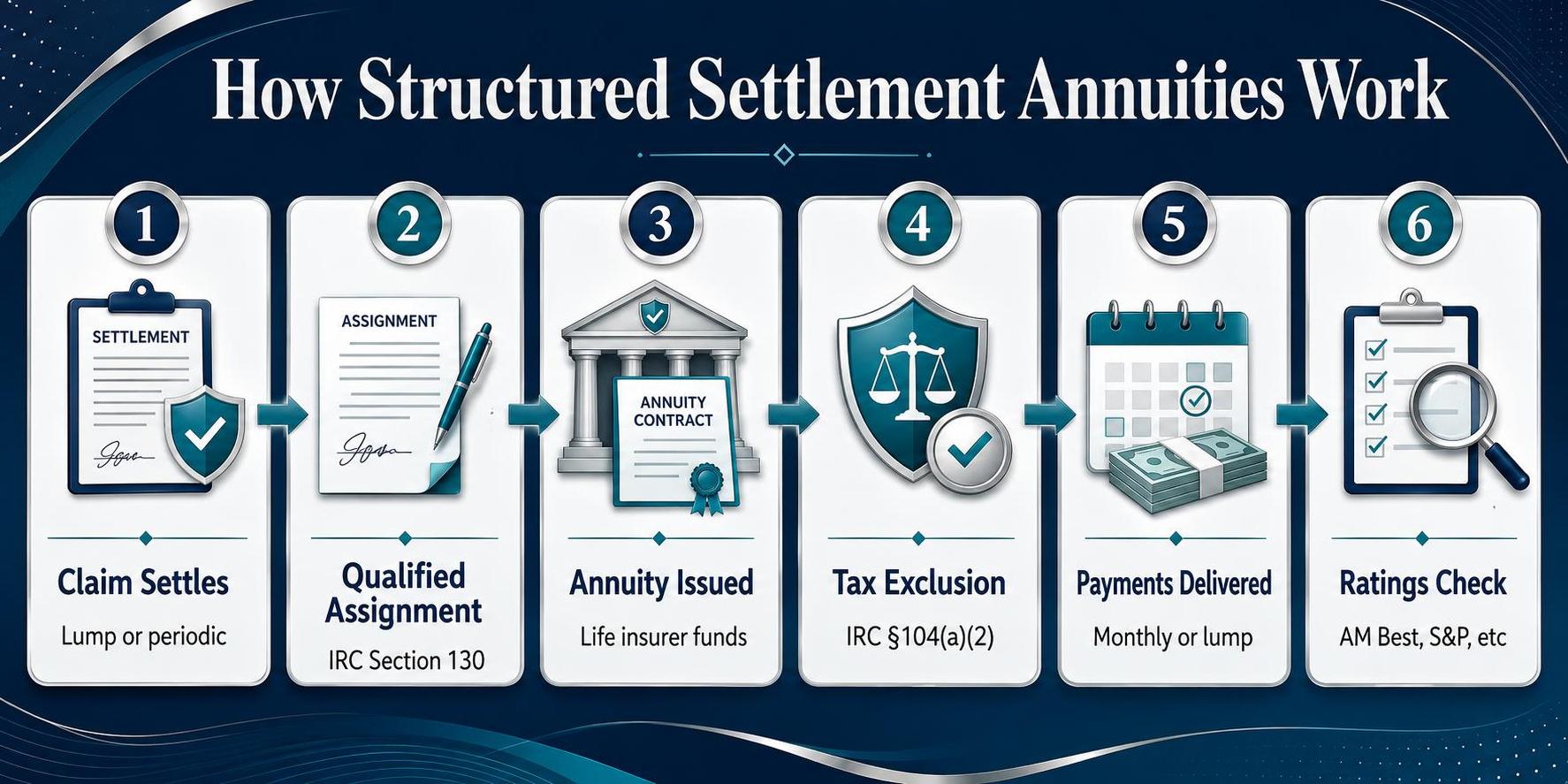
How structured settlement annuity companies work
Structured settlement annuity companies are usually life insurers that issue annuities used to fund injury-settlement payments over time.
In a typical case, the defendant or its insurer settles the claim, then transfers the payment obligation to a qualified assignment company under Internal Revenue Code Section 130.
That assignment company pays a lump sum to a life insurer, which issues an annuity designed to match the settlement schedule.
The claimant then receives the agreed payments, while the annuity owner is usually the assignment company, not the claimant, according to the Internal Revenue Service and standard structured settlement practice.
The tax treatment is a core reason these arrangements exist.
Internal Revenue Code Section 104(a)(2) generally excludes damages received on account of personal physical injuries or physical sickness from gross income, and Section 130 sets rules for qualified assignments.
Readers should verify tax treatment with a tax professional because facts matter.
| Step | What happens | Primary source |
| 1 | A claim settles for a lump sum or periodic payments. | 26 U.S. Code Section 104(a)(2) |
| 2 | The defendant or insurer assigns the periodic payment obligation to a qualified assignment company. | 26 U.S. Code Section 130 |
| 3 | The assignment company buys an annuity from a life insurer to fund those payments. | U.S. Treasury regulations and industry settlement documents |
| 4 | The claimant receives scheduled payments such as monthly, annual, or deferred lump sums. | Settlement agreement and annuity contract |
Payment schedules can be highly customized. The Consumer Financial Protection Bureau says structured settlements may pay monthly income, future lump sums, or both.
A settlement might include immediate monthly payments for living costs and larger future payments for college, housing, or medical care.
Financial strength matters because payments can last decades. AM Best, Fitch, Moody’s, and S&P Global Ratings all rate insurers, and buyers often compare those ratings before a settlement is finalized.
A rating is not a guarantee, so readers should review current ratings directly with the rating agency.
State protection is limited if an insurer fails. Coverage comes from state life and health insurance guaranty associations, but limits vary by state.
The National Organization of Life & Health Insurance Guaranty Associations says many states provide up to $250,000 in present-value annuity benefits, while some provide more.
- The annuity company usually funds the payments; it does not negotiate the injury settlement itself.
- The claimant typically cannot accelerate payments unless a separate court-approved transfer occurs under a state structured settlement protection act.
- Before agreeing, review the settlement agreement, annuity contract, insurer ratings, and state guaranty association limits. Acting on assumptions alone can cause tax or cash-flow problems.

Major annuity issuers in the United States
Structured settlement annuities are typically issued by large life insurers with long operating histories and high financial-strength ratings.
The insurer matters because future payments depend on that company’s claims-paying ability, subject to contract terms and state guaranty limits.
Buyers and payees should verify the exact issuing company on the annuity contract, not only the parent brand. Ratings can change, and state guaranty association protection varies by state and by contract type.
| Issuer | Selected current financial-strength ratings | Source |
| Berkshire Hathaway Life Insurance Company of Nebraska | A++ from AM Best; AA+ from S&P Global Ratings | AM Best insurer profile; S&P Global Ratings insurer profile |
| Metropolitan Tower Life Insurance Company | A+ from AM Best; AA- from S&P Global Ratings | AM Best insurer profile; S&P Global Ratings insurer profile |
| New York Life Insurance and Annuity Corporation | A++ from AM Best; AAA from Fitch Ratings | AM Best insurer profile; Fitch Ratings insurer profile |
| Pacific Life & Annuity Company | A+ from AM Best; AA- from Fitch Ratings | AM Best insurer profile; Fitch Ratings insurer profile |
| Prudential Annuities Life Assurance Corporation | A+ from AM Best; AA- from S&P Global Ratings | AM Best insurer profile; S&P Global Ratings insurer profile |
Berkshire Hathaway Life Insurance Company of Nebraska is a frequent structured settlement issuer.
Berkshire Hathaway reported $1.047 trillion in total assets at December 31, 2024, in its annual report, giving the broader group exceptional balance-sheet scale.
Metropolitan Tower Life Insurance Company, part of MetLife, is also widely used in settlements. MetLife reported $687 billion in total assets under management at December 31, 2024, according to MetLife’s annual report and investor materials.
New York Life Insurance and Annuity Corporation benefits from the scale of New York Life. New York Life reported $783 billion in assets under management at December 31, 2024, according to the company’s 2024 financial highlights.
Pacific Life & Annuity Company is part of Pacific Life, a major annuity writer. Pacific Life reported more than $1.4 trillion in life insurance in force and more than $245 billion in assets at December 31, 2024, according to Pacific Life.
Prudential Annuities Life Assurance Corporation sits within Prudential Financial’s insurance platform. Prudential Financial reported $1.5 trillion in assets under management at December 31, 2024, according to Prudential’s annual report.
- Check the exact issuer named in the settlement documents.
- Review current ratings from AM Best, Fitch, Moody’s, or S&P Global Ratings.
- Confirm state guaranty limits with the National Organization of Life & Health Insurance Guaranty Associations or the state guaranty association.
Caution: a strong parent company does not eliminate risk at the subsidiary level. Before selling payment rights or relying on guaranty coverage, review the contract and confirm the rules in the payee’s state.

How insurers fund structured settlement payments
Structured settlement payments are usually funded with a single-premium annuity issued by a life insurance company.
In most injury cases, the defendant or its insurer pays one upfront amount, and a qualified assignment company then assumes the payment obligation under Internal Revenue Code Section 130.
The annuity does not replace the legal duty to pay by itself. It is the funding asset behind the promise to make future periodic payments, which is why the financial strength of the life insurer and the assignment structure both matter.
After settlement terms are set, the defendant or liability insurer transfers the obligation to a qualified assignee.
The assignee uses the settlement funds to buy a structured settlement annuity from a life insurer, and the insurer then makes scheduled payments to the payee.
This structure is tied to federal tax rules.
The Internal Revenue Service says damages received on account of personal physical injuries or physical sickness are generally excluded from gross income under Internal Revenue Code Section 104(a)(2).
And Section 130 governs qualified assignments used to fund many structured settlements.
Insurers fund those future checks by investing the premium and holding statutory reserves.
Reserve rules are set at the state level, and solvency monitoring is coordinated through the National Association of Insurance Commissioners, which collects annual statement data from licensed insurers.
Because the buyer is relying on long-term claims-paying ability, rating data is commonly reviewed.
AM Best said in its 2024 market segment report that U.S. life/annuity direct premiums and considerations totaled about $818 billion in 2023, showing the scale of the annuity market that supports products like structured settlement annuities.
| Element | How funding works | Primary source |
| Tax treatment | Physical injury damages are generally tax-free; qualified assignments are authorized by federal tax law. | Internal Revenue Code Sections 104(a)(2) and 130 |
| Funding asset | A single-premium annuity is commonly purchased to match the payment schedule. | U.S. Department of Justice settlement guidance; insurer contract forms |
| Solvency oversight | Life insurers file annual statutory statements and are regulated by state insurance departments. | NAIC |
| Backstop protection | Coverage is not federal deposit insurance; protection comes, if at all, from state guaranty associations. | NOLHGA and state guaranty laws |
Guaranty protection has limits, and the cap depends on state law.
The National Organization of Life & Health Insurance Guaranty Associations says many states protect annuity benefits up to $250,000 in present value, but some states use different limits or rules.
Caution: do not assume every structured settlement has identical protections.
Before relying on a payment stream, check the annuity issuer, assignment company, state guaranty association statute, and the actual settlement and annuity contracts with a lawyer or licensed adviser.
- Confirm the insurer’s current financial strength ratings from AM Best, S&P Global, Moody’s, or Fitch.
- Ask which entity is legally obligated to pay: the defendant, the assignee, or both under the documents.
- Verify guaranty association limits in the payee’s state through the state insurance department or NOLHGA.

Financial strength ratings consumers should check
When comparing structured settlement annuity companies, the first screen is insurer financial strength.
A structured settlement can last decades, so the key question is whether the issuing life insurer has the claims-paying capacity to keep sending checks over time.
Consumers should check current ratings from at least AM Best, S&P Global Ratings, Moody’s Ratings, and Fitch Ratings when available.
Ratings are opinions, not guarantees, and they can change, so verify the insurer’s latest rating on the rating agency’s site before signing anything.
AM Best focuses on insurers. In AM Best’s scale, A++ and A+ are “Superior,” while A and A- are “Excellent,” according to AM Best’s published rating guide.
S&P uses AAA and AA categories for very strong capacity, and Moody’s uses Aaa and Aa categories for the highest tiers.
For structured settlements, many issuers are large life insurers owned by major insurance groups. A practical check is whether the exact issuing insurer, not only the parent company, carries high grades from multiple agencies.
Parent strength matters, but the annuity obligation sits with the named insurer on the contract.
| Agency | Top rating | Next tier | What the agency says |
| AM Best | A++ | A+ | Both are “Superior,” the highest category on AM Best’s Financial Strength Rating scale. |
| S&P Global Ratings | AAA | AA+, AA, AA- | AAA means “extremely strong” capacity; AA means “very strong” capacity to meet financial commitments. |
| Moody’s Ratings | Aaa | Aa1, Aa2, Aa3 | Aaa is the highest-quality tier; Aa obligations are judged high quality and subject to very low credit risk. |
| Fitch Ratings | AAA | AA+, AA, AA- | AAA denotes the lowest expectation of default risk; AA denotes very low default risk. |
Consumers should also check outlooks and watch notices. A “negative outlook” does not equal a downgrade, but it signals possible pressure, according to S&P, Moody’s, and Fitch methodology publications.
That matters if payments may continue for 20 or 30 years or longer.
- Confirm the insurer’s exact legal name on the annuity contract.
- Look for ratings from more than one agency, not one score alone.
- Check the rating date, outlook, and whether the rating is insurer-specific.
- Review your state insurance department and guaranty association materials for protection limits, because limits vary by state.
Caution: do not rely on a sales summary alone.
Ratings can be updated, withdrawn, or differ by insurer entity, so verify them directly with AM Best, S&P Global Ratings, Moody’s Ratings, Fitch Ratings, and your state regulator before acting.

Payment options offered by annuity companies
Structured settlement annuity companies fund payment schedules that are set in a settlement agreement and then backed by an annuity contract.
The main choices are timing, amount pattern, and whether payments continue for a fixed term, for life, or both.
These choices matter because a structured settlement is usually hard to change after court approval and annuity purchase.
Before acting, readers should review the settlement agreement, annuity contract, and applicable state transfer law with a qualified attorney or tax adviser.
Payment designs usually combine one or more periodic streams with optional future lump sums.
The Internal Revenue Service says damages received on account of personal physical injuries or physical sickness are generally excluded from gross income under Internal Revenue Code Section 104(a)(2).
And structured settlements are governed in part by Section 130 assignments.
| Option | How it works | Source-backed fact |
| Monthly payments | Equal payments every month for a set period or for life. | The Social Security Administration sends Supplemental Security Income in 12 monthly payments per year, showing why monthly income matching is common in budgeting. |
| Annual payments | One payment each year, often used for ongoing care or education. | The IRS annual exclusion for gifts is $18,000 in 2024 and $19,000 in 2025, illustrating why annual cash-flow planning often uses calendar-year timing. |
| Future lump sums | Larger payments scheduled on specific dates, such as years 5, 10, or 18. | The CFPB says consumers should compare large future obligations such as tuition and housing when planning cash flow, which is the common reason for staged lump sums. |
| Lifetime payments | Payments continue for the claimant’s life, sometimes with a minimum guarantee period. | According to the CDC, U.S. life expectancy at birth was 77.5 years in 2022, a key figure when lifetime income is being modeled. |
| Increasing payments | Payments rise over time, often by a fixed percentage. | The Bureau of Labor Statistics reported a 3.4% 12-month CPI-U increase for December 2023, which shows why some claimants ask for growth instead of level payments. |
In practice, annuity issuers can mix these options.
A claimant might receive $2,000 monthly for living expenses, $25,000 every five years for major needs, and a lifetime stream starting at retirement, but the exact figures depend on the negotiated settlement and the annuity pricing offered by the insurer.
- Level payments fit stable bills such as rent, insurance, and utilities.
- Step-up or increasing payments can address inflation, but they start lower than a flat stream with the same present cost.
- Period-certain guarantees protect a family if the payee dies early, while life-only designs maximize payout during the payee’s lifetime.
- Deferred start dates can preserve funds for later medical care, college, or retirement.
Caution: selling future payments later can reduce value.
The U.S. Government Accountability Office reported in 2021 that transaction costs and discounting can significantly cut the cash a seller actually receives, so the original payment design should be chosen carefully.

Risks before choosing an annuity issuer
The issuer matters because a structured settlement annuity is only as strong as the insurance company making the future payments.
Court approval and settlement paperwork do not remove insurer credit risk, so the issuer’s balance sheet, ratings, and state guaranty limits matter before any contract is issued.
A second risk is false comfort from marketing language. “Guaranteed” usually means guaranteed by the claims-paying ability of the insurer, not by the federal government, and annuities are not FDIC-insured, according to the FDIC.
Start with financial strength ratings, but do not treat them as promises. AM Best says its Financial Strength Rating is an opinion of an insurer’s ability to meet insurance obligations.
S&P Global Ratings, Moody’s Ratings, and Fitch Ratings use similar opinion-based ratings, and each agency can downgrade an insurer later.
Concentration risk is next. A single large annuity from one issuer can leave a payee exposed if that company is later impaired.
State guaranty association backstops exist, but limits vary by state and may be lower than the present value of expected payments.
| State guaranty protection example | Official limit stated by source |
| California | 80% of the present value of annuity benefits, up to $250,000, according to the California Life & Health Insurance Guarantee Association. |
| New York | $500,000 in present value annuity benefits, according to the New York Life Insurance Company Guaranty Corporation. |
| Texas | $250,000 in present value annuity benefits per individual life, according to the Texas Life & Health Insurance Guaranty Association. |
That gap matters. If a payee expects more than the applicable state limit from one insurer, part of the stream may be exposed in a failure scenario.
Check the guaranty association in the payee’s state and the contract language before relying on any number.
Another risk is mismatch between the payment design and the claimant’s needs. A life-contingent annuity can stop at death, while a period-certain structure continues for the guaranteed term.
The exact continuation rules depend on the contract and settlement documents.
- Review ratings from at least AM Best, S&P, Moody’s, and Fitch if available.
- Check whether the issuer is licensed in the relevant state insurance department database.
- Confirm guaranty limits with the state guaranty association, not a sales summary.
- Ask counsel or a tax adviser to review ownership, beneficiary, and payment terms before signing.
Caution: do not choose an issuer on yield claims or brand recognition alone. A structured settlement can last decades, and mistakes may be hard or impossible to reverse after the annuity is issued.

What Coin Abul independently reviewed
Coin Abul reviewed the public records and rating frameworks that matter most when judging structured settlement annuity companies. The focus was insurer strength, complaint patterns, regulatory standing, and state backstops, not marketing claims.
This review did not treat any single data point as decisive. A high rating can change, and guaranty protection varies by state, so readers should verify the insurer and the state rules before relying on any annuity issuer.
The review started with insurer financial-strength ratings because structured settlements can last decades.
Coin Abul checked rating agency scales used for life insurers and annuity issuers, including AM Best, S&P Global Ratings, and Moody’s.
| Source reviewed | Specific fact used | Why it matters |
| AM Best | Its Financial Strength Rating scale has 6 “Secure” categories, from A++ to B+, and 10 “Vulnerable” categories, from B to S. Source: AM Best rating guide. | Shows whether an insurer is judged able to meet ongoing obligations. |
| S&P Global Ratings | Its insurer financial strength scale runs from AAA to D. Source: S&P Global Ratings definitions. | Adds a second credit view instead of relying on one agency. |
| Moody’s | Its insurance financial strength scale runs from Aaa to C, with 21 notches. Source: Moody’s rating symbols and definitions. | Helps compare issuers across a long-term obligation. |
| NAIC | The NAIC Complaint Index uses 1.00 as the benchmark; above 1.00 means more complaints than expected for market share. Source: NAIC Consumer Insurance Search. | Flags complaint levels that may deserve closer review. |
Coin Abul also checked whether an insurer is licensed and in good standing through state insurance department records. That matters because structured settlement annuities are insurance products, and oversight sits largely with state regulators.
The review considered state guaranty association protection, but with caution. Coverage limits are set by state law, not by the insurer, and limits differ.
The National Organization of Life & Health Insurance Guaranty Associations says protection is not a substitute for choosing a financially strong insurer.
- Public rating agency reports and definitions.
- NAIC complaint tools and insurer filings.
- State insurance department license and enforcement records.
- NOLHGA summaries of guaranty association protections.
Readers should not choose a structured settlement annuity company from advertising alone. Check the current rating report, the insurer’s license status, and the guaranty association rules in the state tied to the annuity contract.

Questions to ask before signing documents
Before signing any structured settlement annuity document, confirm who owes the payments, what protections apply, and what rights are being waived. Small wording changes can affect taxes, transfer rights, and what happens if the payee dies.
Do not rely on a sales summary alone. Read the contract, the qualified assignment, and any disclosure statement side by side, then verify key facts with the issuer, the state guaranty association, and the court record if a transfer is involved.
Start with the annuity issuer’s financial strength. Ask which company guarantees the payments and what its current ratings are, because ratings can change after the original settlement was set up.
| Question | Why it matters | Source-based fact |
| Who is the annuity issuer and obligor? | The payment obligation may sit with an assignment company, while the annuity backs that obligation. | The Internal Revenue Code section 130 framework allows a qualified assignment of liability; the annuity owner is often the assignee, not the payee. Source: 26 U.S.C. §130. |
| What are the insurer’s ratings today? | Ratings are not guarantees, but they are a standard solvency checkpoint. | AM Best uses ratings from A++ to D. Source: AM Best rating scale. |
| What state guaranty coverage applies? | Coverage limits differ by state and by benefit type. | The National Organization of Life & Health Insurance Guaranty Associations says coverage limits vary by state and consumers must check their own state association. Source: NOLHGA consumer information. |
| Is this sale or transfer court-approved? | Most transfers require judicial or administrative approval under state structured settlement protection acts. | Forty-nine states have structured settlement protection acts; only Wisconsin does not, according to the National Association of Settlement Purchasers. Source: NASP. |
Ask whether the payment stream is fixed, life-contingent, or has a guaranteed period. That determines whether payments stop at death, continue to a beneficiary, or end after a certain date.
Ask for the exact gross payment amount, payment dates, and any cost-of-living adjustment formula. If a transfer is proposed, ask for the discounted present value, the discount rate, all fees, and the net amount payable to the seller.
For tax treatment, ask whether the payments are intended to remain excluded from gross income under Internal Revenue Code section 104(a)(2). Source: 26 U.S.C. §104(a)(2). A change that looks minor can affect tax results.
Tax treatment depends on the facts and documents.
- Ask for every document in final form before signing, not a summary.
- Ask whether there is any penalty, rescission right, or waiting period under state law.
- Ask who receives payments if the payee dies before all guaranteed payments are made.
- Ask whether independent professional advice is required or was waived.
Caution: do not sign based on a verbal explanation. If any figure, rating, or state-law protection cannot be verified in the contract or primary source, stop and confirm it with a qualified attorney, tax adviser, or the relevant state authority.
Frequently Asked Questions
What does a structured settlement annuity company do?
A structured settlement annuity company is usually a life insurance company that issues the annuity used to make periodic payments after a settlement.
The U.S. Government Accountability Office said structured settlement agreements often involve the defendant, a qualified assignment company, and a life insurer that issues the annuity, while the injured person receives the payment rights; source: U.S. Government Accountability Office, GAO-09-289.
Are structured settlement annuity companies the same as companies that buy settlement payments?
No. The annuity issuer is typically an insurance company responsible for funding scheduled payments, while a factoring company is a separate business that may offer to buy future payments for cash; source: U.S. Government Accountability Office, GAO-09-289, and the Internal Revenue Service, 26 U.S. Code Section 5891.
Do not assume the annuity issuer will buy payments back, because many sales require a court approval process under state structured settlement protection laws.
How can someone check whether a structured settlement annuity company is financially strong?
One practical step is to review insurer financial strength ratings from major rating agencies such as A.M. Best, S&P Global Ratings, Moody’s, or Fitch, because those firms publish insurer-specific claims-paying assessments.
Ratings can change, and they are opinions rather than guarantees, so a reader should verify the current rating directly with the rating agency and the insurer’s state regulator before acting.
What protections apply if a structured settlement annuity company runs into trouble?
State insurance guaranty associations may provide limited protection if a member insurer becomes insolvent, but coverage limits vary by state.
The National Organization of Life & Health Insurance Guaranty Associations says protection is governed by state law and consumers should check their own state association for exact limits, because relying on a generic number could be harmful.
Can a payee choose any structured settlement annuity company when settling a case?
Not always.
The annuity issuer is commonly selected as part of the settlement and qualified assignment arrangement, and the tax treatment for structured settlements is governed by Internal Revenue Code Sections 104(a)(2) and 130; source.
Internal Revenue Service and U.S. Government Accountability Office, GAO-09-289.
Because settlement design can affect tax treatment and long-term payment security, readers should confirm terms with the settlement documents and qualified legal or tax professionals rather than rely on a summary alone.
Related Reading
- Structured Settlement Quotes
- What Is A Structured Annuity?
- AIG Structured Settlements – The Truth You Didn't Know
- Structured Settlement Annuity Companies
- JG Wentworth Loan Reviews
- Cash For Structured Settlement Payments
- Can I Sell My Neap Annuity?
- Structured Settlement Annuities for Minors
- All Blog Guides
- Internal Revenue Service – Structured Settlements Fact Sheet (2008)
- U.S. Government Accountability Office – Structured Settlement Transfers: State Laws and Factors Contributing to Certain Transfers (2001)
- Bureau of Justice Assistance – Structured Settlements and Periodic Payment Judgments (1990)
- National Association of Insurance Commissioners – What Is an Annuity? (2024)
- Cornell Law School Legal Information Institute – 26 U.S. Code § 5891 (n.d.)
- Nolo – Structured Settlements and Lump-Sum Payments (n.d.)