
Quick answer: Kitchen appliances go on sale most often during major holiday weekends and retail events: Presidents Day, Memorial Day, Fourth of July, Labor Day, Black Friday, Cyber Monday, and year-end clearance.
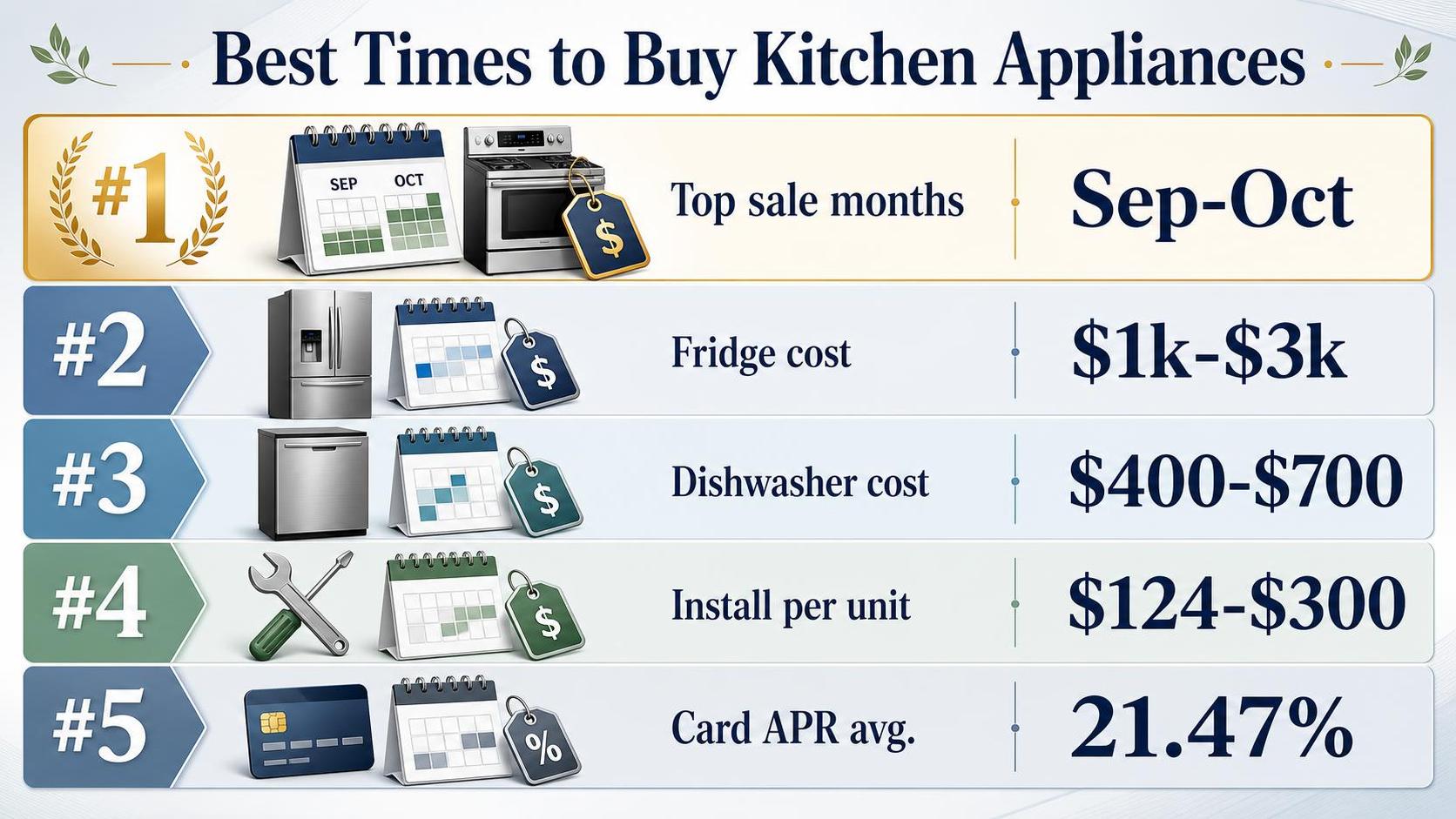
Discounts also appear when new models arrive, usually in fall, and during January inventory clear-outs. Compare prices and check warranty terms before buying.
When Do Kitchen Appliances Go On Sale is best answered financially: major appliances cost a median $1,354 in 2023, according to the U.S. Energy Information Administration’s Residential Energy Consumption Survey, so timing can affect a four-figure household expense.
Plan from total cost, not the sale tag: a $1,354 appliance on a 24-month plan at 29.99% APR costs about $1,802 before fees. Prices often fall around Memorial Day, Labor Day, Black Friday, and model-year turnover.
If the old unit still works, waiting or buying used can beat debt.
What kitchen appliances cost before discounts
A kitchen-appliance purchase can absorb a large share of a household budget before any sale starts. For a U.S. buyer, the useful question is not the promo price first.
It is the regular market cost, the financing cost, and whether the purchase can wait.
National consumer sources put baseline appliance costs in the high hundreds to several thousand dollars, depending on category and features.
Angi reports that a refrigerator typically costs $1,000 to $3,000, a dishwasher $400 to $700, an oven and stove $600 to $1,300, and a microwave $200 to $500.
| Appliance category | Typical pre-discount cost | Source |
| Refrigerator | $1,000 to $3,000 | Angi appliance cost guide |
| Dishwasher | $400 to $700 | Angi appliance cost guide |
| Oven and stove | $600 to $1,300 | Angi appliance cost guide |
| Microwave | $200 to $500 | Angi appliance cost guide |
Those sticker prices do not include delivery, installation, haul-away, new cords or hoses, or electrical and plumbing changes. HomeAdvisor says appliance installation commonly costs $124 to $300 per appliance, with a national average of $214.
Operating cost also matters. ENERGY STAR says a certified dishwasher can save about 5,800 gallons of water over its lifetime.
ENERGY STAR also says certified refrigerators are about 9% more energy efficient than models that meet the federal minimum standard.
If the purchase goes on a credit card, the monthly payment can hide the true cost. The Federal Reserve reported the average APR for all credit card accounts was 21.47% in the fourth quarter of 2024.
| Example purchase | Amount financed | Term | APR | Approx. monthly payment | Approx. total paid |
| Mid-range refrigerator | $2,000 | 24 months | 21.47% | $102.35 | $2,456.40 |
| Dishwasher plus installation | $914 | 24 months | 21.47% | $46.78 | $1,122.72 |
These examples use the Federal Reserve’s average card APR and standard amortization. Actual card terms vary, and deferred-interest offers can cost more if the balance is not cleared on time.
Check the issuer’s Schumer box and fee schedule before using debt.
- Cash need is often higher than the shelf tag because installation can add $124 to $300 per unit, according to HomeAdvisor.
- Debt cost can add hundreds of dollars. In the example above, financing a $2,000 appliance at 21.47% adds about $456.
- If the current appliance still works safely, waiting for a sale or replacing one unit instead of a full suite can protect cash flow.
When kitchen appliance prices usually drop
Kitchen appliance prices usually fall in a few predictable windows, not every time a retailer uses the word “sale.” Consumer Reports says the strongest timing tends to be September and October for many large appliances.
Plus major holiday weekends such as Memorial Day, July 4, Labor Day, and Black Friday.
That timing matters because waiting a few weeks can lower the cash price without adding interest charges.
It also matters because “discounted” does not always mean cheap; retailers often rotate promotions, bundles, and financing offers instead of cutting the base price.
| Sale window | Typical timing | Why prices can drop | Source |
| Model-change season | September and October | Retailers clear older inventory as new models arrive | Consumer Reports; J.D. Power |
| Memorial Day | Late May, 3-day weekend | Promotional pricing tied to holiday retail traffic | Consumer Reports |
| Independence Day | Early July | Mid-year holiday promotions | Consumer Reports |
| Labor Day | Early September, 3-day weekend | Holiday promotions plus seasonal inventory turnover | Consumer Reports |
| Black Friday | Late November | Heavy holiday discounting and doorbuster pricing | Consumer Reports; National Retail Federation |
The best financial move depends on the appliance. If the current unit still works safely, waiting until September, October, or a holiday weekend can reduce the upfront price and avoid borrowing.
If the appliance is failing, delaying can cost more through spoiled food, laundromat fees, or emergency delivery charges.
- Refrigerators, washers, dryers, and dishwashers often follow the fall-and-holiday pattern cited by Consumer Reports.
- Cooking appliances can also be discounted on holiday weekends, but exact markdowns vary by model and retailer.
- Scratch-and-dent, open-box, and floor models may appear during these same periods as stores reset inventory.
- ENERGY STAR says some buyers can also stack manufacturer sales with utility or state efficiency rebates, but rebate amounts vary by ZIP code and program rules.
Caution: do not go into debt only because a sale appears temporary. A smaller markdown paid in cash is often cheaper than a larger “sale” financed at interest.
Before buying, compare the final out-the-door price, delivery, haul-away, taxes, and any financing cost using the retailer’s written terms.

How to budget for replacement costs
Start with the replacement bill, not the sale sign. Consumer Reports says a new refrigerator often runs about $600 to $2,300, a dishwasher about $400 to $700, and a washing machine about $500 to $1,400, depending on type and features.
That makes an appliance failure a savings problem first. If a household needs a $1,500 replacement fast, paying over time can add meaningful interest, especially on a credit card.
Build the budget backward from the likely cost and the remaining life of the old unit. If the target is $1,500 and replacement is likely within five years, saving $25 a month covers that amount before tax, delivery, or haul-away charges.
| Budget or payment example | Math | Total paid |
| Save cash for 60 months | $1,500 divided by 60 months = $25 a month | $1,500 |
| Put $1,500 on a credit card at 20.75% APR and pay it off in 12 months | About $138.95 a month; about $167.40 interest, using Bankrate’s average credit card APR reported January 29, 2025 | About $1,667.40 |
| Finance $1,500 with a 24-month personal loan at 12.33% APR | About $70.79 a month; about $198.96 interest, using the Federal Reserve’s May 2024 average rate for a 24-month personal loan at commercial banks | About $1,698.96 |
The monthly payment can hide the real cost. The personal loan looks easier at about $71 a month, but stretching repayment to 24 months costs more in dollars than paying a higher monthly amount for 12 months on the card example above.
For a household budget, set a separate “appliance reserve” alongside emergency savings. A practical target is one major replacement cost per key appliance class.
Consumer Reports’ ranges imply a reserve of roughly $1,500 to $2,000 can cover many midrange replacements.
- Check the full contract for APR, origination fees, deferred-interest terms, delivery fees, installation, and removal charges.
- If the plan says “no interest,” confirm whether interest is waived or merely deferred. Deferred interest can be costly if the balance is not cleared on time.
- If taking debt would force missed rent, utility, or minimum debt payments, waiting, repairing, or buying used may be the safer financial move.
Caution: financing can solve a broken-appliance problem and still worsen a cash-flow problem. Before signing, total every payment and fee in dollars and compare it with the replacement cost.
What financing adds to appliance costs
Major appliances can strain a household budget before financing starts. The U.S. Bureau of Labor Statistics said the average household spent $528 on major appliances in 2023, so replacing even one failed appliance can be a meaningful cash-flow event.
Financing can solve the timing problem, but it raises the final cost. The total depends on the APR, fees, and whether the plan charges deferred interest or late fees.
| How the purchase is paid | Source for terms | Example cost on a $1,000 appliance |
| Cash or debit | No financing charge | $1,000 total paid |
| General credit card | Federal Reserve G.19 reported a 21.47% average APR for accounts assessed interest in Feb. 2025 | About $1,122 total if repaid over 12 equal monthly payments at 21.47% APR |
| Installment plan | Affirm says APRs range from 0% to 36% and it charges no late or hidden fees | About $1,206 total if repaid over 12 months at 36% APR |
| Pay-in-4 plan | Afterpay says four installments are interest-free, but late fees can reach 25% of the order value, capped at $68 for orders above $40 | $1,000 if paid on time; up to $1,068 if maximum late fees apply |
The expensive trap is not the monthly number. It is the total paid. A $1,000 appliance financed on a typical interest-bearing card can cost about $122 extra over one year, based on the Federal Reserve’s Feb. 2025 average APR.
Installment plans are not automatically cheaper. Affirm’s disclosed range reaches 36% APR. At that rate, a one-year payoff adds about $206 to a $1,000 purchase, even without fees.
Pay-in-4 plans look safer because they usually advertise 0% interest. That only holds if every payment is on time. Afterpay’s published U.S. fee cap means a missed-payment chain can still add up to $68 on a $1,000 order.
- Check whether the plan is true 0% financing or deferred interest. Deferred-interest offers can charge retroactive interest if the balance is not cleared by the deadline. Read the issuer disclosure before agreeing.
- Compare the financed total with the cost of waiting one or two pay cycles. If the appliance is inconvenient but not urgent, delay may be cheaper than paying triple-digit interest or fees.
- Caution: do not rely on monthly payment size alone. Terms change, and one missed payment can make a manageable purchase materially more expensive.
When used appliances make financial sense
Used appliances make financial sense when the upfront discount is larger than the extra repair and energy risk.
The clearest example is refrigeration: ENERGY STAR says replacing a refrigerator made before 1993 can save more than $110 a year on electricity, and the U.S. Energy Information Administration says the average residential electricity price was 16.00 cents per kWh in 2023.
That means a cheap older fridge can erase its bargain fast. If a used unit costs $300 less than a newer alternative, but it burns about $110 more a year in power, the price gap can close in under three years before any repair bill.
| Financial test | Figure | Source |
| Annual electricity savings from replacing a pre-1993 refrigerator | More than $110/year | ENERGY STAR |
| Average U.S. residential electricity price | 16.00 cents/kWh in 2023 | U.S. Energy Information Administration |
| Typical life expectancy: refrigerator | 13 years | National Association of Home Builders, Study of Life Expectancy of Home Components |
| Typical life expectancy: dishwasher | 9 years | National Association of Home Builders |
| Typical life expectancy: electric range | 13 years | National Association of Home Builders |
Used usually works best for simple, durable appliances near the low-repair end of the spectrum.
A range often makes more financial sense used than a refrigerator, because ranges do not run around the clock and NAHB estimates a longer life than dishwashers.
Age matters more than category alone. If a refrigerator’s expected life is 13 years, a 3-year-old used model leaves far more runway than a 10-year-old one.
The same logic applies to dishwashers: at a 9-year expected life, buying one already 7 years old leaves little margin.
Debt changes the math. The Federal Reserve reported average credit card interest for accounts assessed interest at 22.80% APR in the fourth quarter of 2023.
Financing a $600 used appliance on a card at 22.80% APR with equal payments over 12 months would cost about $677 total, not $600.
- Buy used when the appliance is relatively young, the seller can show model and serial information, and the savings are large enough to cover possible repairs and higher utility costs.
- Wait or buy new when the used option is old, energy-hungry, or would be financed at high APR.
- Check recall notices with the U.S. Consumer Product Safety Commission before paying. A low price is not worth a safety defect.
Caution: do not rely on appearance alone. For any used appliance, verify age, energy use, and recall status from the manufacturer label and primary sources before spending money.

When waiting beats buying immediately
Waiting often saves more than shopping harder. Major appliance prices usually drop around holiday promotions, and financing can turn a needed replacement into a much larger bill.
For a US household, the money question is total cost, not the monthly payment.
The U.S. Bureau of Labor Statistics reported the average price of a refrigerator was $1,777.17 in April 2024.
The average price of a washing machine was $760.40, and a clothes dryer averaged $702.78, according to the same BLS Consumer Price Index average price series.
| Item | Average price | Source |
| Refrigerator | $1,777.17 | U.S. Bureau of Labor Statistics, CPI Average Price Data, April 2024 |
| Washing machine | $760.40 | U.S. Bureau of Labor Statistics, CPI Average Price Data, April 2024 |
| Clothes dryer | $702.78 | U.S. Bureau of Labor Statistics, CPI Average Price Data, April 2024 |
If the current appliance still works safely, waiting for a sale window can be the cheaper move. The National Retail Federation says major retailers commonly promote large discounts around Memorial Day, Labor Day, and Black Friday.
Those periods matter because appliance promotions are usually event-driven, not evenly spread through the year.
Waiting also beats borrowing when interest is high. The Federal Reserve reported the average APR for all credit card accounts assessed interest was 22.80% in November 2023.
At that rate, carrying a refrigerator balance for a year adds meaningful cost.
| Purchase | Amount financed | APR and term | Total paid | Interest cost |
| Refrigerator | $1,777.17 | 22.80% APR, 12 months | About $2,006 | About $229 |
| Washer | $760.40 | 22.80% APR, 12 months | About $858 | About $98 |
Used can be the better financial move when the replacement is not urgent. Consumer Reports advises caution with used appliances because condition, age, and missing parts can erase savings.
Waiting to buy used is usually smarter for a secondary fridge or spare laundry machine than for a critical household appliance.
- Wait if the appliance works, repair cost is modest, and a holiday sale is close.
- Buy now if failure creates health or safety risk, such as food spoilage or electrical problems.
- Avoid debt for a non-urgent upgrade. Interest can cost more than the discount.
- Check deferred-interest plans carefully. If the balance is not cleared on time, retroactive interest may apply under the card agreement.
Caution: do not rely on a general timing rule if an appliance is unsafe, leaks gas, or causes electrical hazards. Check the retailer terms, card agreement, and manufacturer safety notices before delaying or financing a purchase.
What Coin Abul checked independently
A new major kitchen appliance is usually a four-figure expense, not a casual purchase.
Consumer Reports says many refrigerators, ranges and dishwashers are sold across broad price bands, with common full-size refrigerators often starting around $800 and premium models running well above $2,000; that makes timing and financing matter.
For the money decision, the first question is total cost, not the monthly payment. Financing can turn a $1,500 appliance into a much larger bill once APR and fees are counted.
Coin Abul reviewed lender and retailer financing disclosures, Federal Reserve credit-card data, and sale-timing guidance from Consumer Reports.
Figures below use published terms and simple payoff math; exact offers vary by credit profile, so readers should confirm the final disclosure before borrowing.
| Example | Published term checked | Total paid on $1,500 purchase |
| Pay now | No financing charge | $1,500 |
| Affirm-style installment | Affirm says APR can run from 0% to 36%, depending on approval terms | At 20% APR over 12 months, about $1,666 total |
| General-purpose credit card | The Federal Reserve reported average APRs of 21.37% for all credit card accounts and 22.80% for accounts assessed interest in Q4 2024 | At 21.37% APR over 12 months, about $1,678 total |
| Klarna Pay in 4 | Klarna says Pay in 4 has no interest, with late fees up to $7 per missed payment | $1,500 if paid on time; more if fees are triggered |
Sale timing also affects the real price.
Consumer Reports says major appliances often see stronger discounts around Memorial Day, Labor Day and Black Friday, and when retailers clear older inventory as new models arrive, often in September and October.
Waiting can beat borrowing. If the appliance still works safely, delaying for a sale can save more than a 0% teaser is worth once deferred-interest or card balances are missed.
If it does not work, buying a used basic model may cost less than financing a premium replacement.
A simple budget rule is to compare the purchase with emergency savings. If charging the appliance would leave no cash for rent, utilities or insurance, the debt risk may be too high. Missing payments can add fees, raise utilization and damage credit.
Caution: financing disclosures differ by state, lender and credit score. Readers should check the appliance seller’s agreement, the cardholder terms and the Consumer Reports timing guidance before acting on this information alone.
Frequently Asked Questions
When are the best months to buy kitchen appliances?
Major appliances often go on sale around September through November because manufacturers commonly roll out new models in the fall, and retailers discount older inventory to clear floor space, according to Consumer Reports.
Holiday events also matter: the National Retail Federation reported that 183.4 million people planned to shop in stores and online over the 2023 Thanksgiving weekend, which helps explain why Black Friday and Cyber Monday are heavily promoted sale periods.
Are holiday appliance sales better than everyday promotions?
They can be, but not always.
Adobe reported that U.S. consumers spent $9.8 billion online on Black Friday 2023 and $12.4 billion on Cyber Monday 2023, showing those dates bring unusually intense discounting and competition, but appliance pricing still varies by brand.
Stock levels, delivery fees, and installation charges.
Check the full out-the-door price before acting because a lower sticker price can be offset by costly add-ons.
Do refrigerators, ranges, and dishwashers go on sale at the same time?
Often yes, because retailers frequently promote kitchen packages and match discount calendars across large appliance categories, especially during holiday events and model-year transitions, according to Consumer Reports.
Timing still differs by product line, so shoppers should compare current prices against recent price history and the manufacturer’s advertised promotions instead of assuming every appliance has hit its low point.
Is Memorial Day or Labor Day better for appliance deals?
Both are common sale periods, but Labor Day often aligns more closely with late-summer inventory clearing before new fall models arrive, a pattern noted by Consumer Reports and major retailers’ seasonal promotion calendars.
Memorial Day can still be competitive for package deals, so the practical step is to compare the same model across multiple sellers and confirm whether haul-away, installation, and warranty terms are included.
Should shoppers wait for Black Friday to buy a kitchen appliance?
Not necessarily. If an appliance has failed, waiting can create food-safety or household risks, and the U.S. Department of Agriculture says refrigerator temperatures should stay at 40 degrees Fahrenheit or below and freezer temperatures at 0 degrees Fahrenheit for safe food storage.
If the appliance still works, waiting for a major sale window can help, but verify the retailer’s return policy, delivery timeline, and total cost before purchasing.
Related Reading
- Where To Buy Appliances Cheap?
- How To Price Furniture When Selling A House?
- Creative Ways To Save Money – What You Need to Know
- Which Furniture Stores Offer Financing?
- What Bank Is Cash App On Plaid?
- Extreme Frugal Living – What You Need to Know
- Why Are New Car Prices So High?
- How Much Home Appraisal Cost?
- Why Personal Finance Is Important?
- All Personal Finance Guides