

In short: Cash for structured settlement payments means selling some or all future settlement payments to a factoring company for a lump sum now, usually at a discount.
Court approval is generally required under state Structured Settlement Protection Acts. Compare offers, review fees, and consult independent legal or financial advice before signing.
Cash For Structured Settlement Payments is a transaction where a payment purchaser buys some or all future settlement payments in exchange for a discounted lump sum, subject to court approval under state structured settlement protection laws.
The cash amount depends on the payment schedule, discount rate, fees, and required judicial finding that the transfer is in the seller’s best interest. Selling can reduce long-term guaranteed income.
Readers should compare quotes, read the transfer agreement, and consult an independent attorney or financial professional before relying on any offer. Acting on marketing claims alone can cause permanent financial loss.
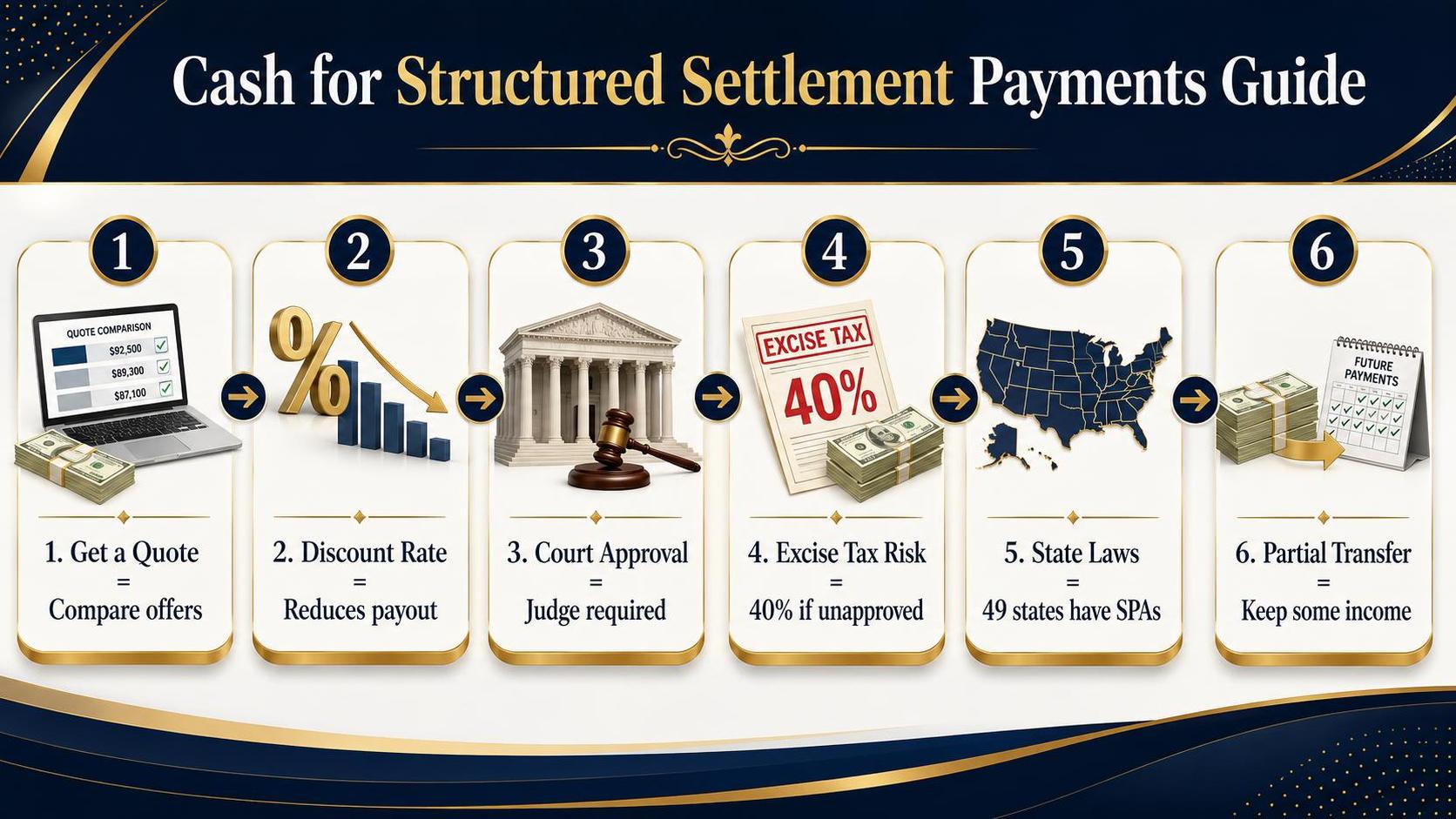
How structured settlement cash buyouts work
A structured settlement cash buyout turns some or all future settlement payments into a lump sum today.
The buyer pays less than the total face value because the buyer applies a discount rate, pays transaction costs, and waits years to collect the payments.
Most transfers require a judge’s approval. That safeguard exists because structured settlements often support long-term injury victims, and Congress and the states built review rules to prevent abusive deals.
The process starts when the payment owner asks a purchasing company for a quote. The company reviews the annuity contract, settlement agreement, payment schedule, and any prior transfers.
It then estimates a present value and offers a lump sum for either a full transfer or a partial transfer.
Federal tax law is central. Under 26 U.S.C. Section 5891, a transfer of structured settlement payment rights can trigger a 40% federal excise tax unless it is approved in advance in a qualified court order.
That rule is why court approval is not a formality.
State law also matters. The National Conference of State Legislatures says 49 states have Structured Settlement Protection Acts.
Those laws generally require disclosure, independent advice language, and a finding that the transfer is in the seller’s best interest.
| Rule or fact | Number | Source |
| Federal excise tax on an unapproved transfer | 40% | 26 U.S.C. Section 5891 |
| States with Structured Settlement Protection Acts | 49 states | National Conference of State Legislatures |
| Transfer options usually offered | 2 common forms: full or partial | Industry practice described by state transfer statutes and court petitions |
After disclosures are signed, the buyer files a petition in the proper court. The judge reviews the deal terms, the seller’s financial need, dependents, and alternatives.
If approved, the annuity issuer and payment obligor are notified to redirect the assigned payments.
A partial transfer can preserve some future income. For example, a seller might assign only a set number of monthly payments or only payments due during a defined period, while keeping later checks. That structure can reduce the amount surrendered.
- Compare the lump sum with the total payments being sold.
- Ask for the discount rate and every fee in writing.
- Check whether losing future guaranteed income affects housing, medical care, or support obligations.
- Verify state-specific approval rules with the court or statute before acting.
Caution: a buyout is hard to reverse after approval and funding. Do not rely on a quote alone; read the court disclosures and consider advice from a lawyer or financial professional before selling future payments.

When selling payments may make sense
Selling structured settlement payments can make sense when a near-term cash need is costly, urgent, and hard to cover any other way. The key test is simple: compare the discount on the sale against the cost of waiting, borrowing, or falling behind.
It usually fits better for a partial sale than for giving up the entire stream. A partial transfer can solve one defined problem while preserving some future income, which matters because the payments are often replacing wages after an injury.
One common case is expensive short-term debt. The Consumer Financial Protection Bureau says a typical payday loan charges $15 per $100 borrowed for a two-week loan, which is almost 400% annual percentage rate.
On a $500 payday loan, that fee is $75 in two weeks alone, before any rollover costs.
Another case is tax debt that is already triggering penalties and interest. The Internal Revenue Service says the failure-to-pay penalty is generally 0.5% of unpaid tax per month, up to 25%, and interest compounds daily.
On a $10,000 balance, the penalty alone can be up to $50 each month, before interest.
A sale may also be worth considering when it prevents a larger legal or financial breakdown. The U.S. Courts list the filing fee for Chapter 7 bankruptcy at $338 and Chapter 13 at $313.
Those fees are small beside total bankruptcy costs, but they show how quickly financial distress creates additional required cash outlays.
| Situation | Relevant figure | Source | Why it may matter |
| Payday loan payoff | $15 per $100 for a two-week loan; almost 400% APR | Consumer Financial Protection Bureau | Stopping very high-cost debt can outweigh the discount on a limited sale. |
| IRS tax debt | 0.5% monthly failure-to-pay penalty, up to 25%; interest compounds daily | Internal Revenue Service | Delays can make the balance grow even if no new money is borrowed. |
| Bankruptcy pressure | Chapter 7 fee $338; Chapter 13 fee $313 | U.S. Courts | Immediate cash needs can escalate into court costs and broader financial damage. |
Selling may also make sense for a time-sensitive need with a measurable return, such as avoiding eviction, paying for essential car repairs needed to keep a job, or funding medical equipment not covered by insurance.
In those cases, the real comparison is not “cash now versus cash later.” It is “cash now versus a larger loss.”.
Caution: A sale is permanent, and discount rates vary widely.
Readers should get quotes from multiple buyers, ask for the net amount after fees, and verify state court approval rules and tax consequences with the primary source or a qualified attorney or tax adviser before signing.

Costs and discounts in settlement factoring
The main cost in a structured settlement sale is the discount rate. That rate converts future payments into a smaller lump sum today, so the seller receives less than the total face value of the payments being sold.
The other costs are usually fees and timing risks. State laws often require court approval, and federal tax law can impose a major penalty if a transfer is completed without the approval required by state structured-settlement transfer law.
Start with the discount rate because it does most of the economic work. A higher rate means a lower present value.
The exact rate depends on the buyer, the payment schedule, the insurer’s credit, the state approval process, and how quickly cash is requested.
Federal law makes court approval more than a formality.
Internal Revenue Code Section 5891 imposes a 40% federal excise tax on the factoring company’s “structured settlement factoring transaction” amount unless the transfer is approved in a qualified order under applicable state law.
State transfer laws usually require a disclosure statement before the hearing. Exact timing and wording vary by state, so readers should check the statute and court forms in their state before relying on any timeline or fee assumption.
The table below shows the math only. These are illustrative present-value examples, not quoted market offers. They use the standard present-value formula to show how the discount rate changes what a seller may receive before any fees are deducted.
| Future payment stream sold | Assumed annual discount rate | Illustrative present value before fees |
| $10,000 due in 3 years | 8% | $7,938 |
| $10,000 due in 3 years | 12% | $7,118 |
| $25,000 due in 5 years | 8% | $17,014 |
| $25,000 due in 5 years | 12% | $14,186 |
Those examples show why small rate changes matter. On a $25,000 payment due in five years, moving from 8% to 12% cuts present value by about $2,828 using the same formula.
Fees can reduce proceeds further. Depending on the transaction and state process, sellers may see line items for application processing, court filing, service, document preparation, or legal review.
Not every company charges every fee, so the disclosure statement matters.
- Compare the gross advance with the net amount actually paid.
- Ask whether fees are deducted separately or built into the discount.
- Check whether only part of the payment stream can be sold.
- Do not sign based on a verbal quote alone; wait for the written disclosure and court papers.
Caution: selling structured-settlement payments can permanently reduce long-term income.
Readers should review the written disclosure, the annuity contract, and the state court documents, and consider advice from a qualified attorney or financial professional before acting.

Court approval for structured settlement transfers
Selling structured settlement payments usually requires a judge’s approval before the transfer can be completed.
The core federal rule is in 26 U.S.C. § 5891, which imposes a steep tax if a transfer is not approved in a “qualified order” under a state structured settlement protection law.
That approval step exists to slow the deal down, force disclosures, and let a court decide whether the sale is in the payee’s best interest. Acting on a quote alone can be risky.
The discount rate, fees, and loss of future income should be checked against the court papers and the state statute.
Under 26 U.S.C. § 5891(a), a transfer of structured settlement payment rights that does not meet the statute’s requirements triggers a federal excise tax. Section 5891(b) sets that tax at 40% of the factoring discount.
In practice, that tax is meant to discourage unapproved transfers.
To avoid that result, the buyer typically must obtain a “qualified order.” Under 26 U.S.C. § 5891(b)(2).
That means a final court or responsible administrative order that finds the transfer does not contravene any federal or state statute or court order and is in the payee’s best interest, considering the welfare and support of dependents.
| Rule | Number | Source |
| Federal excise tax on a nonqualified transfer | 40% | 26 U.S.C. § 5891(a), (b) |
| Required finding standard | Best interest of the payee, considering dependents | 26 U.S.C. § 5891(b)(2) |
State structured settlement protection acts add the procedural details. Those laws commonly require a written disclosure statement before signing or before the hearing, notice to interested parties, and a court hearing.
Interested parties often include the annuity issuer and the structured settlement obligor, because the transfer can affect payment administration.
Judges often look beyond the headline cash amount.
They may examine the net amount the seller actually receives, whether the funds are for necessities such as medical bills or housing, whether the seller has dependents, and whether prior transfers have already reduced long-term support.
If the paperwork is incomplete, the discount appears excessive, or the sale seems harmful, the court can deny it.
The practical point is simple: approval is not automatic.
A seller should read the disclosure, compare the present cash offer to the total payments being given up, and confirm the exact state-law process in the court file or statute before signing anything irreversible.

State rules that affect payment sales
State law controls whether a sale of structured settlement payments can close.
The baseline rule is federal: under 26 U.S.C. § 5891, a transfer without a court-approved “qualified order” can trigger a 40% federal excise tax on the buyer, so legitimate deals are built around state approval.
Most state structured settlement protection acts follow the same core pattern. A judge must approve the transfer, review written disclosures, and decide whether the sale is in the payee’s best interest.
That usually includes looking at dependents, the discount rate, fees, and whether the seller had independent professional advice.
Timing rules vary by state, and they can change the speed of a transaction. Some states require longer disclosure periods before a contract is signed. Some also give the seller a short cancellation window after signing.
| State | Example rule | Source |
| New York | Disclosure statement must be given at least 10 days before signing; the payee may cancel within 3 business days after signing. | N.Y. Gen. Oblig. Law § 5-1703 and § 5-1705 |
| Texas | Disclosure statement must be provided not later than the 3rd day before the transfer agreement is signed. | Tex. Civ. Prac. & Rem. Code § 141.003 |
| Florida | The court must find the transfer is in the payee’s best interest and that the payee received advice or knowingly waived it in writing. | Fla. Stat. § 626.99296 |
| California | The court must expressly find the transfer is fair, reasonable, and in the payee’s best interest, considering dependents’ welfare. | Cal. Ins. Code § 10139.5 |
Venue rules also matter. Many states require the petition to be filed where the payee lives. That can stop forum shopping and force the buyer to use a local court, which may slow closing but can add protection for the seller.
Another common state rule limits conflicts with prior court orders. If the original settlement or annuity contract bans assignment, the judge may examine that language closely.
In some cases, the anti-assignment terms or support obligations can complicate approval.
Read the statute in the payee’s state before signing. Rules on notice, cancellation, and judicial findings are not identical.
Acting on a generic timetable can cause missed deadlines, extra cost, or a void transfer, so the primary source should be checked first.

What the editorial team reviewed
For this update, we focused on source documents that control a structured settlement sale: the federal tax rule, state transfer laws, and purchaser disclosures. We did not treat marketing claims as proof.
We checked what a reader can verify in statutes, court-required paperwork, and regulator guidance.
We started with the federal rule because it sets the legal floor.
We reviewed 26 U.S.C. § 5891, which imposes a 40% excise tax on a structured settlement factoring transaction unless the transfer receives a qualified order under the applicable state law. Source: U.S. Code, 26 U.S.C. § 5891.
We then checked state-law structure. The key point was consistency, not headline offers.
We looked for the same core requirements repeated across state structured settlement protection acts: court approval, advance disclosure, and a finding that the transfer is in the payee’s best interest.
Source: state SSPA statutes and the Uniform Law Commission’s Structured Settlement Protection Act model.
| Source reviewed | Specific fact checked | Why it matters |
| 26 U.S.C. § 5891 | 40% excise tax on non-qualified transfers | Shows why court approval is not optional paperwork |
| State SSPA statutes | Court approval and best-interest standard | Determines whether a sale can legally close |
| Disclosure forms required by SSPA laws | Itemized amounts, fees, and net payment to seller | Lets readers compare the cash offer with the value surrendered |
| FTC consumer guidance | Advice to compare offers and read all terms | Helps readers avoid relying on ad copy alone |
We also reviewed how offers are usually framed. Purchasers commonly emphasize speed, but the legal process still turns on disclosures and a judge’s order.
That is why we weighted the net amount paid, the itemized fees, and the transfer language more heavily than “same-day” or “fast cash” claims.
We measured one practical risk in every document set: whether the papers clearly separated the gross advance from the net amount the seller would actually receive after fees. If that line was unclear, we treated the presentation as weaker.
Source basis: disclosure requirements in state SSPA statutes.
Plain caution: a structured settlement sale can permanently reduce long-term income. Do not act on advertising or this summary alone.
Check the disclosure statement, proposed transfer agreement, and court filing against the controlling state law, and consider independent legal or tax advice before signing.

Risks before selling future payments
Selling structured settlement payments can solve a short-term cash problem, but it can also erase long-term protection built into the settlement.
The biggest risks are a steep price cut, possible benefit loss, and a court process that can stop the transfer.
Read the purchase agreement line by line. Compare the cash offered to the total payments being given up, then check whether the sale could affect taxes or public benefits with the primary source or a qualified adviser.
The first risk is the discount rate. Buyers do not pay the face value of future payments.
The U.S. Government Accountability Office found discount rates in its review of transfer transactions ranging from 9 percent to 18 percent, which can sharply reduce what a seller receives compared with the scheduled payments. Source: U.S. GAO, Structured Settlement Annuities, GAO-12-799, 2012.
The second risk is legal approval. Under federal tax law, a transfer can trigger a 40 percent excise tax unless it is approved in a qualified court or administrative order under state law. Source: 26 U.S.C. § 5891(a) and § 5891(b).
A third risk is losing eligibility for means-tested benefits. A lump sum from a sale can become a countable resource. For Supplemental Security Income, the federal resource limit is $2,000 for an individual and $3,000 for a couple.
Source: Social Security Administration, SSI resource limits.
| Risk point | Figure | Source |
| Typical discount rates reviewed by GAO | 9% to 18% | GAO-12-799 (2012) |
| Federal excise tax without a qualified order | 40% | 26 U.S.C. § 5891(a) |
| SSI resource limit | $2,000 individual / $3,000 couple | SSA SSI resource limits |
Another risk is selling too much. Once approved and completed, those future payments are usually gone. That can undermine money intended for medical care, housing, or basic living costs years later.
Fees also matter. Some transactions include court costs, processing charges, or other deductions that reduce net cash. If a fee is not clearly listed in dollars, ask for a revised disclosure before signing anything.
- Request the gross payment total being sold and the net amount to be paid.
- Ask whether the quoted discount rate is fixed and whether any extra fees apply.
- Check your state’s structured settlement protection law and court rules.
- Verify SSI, Medicaid, or other benefit effects with the administering agency.
Plain caution: do not rely on a sales quote alone. A structured settlement is often meant to replace income for years, and a sale can be hard or impossible to undo after court approval.

How to compare structured settlement buyers
Compare structured settlement buyers on net cash, timing, disclosures, and legal compliance. The headline offer can mislead. A lower discount rate, lower fees, and cleaner paperwork usually matter more than the gross amount advertised.
Start with the buyer’s written disclosure.
Under the National Conference of Insurance Legislators’ Model State Structured Settlement Protection Act, the buyer should give a disclosure statement at least 10 days before the payee signs the transfer agreement.
| Checkpoint | Verified figure | Why it matters | Primary source |
| Advance disclosure period | At least 10 days before signing | More time makes it easier to compare net proceeds, fees, and alternatives. | National Conference of Insurance Legislators, Model State Structured Settlement Protection Act |
| Tax risk if approval rules are not met | 40% excise tax on the factoring discount | A compliant buyer should structure the deal to avoid the federal tax triggered by a non-qualified transfer. | 26 U.S. Code Section 5891(a) |
| Key cost disclosure | Effective annual interest rate must be disclosed | This converts the deal’s cost into a comparable annualized figure. | National Conference of Insurance Legislators, Model State Structured Settlement Protection Act |
Ask every buyer for the same package. Get the gross amount assigned, the net amount paid, every fee in dollars, the effective annual interest rate, and the payment schedule being sold. Then compare the documents line by line.
Focus on net proceeds, not speed claims. Some buyers market fast funding, but a structured settlement transfer normally needs court approval under state structured settlement protection laws and federal tax rules.
Timing depends on filing, notice, and hearing schedules.
Check whether the buyer explains the “best interest” standard clearly. In many states, a judge must find the transfer is in the seller’s best interest and does not contravene law or court order.
A buyer that glosses over this is a red flag.
- Ask whether the quote is locked or can change before the hearing.
- Ask whether legal, filing, or processing fees are deducted from proceeds.
- Ask whether the buyer requires independent professional advice or a signed waiver.
- Ask for a copy of the proposed transfer petition before signing.
Caution: do not sign based on a verbal quote alone. Read the disclosure statement, transfer agreement, and court papers. State rules vary.
Check your state’s structured settlement protection act or get qualified legal or financial advice before acting.
Frequently Asked Questions
What does “cash for structured settlement payments” mean?
It means selling some or all future structured settlement payments to a factoring company in exchange for a lump sum today.
These transactions are regulated because structured settlements are often created to protect injury victims.
And the National Association of Insurance Commissioners explains that the original payments are typically funded through an annuity issued by a life insurer.
Is selling structured settlement payments legal?
Usually yes, but a court must generally approve the transfer under state structured settlement protection laws.
The National Conference of State Legislatures has reported that states enacted Structured Settlement Protection Acts to require judicial review, and readers should check their own state statute or court rules because procedures and standards differ.
How much money does a seller usually receive?
The lump sum is usually less than the total face value of the future payments because the buyer applies a discount rate and may deduct fees.
The U.S. Government Accountability Office has documented that effective discount rates in these transactions can vary widely and may be high, so a seller should review the full transfer disclosure and compare multiple offers before signing.
How long does the process take?
Timing depends on the state court process, insurer response time, and whether the paperwork is complete.
Because court approval is commonly required under state law, a transfer can take weeks or longer, and no fixed national timeline is published by a single regulator for every case.
Can someone sell only part of a structured settlement?
Often yes.
Many transfers involve selling specific payments or a set period of payments instead of the entire settlement stream, but the court must still decide whether the proposed transfer is in the payee’s best interest under the applicable state law.
What are the main risks of taking cash now?
The main risk is giving up future guaranteed income that may have been intended to cover medical needs, housing, or long-term support.
The Consumer Financial Protection Bureau warns consumers to understand the total cost and alternatives before entering high-cost financial transactions.
And anyone facing hardship should consider getting advice from a lawyer or financial professional before acting.
What documents are usually needed to sell structured settlement payments?
Common documents include the settlement agreement, annuity contract, payment schedule, identification, and the transfer disclosure statement required by state law.
A seller may also need court forms and proof of dependents or expenses, and readers should verify the exact list with the purchasing company, the court, and the original annuity issuer because requirements vary.
Related Reading
- Structured Settlement Annuity Companies
- Can I Sell My Neap Annuity?
- Structured Settlement Broker
- Structured Settlement Sale
- Structured Settlement Debt Collector
- Prudential Structured Settlement – What You Need to Know
- Structured Settlement Interest Rates
- Structured Settlement Buyer – What You Need to Know
- All Blog Guides
Sources & References:
- Internal Revenue Service (2024)
- Legal Information Institute, Cornell Law School (2024)
- Legal Information Institute, Cornell Law School (2024)
- Legal Information Institute, Cornell Law School (2024)
- National Association of Insurance Commissioners (2024)
- National Structured Settlements Trade Association (2024)
- U.S. Securities and Exchange Commission (2024)