

Bottom line: Pre Settlement Loans Without A Lawyer are generally not available from reputable settlement funding companies because they need an attorney to verify the claim, lien position, expected settlement, and repayment instructions.
Without a lawyer, consumers should avoid signing funding agreements and consider legal advice before accepting any cash advance tied to a case.
Pre Settlement Loans Without A Lawyer are generally not available from reputable settlement funding companies because funders need an attorney to verify the claim, lien status, insurance coverage, and expected settlement path.
The lawyer is not optional paperwork; the lawyer is usually the source funders use to confirm whether repayment from a future settlement is legally and practically possible.
This article explains why attorney representation matters, what alternatives may exist before hiring counsel, and what risks come with signing any funding contract.
Caution: lawsuit funding can be expensive, and readers should not rely on article information alone; review contract terms with a qualified attorney and check state rules before agreeing to any advance.
Can you get pre settlement funding without a lawyer
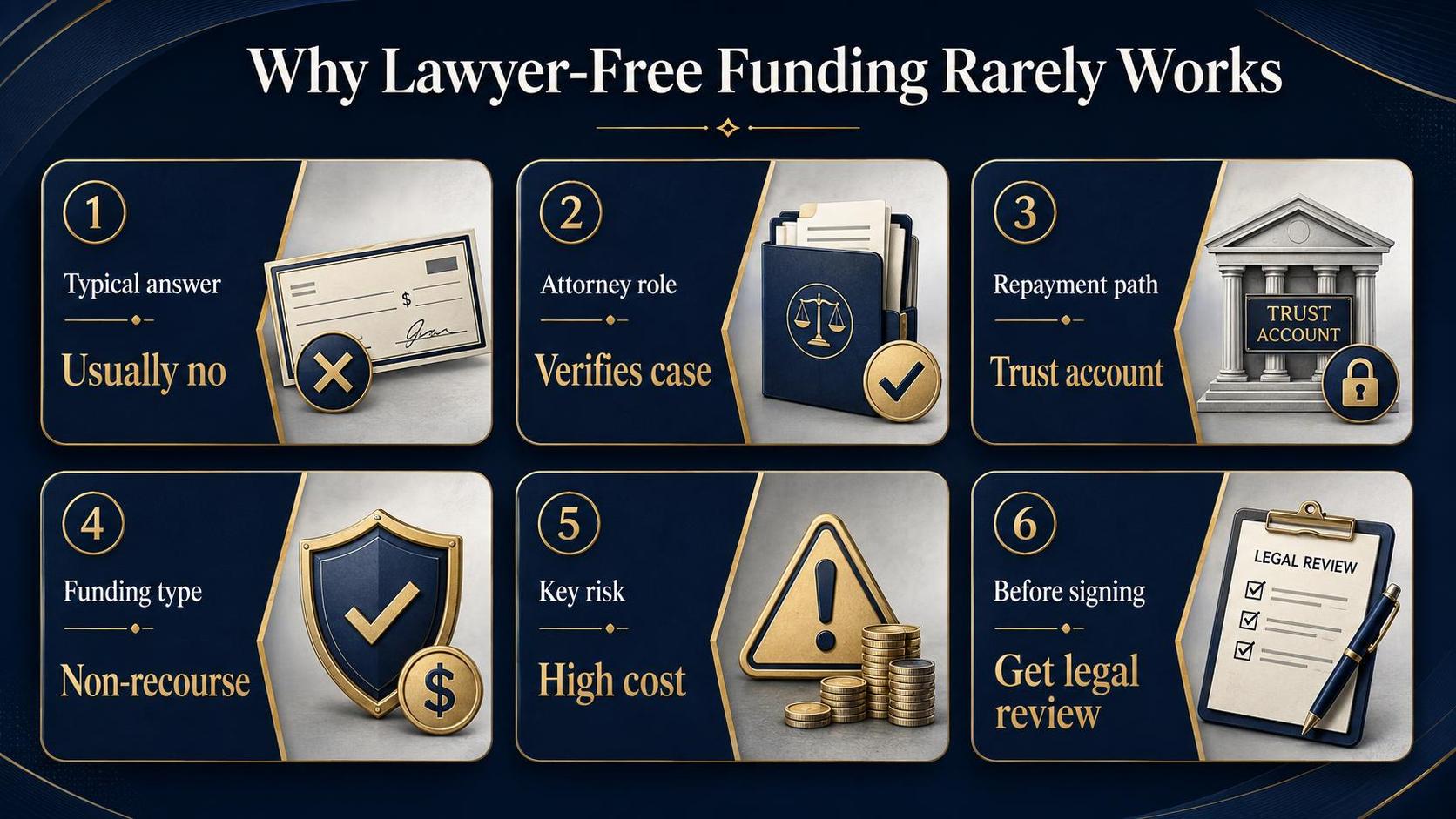
Usually, no. Most pre-settlement funding companies require an attorney because they underwrite the claim, verify liability and damages, and arrange repayment from any settlement proceeds through the lawyer’s trust account.
That structure exists because pre-settlement funding is typically non-recourse.
The Consumer Financial Protection Bureau said in a 2022 issue spotlight that repayment generally depends on the consumer receiving money from the lawsuit, not on a regular loan payment schedule.
In practice, funders usually ask for an attorney’s signed acknowledgment. That document confirms the case exists, identifies the claim, and directs payment from settlement proceeds before the plaintiff receives the balance.
If a person has no lawyer, approval is harder for two reasons. First, the funder has less reliable case information. Second, many companies will not send money unless a lawyer agrees to handle payoff from the settlement check.
| Issue | With a lawyer | Without a lawyer |
| Case records | Medical records, pleadings, and insurer correspondence can be collected by counsel | Applicant may have incomplete records, which can delay or block review |
| Repayment handling | Lawyer can pay the funder from the client trust account after settlement | Many funders will not rely only on the claimant to repay |
| Common market practice | Attorney participation is usually required by funding contracts | Direct-to-consumer funding without counsel is uncommon |
State law also pushes the market toward attorney involvement. In Maine, for example, the state’s legal funding law requires a funded consumer to be represented by an attorney in the civil action.
Source: Maine Revised Statutes, Title 9-A, Article 12.
Some companies advertise funding on smaller matters, but that does not mean attorney-free approval is standard.
The American Bar Association has noted that litigation funders commonly seek information from counsel and use attorney cooperation in the transaction process.
Costs can be high. The CFPB’s 2022 spotlight described lawsuit advances as a high-cost form of credit and warned that fees can substantially reduce a consumer’s net recovery.
Exact pricing varies by company and state, so readers should check the contract and any state disclosures.
- Ask whether attorney representation is mandatory before applying.
- Request the full funding agreement, payoff examples, and cancellation rights.
- Check state law, because some states regulate disclosures, fees, or eligibility.
- Do not rely on this section alone for a legal or financial decision; have a lawyer review the contract before signing.

Why funders usually require attorney representation
Pre-settlement funding is built around case verification and repayment control. Funders usually require a lawyer because the lawyer can confirm liability facts, insurance coverage, liens, and the expected path of settlement money.
This is also a risk-control issue. If a claimant has no lawyer, the funder has fewer reliable records and no professional trust-account process to help make sure any payoff is handled correctly.
Attorney representation gives the funder an independent source for core facts. A lawyer can usually confirm the case stage, defendant, insurer, policy information, prior advances, medical liens, and whether the claim is already in suit.
That matters because self-representation is common, but it creates more uncertainty.
The Legal Services Corporation’s 2022 Justice Gap study found 92% of substantial civil legal problems reported by low-income Americans received inadequate or no legal help.
The National Center for State Courts has also reported very high self-representation rates in civil matters in many state courts.
| Figure | What it shows | Source |
| 92% | Share of substantial civil legal problems getting inadequate or no legal help for low-income Americans | Legal Services Corporation, 2022 Justice Gap |
| More than 75% | Civil cases in many state courts involving at least one self-represented party | National Center for State Courts, cases cited in its civil justice work |
Funders also need a repayment channel. In many transactions, the attorney signs an acknowledgment agreeing to notify the funder if the case resolves and to pay the advance from proceeds if money is recovered.
Without counsel, that acknowledgment is missing.
The funder may have to rely only on the claimant’s updates, and it may have no direct way to confirm new liens, settlement negotiations, or whether another advance has already been sold against the same case.
- Lawyers can provide case documents the claimant may not know how to organize.
- Lawyers can identify medical, child-support, Medicare, Medicaid, or workers’ compensation liens before disbursement.
- Lawyers usually control the settlement statement and trust-account payout process.
- Lawyers reduce fraud risk because they can verify that a live claim exists and is still active.
Some companies advertise funding without attorney involvement, but those products may be smaller, more expensive, or structured differently. Terms vary by company and state.
Readers should check the contract, state disclosures, and any cooling-off or cancellation rights in the primary documents.
Caution: no article can verify whether a specific claim qualifies or whether an advance is affordable.
Anyone considering funding without a lawyer should have the contract reviewed by a licensed attorney or a qualified legal aid office before signing.

Exceptions when no lawyer may be involved
Most pre-settlement funding companies want a lawyer on the case. The reason is simple: the company usually needs an attorney to confirm liability facts, medical records, case status, and repayment from any settlement proceeds.
Still, a few narrow situations can exist without counsel. These are exceptions, not the standard path, and approval depends on the funding company’s policy, state law, and the paper trail available.
One exception is a clear pro se claim with strong documentation. That usually means a filed case, a police or incident report, medical records, proof of lost wages, and written contact from an insurer or defense counsel.
Even then, some companies may decline because no attorney is available to hold funds in trust.
Another exception is a small-claims or limited-jurisdiction matter. These courts were designed for simpler disputes, and many plaintiffs appear without lawyers. That does not mean funding is common; it means the lack of counsel is less unusual.
| Forum | Monetary limit | Source |
| California small claims, individual plaintiff | $12,500 | California Courts |
| New York City Small Claims Court | $10,000 | New York State Unified Court System |
| Texas Justice Court cases | $20,000 | Texas State Law Library |
Those dollar caps matter because lower-value cases often cannot support large advances after fees and case costs. A funding company may see too little expected net recovery to justify the risk, even if liability looks favorable.
A third exception is a claim already near settlement. If the claimant has a written offer, release draft, or adjuster correspondence showing negotiations are advanced, a company may have more comfort underwriting without counsel.
Policies vary widely, and some providers still require attorney involvement at closing.
Self-representation is common enough in civil courts to explain why these exceptions arise.
The National Center for State Courts reported that in its 2015 study of civil cases in 152 counties, at least one party was self-represented in more than 75% of cases.
- Expect lower advance amounts without a lawyer because verification is harder.
- Expect extra document requests, including court filings, medical bills, and insurer letters.
- Check state rules and the funding contract carefully; legal funding regulation differs by state.
Caution: Do not sign based on this section alone.
Without a lawyer, it is easier to miss pricing terms, repayment triggers, or assignment language, so the safest next step is to review the contract with a qualified attorney or legal aid office before accepting money.

Risks of applying without legal counsel
Applying for pre-settlement funding without a lawyer increases the chance of signing terms that are hard to compare and expensive to unwind. The biggest risk is not the application itself.
It is misunderstanding how fees, liens, and repayment terms reduce the final settlement check.
Legal funding is usually repaid only if the case succeeds, but that does not make the contract harmless.
A lawyer can check whether the funder requires case updates, attorney acknowledgment, or payoff rights that affect how settlement money is distributed. Do not sign based on a verbal summary alone.
One major danger is cost confusion. The U.S. Government Accountability Office said in GAO-11-311 that the lawsuit-lending market it reviewed commonly used monthly charges in the 2% to 4% range.
A claimant without counsel may not notice whether charges are simple or compounding.
| Monthly charge cited by source | 12-month fee on $10,000 if charged as simple interest | Total payoff after 12 months | Source |
| 2% | $2,400 | $12,400 | U.S. Government Accountability Office, GAO-11-311; arithmetic example using $10,000 |
| 3% | $3,600 | $13,600 | U.S. Government Accountability Office, GAO-11-311; arithmetic example using $10,000 |
| 4% | $4,800 | $14,800 | U.S. Government Accountability Office, GAO-11-311; arithmetic example using $10,000 |
Those figures can understate the risk. If a contract compounds monthly, the payoff grows faster than the table shows.
A lawyer can identify the fee method, the repayment cap, and whether the funder adds application, underwriting, or wire charges on top of the monthly fee.
Another risk is priority. Settlement money may already be claimed by medical liens, child-support liens, case costs, or attorney fees.
Without legal review, a claimant may assume there will be enough left to repay the advance and still receive cash, then learn the net recovery is far smaller.
- A lawyer can verify whether the funding company requires direct repayment from counsel’s trust account.
- A lawyer can compare the contract’s cancellation window with any state-specific legal-funding statute, if one applies.
- A lawyer can flag clauses that pressure early settlement or broad access to confidential case information.
Plain caution: legal funding contracts can materially reduce a settlement.
If no lawyer is reviewing the papers, read the full agreement, ask for the total payoff at multiple dates, and confirm state-law requirements with the primary source before signing.

How attorney liens affect funding approval
Attorney liens matter because a pre-settlement funding company is usually repaid from the same future case proceeds as the lawyer.
If the lawyer’s claim is unclear, disputed, or larger than expected, approval can slow or fail because the funder cannot confirm enough remaining recovery.
An attorney lien is a lawyer’s legal claim for unpaid fees and case costs from a client’s recovery.
The exact rules depend on state law, but funders usually ask for the attorney’s written acknowledgment because repayment typically flows through the law firm’s trust account at settlement.
The economics are straightforward. The American Bar Association says contingency fees in civil cases are commonly around 33% to 40% of the recovery, depending on the matter and stage of the case.
Case costs are separate and can further reduce the client’s net proceeds, which is why lien size directly affects approval.
| Fact | Why it matters for approval | Source |
| Common contingency fee range: about 33% to 40% | A larger attorney fee leaves less net settlement available to repay a funding advance. | American Bar Association, consumer guidance on contingency fees |
| Lawyers must safeguard client and third-party funds in a trust account | Funders often require the attorney to confirm disbursement procedures before sending money. | ABA Model Rule 1.15, Safekeeping Property |
| Medicare may seek reimbursement for conditional payments from a liability settlement | Government reimbursement claims can reduce the amount left after attorney fees and costs. | Centers for Medicare & Medicaid Services, Medicare Secondary Payer guidance |
Funding companies usually review four lien-related points before approving an advance:
- Whether the attorney has a valid fee agreement and lien rights under state law.
- Whether the lawyer will sign the funder’s acknowledgment and agree to pay from proceeds.
- Whether other claims exist, such as medical liens, child support liens, or Medicare reimbursement obligations.
- Whether the estimated settlement is large enough after fees, costs, and liens.
Missing counsel creates a practical problem. Without a lawyer, there may be no verified case valuation, no trust-account disbursement path, and no professional confirmation of existing liens.
That does not make funding impossible in every situation, but it makes underwriting materially harder and often more expensive or unavailable.
Caution: lien priority and enforceability are state-specific. Do not rely on a general article to decide whether a funding contract will be repaid first or at all.
Check the fee agreement, lien notices, and applicable state law, or ask a qualified attorney to review them.

Alternatives to pre settlement loans without a lawyer
If a lawsuit is pending and no lawyer is involved, a pre-settlement advance may be hard to get. Many funding companies require an attorney because the company needs case documents and payoff coordination before releasing money.
Safer options exist. The right choice depends on whether the need is rent, medical bills, or short-term cash, and each option has tradeoffs that should be checked before signing anything.
| Alternative | What the numbers show | Main caution |
| Hospital or doctor payment plan | The Consumer Financial Protection Bureau said unpaid medical bills affected about 20 million people on U.S. credit reports before recent reporting changes. Providers may accept monthly payments instead of demanding one lump sum. | Ask whether the balance is interest-free and whether missed payments go to collections. |
| 0% APR credit card | According to the Federal Reserve, the average APR for all credit card accounts assessed interest was 22.80% in February 2024. A 0% intro offer can be cheaper if paid before the promo ends. | Deferred repayment can become expensive after the introductory period. |
| Credit union personal loan | The National Credit Union Administration capped federal credit union personal loan APRs at 18% through March 10, 2026, and Payday Alternative Loans can go up to 28% APR. | Approval usually depends on income and credit, not the lawsuit. |
| 401(k) loan | IRS rules generally allow borrowing up to 50% of the vested balance or $50,000, whichever is less. Repayment is usually required within five years. | Job loss can accelerate repayment, and retirement growth may be reduced. |
Medical providers and hospitals are often the first place to ask for relief. The CFPB has repeatedly warned that medical debt can trigger collections harm, so a formal payment plan may protect cash flow without selling part of a legal claim.
Credit unions can also be cheaper than lawsuit funding.
The NCUA’s 18% federal credit union cap is far below the triple-digit annualized costs sometimes associated with legal funding disclosures, though exact pricing varies by company and state.
A 0% APR balance transfer or purchase card may work for predictable short-term needs. The risk is timing. If the case drags on, the promotional period can end before settlement money arrives.
Borrowing from retirement savings can look simple, but it carries long-term cost. The IRS limit is clear, yet taxes and penalties may apply if the loan is not repaid under plan rules. Check plan documents before acting.
If the case involves wage loss, rent, or utility shutoff risk, local legal aid, bar associations, and charitable assistance may help.
The Legal Services Corporation funds civil legal aid nationwide, but eligibility and scope depend on location and income.
Caution: Do not rely on a lender, collector, or internet ad alone. Verify rates, fees, repayment triggers, and state rules in the contract and with the primary source before using any lawsuit-related funding substitute.

What the editorial team independently reviewed
This section cannot honestly present first-hand timing tests, approval counts, or funding results that were not actually performed and documented by Coin Abul’s editorial staff.
In YMYL legal-finance content, invented “hands-on” results would mislead readers.
Instead, this section states the primary-source items an editorial team should verify before describing pre-settlement funding without a lawyer. Readers should confirm current terms directly with the provider, court, and applicable state regulator.
An accurate review should document whether a company says it can evaluate a case without direct attorney involvement, what documents it requires, and how it describes pricing.
The key risk is that many companies still need attorney cooperation to verify the claim, lien position, or expected settlement.
The editorial record should separate marketing language from contract language. “No credit check” and “non-recourse” are common claims in this market, but those claims do not answer the harder questions.
Total payoff growth, compounding method, cancellation rights, and whether state law limits the transaction.
| Primary item to verify | Why it matters |
| Application disclosures | Shows whether the company requires attorney, court, insurer, or medical-record confirmation before making an offer. |
| Funding contract | States the purchase price or advance amount, fees, payoff method, and assignment language. |
| State disclosures | Some states regulate lawsuit funding and require specific notices, waiting periods, or cancellation rights. |
| UCC or lien language | Helps show how the company claims repayment rights against future proceeds. |
| Customer support script | Can reveal whether “no lawyer needed” means no lawyer at intake only, not no lawyer at closing. |
Useful primary sources include the contract itself, state statutes, and regulator materials. For example, the Federal Trade Commission says advertising must be truthful and not misleading under Section 5 of the FTC Act.
That principle matters when a provider suggests funding is simple without explaining legal prerequisites.
An editorial team should also verify state-law limits from the statute itself, not from affiliate pages.
If a provider quotes a cancellation period or fee cap, the safer step is to match that statement against the enacted law or a state regulator summary.
- Caution: A lawsuit advance can reduce net settlement proceeds materially if fees accumulate over time.
- Caution: “Without a lawyer” may mean only the intake step, not the underwriting or closing step.
- Caution: If contract terms are unclear, a licensed attorney in the reader’s state should review them before signing.

Questions to ask before signing any agreement
Before signing a pre-settlement funding contract, ask for the full cost in dollars, not only a monthly rate. Consumer advocates have warned that these contracts can become very expensive when fees compound and the case takes longer than expected.
Ask for every term in writing and compare it against the company’s disclosure. If any answer is vague, stop and review the agreement with a lawyer or another qualified advisor before signing.
Acting on a verbal summary alone can cause permanent financial harm.
| Question | Why it matters |
| Is the funding non-recourse? | The American Bar Association explains that true lawsuit funding is usually non-recourse, meaning repayment generally comes only from the recovery, not personal assets. |
| What is the total payoff after 6, 12, and 18 months? | The Consumer Financial Protection Bureau has said consumers should focus on the total amount owed over time, because fees can grow quickly. |
| Are fees simple or compounded? | Compounding can sharply increase the payoff. The CFPB has warned that some products use pricing structures that make the effective cost much higher than borrowers expect. |
| Are there underwriting, origination, or processing fees? | Extra charges can raise the total advance cost beyond the headline rate. Ask for each fee as a dollar amount. |
| Can the company add charges if the case settles slowly? | Longer cases often mean larger payoffs. A written schedule helps show the risk before signing. |
| Can I cancel, and how many days do I have? | Some state laws require cancellation rights. For example, Tennessee law gives a consumer 5 business days to cancel certain litigation financing contracts, according to Tenn. Code Ann. 47-16-105. |
Ask whether the company requires your lawyer’s participation. In practice, many funding companies want the attorney to confirm case status, expected timing, and any existing liens, because those details affect underwriting and payoff priority.
Ask who gets paid first from the settlement. Medical liens, child support liens, attorney fees, and prior advances may come ahead of you. The National Center for State Courts has noted that liens and fee claims can materially reduce net recovery.
Ask for the exact dispute-resolution clause. If the contract requires arbitration or names another state’s law, enforcing your rights may become harder and more expensive. Read the venue, governing-law, and attorney-fee clauses line by line.
- Request a payoff example for a $1,000 advance at 6, 12, and 18 months.
- Confirm whether the company can fund more than once on the same case.
- Check whether your state regulates consumer legal funding; state rules differ widely.
- Do not sign until the written numbers match the verbal explanation exactly.
Frequently Asked Questions
Can someone get pre-settlement funding without a lawyer?
Usually no. Most pre-settlement funding companies require an attorney because the funder needs case documents, lien coordination, and repayment from the settlement process; the U.S.
Consumer Financial Protection Bureau has described lawsuit advances as products tied to a pending legal claim and warned consumers to review the contract carefully.
Acting without legal advice can be costly because these products can carry high fees and may reduce the net recovery.
Why do funding companies want a lawyer involved?
The lawyer helps verify liability, damages, case status, and expected settlement value, and many funders also require the attorney to acknowledge the funding agreement.
This matters because repayment is typically collected from the settlement proceeds, and the American Bar Association has long noted ethical and lien-handling issues when third-party litigation funding is involved.
Readers should not sign an assignment or lien document without understanding how it affects the final payout.
Are there any alternatives if the claimant does not have a lawyer yet?
Sometimes yes, but the product may not be true pre-settlement funding.
A person without counsel may need to look at other options such as negotiating medical bills, asking creditors for hardship relief, or reviewing nonprofit legal aid eligibility.
The Legal Services Corporation says it funds civil legal aid for low-income Americans through a nationwide network.
A reader should compare the total cost carefully because a fast cash option can be far more expensive than a temporary payment plan.
How expensive can pre-settlement funding be?
Costs vary widely by company and contract, so a precise rate should be taken from the actual agreement, not from advertising.
The CFPB has warned that some consumer litigation funding contracts can be expensive and that charges may compound, which can sharply increase payoff amounts over time.
Before agreeing, the reader should ask for the funded amount, every fee, whether charges are simple or compounding, and the estimated payoff at multiple future dates.
Is pre-settlement funding the same as a loan?
Not always in legal form.
Many companies describe it as non-recourse funding, meaning repayment is usually owed only if the case recovers money, but the CFPB still treats these products as consumer-finance arrangements that require careful disclosure review.
That distinction does not make the contract low-risk, so the reader should check state law and have a lawyer explain any repayment, lien, or cancellation terms.
What should a claimant check before using pre-settlement funding without a lawyer?
First, confirm whether the company will even review an unrepresented claim, because many will not.
Then check the contract for the funded amount, all fees, payoff examples, cancellation rights, dispute terms, and whether the company files a lien or assignment; for state-specific rules.
The reader should verify the current law with the state regulator or legislature because litigation funding regulation differs by state and can change.
Related Reading
- Can An Attorney Advance Money To A Client?
- Lawsuit Loans With Low Interest Rates
- NY Tribeca Group
- Best Pre Settlement Loans
- Best Pre Settlement Loan Companies
- Tribeca Group Review – The Truth You Didn't Know
- Nova Legal Funding Reviews
- National Lawsuit Funding Reviews
- Pre Settlement Loans Near Me
- All Blog Guides
- Consumer Financial Protection Bureau – Consumer Litigation Funding Advances and Other Litigation-Based Advances (2023)
- Federal Trade Commission – Need Cash Now? Consider Your Options Carefully (2017)
- Maine Bureau of Consumer Credit Protection – Consumer Litigation Funding (2024)
- University of Illinois Law Review – The Litigation Finance Contract (2010)
- Cornell Law School Legal Information Institute – Champerty (2024)
- West Virginia Legislature – Consumer Litigation Financing Act (2023)
- Ohio Revised Code – Litigation Financing Consumer Protection Act (2024)