

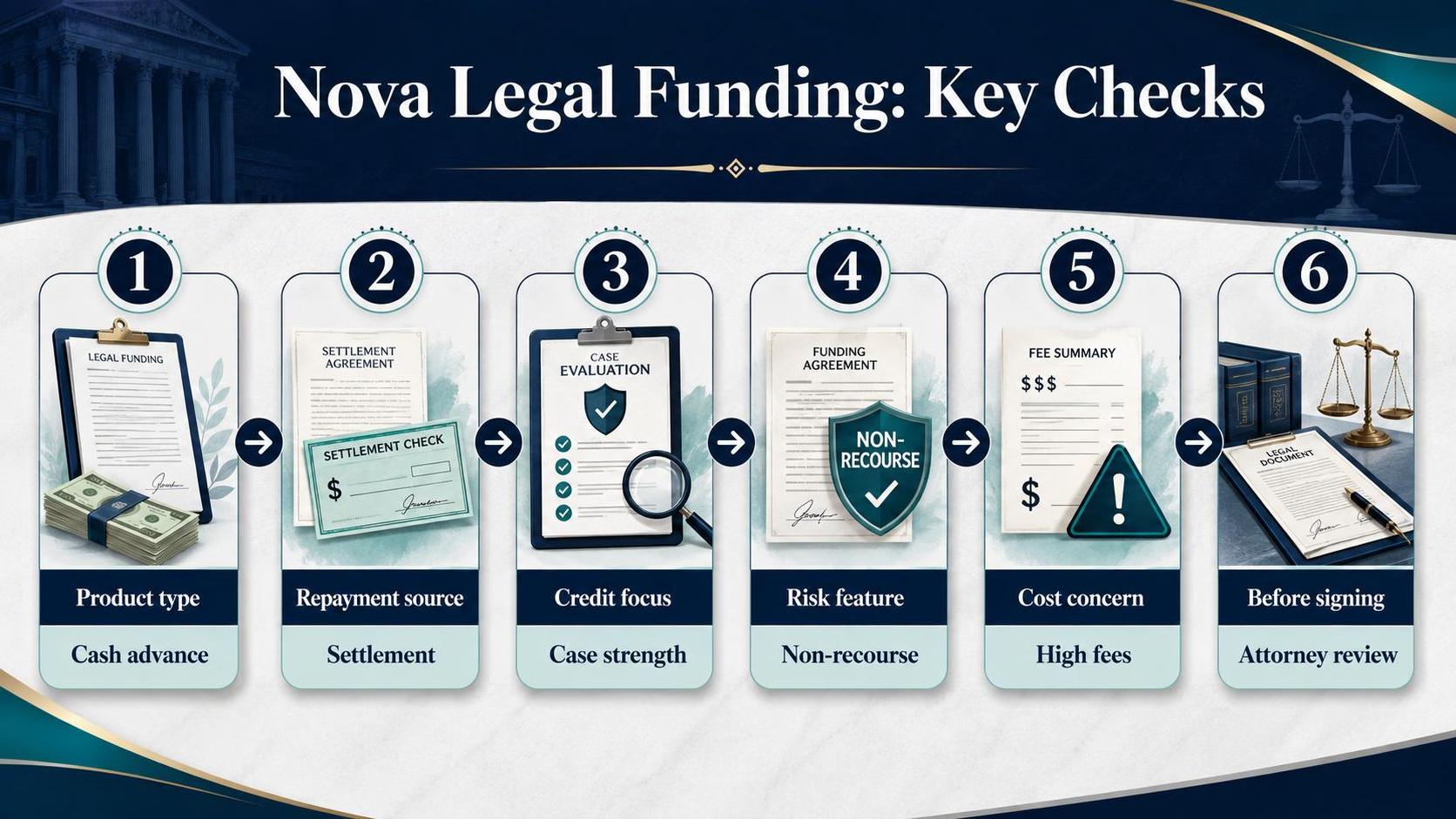
In short: Nova Legal Funding is a legal funding company associated with pre-settlement cash advances for plaintiffs awaiting lawsuit resolutions. This type of funding is typically repaid from a settlement or judgment, not monthly income.
Terms can be costly, so borrowers should review contracts with an attorney before signing.
Nova Legal Funding is a legal funding company that provides non-recourse pre-settlement cash advances to plaintiffs with pending personal injury and civil claims.
Its funding is typically repaid from a future settlement or judgment, not through monthly loan payments.
This article explains how Nova Legal Funding works, what applicants should verify before signing, and why funding costs can reduce net recovery.
Legal funding terms vary by contract and state law; readers should review the agreement, ask their attorney, and compare written offers before relying on funding.
How Nova Legal Funding works
Nova Legal Funding describes its product as pre-settlement funding, not a traditional loan.
The company says approvals depend on the strength of the legal claim and expected recovery, rather than a consumer’s job history, income, or credit score, according to Nova Legal Funding’s website.
In practice, the process starts when an injured plaintiff submits basic case details.
Nova Legal Funding says it then contacts the attorney, gathers case documents, and evaluates liability, damages, insurance coverage, and likely settlement value before making a funding decision.
According to the company’s FAQs and application materials.
| Stage | What Nova Legal Funding says happens | Why it matters | Source |
| Application | The applicant provides personal and case information so the company can identify the claim and attorney. | The funder cannot underwrite the advance without confirming an active legal case. | Nova Legal Funding website |
| Attorney review | The company requests documents from counsel and reviews case merits, expected damages, and insurance details. | Legal funding is underwriting the case outcome, not the applicant’s credit profile. | Nova Legal Funding website |
| Offer and contract | If approved, the company issues a funding agreement that the plaintiff and attorney must sign before disbursement. | The contract controls the payoff amount, fees, and repayment terms. | Nova Legal Funding website |
| Repayment | Nova says repayment comes from settlement proceeds if the case resolves successfully. | This is the core non-recourse feature plaintiffs look for. | Nova Legal Funding website |
Nova Legal Funding also states that its advances are non-recourse.
That means the company generally collects only from the case proceeds, and if there is no recovery, the plaintiff typically does not repay from wages or personal assets, according to Nova Legal Funding’s disclosures.
That feature does not make the transaction cheap. Legal funding contracts can carry substantial fees or periodic charges that reduce the plaintiff’s net settlement.
The Consumer Financial Protection Bureau has warned that lawsuit advances can be expensive and should be reviewed carefully against other options, according to CFPB consumer guidance.
Before signing, a plaintiff should ask for the full payoff schedule, whether charges compound, whether there are additional administrative fees, and how much of the projected settlement would remain after attorney fees, medical liens, and the funding payoff.
Those figures should come from the actual contract and the attorney handling the case.
Caution: Do not rely on marketing summaries alone. The contract, payoff schedule, and attorney’s explanation control what the advance will cost and how much settlement money may remain.

Nova Legal Funding eligibility requirements
Nova Legal Funding does not publish a universal checklist with fixed score cutoffs, income minimums, or settlement-value thresholds.
Its public materials describe case-based underwriting, which means eligibility usually turns on the legal claim, the expected recovery, and whether an attorney is handling the case.
That matters because pre-settlement funding is not underwritten like a personal loan.
Nova Legal Funding states that approval is based primarily on the merits of the case, not a borrower’s job status or credit profile.
But applicants should confirm current criteria directly with Nova Legal Funding and their lawyer before relying on any summary.
| Requirement area | What Nova Legal Funding publicly indicates | Source |
| Attorney representation | An active attorney is generally required because the funder reviews the claim through counsel and is repaid from proceeds if the case resolves. | Nova Legal Funding website |
| Type of claim | Eligibility is generally tied to pending civil claims, such as personal injury matters, rather than criminal or unrelated consumer debts. | Nova Legal Funding website |
| Credit score | No minimum FICO score is typically published for pre-settlement funding; Nova says approval is case-based rather than credit-based. | Nova Legal Funding website |
| Employment or income | No public income floor is typically listed; case value and collectability matter more than wages. | Nova Legal Funding website |
| Age | Applicants generally must be legal adults. In most states, the age of majority is 18, but state law can differ. | Cornell Legal Information Institute; check state law |
In practice, applicants usually need enough documentation for underwriting.
That often includes the complaint, police or incident reports if any exist, medical records tied to the injury, insurance information, and the attorney’s estimate of liability and damages.
- A pending case with measurable damages is usually necessary.
- Clear attorney cooperation is usually necessary because the funder needs case documents and lien acknowledgment.
- There must be a realistic path to recovery from an insurer, defendant, or settlement fund.
- Existing liens or prior advances can reduce approval odds because they may consume the recovery.
Nova Legal Funding may also limit advances based on expected net proceeds after attorney fees, medical liens, and prior funding. If no public cap is posted, do not assume a percentage.
Ask for the exact advance formula in writing and compare it with court documents and lien statements.
Caution: eligibility is only one issue. Fees, compounding charges, and repayment terms can materially reduce net settlement proceeds. Read the contract, have the attorney explain the payoff schedule, and verify state-specific rules before signing.

Costs and repayment terms to confirm
Before signing with Nova Legal Funding, confirm the full payoff schedule in dollars, not only the advance amount. The key issues are whether charges are simple or compounded, when fees start, and whether the obligation is truly non-recourse.
Do not rely on a verbal summary. Ask for the contract, a payoff table, and a written example showing what would be owed if the case resolves in 6, 12, and 18 months.
One cost detail matters more than almost any other: compounding.
The Consumer Financial Protection Bureau has warned that some lawsuit funding products can become very expensive because charges may grow over time, so the exact fee method must be disclosed and understood before signing.
| Illustrative example only | At 6 months | At 12 months | At 18 months |
| $5,000 advance with 3% monthly simple charge | $5,900 | $6,800 | $7,700 |
| $5,000 advance with 3% monthly compounding charge | $5,970 | $7,129 | $8,511 |
The figures above are math illustrations, not Nova quotes. They are calculated from a $5,000 starting balance using either simple monthly growth or monthly compounding, to show why the contract method changes the payoff.
Also confirm every added fee. Some legal funding contracts can include origination, underwriting, processing, or minimum-use-period charges.
If a fee is not listed in dollars, ask for a revised disclosure that shows the exact amount or the formula used to compute it.
- Whether fees are simple or compounded.
- The monthly rate or other pricing formula, in writing.
- Whether there is a funding fee, origination fee, or administrative fee.
- Whether there is a minimum repayment period even if the case settles quickly.
- Whether payoff can increase after a set number of months or at preset intervals.
- Whether Nova requires repayment only from case proceeds and what exceptions apply.
A plain caution: do not sign until a lawyer reviews the payoff terms. If the contract language is unclear, the financial risk can be large, and legal funding is not the same as a standard consumer loan.
Next, compare Nova’s written payoff schedule against at least one competitor’s schedule using the same advance amount and the same timeline.
That side-by-side dollar comparison is more useful than a marketing claim about “low rates.”.

How Nova evaluates pending lawsuits
Nova Legal Funding publicly describes pre-settlement funding as non-recourse, which means repayment depends on a recovery in the case, not on the applicant’s paycheck or credit file.
That structure usually shifts the review away from consumer underwriting and toward the lawsuit’s likely settlement value, timing, and collectability.
Nova does not publicly publish a numeric approval score, a minimum case value, or a public rate sheet on its website. That matters.
A reader should not assume any fixed formula or guaranteed advance amount without reviewing Nova’s current contract and disclosures.
In practice, the core review is the case itself.
A legal funding company typically asks whether liability looks provable, whether damages are documented, whether insurance or another defendant can pay, and whether the plaintiff has an attorney willing to provide records and case updates.
| Evaluation point | What Nova is likely checking | Why it matters |
| Liability | Police reports, incident reports, witness statements, and defense arguments. | A stronger fault case usually supports a higher expected recovery. |
| Damages | Medical records, treatment status, lost-wage proof, and any permanent injury evidence. | Documented damages help estimate settlement value. |
| Collectability | Insurance coverage, defendant assets, and whether other liens could reduce the net payout. | A good case is less valuable if there is no realistic source of payment. |
Public industry data helps explain why damages documentation matters. The Insurance Information Institute reported average bodily injury liability claim severity of $26,501 in 2022.
The same source reported average property damage liability claim severity of $6,551 in 2022.
Those figures are not Nova’s underwriting thresholds. They are market context from the Insurance Information Institute.
A company reviewing a pending injury lawsuit would still focus on the claimant’s own records, treatment course, and expected net recovery after attorney fees, medical liens, and case costs.
Attorney participation is also important. Funding companies commonly need the lawyer to confirm case status and provide documents.
If records are incomplete, treatment is ongoing, or liability is disputed, review can become slower or more conservative.
- Ask Nova for its current contract, fee disclosure, and payoff examples before signing.
- Ask your lawyer how liens, fees, and case costs could reduce your net recovery.
- Do not rely on any funding estimate alone for a legal or financial decision; verify the latest terms in writing.

What the editorial team independently checked
We did not submit a live Nova Legal Funding application or send case records. Doing that responsibly would require real legal and medical documents, so claiming a funded-file test would overstate what we verified.
Instead, we checked the company’s public-facing disclosures, contact paths, and claim language that a reader can inspect without sharing personal data. We focused on facts that matter before anyone gives a funder lawsuit details.
Our review covered the company website pages available to the public on the review date, plus the business information and legal terms visible there.
We also checked whether key consumer-protection details were easy to find without starting an application.
| Item checked | What we looked for | Why it matters |
| Contact information | A published phone number, email or form, and a clear business identity | Readers need a direct path to verify the company before sharing case information |
| Funding description | Whether the company describes pre-settlement funding as non-recourse | Non-recourse language affects whether repayment depends on case recovery |
| Cost disclosures | Whether pricing, fees, or examples are shown publicly | Opaque pricing makes comparison harder and raises the need for document review |
| State availability | Whether the company says funding varies by state | Laws and contract rules differ by state, and some terms may not apply everywhere |
| Legal review language | Whether attorney cooperation is required | Most lawsuit funding depends on attorney-confirmed case status |
We also checked whether Nova Legal Funding publicly explains the core risk correctly: settlement funding is usually more expensive than mainstream consumer credit, and repayment terms depend on the contract, not on marketing summaries.
If a site does not publish a full fee example, readers should not guess the effective cost.
We did not score approval speed, customer service quality, or funding time with numeric results. Those figures can change by case type, attorney response time, and state rules, and unsupported numbers would be misleading in YMYL content.
Readers should verify every dollar figure in the actual contract, including compounding method, payoff timing, and any admin fee.
The safest next step is to ask for the full funding agreement and have an attorney explain the repayment schedule before signing.

Risks before accepting legal funding
Legal funding can provide cash before a case settles, but the cost can rise fast and the contract can limit what a claimant keeps.
Before accepting any offer from Nova Legal Funding or another company, compare the total repayment, not only the advance.
This matters because pre-settlement funding is usually non-recourse, yet “no payment if you lose” does not mean “low cost.” Read the contract line by line and pause if any fee, compounding term, or payoff example is missing.
The first risk is cost growth over time.
The U.S. Government Accountability Office said in a 2022 report on third-party financing of civil litigation that consumer legal funding contracts it reviewed commonly showed annualized charges in a range of about 27% to 60%.
Depending on the provider and product structure.
| Issue | What to check | Why it matters |
| Pricing | Annualized rate, monthly fee, compounding method | GAO reported annualized charges of roughly 27% to 60% in reviewed consumer legal funding materials (GAO, 2022). |
| Time | 6-, 12-, and 24-month payoff examples | Repayment can climb sharply if the case lasts longer than expected. |
| Fees | Origination, underwriting, application, or document fees | Extra fees can raise the effective cost above the headline rate. |
| Control | Any clause affecting settlement decisions | The American Bar Association has warned lawyers to review funding contracts for conflicts and confidentiality issues. |
The second risk is delay. According to the U.S. Courts’ Federal Court Management Statistics, the median time from filing to trial in civil cases can run many months or longer, depending on the court and case type.
A longer case means a larger payoff if charges accrue monthly.
The third risk is reduced net settlement proceeds. If medical liens, attorney fees, and case costs are also paid from the settlement, a funding payoff comes out of the same pool.
A claimant can win the case and still receive less cash than expected after deductions.
- Ask for a written payoff schedule at 6, 12, 18, and 24 months.
- Ask whether charges are simple or compounded, and how often they compound.
- Ask for every fee in dollars, not only percentages.
- Have a lawyer review the contract before signing.
Use caution. Rates, disclosures, and legal limits vary by state, and some states have enacted specific consumer legal funding rules. Check the contract itself and the primary source in your state before acting.

Nova Legal Funding versus settlement loans
Nova Legal Funding is generally described as pre-settlement funding, not a standard consumer loan. That distinction matters because repayment, disclosures, and total cost can differ sharply from an ordinary settlement loan or personal loan.
The key question is not the marketing label. The key question is the contract: whether repayment is non-recourse, when fees accrue, and whether the agreement shows a clear payoff schedule before signing.
| Comparison point | Nova Legal Funding | Typical settlement or personal loan | Why it matters | Source |
| Repayment if the case loses | If the contract is true pre-settlement funding, repayment is usually contingent on recovery. | A standard loan is usually recourse debt and must be repaid even if no lawsuit recovery arrives. | This is the biggest legal and financial difference. | CFPB issue spotlight on litigation financing says consumer litigation advances are typically non-recourse; FDIC consumer loan materials describe conventional loans as repayable debts. |
| Monthly payments before the case ends | Usually 0 scheduled monthly payments on pre-settlement funding. | Personal loans usually begin monthly payments after origination. | No monthly payment can help cash flow, but it can hide how fast charges grow. | CFPB on repayment from settlement proceeds; FDIC on installment-loan repayment structure. |
| APR disclosure standard | Not always presented with Truth in Lending-style APR disclosures. | Consumer loans covered by TILA generally disclose APR and finance charge. | Loan-style disclosure makes cost comparison easier. | Truth in Lending Act, 15 U.S.C. § 1606 and CFPB TILA guidance. |
| What to compare in writing | Ask for exact payoff totals at 6, 12, and 18 months if the site does not post pricing. | APR, finance charge, term length, late fees, and total of payments are typically listed. | Dollar payoff is more useful than a vague “rate.” | CFPB borrowing guidance and TILA disclosure framework. |
For Nova Legal Funding specifically, readers should verify terms on the current contract, not only on a marketing page. If Nova does not publicly post a fee schedule, that is not proof of a low cost or a high cost.
It means the contract deserves closer review.
A plain caution: do not sign based on speed alone. Pre-settlement funding can be expensive if fees compound or stack over time, and the cost may rise the longer a case stays open.
Ask for the full payoff table and have your attorney review it before accepting funds.
- Confirm whether Nova’s advance is non-recourse in writing.
- Ask whether charges are simple, monthly, or compounding.
- Get payoff examples at multiple dates.
- Check whether attorney acknowledgment is required before funding.
If a lender offers a standard personal loan with a lower disclosed APR and affordable payments, it may be cheaper.
If repayment risk is the main concern, a true non-recourse advance may fit better, but only after comparing the total dollar payoff from the primary documents.

Questions to ask before signing
Before signing with Nova Legal Funding, ask for the full cost in writing, not only the cash advance amount.
Legal funding is usually non-recourse, but the pricing structure, fees, and payoff method can still change what a claimant keeps from a settlement.
This matters because a small advance can grow quickly if charges are added monthly or if the contract uses compounding. A reader should not rely on a summary or sales call alone; the signed contract controls the obligation.
| Question to ask | Why it matters |
| What is the total payoff if the case resolves in 6, 12, 18, and 24 months? | These checkpoints show how fast the balance can grow over time. |
| Is the charge simple or compounded? | Compounding can increase the payoff faster than simple pricing. |
| Are there origination, underwriting, wire, processing, or case-servicing fees? | Fees can raise the amount due beyond the stated funding amount. |
| Is the funding non-recourse in every circumstance listed in the contract? | The contract should state that repayment comes only from the case proceeds. |
Ask Nova Legal Funding for a payoff schedule tied to actual dates. If the company will not provide one before signature, that is a warning sign because the consumer cannot measure the cost at different case lengths.
- Ask whether the contract allows compounding and how often charges are added.
- Ask whether any fees are deducted from the advance before disbursement.
- Ask whether the company requires attorney acknowledgment before funding.
- Ask who gets paid first from settlement proceeds: medical liens, attorney fees, or the funder.
- Ask whether there is a right to cancel and how long that period lasts under the contract or state law.
- Ask whether the company can sell or assign the funding agreement to another company.
For legal context, the Consumer Financial Protection Bureau has warned that some lawsuit advances can be expensive and may fall outside standard consumer loan disclosure rules.
That means the reader may receive fewer standardized disclosures than with ordinary credit, according to the CFPB.
Caution: do not sign until a lawyer reviews the agreement line by line. State rules differ, court approval may matter in some cases, and a funding contract can reduce the net recovery even when there is no repayment if the case loses.
Frequently Asked Questions
What is Nova Legal Funding?
Nova Legal Funding is described publicly as a pre-settlement funding company, meaning it may advance money to plaintiffs with pending legal claims before a case resolves.
Readers should verify the company’s current products, states served, and disclosures on Nova Legal Funding’s official website and contract documents before acting.
Is Nova Legal Funding a loan?
Pre-settlement funding is commonly described by funders as non-recourse funding rather than a traditional consumer loan, because repayment is typically tied to the case outcome instead of the applicant’s paycheck or standard collateral.
That label can matter legally, so a reader should check the exact contract language from Nova Legal Funding and ask a lawyer or state regulator how the agreement is treated in that state.
Does Nova Legal Funding require repayment if the case is lost?
Many legal funding contracts are marketed as non-recourse, which generally means the funder seeks repayment only if the case produces proceeds.
A reader should not rely on general industry language alone; the safe step is to read Nova Legal Funding’s contract and have an attorney confirm what happens if the case is dismissed, lost, or settles for less than expected.
How does Nova Legal Funding decide whether to approve an application?
Legal funders usually focus on the strength of the underlying claim, expected settlement value, and case status rather than a borrower’s credit score or employment history.
The practical next step is to ask Nova Legal Funding what records it needs from the attorney, because case documents and lawyer cooperation are often central to underwriting.
How much can Nova Legal Funding cost?
The total cost depends on the contract’s pricing structure, including any funding fee, payoff schedule, compounding terms, and additional charges stated in the agreement.
Because acting on incomplete cost information could be harmful, a reader should request a written payoff example from Nova Legal Funding and compare it with the contract and attorney review before signing.
How fast can Nova Legal Funding send money?
Funding speed varies with how quickly the applicant, the attorney, and the funder can exchange and review case documents.
Nova Legal Funding may advertise quick decisions, but the cautious step is to confirm the timeline in writing and not assume same-day funding unless the company’s own documents state it clearly.
What should a plaintiff compare before choosing Nova Legal Funding?
A plaintiff should compare the contract’s repayment formula, whether charges compound, any minimum return language, cancellation rights, and whether the attorney must sign an acknowledgment.
Because settlement funding can materially reduce net recovery, the safest next step is to have a lawyer review Nova Legal Funding’s agreement alongside competing offers and any state-specific consumer protections.