

Bottom line: JG Wentworth Structured Settlement refers to J.G. Wentworth’s business of purchasing future structured settlement payment rights for a lump sum. The company is a well-known structured settlement factoring firm in the U.S.
Courts generally must approve these transfers under state structured settlement protection laws. Terms, fees, and discounts vary by case.
JG Wentworth Structured Settlement is a purchasing option through J.G. Wentworth for people who want to sell some or all future structured settlement payments for a lump sum.
The company is widely known in the settlement-purchasing market, but any sale usually requires court approval and a judge’s finding that the transfer is in the seller’s best interest.
Readers should compare offers, fees, discount rates and state requirements before signing. Selling payments can permanently reduce future income, so independent legal or financial advice is important before acting on the information alone.
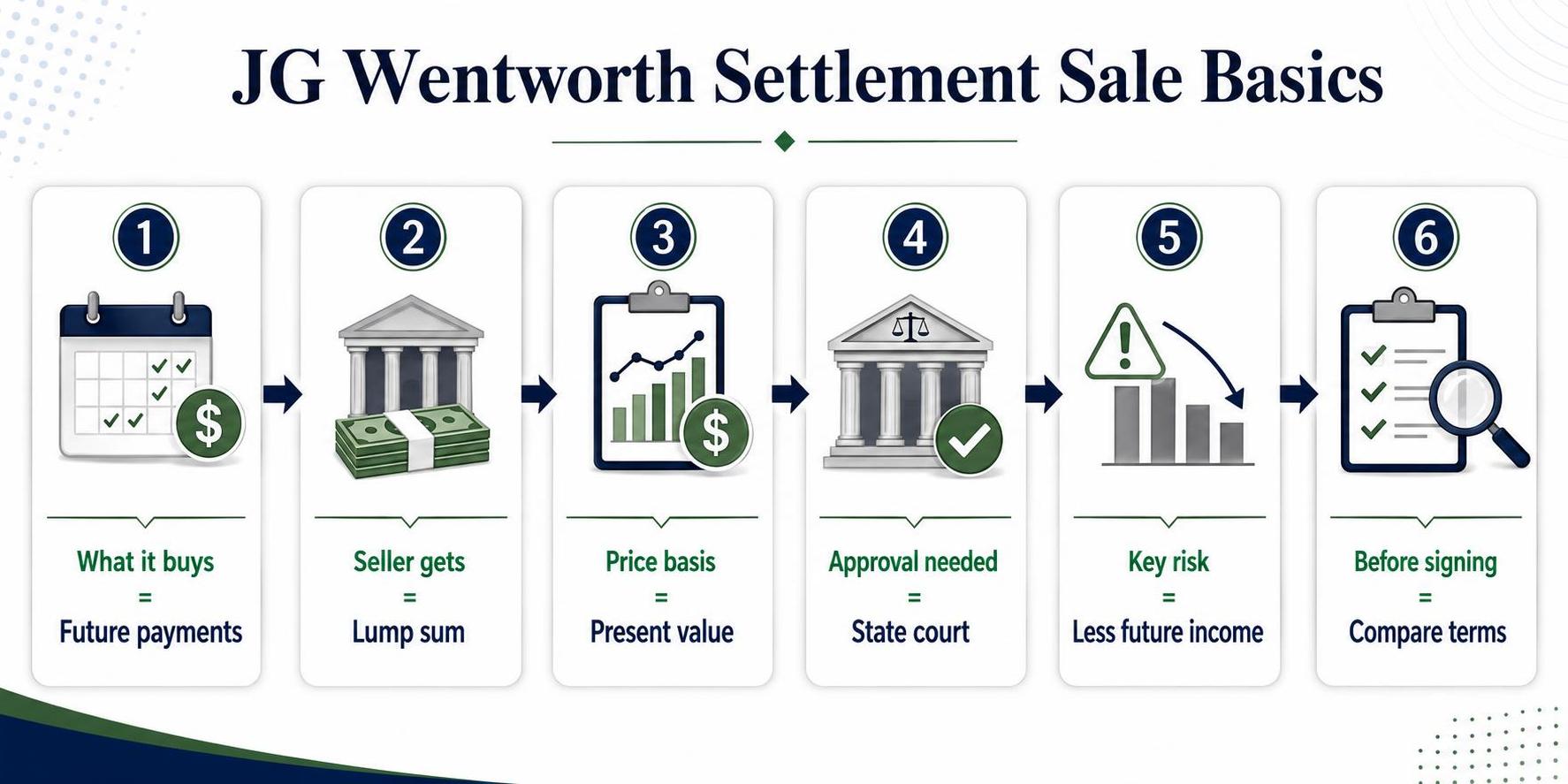
How JG Wentworth structured settlement transfers work
JG Wentworth buys some or all of a person’s future structured settlement payments in exchange for a lump sum. The transfer is not complete when the contract is signed.
It must usually be approved by a state court under a Structured Settlement Protection Act and by the federal tax rules in 26 U.S. Code Section 5891.
In practice, the company reviews the payment stream, makes an offer based on the present value of the payments, prepares disclosure documents, and then asks a court to approve the sale.
The judge decides whether the transfer is in the payee’s best interest under the applicable state law.
| Step | What happens | Key fact |
| 1. Quote and offer | JG Wentworth reviews the settlement annuity and identifies the payments the seller wants to transfer. | The seller can transfer all payments or only a defined portion, depending on the contract and state law. The lump sum is lower than the total future payments because it is discounted to present value. |
| 2. Required disclosure | The company gives a written disclosure statement before the transfer is finalized. | 26 U.S. Code Section 5891 requires compliance with state structured settlement transfer laws. Those laws typically require disclosure of the amounts being sold, the discounted present value, and fees. |
| 3. Court review | A petition is filed, and a judge reviews the transfer. | Under 26 U.S. Code Section 5891, a transfer without a qualified court order can trigger a 40% federal excise tax on the factoring company. That tax rule is designed to force court-approved transfers. |
| 4. Funding | If approved, the annuity issuer redirects the sold payments and JG Wentworth sends the lump sum. | Funding happens only after the signed order is processed by all parties, including the annuity issuer and, in some cases, the settlement obligor. |
The discount rate matters because it directly affects how much cash the seller receives.
Consumer court filings often show effective annual discount rates that can be much higher than standard loan rates, but the exact rate varies by transaction and should be read from the disclosure statement and court papers.
Some states also require the payee to receive advice about the financial and legal consequences, or to waive that advice in writing. That requirement comes from the state’s Structured Settlement Protection Act, not from JG Wentworth alone.
Caution: A transfer can permanently reduce long-term income meant for medical care, living expenses, or family support. Do not rely on a quote alone.
Read the disclosure, compare the discounted present value to the cash offered, and check the court documents and your state law before signing.

When selling payments may make sense
Selling structured settlement payments can make sense when the cash solves a defined problem that is larger than the value of keeping the next payments on schedule.
It is usually strongest when the need is urgent, the use of funds is specific, and lower-cost options have been checked first.
The decision should stay narrow. Many state laws require court approval because future payments are meant to protect long-term income, and a sale can permanently reduce that protection.
| Need or pressure point | Verified figure and source | Why a sale may be considered |
| Emergency expense with no liquid savings | $400 emergency benchmark; 63% of U.S. adults said they would cover it with cash or its equivalent, meaning 37% would not, according to the Federal Reserve’s 2023 Survey of Household Economics and Decisionmaking | If a recipient cannot cover a necessary expense and cheaper credit is unavailable, selling a limited portion of future payments may be a last-resort source of cash. |
| High-cost short-term debt | The CFPB reported that payday loan fees can translate to an annual percentage rate of nearly 400% | Using a partial sale to eliminate extremely expensive debt can be rational if the debt is growing faster than the settlement’s value is being preserved. |
| Required court process | Structured settlement transfer laws exist in all 50 states, according to the National Structured Settlements Trade Association | A judge must usually find that the transfer is in the seller’s best interest. That standard fits better when the proceeds are tied to health, housing, education, or debt reduction. |
In practice, the strongest cases are partial sales, not full buyouts. Selling only the payments needed for a surgery deductible, foreclosure cure, tuition balance, or debt payoff can preserve part of the original income stream.
That matters because discounting reduces what the seller receives today versus the total face value of the payments.
The exact gap varies by case, company, timing, and state review, so readers should ask for a written disclosure and compare the net amount, not only the headline cash offer.
- Make the use of funds specific: stop an eviction, pay for medically necessary care, retire very high-cost debt, or fund job training with a clear completion date.
- Ask whether a smaller transfer works. A narrower sale can reduce long-term damage.
- Check alternatives first: insurer hardship options, nonprofit credit counseling, hospital financial assistance, or a lower-cost loan if available.
Caution: Do not sell payments based on a verbal estimate alone. Review the transfer agreement, fees, tax questions, and court papers with a qualified attorney or financial professional before signing.

Costs and discounts JG Wentworth may apply
JG Wentworth does not publish a single public price sheet for structured settlement purchases. The cash offer usually reflects a discount rate, the time until each payment is due, and any transaction costs allowed by the contract and court process.
That means the key number is not the face value of the payments sold. It is the net amount the seller receives after discounting and any approved deductions.
| Cost item | Figure | Source | Why it matters |
| Federal excise tax if a transfer is not court-approved under applicable law | 40% | 26 U.S.C. § 5891(a) | This tax is designed to make non-compliant transfers uneconomic. A lawful court order is usually essential. |
| Required federal disclosure timing before signing a transfer agreement | At least 3 days before signing | 26 U.S.C. § 5891(c)(3) | The buyer must provide a disclosure statement, including the discounted present value and fees. |
| Common effective discount-rate range seen in market analyses | About 9% to 18% | U.S. Government Accountability Office, Structured Settlement Annuities (GAO-12-712, 2012) | This is not a JG Wentworth quote. It is a benchmark range often used to judge whether an offer is expensive. |
For JG Wentworth specifically, the public consumer pages describe lump-sum purchases of future payments but do not post a standard discount-rate table.
That matters because two sellers with the same annuity can receive different offers based on payment timing, amount sold, insurer strength, state rules, and underwriting.
The federally required disclosure should show at least these figures before signing:
- the amounts and due dates of the structured-settlement payments being sold,
- the aggregate amount of those payments,
- the discounted present value using the applicable federal rate,
- the gross advance amount,
- an itemization of fees and charges, and
- the net amount payable to the seller.
Those disclosure items come from 26 U.S.C. § 5891(c)(3). Use them to compare JG Wentworth’s quote with at least one competing quote.
State filing fees, notary costs, or mailing charges may also appear, but those amounts are state- and court-specific. If a charge is not listed clearly in the disclosure or transfer agreement, check the contract and the court filing before agreeing.
Caution: A high discount rate can sharply reduce what a seller keeps. Do not rely on an advertised “cash now” message alone.
Read the disclosure line by line, and if the rate or fee treatment is unclear, ask the company and the court-approved adviser to explain it in writing.

Court approval for JG Wentworth transfers
A JG Wentworth structured settlement transfer is not complete when the seller signs papers. In most cases, a judge must approve the sale under a state Structured Settlement Protection Act, and federal tax law reinforces that requirement.
The key federal rule is Internal Revenue Code Section 5891.
The IRS states that any person acquiring structured settlement payment rights owes a 40% excise tax unless the transfer is approved in a “qualified order” by a state court or responsible administrative authority.
That is why JG Wentworth, like other factoring companies, files a court petition before taking payments.
The judge reviews the transfer documents, disclosure statement, discounting terms, and whether the sale is in the payee’s best interest under the applicable state law.
| Rule | Specific fact | Source |
| Federal tax penalty | 40% excise tax applies unless the transfer is approved in a qualified order | Internal Revenue Code, 26 U.S.C. Section 5891(a) and (b) |
| Minimum disclosure timing | Disclosure must be given at least 3 days before the transfer agreement is signed | Model State Structured Settlement Protection Act, National Conference of Insurance Legislators |
| Cooling-off cancellation | Seller may cancel within 3 business days after signing | Model State Structured Settlement Protection Act, National Conference of Insurance Legislators |
State law controls the hearing process.
Many state statutes require findings that the transfer is fair and reasonable, that the payee received independent professional advice or knowingly waived it, and that the transfer does not violate any court order or child-support obligation.
The waiting period is not identical nationwide. For example, New York General Obligations Law Section 5-1703 requires the transferee to provide a disclosure statement no less than 10 days before the payee signs.
Florida Statutes Section 626.99296 requires at least 3 days’ advance disclosure.
Courts can deny a transfer. Judges have rejected petitions where the net payment looked too small, family support needs were unclear, or the payee did not understand the long-term loss of guaranteed income.
Those outcomes depend on the facts and the state statute.
- Check the petition and disclosure for the gross payments sold, all fees, and the net amount the seller actually receives.
- Compare the hearing standard in the relevant state statute, not only the company’s summary.
- Ask a lawyer or financial adviser to explain the future income being surrendered. Acting on the paperwork alone can cause permanent financial harm.
For JG Wentworth transfers, the practical point is simple: no valid court order usually means no enforceable transfer.
Readers should verify the exact state rules in the current statute or court materials before relying on any timeline or requirement.

What editors independently checked about JG Wentworth
Editors checked core facts that affect whether a structured settlement buyer is real, legally allowed to complete transfers, and clear about the tradeoff.
The review focused on company identity, the court-approval process, and disclosures that matter before anyone sells long-term payments for cash.
Caution: a structured settlement sale can permanently reduce future income. Readers should verify current terms in the purchase contract, ask for the court filing package, and confirm state-law requirements with the court or a qualified attorney.
| Item checked | What editors found | Source named |
| Company identity | J.G. Wentworth says it was founded in 1991 and is headquartered in Chesterbrook, Pennsylvania. | J.G. Wentworth corporate materials |
| Transfer approval rule | A structured settlement transfer normally must be approved in advance by a court or responsible administrative authority. | 26 U.S. Code § 5891; state Structured Settlement Protection Acts |
| Federal penalty for noncompliance | The federal excise tax for a non-approved transfer is 40% of the factoring discount. | 26 U.S. Code § 5891(a) |
| Waiting period example | Many state laws require advance disclosure before a hearing. For example, New York requires disclosure not less than 10 days before the payee signs a transfer agreement. | N.Y. General Obligations Law § 5-1703 |
Editors also checked whether J.G. Wentworth operates in a market with heavy legal safeguards. That matters because a seller is not taking a loan.
The seller is giving up some or all future settlement payments in exchange for a lump sum, and the discount can be substantial.
The legal framework is clear. Congress created tax consequences under 26 U.S. Code § 5891, and states added approval rules through Structured Settlement Protection Acts.
Those laws generally require findings that the transfer is in the seller’s best interest and does not contravene law or prior court orders.
- Editors confirmed that structured settlement transfers are not automatic cash advances. Court review is a standard part of the process.
- Editors checked for location and founding details because basic corporate identity is the first fraud screen.
- Editors reviewed statute-based timing examples because disclosure periods affect how quickly a seller could receive funds.
Readers should not rely on ads or quoted speed alone. The exact net amount, fees, payment rights being sold, and hearing timeline should be checked against the transfer agreement and the governing state statute before signing.

Alternatives to selling structured settlement payments
Selling payments to JG Wentworth is not the only way to raise cash. Before giving up future income, compare options that may cost less, preserve tax advantages, or avoid a permanent reduction in long-term income.
Structured settlements are usually built to provide steady support over time. A transfer is often irreversible after court approval, so acting on cash pressure alone can create a larger gap later.
Some alternatives have published limits or consumer protections. The figures below come from primary regulators or tax authorities.
| Alternative | Verified numbers | Why it may help |
| 401(k) loan | The IRS says a plan may allow borrowing up to the lesser of $50,000 or 50% of the vested account balance. Source: Internal Revenue Service, retirement plan loan rules. | No court transfer of settlement rights. Repayment usually goes back into the account, though job loss can trigger tax problems. |
| Federal credit union Payday Alternative Loan | The NCUA says PAL I can range from $200 to $1,000, with 1 to 6 months to repay and an application fee capped at $20. PAL II can be up to $2,000 with 1 to 12 months to repay. Source: National Credit Union Administration. | Small emergency funding with defined caps and consumer rules. This can be cheaper than surrendering years of future payments. |
| Payment plan for medical bills | Nonprofit hospitals must maintain a written financial assistance policy under section 501(r) of the Internal Revenue Code. Source: Internal Revenue Service. | A negotiated plan or charity care can reduce the immediate cash need without selling settlement income. |
Other alternatives depend on the reason for the cash need. These options do not guarantee approval, but they can be worth checking before a transfer petition is filed.
- Ask creditors about hardship plans, reduced payments, or settlement offers in writing.
- Check whether state or local assistance can help with rent, utilities, or medical costs.
- Review whether a bank or credit union personal loan is available from a regulated lender.
- Talk to a tax professional before using retirement funds, because taxes and penalties can apply if a transaction is mishandled.
Caution: a structured settlement often funds future living costs, medical care, or dependents.
Compare the cash received today against the total payments being given up, and review any loan or transfer documents with a qualified attorney or financial professional before signing.

Risks before accepting a JG Wentworth offer
Accepting a structured settlement transfer can solve a short-term cash need, but it can also lock in a permanent loss.
Before accepting a JG Wentworth offer, compare the cash today with the after-tax value of the payments being sold and the legal costs of giving them up.
The biggest risk is the discount. Structured settlement buyers purchase future payments for less than their face value, and the gap can be large.
The U.S. Government Accountability Office said in a 2021 report on structured settlement transfers that discount rates in reviewed transactions ranged from about 4.4% to 29.9%.
| Fact | What it means before signing |
| Discount rates reviewed by the U.S. GAO ranged from 4.4% to 29.9% in 2021. | A high rate can sharply reduce the cash received compared with the payments surrendered. |
| Under Internal Revenue Code Section 5891, a non-qualified transfer triggers a 40% federal excise tax on the purchaser. | The sale must meet state-law and court-approval rules, or the transaction can become legally defective. |
| Structured settlement transfer laws exist in 49 states plus Washington, D.C., according to the National Conference of Insurance Legislators. | Court review is standard, but procedures and consumer disclosures vary by state. |
Another risk is giving up future tax-free income. Periodic payments from a personal injury structured settlement are generally excluded from gross income under Internal Revenue Code Section 104(a)(2).
Once sold, that steady stream is gone, and replacing it later could cost more than the lump sum received.
Timing also matters. JG Wentworth states that transfers require court approval, so funding is not immediate.
If the money is needed for rent, medical bills, or foreclosure prevention, a delayed closing can create pressure to accept terms without enough comparison shopping.
Fees and net proceeds need close review. Buyers may disclose administrative, legal, and processing charges differently. The key number is the net amount paid after all deductions, not the headline lump sum.
If the disclosure does not clearly show every deduction, pause and ask for the full itemization.
- Ask for the gross offer, every fee, and the final net cash in writing.
- Compare the offer with the present value of the payments being sold.
- Check the court petition and disclosure form against your state’s structured settlement transfer law.
- Have a lawyer or financial professional review the transfer before signing.
Caution: a structured settlement sale is usually irreversible after court approval. Do not rely on an advertisement or verbal estimate alone; verify numbers in the written disclosure and check the governing state law and tax rules.
Questions to ask before signing documents
Before signing a structured settlement transfer agreement with JG Wentworth or any purchaser, ask for the exact economics in writing. The key issue is how much cash arrives now versus how much future payment value is being given up.
This matters because discount rates in the secondary market can be high, and every state requires court approval under a Structured Settlement Protection Act.
Do not rely on a verbal estimate alone; compare the contract, disclosure statement, and court filing side by side.
| Question to ask | Why it matters | Source |
| What is the gross advance amount, and what is the net amount after all fees? | The federal disclosure statement must show the amounts being transferred, the aggregate payments, the discounted present value, the gross advance, and itemized expenses. That lets a seller see the real cash proceeds before signing. | 26 U.S. Code Section 5891; Legal Information Institute, Cornell Law School. |
| What discount rate is being used? | The disclosure must state the “quotient,” effectively the discount rate. The U.S. Government Accountability Office reported transfer discount rates ranging from 9 percent to 18 percent in its review of structured settlement transfers. | 26 U.S. Code Section 5891; U.S. GAO, “Structured Settlement Transfers” (GAO-03-828). |
| How does the offer compare with the discounted present value using the applicable federal rate? | Federal law requires disclosure of discounted present value using the applicable federal rate and the calculation date. A large gap between that value and the net payment can signal a costly deal. | 26 U.S. Code Section 5891; Internal Revenue Service applicable federal rate framework referenced in the statute. |
| When can the seller cancel? | Cancellation rights are set by state law and contract language, not a universal national number. The seller should verify the rescission period in the agreement and in the state’s Structured Settlement Protection Act before signing. | State Structured Settlement Protection Acts; National Conference of State Legislatures overview of state transfer laws. |
Other questions should focus on timing, taxes, and the court process. Ask whether the transfer covers all payments or only specific payments, because selling a partial stream can reduce long-term income less than selling the full annuity right.
- Ask for the court hearing date and the county where approval will be sought. State law usually requires a judge to find the transfer is in the payee’s best interest.
- Ask whether independent professional advice was obtained or waived. Many state statutes specifically address that disclosure.
- Ask who pays filing fees, legal fees, and any administrative charges, and request each charge in dollars.
- Ask whether any payments are assigned from a life insurer annuity and whether the issuer must acknowledge the transfer.
Caution: do not sign based on urgency alone. Verify the disclosure statement, the transfer agreement, and the state court paperwork against the primary sources, and consider tax or legal advice before giving up guaranteed future payments.
Frequently Asked Questions
What is JG Wentworth in the structured settlement market?
JG Wentworth is a purchaser of future payment rights, including structured settlement payments, not a law firm or insurer.
The company says it has operated for more than 30 years and has completed more than 450,000 transactions, according to JG Wentworth’s company website; readers should verify current claims directly with the company because marketing figures can change.
How does JG Wentworth buy structured settlement payments?
A seller asks to transfer some or all future payments for a lump sum, and the transfer must usually be reviewed by a court under state structured settlement protection laws.
The federal framework comes from 26 U.S. Code Section 5891, which imposes tax consequences on transfers that do not meet legal approval rules, so acting without court approval can create serious legal and financial harm.
Does JG Wentworth buy all of a settlement or only part of it?
Structured settlement purchasers such as JG Wentworth may offer to buy all payments or only selected payments, depending on the contract terms and the company’s underwriting.
The National Association of Settlement Purchasers explains that partial sales are common in the secondary market, but the exact options depend on the annuity terms, state law, and court approval.
So sellers should review the transfer documents carefully before signing.
Related Reading
- Structured Settlement Interest Rates
- Structured Settlement Collection Agency
- Structured Settlement Sale
- Structured Settlement Payout
- Structured Settlement Loans – What You Need to Know
- Pacific Life Structured Settlement Phone Number
- Structured Settlement Buyer – What You Need to Know
- All Blog Guides