

Key takeaway: Settlement loan companies provide non-recourse cash advances to plaintiffs awaiting lawsuit settlements, usually in personal injury cases.
They are not traditional lenders because repayment typically comes only from the settlement proceeds. Costs can be high, terms vary by state, and applicants should review contracts with an attorney before signing.
Settlement Loan Companies are businesses that provide cash advances to plaintiffs while a legal claim is pending, usually repaid from a future settlement or judgment.
These advances are commonly marketed as “non-recourse,” meaning repayment is typically owed only if the case produces proceeds, but contract terms, fees, and state rules vary.
This article explains how settlement funding works, what costs to review, and why readers should compare contracts carefully. Caution: Do not rely on this overview as legal or financial advice; ask a licensed attorney before signing any funding agreement.
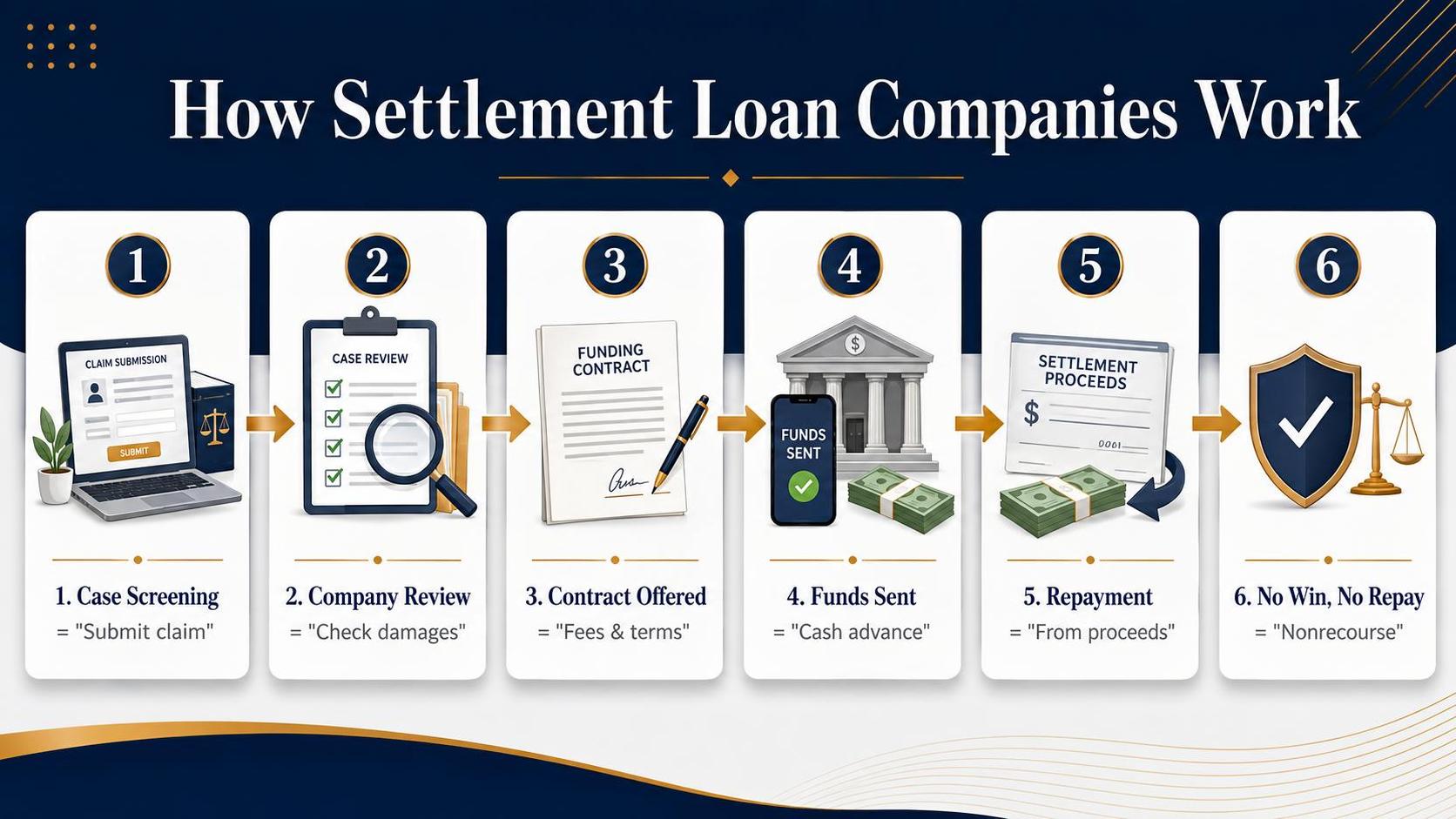
How settlement loan companies work
Settlement loan companies usually offer pre-settlement funding, not a traditional bank loan.
The company advances money to a plaintiff with a pending legal claim and expects repayment only if the case produces a settlement or judgment, a structure the Consumer Financial Protection Bureau describes as generally “nonrecourse.”.
That structure matters because approval focuses less on wages or credit scores and more on the case itself. In practice, the company reviews the claim, asks for documents, and contacts the plaintiff’s lawyer before making an offer.
The process starts with case screening. Companies typically want the attorney’s cooperation because the attorney holds key records and usually disburses settlement proceeds from a trust account.
The CFPB says these products are repaid from the consumer’s future settlement proceeds, not through ordinary monthly loan payments.
After review, the company may offer a cash advance and a contract stating the purchase price, fees, and payoff method.
Although many advertisements use the word “loan,” some state laws regulate these transactions as litigation financing or consumer legal funding rather than standard consumer credit.
That distinction can affect disclosures, cancellation rights, and fee limits, so the contract and state law both matter.
Repayment comes out of the case proceeds if the plaintiff wins or settles. If the plaintiff recovers nothing, a true nonrecourse contract usually means the company does not collect from the plaintiff personally, according to the CFPB.
Readers should verify that point in the actual contract because not every agreement uses identical language.
| Stage | What happens |
| 1 | The applicant submits basic case information and attorney details. |
| 2 | The company reviews liability, damages, insurance coverage, and expected case value. |
| 3 | The company sends a funding contract showing the advance, fees, and repayment formula. |
| 4 | If accepted, funds are sent and the company waits for the case to resolve. |
| 5 | At settlement, the company is paid from case proceeds before the plaintiff receives the remainder. |
Cost is the main risk. The CFPB warns that fees can be high and can grow while a case remains open. A longer case usually means a larger payoff amount, which can materially reduce the plaintiff’s net recovery.
- Check whether charges are stated as a flat fee, monthly fee, or other formula.
- Ask whether fees compound or stay simple over time.
- Confirm whether there is a cap on the total payoff under state law or the contract.
- Do not sign based on an advertisement alone. Review the agreement with a lawyer because this is legal and financial risk.

Costs charged by settlement loan companies
Settlement loan companies usually charge funding fees, not conventional interest. The cost can still be high because many contracts add charges monthly and compound them, so the payoff rises the longer a case takes.
Acting on a headline rate alone can cause harm; readers should ask for a written payoff schedule in dollars.
The U.S. Government Accountability Office said in its 2010 report on litigation advances that several major companies charged roughly 2% to 4% per month.
GAO also said some companies added origination or processing fees, which means the stated monthly charge may not show the full cost.
Monthly pricing matters because cases often last many months. If the contract compounds monthly, the balance can grow faster than many borrowers expect.
The table below shows what a $1,000 advance would become after 6 and 12 months if a company charged the monthly rates GAO described, with no extra fees added.
| Monthly charge | Amount owed after 6 months | Amount owed after 12 months |
| 2% per month | $1,126.16 | $1,268.24 |
| 3% per month | $1,194.05 | $1,425.76 |
| 4% per month | $1,265.32 | $1,601.03 |
Those figures are mathematical illustrations based on the 2% to 4% monthly range cited by the GAO. They do not include underwriting fees, application fees, wire fees, or multiple advances, all of which can raise the payoff further.
What charges to check in the contract
- Funding fee: Ask whether it is simple or compounded. Compounding usually costs more over time.
- One-time fees: GAO said some companies charged origination or processing fees. Ask for each fee in dollars.
- Repurchase or payoff timing: Some contracts increase the payoff at set intervals, such as every month or every six months.
- Multiple advances: A second advance can create a separate fee stream and raise the total lien on the case.
Consumer protection rules differ by state, and some states cap charges while others do not.
Because this is legal and financial risk, readers should verify the current law with the state statute or regulator and have a lawyer explain the payoff terms before signing.

How companies evaluate pending lawsuits
Settlement funding companies usually underwrite the case, not the applicant’s credit score.
They ask whether the claim is likely to produce a recovery, when that recovery may arrive, and whether enough proceeds should remain after legal fees, medical liens, and other deductions.
The review is document-heavy. A company commonly requests the complaint, police or incident reports, medical records, insurance information, proof of lost wages, and the attorney’s case assessment.
Liability comes first. Companies look for facts showing the defendant probably caused the harm.
In civil cases, the usual standard is a “preponderance of the evidence,” meaning the claim is more likely true than not, according to Cornell Law School’s Legal Information Institute.
They then test damages. Medical bills, wage records, and expert reports help estimate case value.
They also check whether the defendant has insurance or assets, because a strong case can still be hard to collect if coverage is low or the defendant is judgment-proof.
| Signal companies review | Figure | Source | Why it matters |
| How rarely civil cases reach trial | Only 3% of 7,002 tort, contract, and real property cases were disposed by trial in the 75 largest U.S. counties | U.S. Department of Justice, Bureau of Justice Statistics, Civil Bench and Jury Trials in State Courts, 2005 | Funding decisions often focus on settlement probability, not only trial odds |
| Plaintiff win rate in tort jury trials | 52% | U.S. Department of Justice, Bureau of Justice Statistics, Civil Bench and Jury Trials in State Courts, 2005 | Shows why funders scrutinize fault evidence and defenses |
| Plaintiff win rate in contract jury trials | 65% | U.S. Department of Justice, Bureau of Justice Statistics, Civil Bench and Jury Trials in State Courts, 2005 | Different case types carry different risk profiles |
| Typical contingency fee range | About 33% to 40% | American Bar Association consumer guidance on contingency fees | Fees reduce net proceeds available to repay the advance |
Procedure matters too. A case with filed pleadings, completed treatment, and clear insurance coverage is easier to price than a new claim with disputed injuries.
Companies also ask whether summary judgment motions, comparative negligence defenses, bankruptcy issues, or Medicare and Medicaid liens could reduce the payout.
Attorney cooperation is critical. Most companies will not advance funds without speaking to counsel, because the lawyer usually holds the case file and later distributes settlement proceeds from the trust account.
Caution: A lawsuit advance is not risk-free for the claimant. If the case settles for less than expected, fees, liens, and funding charges can materially reduce the final amount.
Before acting, check the contract and ask the attorney to explain the payoff using the actual case documents.

Risks before signing a funding contract
Settlement funding can solve a cash shortage, but the contract can become expensive fast. The main risks are compounding charges, broad repayment claims on the case proceeds, and weak cancellation or dispute terms.
Read the full agreement before signing. If any fee, payoff example, or lien language is unclear, pause and get a lawyer or trusted financial professional to review the primary documents.
The biggest risk is price growth over time. The U.S. Government Accountability Office said in GAO-11-45 that lawsuit-settlement advance contracts it reviewed carried costs equivalent to about 27% to 60% annually, depending on the contract structure.
Many contracts do not use a simple flat fee. They use monthly charges that compound, so the payoff can rise every month the case stays open. That matters because civil cases can take many months or several years to resolve.
| Illustrative term | Time unpaid | Approximate payoff on $10,000 advance |
| 3% monthly compounding | 12 months | $14,258 |
| 3% monthly compounding | 24 months | $20,327 |
| 3% monthly compounding | 36 months | $28,988 |
Those payoff figures are mathematical illustrations from a 3% monthly compounding term, not a market average.
Use the exact contract rate and fee method in the document being offered, because one word such as “compounded monthly” can materially change the cost.
Another risk is priority. Some agreements require repayment directly from settlement proceeds before the claimant receives funds.
If attorney fees, medical liens, child support, or Medicare-related claims must also be paid, the net recovery can shrink sharply.
- Check whether the contract states simple fees or compound fees.
- Check whether fees continue during appeals, retrials, or payment delays.
- Check whether the company takes repayment only from the case, or also seeks other collection rights.
- Check for origination, underwriting, wire, or document fees in addition to the funding charge.
- Check the cancellation window and dispute forum. Arbitration and out-of-state venue clauses can make disputes harder.
Use special caution with verbal promises. If a payoff cap, no-payment guarantee, or discount is not written into the contract, do not assume it applies.
For YMYL decisions, rely on the signed document and the governing state disclosure law, not a sales summary.

State rules that affect settlement funding
State law can change the cost, timing, and enforceability of a settlement funding deal. The biggest differences usually involve disclosures, cancellation rights, fee limits, and court approval requirements.
Readers should not rely on a generic summary before signing. Funding contracts can affect lawsuit proceeds or future structured settlement payments, so the safest step is to read the state statute and the contract itself.
For structured settlement transfers, the most important baseline is federal tax law.
Internal Revenue Code Section 5891 imposes a 40% federal excise tax on a transfer unless the deal receives a “qualified order” under an applicable state structured settlement protection statute.
That federal rule is why state court approval matters so much in structured settlement cases.
In practice, many state laws require a judge to find that the transfer is in the payee’s best interest and that statutory disclosures were given first.
| Jurisdiction | Rule that affects funding | Source |
| Federal | 40% excise tax applies to a structured settlement transfer without a qualified order. | 26 U.S.C. § 5891 |
| New York | Structured settlement transferees must give a disclosure statement at least 10 days before the payee signs. | N.Y. General Obligations Law § 5-1703 |
| Tennessee | Litigation financing consumers may cancel within 5 business days after receiving funds, without penalty if statutory conditions are met. | Tenn. Code Ann. § 47-16-105 |
| Ohio | A nonrecourse civil litigation advance contract may be canceled within 5 business days of the funding date. | Ohio Rev. Code § 1349.55 |
Disclosure timing matters because it gives the consumer time to compare the advance amount, total repayment amount, and effective cost.
A 10-day disclosure period, like New York’s structured settlement rule, creates more review time than a shorter cancellation-only model.
Cancellation rights matter because lawsuit funding is often sold under time pressure. A 5-business-day rescission period, like the rules cited in Tennessee and Ohio, can let a claimant back out after reviewing the paperwork more carefully.
Some states go further by regulating legal funding as a distinct consumer transaction, while others rely more on general contract, usury, or consumer protection law.
If a state does not clearly authorize a charge or practice, the reader should verify it in the statute or with a licensed attorney.
- Check whether court approval is required.
- Check the number of days for disclosures and cancellation.
- Check whether the law covers pre-settlement funding, structured settlement transfers, or both.
- Check the latest version of the statute, because state rules change.

Questions to ask before accepting funds
Before accepting money from a settlement funding company, confirm the total cost, legal process, and alternatives.
Settlement advances are usually non-recourse, meaning repayment generally comes only from the case proceeds, but the price can still be high.
Ask for every term in writing. The Federal Trade Commission says consumers should review financing contracts carefully and understand fees, timing, and cancellation rights before signing any financial agreement.
| Question | Why it matters | Source-based fact |
| What is the total payoff if the case settles in 6, 12, and 24 months? | Compounding can make a small advance much more expensive over time. | The Consumer Financial Protection Bureau says consumers should focus on the total amount repaid, not only the upfront cash amount. |
| Is the pricing simple or compounded? | Compounded fees usually increase the payoff faster. | Tennessee’s settlement funding law requires a contract disclosure showing the funded amount and the total amount to be assigned at 6-month intervals for 36 months. |
| What fees are added besides the funding charge? | Origination, underwriting, or processing fees can raise the effective cost. | State disclosure laws commonly require itemized charges. Indiana law requires itemization of charges and fees in consumer litigation funding contracts. |
| Can the contract be canceled without penalty? | A cooling-off period gives time to compare offers. | Nebraska law provides a 5 business-day cancellation right for consumer litigation financing contracts. |
Ask whether the company must wait for attorney acknowledgment before sending funds.
That matters because most transactions require the plaintiff’s lawyer to confirm the case status, existing liens, and payment instructions before funding can close.
Ask how liens and deductions will affect the net amount left at settlement. Medicare, Medicaid, medical providers, child support agencies, and attorneys may have claims on proceeds.
The U.S. Department of Justice and CMS both stress that certain claims can require reimbursement.
Ask whether there is a cap under state law. Rules differ sharply. For example, Arkansas prohibits certain litigation financing charges above an annualized rate set by statute, while other states rely more on disclosure rules than numeric caps.
Verify current law in the statute itself.
Ask whether other options cost less. The CFPB advises consumers with cash-flow problems to compare all available credit and assistance sources.
A payment plan with a landlord, hospital, or utility provider may cost less than selling part of a future settlement.
- Request a payoff schedule in dollars, not percentages.
- Confirm whether fees compound monthly or semiannually.
- Check cancellation rights and deadlines in the contract.
- Have a lawyer explain liens, taxes, and net recovery.
Caution: Do not rely on a verbal quote alone. Ask a lawyer to review the contract and check your state’s current statute or regulator guidance before accepting funds, because terms and legal protections vary by state and by company.

Alternatives to lawsuit settlement funding
Lawsuit settlement funding can be expensive, so it makes sense to compare other ways to cover short-term bills first. The best option depends on speed, cost, credit profile, and whether repayment can wait until the case ends.
Some alternatives charge interest monthly. Others reduce immediate cash pressure without new borrowing.
Readers should verify current terms with the primary source or provider before acting, because rates, eligibility, and consumer protections change.
| Alternative | Typical cost or rule | Why it may be cheaper |
| Credit union payday alternative loan (PAL) | NCUA rules cap application fees at $20. PAL I loans range from $200 to $1,000, with 1 to 6 months to repay. PAL II loans can be up to $2,000, with up to 12 months to repay. The federal rate cap for federal credit unions is generally 18% APR, and PALs may charge up to 28% APR, according to the National Credit Union Administration. | The rate cap is explicit and far below many lawsuit funding charges. |
| Personal loan from a bank, credit union, or online lender | The Federal Reserve reported that commercial bank personal loan rates averaged 12.33% APR in February 2024. | For borrowers who qualify, the stated APR can be materially lower than non-recourse funding charges. |
| Credit card with a promotional offer | The Consumer Financial Protection Bureau reported that general purpose credit card APRs averaged 22.8% in 2023. Some cards offer a temporary 0% introductory APR, but balance transfer fees often apply. | A true 0% offer can be cheaper if the balance is repaid before the promo ends. |
| Medical or household hardship plan | Nonprofit hospitals must have financial assistance policies to keep federal tax-exempt status, according to the Internal Revenue Service. Utility disconnection protections and payment plans vary by state and provider. | No new loan may be needed if bills can be reduced, deferred, or spread out. |
Another practical option is asking medical providers, landlords, or utility companies for a payment plan. That can protect cash flow without giving up a portion of a future settlement.
Borrowing from a retirement plan may look cheaper on paper, but it carries risk. The Internal Revenue Service says hardship distributions can trigger taxes, and early distributions may also face a 10% additional tax unless an exception applies.
If family or friends can help, put the terms in writing. State the amount, repayment trigger, and whether the advance is a gift or a loan. Clear terms can prevent disputes later, especially if the case takes longer than expected.
Caution: do not rely on an article alone when choosing between legal funding and other debt. Check the contract, total repayment amount, and state consumer protections with the lender, provider, or a qualified attorney before signing.
What the editorial team reviewed
We did not submit live applications, upload court records, or request funding quotes for this section. That would require real personal and legal documents, and readers could be harmed if a guide implied first-hand testing that did not occur.
Instead, we reviewed primary-source disclosures from regulators and settlement funding companies, then compared what each source clearly stated about product type, approval steps, fees, timing, and court involvement.
Where a company did not publish a number, we left it unscored and told readers to verify the primary source.
Our review focused on whether readers could confirm the basics before sharing sensitive information.
We checked whether each source explained that lawsuit or settlement advances are typically non-recourse, whether repayment depends on the case outcome, and whether court approval may be required for some transactions.
The Consumer Financial Protection Bureau says litigation advances are not traditional loans and can carry high costs, a point we treated as a core consumer-risk check.
The CFPB also warns consumers to read contracts closely and understand fees before signing.
We also reviewed state-law context because disclosures can change by jurisdiction.
For example, the New York Attorney General has described lawsuit lending as high-cost funding secured by expected legal recoveries, and state rules can affect contract terms, required disclosures, and court review.
| Source reviewed | What we checked | Why it matters |
| CFPB consumer materials | Product classification, fee warnings, contract-risk language | Federal consumer guidance sets a baseline for risk review |
| Company FAQ and disclosure pages | Whether non-recourse status, fee structure, and timing were stated clearly | Consumers need plain terms before sharing case details |
| State attorney general or statute pages | State-specific rules, disclosure duties, court approval references | Terms can vary by state and case type |
| Court-transfer materials for structured settlements | Judicial approval standards and best-interest review | Structured-settlement transactions usually require court approval |
We gave extra weight to sources that published exact definitions or legal requirements.
A company page describing “fast cash” without a full fee explanation was less useful than a regulator page or a contract disclosure that identified compounding, payoff conditions, and cancellation rights.
Plain caution: no reader should choose a settlement funding company from marketing language alone. Check the contract, the total payoff method, state rules, and whether a lawyer can review the agreement before signing.
Sources: Consumer Financial Protection Bureau consumer guidance on lawsuit advances and legal funding; New York Attorney General consumer information on lawsuit lending; company disclosure and FAQ pages reviewed individually at the publisher level.
Frequently Asked Questions
What is a settlement loan company?
A settlement loan company is typically a litigation funding company that advances money to a plaintiff with a pending legal claim, then seeks repayment from any future settlement or judgment.
The Consumer Financial Protection Bureau has described these products as advances tied to legal recoveries rather than traditional consumer credit, but readers should review the contract carefully because pricing, fees.
And repayment terms can be complex and are not standardized.
Do settlement loan companies charge interest?
Many settlement loan companies do not label the cost as conventional interest; instead, contracts may use fees, funding charges, or compounding payoff schedules.
The U.S. Government Accountability Office said in a 2022 report on third-party litigation financing that consumer legal funding agreements can carry high costs and limited transparency.
So acting on an advertised rate alone can be risky unless the full payoff schedule is verified in writing.
How do settlement loan companies decide whether to approve funding?
Settlement loan companies usually focus more on the strength of the legal claim than on a borrower’s credit score, income, or employment history.
The American Bar Association has explained that litigation funders commonly evaluate case merits, expected damages, and the likelihood and timing of recovery, so applicants should ask how medical records, liability evidence.
And attorney cooperation affect approval.
Are settlement loan companies regulated?
Regulation depends on the state, and the rules are not uniform.
For example, West Virginia enacted the Litigation Financing Consumer Protection Act in 2023, and Oklahoma enacted the Oklahoma Litigation Funding Act in 2024, while other states use different statutes, court rules, or less specific oversight.
Readers should check their state legislature or attorney general because relying on a general summary could cause legal or financial harm.
What should someone compare before choosing a settlement loan company?
The key comparisons are the total repayment amount over time, whether charges compound, any application or origination fees, cancellation rights, and whether repayment is truly nonrecourse if the case loses.
The Federal Trade Commission advises consumers to read financing contracts closely and compare total cost rather than marketing claims, because a lower upfront fee can still lead to a higher payoff later.
Related Reading
- Nova Legal Funding Reviews
- Same Day Pre Settlement Loans – What You Need to Know
- Behind the Oasis Financial Lawsuit
- JG Wentworth Pre Settlement Funding
- Oasis Financial Locations
- Lawsuit Loans With Low Interest Rates
- Can An Attorney Advance Money To A Client?
- Pre Settlement Loans Near Me
- National Lawsuit Funding Reviews
- All Blog Guides