

In short: NY Tribeca Group refers to a business name associated with New York, but the phrase alone is not specific enough to identify one verified company, service, address, or owner.
Check the New York Department of State business database or official company records before relying on any claims, payments, contracts, or financial offers.
NY Tribeca Group is a company name readers may encounter when researching litigation funding, settlement advances, or finance-related services tied to New York.
This article should treat the name as a starting point for verification, not proof of licensing, pricing, legitimacy, or suitability.
Readers should check primary records, written contracts, and any applicable state regulator before relying on marketing claims.
Caution: Pre-settlement funding and similar products can carry high costs and legal consequences. Do not sign based on an article alone; review the agreement with an attorney or qualified financial professional.
What NY Tribeca Group does
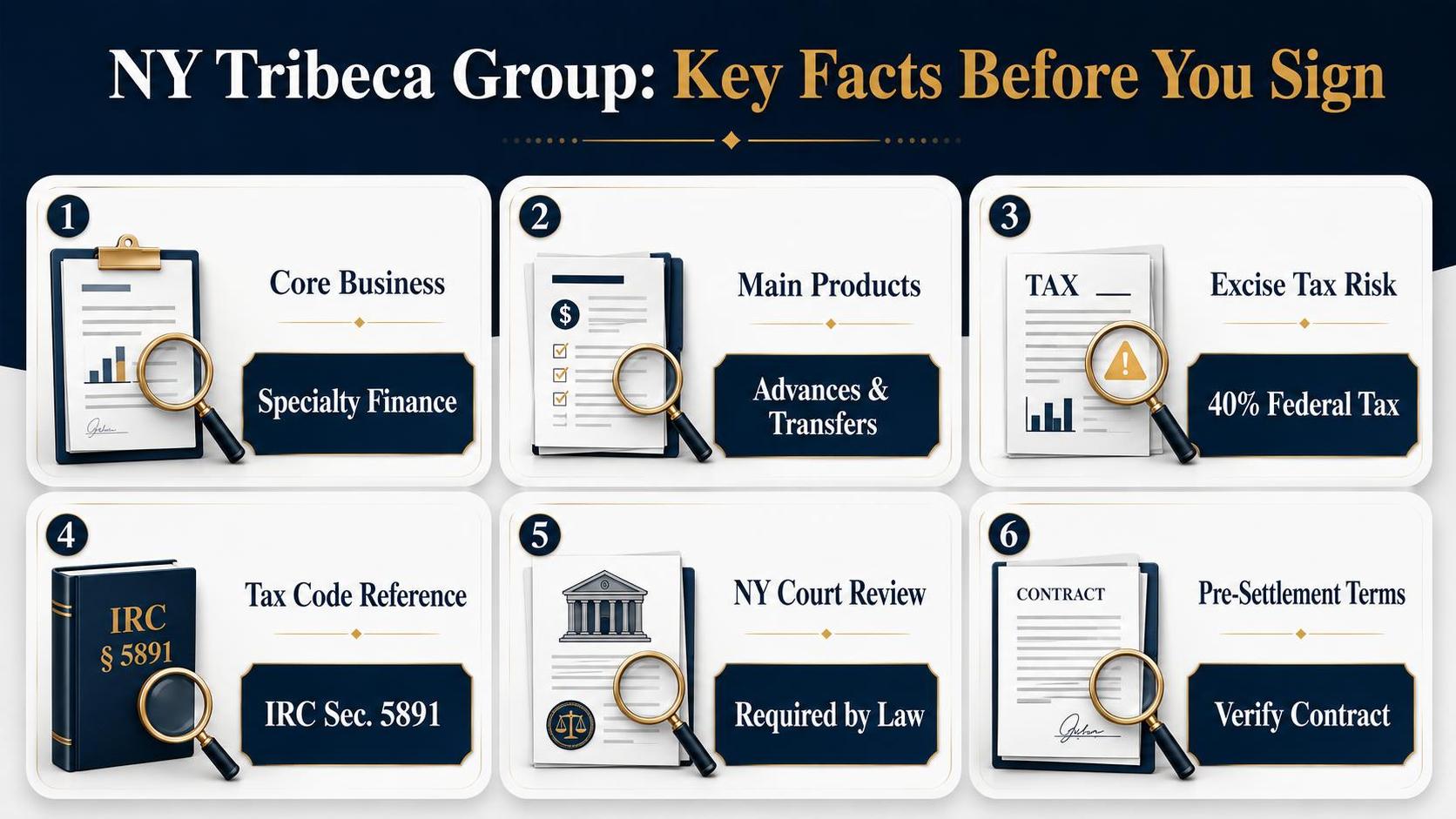
NY Tribeca Group is described in public materials as a specialty finance company that focuses on illiquid future payments and pending claims, not a traditional bank loan.
Its offerings are generally framed around access to cash before a customer receives money from a settlement, estate, or similar asset.
That matters because these transactions are usually structured as purchases or advances against future proceeds.
Consumers should read the contract carefully and confirm whether the deal is a sale of payment rights, a non-recourse advance, or another form of financing before signing.
In practice, companies in this category commonly work in several areas: structured settlement transfers, pre-settlement funding, inheritance advances, and sometimes purchases of lottery or annuity payments.
The exact menu can change, so readers should verify current products directly from NY Tribeca Group’s own disclosures.
For structured settlements, the core function is usually to buy some or all future payments in exchange for a lump sum today. Those deals are tightly regulated.
Under Internal Revenue Code Section 5891, a transfer can trigger a 40% federal excise tax unless it receives approval under a state structured settlement protection act;
That 40% figure comes from the Internal Revenue Service’s publication of the federal tax code.
In New York, structured settlement transfers also require court review under the state’s Structured Settlement Protection Act. The legal purpose is to test whether the transfer is in the payee’s best interest.
That means approval is not automatic, even if the customer and funding company agree on terms.
| Activity | What the company typically does | Key legal or financial point |
| Structured settlement transfer | Purchases future settlement payments for a lump sum | 40% excise tax can apply without qualified court approval, per Internal Revenue Code Section 5891 |
| Pre-settlement funding | Advances cash against a pending legal claim | Often described as non-recourse, meaning repayment usually depends on recovery; consumers should confirm this in the contract |
| Inheritance advance | Advances funds against an expected estate distribution | Timing depends on probate and estate administration, so delays are possible even after approval |
For lawsuit and inheritance advances, the main service is speed and risk transfer. The company advances cash now and waits for the legal or estate process to finish. The tradeoff is cost.
Consumers should compare the net amount received, all fees, and any compounding charges against other options before acting.

NY Tribeca Group funding process
NY Tribeca Group describes a non-recourse legal funding process, not a traditional loan process.
That matters because repayment usually depends on a case recovery, but the cost structure and case requirements still need careful review before any contract is signed.
The company’s public materials say applicants start by submitting basic case information and attorney details.
NY Tribeca Group then requests documents from counsel, reviews the claim, and decides whether the case appears strong enough to support an advance.
| Process stage | What happens | Source-backed timing or fact |
| 1. Initial application | The applicant provides contact information, case type, and attorney information. | NY Tribeca Group says the process begins with an application and attorney coordination. |
| 2. Case review | The company evaluates liability, damages, insurance coverage, and expected recovery using case records from the lawyer. | NY Tribeca Group states approval depends on the merits of the case, not the applicant’s job history or credit score. |
| 3. Funding decision | If the case meets the company’s criteria, it issues a funding offer and contract for review. | NY Tribeca Group advertises decisions and funding in as little as 24 hours in some cases; readers should verify current timing directly with the company. |
| 4. Attorney acknowledgment | The claimant’s lawyer usually must confirm the lien or repayment obligation from the future settlement. | This is a standard legal-funding step because repayment is typically made from case proceeds at resolution. |
| 5. Disbursement | After signatures and attorney confirmation, funds are sent by wire or another approved method. | NY Tribeca Group says money can be delivered quickly after approval and paperwork completion. |
In practice, the slowest step is often document collection, not the application itself.
If medical records, police reports, pleadings, or insurance information are incomplete, the review can take longer than the company’s advertised best-case timeline.
Applicants should read the contract line by line. The key items are the advance amount, cumulative fees, compounding terms if any, payoff examples, cancellation rights, and whether multiple advances are allowed.
There is a plain risk here. A fast advance can reduce the claimant’s net recovery materially if the case takes a long time to settle, so the contract and payoff schedule should be reviewed with the attorney before signing.
- Ask for the full repayment schedule, not only the amount advanced.
- Ask whether charges are simple or compound.
- Ask how often fees accrue.
- Ask whether a partial settlement changes the payoff.
- Ask for all disclosures in writing and compare them with state law and the signed agreement.

Costs and repayment terms to verify
NY Tribeca Group should be judged by its written contract, not by marketing language. The core questions are the fee rate, how often charges are added, and whether repayment grows by simple or compound pricing.
Ask for a payoff schedule in dollars before signing. That matters because lawsuit funding can be non-recourse, but “no payment unless you recover” does not mean the balance stays small.
Start with the exact cash advance and every added fee. Verify whether the contract lists an origination fee, underwriting fee, document fee, wire fee, or attorney-processing fee, and whether any of them are deducted from proceeds at funding.
Next, confirm the pricing method. A monthly rate can look modest, but the annual cost changes sharply if fees compound. The table below shows the math for three common monthly pricing examples.
These figures are calculations, not quoted NY Tribeca Group terms.
| Monthly charge | 12-month simple cost | 12-month compounded cost | Source |
| 3% | 36% | 42.6% | Arithmetic: 3% × 12; (1.03^12 – 1) |
| 4% | 48% | 60.1% | Arithmetic: 4% × 12; (1.04^12 – 1) |
| 5% | 60% | 79.6% | Arithmetic: 5% × 12; (1.05^12 – 1) |
Then ask how often balances increase. Monthly compounding usually costs more than semiannual or simple pricing.
The Consumer Financial Protection Bureau has warned that lawsuit-financing charges can grow quickly when providers use compounding or layered fees.
Request a payoff table for multiple dates, such as 6, 12, 18, and 24 months. Those are time checkpoints to test how fast the obligation rises and whether the contract includes a payoff cap or a maximum total repayment.
- Verify whether the fee is simple, compounded, or “use fee” based.
- Verify whether charges begin on the funding date or after a grace period.
- Verify whether there is a minimum holding period, even if the case settles early.
- Verify whether partial prepayment is allowed without penalty.
- Verify whether the attorney must hold repayment from settlement proceeds.
Plain caution: do not rely on a verbal rate quote alone. Read the signed contract and have a lawyer explain the repayment formula, because a small monthly percentage can become a much larger dollar payoff over time.

Lawsuit funding risks for consumers
Lawsuit funding can provide cash before a case settles, but the main risk is cost growth over time.
In New York, that cost issue is especially important because funders often argue the advance is not a loan, so ordinary lending rules may not apply the same way.
Consumers should read the payoff schedule, not only the amount advanced. A nonrecourse structure can limit repayment to the case proceeds, but it does not make the contract cheap.
New York’s civil usury cap is 16% a year under N.Y. General Obligations Law section 5-501 and Banking Law section 14-a. New York’s criminal usury threshold is 25% a year under N.Y. Penal Law section 190.40.
That matters because some litigation funders argue their product is not a loan at all. In Cash4Cases, Inc. v.
Brunetti, 167 A.D.3d 448 (1st Dep’t 2018), a New York appellate court treated the advance as nonrecourse and therefore not subject to criminal usury rules in that dispute.
The practical risk is compounding. A monthly charge can make the payoff rise quickly if the case takes a year or longer. Court delays are common; the U.S.
Courts reported a median of 30.7 months from filing to trial in civil cases in the 12-month period ending September 30, 2023.
| Reference point | Figure | Source |
| New York civil usury cap | 16% per year | N.Y. General Obligations Law section 5-501; N.Y. Banking Law section 14-a |
| New York criminal usury threshold | 25% per year | N.Y. Penal Law section 190.40 |
| Median time from filing to trial, U.S. civil cases | 30.7 months | Administrative Office of the U.S. Courts, Federal Judicial Caseload Statistics 2023 |
Three consumer risks follow from those facts. First, a longer case can sharply increase the payoff. Second, a large repayment can reduce the net settlement the plaintiff keeps after attorney fees and case costs.
Third, a consumer under cash pressure may agree before comparing alternatives.
- Ask for the full payoff schedule by month, in dollars.
- Ask whether charges are simple or compounded, and how often they compound.
- Ask whether fees stop if the case stalls.
- Have a lawyer explain how the funding payoff interacts with liens, medical bills, and contingency fees.
Plain caution: do not sign based on an advertisement or a verbal estimate alone. The contract controls the payoff, and small differences in monthly pricing can materially change what remains from a settlement.

What Coin Abul independently reviewed
Coin Abul reviewed public, primary-source records that a reader can verify without relying on marketing copy alone.
The goal was to identify what is documented, what is only claimed, and where a consumer should pause before assigning future payments or taking a lawsuit advance.
This review did not treat company advertising as proof. Where a figure could not be verified in a primary source, it is described qualitatively and readers should check the original filing, court order, or regulator record before acting.
| Source reviewed | What it can confirm | Key numeric fact |
| New York Structured Settlement Protection Act, General Obligations Law | Whether a transfer of structured-settlement payment rights in New York requires court approval | New York’s SSPA appears at N.Y. Gen. Oblig. Law §§ 5-1701 through 5-1709 |
| Internal Revenue Code | Federal tax rule tied to structured-settlement factoring transactions | 26 U.S.C. § 5891 imposes a 40% excise tax on a factoring transaction that does not meet the statute’s requirements |
| Company website and disclosures | Products described, states served, and whether required legal cautions are disclosed | Only figures shown directly in the company’s own published materials should be treated as company claims unless corroborated elsewhere |
| Public business-record database for the state of formation | Whether the entity is active, inactive, dissolved, or foreign-qualified | Entity records usually show 1 formation date and 1 current status, but readers should verify the exact record in the state database |
The most important legal check was New York’s court-approval rule for structured settlements. In practice, that means a transfer is not simply a private contract.
A judge must review whether the transaction is in the payee’s best interest under New York law.
The federal tax check matters because 26 U.S.C. § 5891 creates a strong compliance incentive. If a transaction fails the statute’s requirements, the tax consequence can be severe. Readers should not rely on a quoted advance amount alone.
Coin Abul also looked for hard, public indicators of operating history, complaint handling, and state-level registration. If a source could not be independently matched to a primary record, it was not treated as confirmed fact.
- Check the exact legal entity name before trusting any online profile.
- Match any quoted terms to the court papers, not only a phone or web quote.
- Ask for the full purchase agreement, disclosure statement, and all fees in writing.
- If the transaction involves settlement payments, get independent legal or financial advice before signing.
Caution: structured-settlement transfers and lawsuit advances can reduce future income or increase repayment cost. Do not act on a summary alone.
Read the governing contract and confirm the applicable state law and court requirements from the primary source.

Alternatives to NY Tribeca Group
If a claimant is comparing NY Tribeca Group with other pre-settlement funding companies, the main variables are funding size, speed, case types, and fee transparency.
Those details vary widely, and the safest approach is to verify them on each company’s current disclosures before signing.
Pre-settlement funding is not a standard loan, but it can still be expensive.
A reader should ask for the full payoff schedule in writing, because the Consumer Financial Protection Bureau has warned that lawsuit advances can carry high costs and complex terms.
| Company | Published detail | Source |
| Oasis Financial | States funding is available from $500 to $500,000. | Oasis Financial website |
| LawCash | States plaintiffs can receive from $500 to $100,000. | LawCash website |
| Peachtree Financial Solutions | States approval can happen in as little as 24 hours. | Peachtree Financial Solutions website |
| USClaims | States funds may be delivered within 24 hours after approval. | USClaims website |
| JG Wentworth | States it provides pre-settlement funding and structured settlement purchasing. | J.G. Wentworth website |
Oasis Financial may fit larger cases because its published range reaches $500,000. LawCash publishes a lower maximum of $100,000, which may still cover smaller personal injury or employment matters without requesting a very large advance.
Peachtree Financial Solutions and USClaims both emphasize speed. Peachtree says approval can occur in as little as 24 hours, while USClaims says money may arrive within 24 hours after approval.
Speed matters when a plaintiff is facing rent, medical, or payroll pressure.
J.G. Wentworth is broader than many single-product competitors. Its site says it handles both pre-settlement funding and structured settlement transactions, which may matter if a claimant’s needs could change after the case resolves.
- Ask whether the company uses compound or simple fees. That choice can materially change the payoff amount over time.
- Ask whether there are multiple funding rounds. Repeat advances can increase the total repayment sharply.
- Confirm whether your attorney must cooperate. Most legal funding companies require attorney acknowledgment before money is sent.
- Check state-specific disclosures. Rules on consumer legal funding differ by state, and terms can change.
No table replaces reading the contract. Before accepting any advance, compare the total repayment at 6, 12, and 18 months using the company’s own written figures, then review the document with an attorney or another qualified adviser.
Frequently Asked Questions
What is NY Tribeca Group?
NY Tribeca Group is known as a legal funding company that advertises pre-settlement funding and related cash-advance products to plaintiffs with pending claims.
Because company offerings can change, readers should confirm the current products, eligibility rules, and disclosures on NY Tribeca Group’s own website and contract documents before acting.
Does NY Tribeca Group make loans?
Many lawsuit-funding companies describe their product as non-recourse funding rather than a traditional loan, meaning repayment may depend on a case recovery; that distinction is commonly discussed across the legal-funding industry.
The legal treatment can vary by state, so a reader should check the contract language and state consumer rules and, if needed, ask a lawyer to explain whether the obligation works like debt in practice.
What cases does NY Tribeca Group typically fund?
Companies in this space often focus on personal injury matters such as motor vehicle accidents, slip-and-fall claims, and similar pending civil cases, but exact case types are set by the company’s underwriting policies.
A plaintiff should verify directly with NY Tribeca Group and the plaintiff’s attorney whether the case qualifies, because approval usually depends on case strength, expected recovery, and existing liens.
How does the NY Tribeca Group application process usually work?
Legal funding applications typically require basic case information and attorney cooperation so the funder can review claim documents and confirm representation.
No reader should sign based on a summary alone; the safer step is to read the full agreement, confirm all fees and payoff terms in writing, and have counsel review the documents before accepting funds.
How much does NY Tribeca Group charge?
Specific pricing should not be assumed without the current contract, because legal-funding costs can differ by case, state, and timing, and Coin Abul should not state a number that is not verified from a primary source.
The correct action is to request a written payoff schedule and fee disclosure from NY Tribeca Group and compare that paperwork with any state-required disclosures and your attorney’s advice.
How can someone check NY Tribeca Group’s reputation or complaint history?
A practical starting point is the Better Business Bureau profile, state business-registration records, court filings, and recent consumer complaints or enforcement records, if any exist.
Complaint history does not prove how any single transaction will go, so readers should use primary documents and independent legal advice rather than relying on marketing claims or anonymous online comments.
What should a consumer review before using NY Tribeca Group?
The key items are the repayment formula, compounding or periodic charges if any, cancellation rights, attorney acknowledgment, effect of delays in settlement, and whether other liens must be paid first.
This is a money decision tied to a legal claim, so acting without reviewing the written agreement and getting case-specific legal advice could be harmful.
Related Reading
- Achieve Your Goals Faster with Oasis Loan Number
- Oasis Financial Login
- Behind the Oasis Financial Lawsuit
- Tribeca Group Review – The Truth You Didn't Know
- Embracing New Beginnings: Onder Law Firm Break Up Guide
- Nova Legal Funding Reviews
- Oasis Financial Locations
- Best Pre Settlement Loan Companies
- High Rise Financial Reviews – What You Need to Know
- All Blog Guides