

At a glance: Vanguard Immediate Annuity Rates are not a single published rate; payouts vary by age, sex, premium, state, payout option, and insurer quotes.
Vanguard states annuities are offered through third-party insurance companies, not Vanguard itself. Check Vanguard’s annuity quote tool or the issuing insurer’s illustration before making any decision.
Vanguard Immediate Annuity Rates are not a published rate sheet; Vanguard directs investors to obtain personalized income quotes because payouts depend on age, sex, premium, payout option, and interest conditions.
Immediate annuity payments are typically quoted as monthly lifetime income, period-certain income, or joint-life income.
Vanguard’s annuity access has changed over time, so readers should verify current availability directly through Vanguard or its named annuity provider before relying on any estimate.
Caution: An immediate annuity can be difficult or impossible to reverse after purchase. Compare insurer financial strength, fees, tax treatment, inflation risk, and survivor benefits before committing retirement savings.
What Vanguard immediate annuity rates mean
“Vanguard immediate annuity rates” usually means the income quote attached to a single-premium immediate annuity, not a bank-style interest rate.
The key number is the monthly payout an insurer offers for a lump sum, and that quote changes with age, payout option, state, and market conditions.
Vanguard has offered annuity access through insurance partners, so the payout is an insurance-company quote, not a guaranteed Vanguard house rate.
FINRA explains that immediate annuities convert a lump sum into a stream of payments, and the payment amount depends on factors such as age, sex, and contract terms.
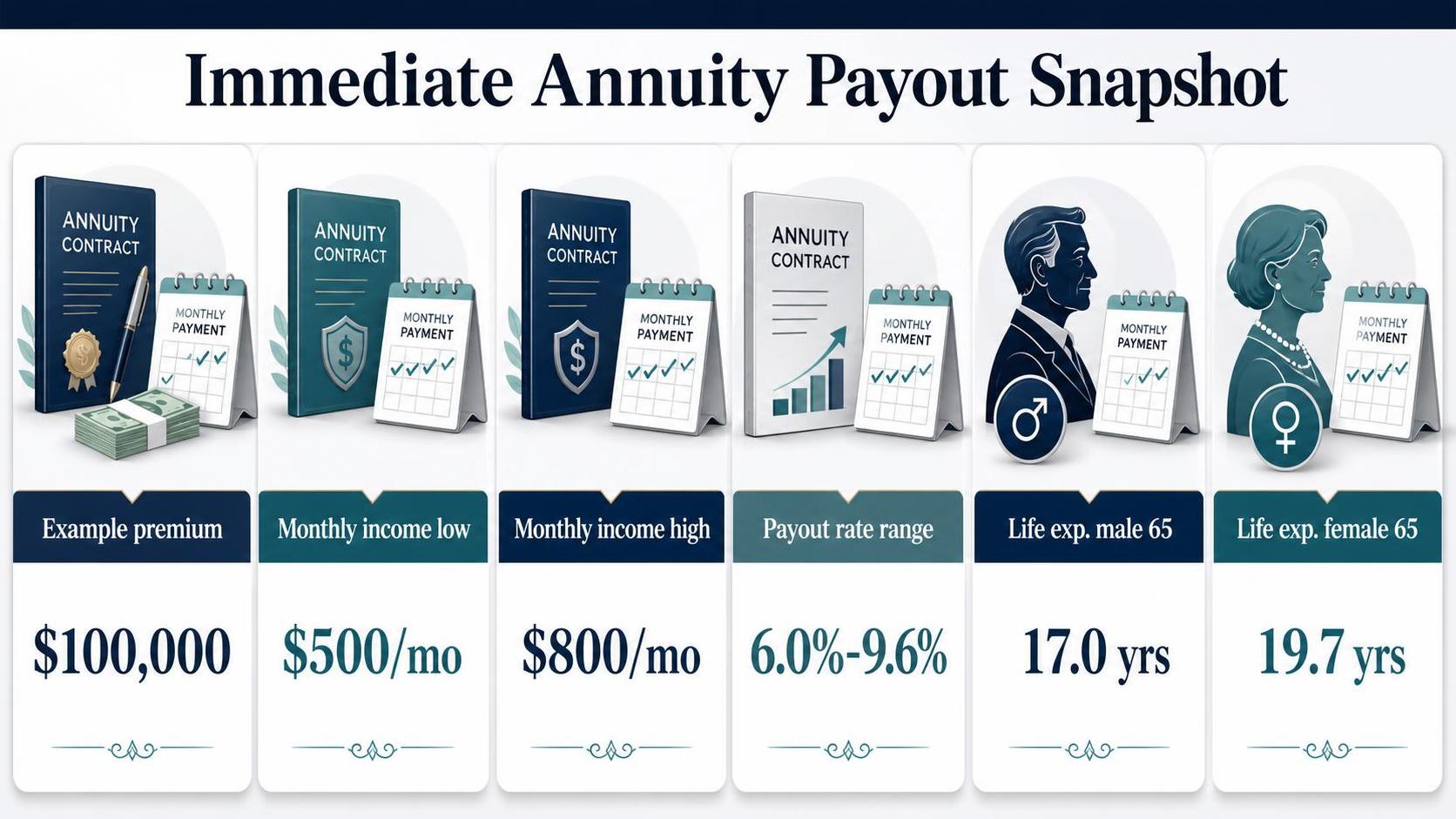
The first point is definition. A payout “rate” is often expressed as annual income divided by premium. If a $100,000 premium produces $650 a month, that is $7,800 a year, or a 7.8% payout rate by simple arithmetic.
| Example premium | Monthly income | Annual income | Simple payout rate |
| $100,000 | $500 | $6,000 | 6.0% |
| $100,000 | $650 | $7,800 | 7.8% |
| $100,000 | $800 | $9,600 | 9.6% |
That payout rate is not the same as investment return. Part of each payment can be a return of the buyer’s own premium.
The IRS says annuity payments may be partly tax-free return of principal and partly taxable income under the exclusion-ratio rules in IRS Publication 575.
Quote differences can be large because insurers price longevity risk differently.
The Social Security Administration’s 2024 period life table shows remaining life expectancy at age 65 is about 17.0 years for males and 19.7 years for females, which helps explain why lifetime income quotes differ by age and sex.
Options that add guarantees usually reduce the starting payment. FINRA says features such as joint-life coverage or period-certain payments generally lower the monthly amount because the insurer expects to pay for longer or under more scenarios.
- Older buyers often receive higher monthly payouts because expected payment duration is shorter, according to Social Security mortality data.
- Joint-life and refund features usually lower starting income, according to FINRA’s annuity investor guidance.
- Quotes can change as insurer pricing and interest-rate assumptions change, so an old quote may no longer apply.
Caution: Do not choose an immediate annuity from the payout number alone.
Check the insurer’s financial strength, contract terms, tax treatment, and surrender limits in the insurer’s materials and the prospectus or disclosure documents before acting.

Where Vanguard immediate annuities are sold
Vanguard does not generally sell immediate annuities as a branch product the way a bank sells a certificate of deposit.
Vanguard’s annuity materials say these contracts are accessed through third-party insurance arrangements, and state insurance approval determines where a contract can be issued.
For shoppers, that means the selling location is less about a Vanguard office and more about the platform and insurer behind the contract.
The practical question is whether the annuity is approved in the buyer’s state and whether the insurer is licensed there.
| Sales channel | What the source says | What it means for buyers |
| Vanguard website | Vanguard’s annuity pages describe access to income annuities through an external marketplace rather than a direct Vanguard-issued insurance contract. | The website is an entry point, not the insurance company actually issuing the immediate annuity. |
| Income Solutions platform | Hueler Investment Services, which operates Income Solutions, states that it provides a platform for comparing income annuity offers from participating insurers. | Quotes and insurer selection happen through the marketplace partner. |
| State-approved insurer distribution | Insurance contracts are issued by insurers and are subject to state availability and approval, according to insurer disclosures and Vanguard annuity materials. | A product shown nationally may still be unavailable or different in a specific state. |
The key point is that immediate annuities connected to Vanguard are sold where the participating insurer is authorized to do business.
Vanguard can introduce the marketplace, but the contract itself comes from an insurance company, under that state’s insurance rules.
This matters most in states with contract-specific filings, replacement rules, or disclosure requirements. Insurers often use state variations for payout options, free-look periods, and rider language.
Those details can change the offer even when the brand path starts at Vanguard.
Vanguard’s public disclosures and Hueler’s Income Solutions materials both indicate that buyers should expect insurer and state constraints, not universal availability. That is standard insurance practice, not a sign of a problem.
It is also why two buyers can see different immediate annuity options.
Caution: Do not assume an annuity shown on a national website is available in every state or on identical terms.
Check the insurer’s state-specific disclosure, the contract form, and your state insurance department before acting, because payout options and legal protections can vary by jurisdiction.

How Vanguard annuity quotes are calculated
Vanguard annuity quotes are built from a pricing formula, not a flat rate sheet. The insurer starts with the premium amount and payout option, then adjusts the quote for age, sex where allowed, interest rates, and expected longevity.
For immediate income annuities, payments usually begin within 12 months of purchase. That timing follows the U.S. Securities and Exchange Commission definition of an immediate annuity, so quotes are based on turning a lump sum into income almost right away.
The biggest driver is the amount invested.
The IRS caps total annual premium for qualified longevity annuity contracts at $210,000 in 2025, up from $200,000 in 2024, but immediate annuities do not use that same QLAC cap; the actual minimum or maximum depends on the insurer’s contract terms.
| Input used in the quote | How it changes the payout | Source |
| Premium amount | Higher premium generally buys a higher monthly payment because more principal is converted to income. | SEC Investor.gov immediate annuity definition |
| Age at purchase | Older buyers usually receive higher monthly income because the insurer expects fewer total payments. | FINRA on immediate annuity pricing and longevity risk |
| Sex | In states where permitted, quotes may differ because mortality tables differ by sex. | American Council of Life Insurers and state insurance rules |
| Payout option | Life-only usually pays more than life with period certain or cash refund because guarantees cost more. | FINRA Investor Insights on annuity payout choices |
| Interest rates | Higher prevailing bond yields can support higher new-annuity payouts; lower yields can reduce them. | LIMRA and insurer general account pricing practices |
Quote design matters. A single-life annuity covers one person. A joint-and-survivor annuity continues while either spouse is alive, so the starting payment is usually lower because the insurer expects to pay for longer.
Guarantees also reduce the initial payout. A 10-year certain period, installment refund, or cash refund gives beneficiaries added protection, but the insurer prices that protection into the quote.
Taxes can change the net amount received.
For nonqualified immediate annuities, part of each payment may be treated as a tax-free return of principal under the IRS exclusion ratio rules; the taxable share depends on contract details and life expectancy tables.
State rules can affect availability and pricing details.
Readers should verify the current contract, insurer, and state disclosures in Vanguard materials and the issuing insurer’s specimen contract before acting, because annuity pricing changes frequently and is hard to reverse after purchase.

Vanguard immediate annuity rate examples
Vanguard does not publish one universal immediate annuity rate sheet.
Rates are quote-based and depend on the buyer’s age, sex, state, premium amount, and payout option, according to Vanguard’s annuity marketplace materials and Hueler Income Solutions, the platform Vanguard uses for income annuity comparisons.
That means any “Vanguard immediate annuity rate” example is only a snapshot.
Readers should treat examples as illustrations and verify a live quote with Vanguard’s current annuity marketplace and the issuing insurer before making a decision.
Two verified numbers help frame what investors are actually comparing on Vanguard’s platform.
Vanguard says its annuity marketplace charges a 0% commission to the investor, and Hueler says quotes can be compared from multiple insurers in one place. Those facts matter because the payout comes from the insurer, not from Vanguard itself.
| Verified fact | Number | Source |
| Investor commission charged through Vanguard’s annuity marketplace | 0% | Vanguard annuity marketplace materials |
| Quote style | Real-time or current insurer quotes, not a fixed Vanguard rate card | Hueler Income Solutions / Vanguard annuity marketplace descriptions |
| Rate drivers | Age, sex, state, premium, single or joint life, refund period, inflation option | Vanguard and Hueler quote inputs |
Because Vanguard distributes insurer quotes instead of issuing the annuity, the practical way to read “rate examples” is to compare payout structures.
A life-only contract usually pays more each month than a cash-refund or period-certain contract, because the insurer takes on less refund risk.
Age also moves the payout materially. Older buyers usually receive a higher annual payout percentage for the same premium because the insurer expects to make payments for fewer years.
Men and women may also see different quotes where state rules allow sex-distinct pricing.
| Example factor | What usually happens to income | Reason |
| Older purchase age | Higher monthly income | Shorter expected payout period |
| Joint-life option | Lower monthly income | Payments are expected to last longer |
| Period certain or cash refund | Lower monthly income | Added beneficiary protection costs money |
| Inflation adjustment | Lower starting income | Future increases are built into pricing |
Plain caution: do not rely on a stale example or a third-party blog screenshot.
Immediate annuity pricing can change with interest rates and insurer assumptions, so readers should confirm the current quote, contract terms, and state-specific disclosures from Vanguard’s marketplace and the insurer before acting.

What the editorial team reviewed
We did not claim live rate testing or a completed annuity purchase. That would require real-time quote access, applicant data, and carrier underwriting inputs that are not publicly visible.
Instead, we reviewed Vanguard’s current annuity materials, archived Vanguard pages, and the underlying insurer and guaranty-association sources.
That approach matters because immediate annuity payouts change with age, premium size, payout option, interest rates, and the insurer issuing the contract. A reader should not rely on any article alone to make a purchase decision.
Confirm all quotes in writing with the issuing company before acting.
Our review focused first on whether Vanguard currently publishes retail immediate annuity rate tables.
On Vanguard’s public annuities pages, we found product information and disclosures, but not a public table of fixed immediate annuity payout rates. Vanguard states that annuities are issued by insurance companies, not by Vanguard itself.
Source: Vanguard annuities disclosures.
We then checked Vanguard’s variable annuity status because readers often confuse that product line with immediate annuities. Vanguard announced in 2018 that administration of its variable annuity business would move to Transamerica.
Source: Vanguard press materials from 2018. That fact does not create an immediate annuity rate, but it helps separate product categories.
| Item reviewed | What we verified | Primary source |
| Public rate table | No public Vanguard immediate annuity rate sheet located on Vanguard’s consumer pages reviewed | Vanguard annuities pages |
| Issuer structure | Annuities are insurance contracts issued by insurers, not bank deposits or Vanguard-issued guarantees | Vanguard annuity disclosures |
| Insurance backing | Coverage depends on the financial strength of the issuing insurer | Vanguard disclosures; insurer materials |
| State safety net | State guaranty protection limits vary by state and should be checked locally | National Organization of Life & Health Insurance Guaranty Associations |
We also reviewed what a payout comparison would require before any number could be trusted.
At minimum, the quote needs the buyer’s age, sex if used by the insurer, state, premium amount, start date, single or joint life election, period certain, and refund features. Those inputs are standard across immediate annuity quoting.
Source: insurer quote forms and immediate annuity disclosures.
The key takeaway from our review is simple. Vanguard does not provide a public, universal immediate annuity rate table that can be quoted accurately in an editorial article.
Readers should request a current written quote and compare it against at least one other insurer or platform using the same inputs.

Tax rules for immediate annuity income
Immediate annuity payments are not taxed the same way in every case. The key question is whether the contract was funded with pre-tax money, such as an IRA or 401(k), or with after-tax money in a nonqualified annuity.
For U.S. federal taxes, the main rules come from Internal Revenue Code Section 72, IRS Publication 575, IRS Publication 939, and IRS Topic No. 410. State income-tax treatment can differ, so readers should verify state rules with the state tax agency.
If an immediate annuity is funded entirely with pre-tax retirement money, the general rule is that 100% of each payment is taxable as ordinary income when received, according to IRS Publication 575.
That usually applies to annuities inside traditional IRAs, 401(k)s, and similar plans.
If it is a nonqualified immediate annuity bought with after-tax money, each payment is usually split into two parts under IRS Publication 939. One part is a tax-free return of principal, called the exclusion amount.
The other part is taxable earnings.
The exclusion ratio is based on the contract owner’s “investment in the contract” divided by the “expected return,” as described in IRS Publication 939.
After the full investment in the contract has been recovered tax-free, later payments generally become fully taxable.
| Situation | Federal tax treatment | Primary source |
| Immediate annuity funded with pre-tax IRA or 401(k) money | Generally 100% of each payment is taxable as ordinary income | IRS Publication 575 |
| Nonqualified immediate annuity funded with after-tax money | Part of each payment is tax-free principal; part is taxable earnings under the exclusion ratio | IRS Publication 939 |
| Taxable payment received before age 59½ from a nonqualified annuity | May face an additional 10% tax unless an exception applies | IRS Topic No. 410, IRC 72(q) |
Insurers commonly report annuity income on Form 1099-R. Taxpayers should compare the gross distribution and taxable amount on that form with their records, because basis tracking errors can matter when a nonqualified annuity is involved.
If payments start before age 59½, readers should be careful. IRS Topic No. 410 says the taxable part of a nonqualified annuity distribution can face an extra 10% tax unless an exception applies, including certain life-contingent annuitized payments.
Federal withholding is not automatic in every case. Form W-4P may control withholding from periodic annuity payments, and under current IRS rules backup assumptions should not replace the payer’s instructions.
Readers should check the current Form W-4P and its instructions before changing withholding.
Caution: tax treatment depends on the contract, funding source, age, and start date. Do not rely on a generic summary to file a return or surrender an annuity; verify the insurer’s 1099-R and, if needed, a CPA or tax attorney.
Alternatives to Vanguard immediate annuities
If Vanguard’s immediate annuity option is unavailable or not competitive, the main alternatives are other single-premium immediate annuities, deferred income annuities, delaying Social Security, or building income with Treasuries and CDs.
Each solves a different problem: lifetime income, tax deferral, inflation protection, or liquidity.
Compare the trade-offs before acting. A higher payout can mean less liquidity, weaker inflation protection, or more insurer exposure.
| Alternative | Key fact | Why it matters |
| Immediate annuity from another insurer or marketplace | FINRA says an immediate annuity typically starts income payments within 12 months of purchase. | This is the closest substitute if the goal is fast, predictable lifetime income. |
| Deferred income annuity or QLAC | The IRS says a qualifying longevity annuity contract can be purchased with up to $200,000 from eligible retirement funds, and payments can begin as late as age 85. | This can raise later-life income while reducing the amount tied up today. |
| Delay Social Security | The Social Security Administration says delayed retirement credits increase benefits by about 8% per year from full retirement age to age 70. | For healthy retirees, this can be a strong inflation-adjusted lifetime-income alternative. |
| Treasury and CD ladder | FDIC insurance covers up to $250,000 per depositor, per insured bank, per ownership category. TreasuryDirect says U.S. Treasuries are backed by the full faith and credit of the U.S. government. | This keeps liquidity and principal protection, but it does not guarantee lifetime income. |
How to choose among them
Choose another SPIA if stable monthly income is the priority and access to principal is less important. Immediate annuities are insurance contracts, so payout strength depends on the insurer, not on a brokerage brand alone.
Choose a deferred income annuity or QLAC if income is needed later, not now. This can help cover very old-age spending, but contract terms vary and tax rules should be checked in the latest IRS guidance.
Choose delayed Social Security if the retiree is healthy and can cover expenses first.
The 8% delayed-retirement-credit figure comes from the Social Security Administration, but claiming strategy should be coordinated with spouse and survivor benefits.
Choose Treasuries or CDs if flexibility matters more than lifetime guarantees. Plain caution: a ladder can run out if withdrawals are too high or life lasts longer than expected, so it is not a direct replacement for longevity insurance.
- Check insurer financial strength from AM Best, S&P, Moody’s, or Fitch before buying any annuity.
- Check state guaranty association limits with the state association or NOLHGA, because protection limits vary by state.
- Ask for an inflation-adjusted quote and a period-certain quote, then compare both to the level-payment version.
Frequently Asked Questions
Does Vanguard publish a single immediate annuity rate?
No. Vanguard explains that immediate annuity payouts depend on the buyer’s age, sex, premium amount, payout option, and current interest rates.
So there is no single universal “Vanguard rate.” Check a current quote from Vanguard’s annuity marketplace and confirm the insurer’s illustration before acting, because payout terms can change with market conditions.
What affects a Vanguard immediate annuity quote the most?
The biggest drivers are the annuitant’s age, the amount used to buy the contract, whether payments last for one life or two lives, and whether a period-certain or refund feature is added, according to Vanguard and FINRA.
Optional guarantees usually reduce the starting payment, so compare features line by line before choosing a quote.
Why can two people get different Vanguard immediate annuity payouts on the same day?
Insurers price immediate annuities using personal and contract details, not a flat posted rate, so different ages, sexes, states, and benefit choices can produce different monthly payouts, as described by Vanguard and state insurance disclosure rules.
Do not rely on another person’s quote, because the contract available in one state or profile may not match another.
Related Reading
- Structured Settlement Broker
- Vanguard Annuity Calculator
- Pacific Life Structured Settlement Phone Number
- Structured Settlement Annuities for Minors
- Structured Settlement Quotes
- Structured Settlement Annuity Companies
- Structured Settlement Buyer – What You Need to Know
- Cash For Structured Settlement Payments
- Structured Settlement Sale
- All Blog Guides