
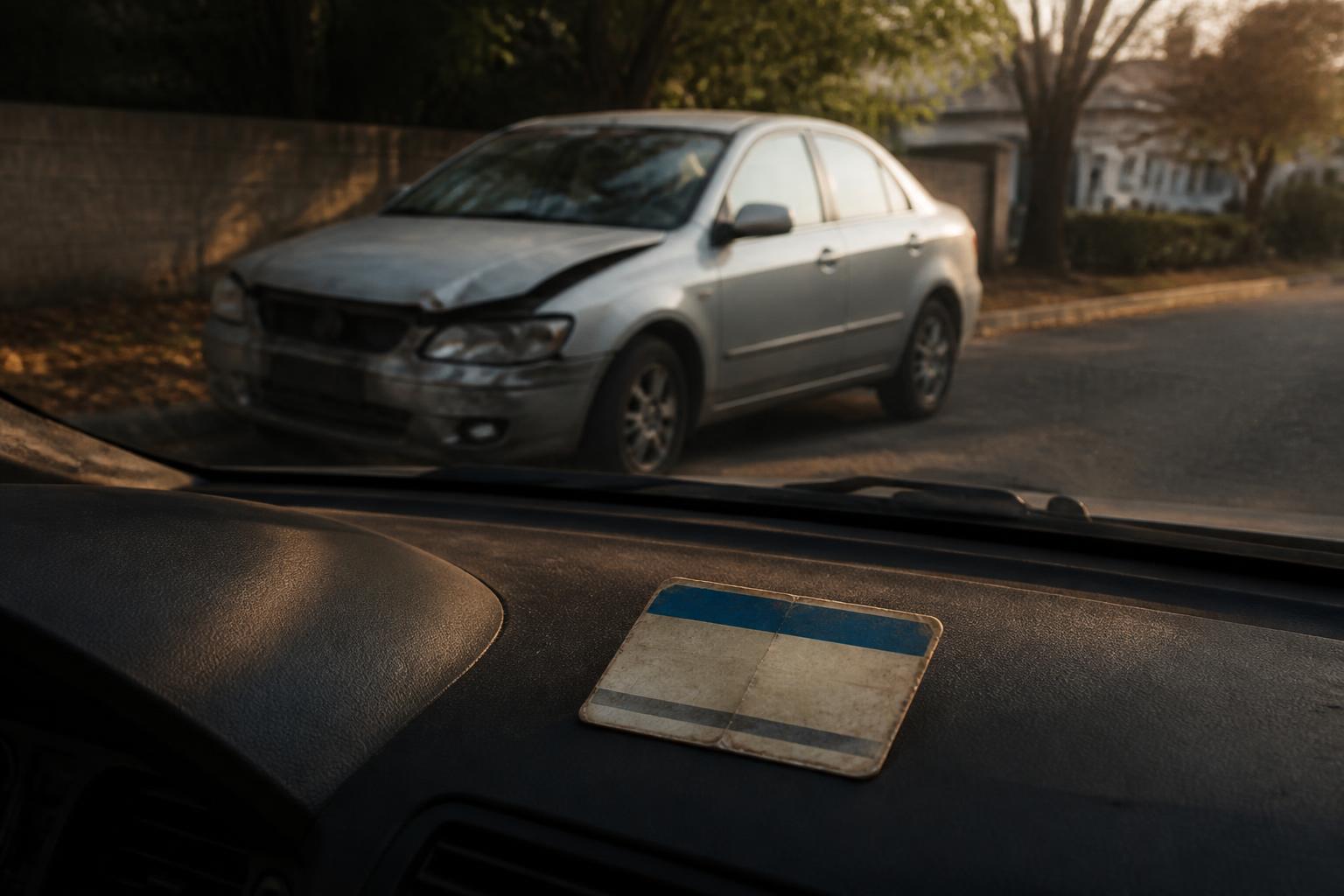
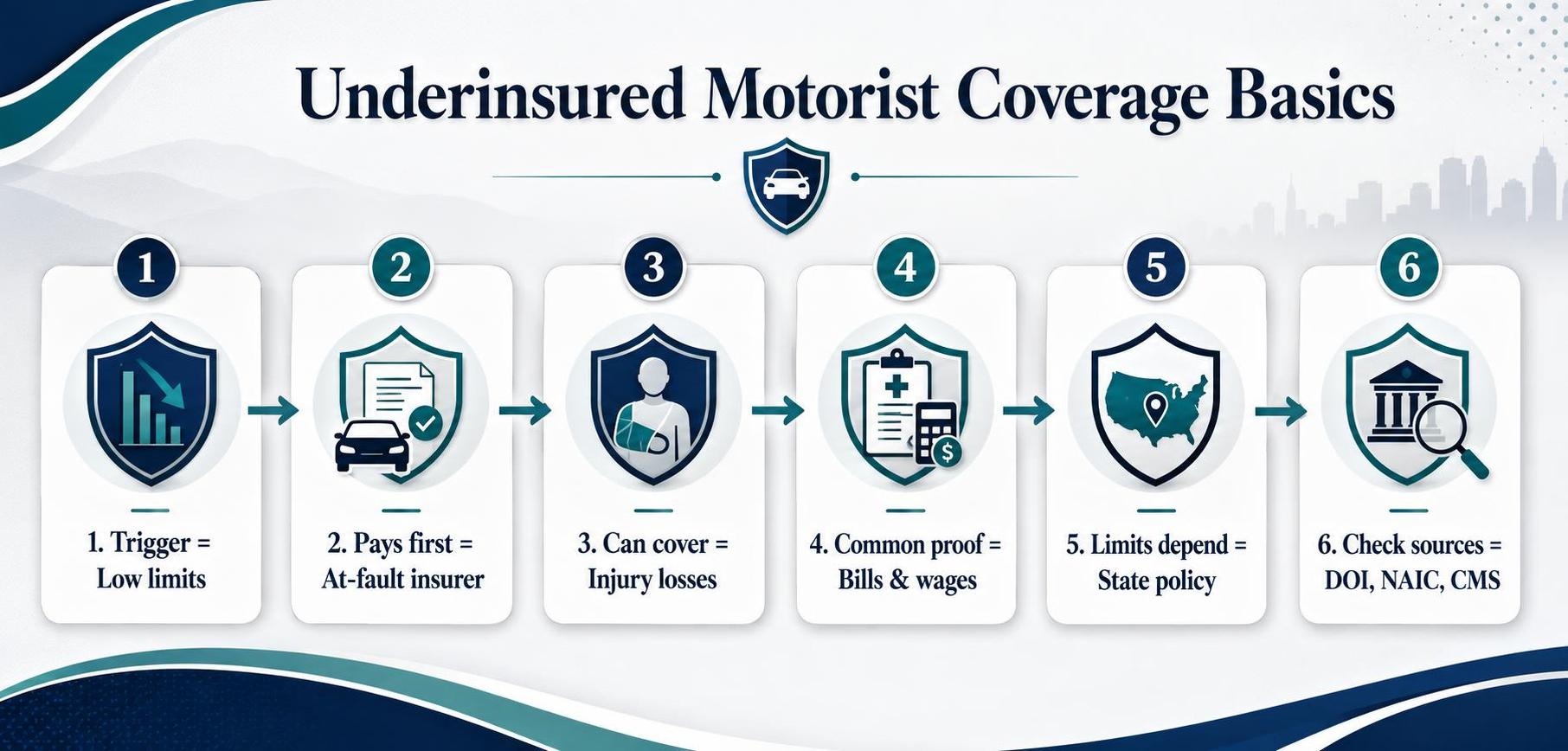
Short version: Underinsured motorist coverage is auto insurance that helps pay injury-related losses when the at-fault driver has liability limits too low to cover your damages.
It can cover medical bills, lost wages, and pain and suffering, depending on the policy and state law. Check your declarations page and state insurance rules before relying on it.
Underinsured motorist coverage is auto insurance that can pay your covered injury losses when the at-fault driver’s liability limits are too low.
The at-fault driver’s insurer usually pays first, up to its policy limit; your UIM coverage may respond after that, subject to your policy terms.
It does not automatically cover every shortfall, vehicle damage, or punitive damages. Claimants must document fault, injuries, medical bills, lost income, insurance limits, and settlement offers.
Rules vary by state and policy, so check your state department of insurance, the NAIC, and CMS for Medicare-related reimbursement issues.
What underinsured motorist coverage pays
Underinsured motorist coverage, usually called UIM, can help pay injury losses when the at-fault driver has liability insurance, but not enough to cover the claim.
The National Association of Insurance Commissioners says this coverage generally applies after the other driver’s bodily injury liability coverage is used first, subject to state law and policy terms.
UIM usually applies to bodily injury, not damage to the policyholder’s car. Property damage rules vary by state and insurer.
Readers should check the policy form and the state department of insurance because some states require different wording, offsets, or coverage types.
UIM commonly pays uncompensated medical bills, lost wages, and pain and suffering up to the insured’s policy limit, after the at-fault driver’s liability insurer pays its limit.
The NAIC’s consumer auto insurance guide describes uninsured and underinsured motorist coverage as protection for injuries caused by drivers with too little or no insurance.
| Issue | Typical rule |
| Who pays first | At-fault driver’s bodily injury liability insurer pays first. |
| What UIM can pay | Remaining covered bodily injury damages, up to the UIM limit and subject to offsets. |
| What it often does not pay | Damage to the insured vehicle, unless the policy or state offers separate UMPD or similar coverage. |
| Why the payout can vary | States use different approaches, including limit-to-limit and damages-based calculations. |
Example: if the injured driver has $100,000 in UIM bodily injury coverage and the at-fault driver has a $25,000 bodily injury limit, the first $25,000 generally comes from the at-fault driver’s insurer.
Whether UIM can pay up to $75,000 more depends on state law, the policy language, and total proven damages.
Claimants usually must document both liability and damages. Insurers often require:
- The crash report and insurance information for all drivers.
- Proof the at-fault driver’s liability limits were tendered or exhausted.
- Medical records, itemized bills, and diagnosis codes.
- Wage-loss proof, such as employer statements or tax records.
- Evidence of other payments, including health insurance or Medicare.
Medicare is generally a secondary payer when another insurer is primary, including liability or no-fault situations, under the Centers for Medicare & Medicaid Services. That can affect reimbursement and settlement paperwork.
Readers should not assume a health plan or Medicare will replace UIM benefits.
Caution: state rules can change the order of payment, setoff method, and required notices. Before signing a release or accepting the other driver’s limits, check the policy and the state insurance department’s consumer guidance.
When the at-fault driver pays first
Underinsured motorist coverage usually comes into play only after the at-fault driver’s bodily injury liability insurance is applied first.
That order matters because a UIM claim is typically measured against the other driver’s available liability limits, the insured’s damages, and the UIM rules in the policy’s state.
The at-fault driver’s insurer generally pays up to its bodily injury liability limit.
If losses exceed that amount, the injured person may then seek UIM benefits under their own policy or, in some cases, a resident relative’s policy, subject to state law and policy terms.
The National Association of Insurance Commissioners states that underinsured motorist coverage applies when the negligent driver has liability insurance, but not enough to fully pay the injured person’s damages.
State departments of insurance set the controlling rules on whether UIM is mandatory, optional, or can be rejected in writing.
| Issue | What usually happens first | Primary source to check |
| Liability payment order | At-fault driver’s bodily injury liability insurer pays first, up to the policy limit | State department of insurance policy summaries and state insurance code |
| UIM trigger | UIM is considered after liability limits are offered or exhausted, depending on state rules and policy language | State department of insurance; NAIC consumer guidance |
| Health coverage | Medical bills may also be paid by health insurance or Medicare under plan rules, separate from fault | CMS for Medicare coordination rules; plan documents for private coverage |
How much UIM pays depends on the state’s method. Some states use a “difference in limits” approach. Others allow broader recovery, sometimes called “add-on” coverage.
Because this varies by state, readers should confirm the rule with the state department of insurance or the policy form.
Claimants usually must document three things: the at-fault driver’s liability limit, the amount actually offered or paid, and the full value of damages.
Without that record, the UIM carrier may dispute whether the other policy was exhausted or whether damages exceed the liability payment.
- The liability declarations page or limits letter from the at-fault insurer.
- The settlement release, tender letter, or proof of payment.
- Medical records, bills, wage-loss proof, and physician opinions on impairment or future care.
- If Medicare is involved, conditional payment information and lien details from CMS.
Caution: accepting the at-fault driver’s settlement without following UIM notice or consent requirements can harm the UIM claim. Check the policy and the state department of insurance before signing a release.
How UIM differs from uninsured motorist
Underinsured motorist coverage, usually called UIM, applies when the at-fault driver has liability insurance, but not enough to pay the injured person’s covered losses.
Uninsured motorist coverage, or UM, applies when the at-fault driver has no liability insurance or the driver is unidentified, such as some hit-and-run claims, if state law and the policy allow it.
The National Association of Insurance Commissioners explains the basic split this way: UM responds to drivers with no insurance, while UIM responds when the at-fault driver’s limits are too low.
What either coverage pays, and whether property damage is included, depends on state law and the policy form.
| Issue | Uninsured motorist (UM) | Underinsured motorist (UIM) |
| At-fault driver’s insurance status | No liability insurance, or a qualifying unknown driver | Has liability insurance, but limits are insufficient |
| Who pays first | The injured person’s UM insurer, after claim conditions are met | The at-fault driver’s liability insurer pays first; UIM is considered after that payment |
| Main purpose | Replace missing liability coverage | Fill part of the gap between damages and the at-fault driver’s liability limit, subject to policy rules |
| State variation | Whether UM is required, offered, or waivable varies by state DOI | Whether UIM is required, offered, stacked, or offset varies by state DOI |
Who pays first matters. In a typical UIM claim, the claimant must pursue the negligent driver’s bodily injury liability coverage before asking the UIM insurer to pay.
Many states and policies also require notice to the UIM insurer before settling, because the insurer may have subrogation rights. Check the policy and the state department of insurance.
What UIM does not cover is as important as what it covers. It does not convert the other driver’s low limits into full payment of every loss.
Payment can be reduced by offsets, anti-stacking rules, workers’ compensation, Medicare Secondary Payer rules under CMS, or the claimant’s own policy limits and exclusions.
Documentation is central.
A claimant usually needs the crash report, proof of the at-fault driver’s liability limits, the liability settlement offer or release, medical records and bills, wage-loss proof, and evidence of noneconomic damages.
If property damage is disputed, photos, repair estimates, and title documents may also be required.
- For state-specific UM/UIM requirements, check the state department of insurance or insurance code.
- For general coverage descriptions, see NAIC consumer guidance.
- For Medicare-related repayment or reporting issues, check CMS primary sources.
Caution: UM and UIM rules vary sharply by state and policy wording. Do not rely on a generic summary to settle a claim, sign a release, or assume a limit applies the same way in every state.

Injuries, passengers, and covered vehicles
Underinsured motorist coverage usually applies to bodily injury when the at-fault driver’s liability limits are too low to pay the full loss. It does not replace the other driver’s insurance.
That liability coverage pays first, then any underinsured motorist claim is evaluated under the policy and state law.
What is covered depends on the policy form and state rules.
The National Association of Insurance Commissioners states that uninsured and underinsured motorist protections are regulated by state law, so readers should confirm details with the state department of insurance and the policy itself.
In most personal auto policies, covered people usually include the named insured and resident family members. Occupants of a covered auto are often included too.
Some policies also protect the insured when walking or biking, but that point varies by state and contract language.
Passengers can be covered, but not always in the same way as the policyholder. A passenger may first claim against the at-fault driver’s bodily injury liability insurance.
If that amount is inadequate, the passenger may have access to underinsured motorist benefits under the host vehicle’s policy, the passenger’s own policy, or both, subject to state anti-stacking rules and policy terms.
Covered vehicles also vary. Many policies tie this coverage to listed autos, newly acquired autos for a limited period, and sometimes temporary substitute cars.
Coverage for motorcycles, rideshare periods, rental cars, and vehicles furnished for regular use often depends on endorsements and exclusions. Check the declarations page and state-approved policy form before relying on an assumption.
| Issue | General rule | Primary source to check |
| Injured driver | At-fault driver’s bodily injury liability pays first; underinsured motorist may pay remaining covered damages up to the policy limit | State department of insurance; policy language; NAIC consumer auto insurance materials |
| Injured passenger | May claim first against the at-fault driver, then potentially under the host vehicle’s or passenger’s own underinsured motorist coverage | State department of insurance; policy language |
| Medical bills while claim is pending | Health insurance, MedPay, or PIP may pay bills earlier, depending on the policy and state no-fault rules | State department of insurance; plan documents |
| Medicare enrollee | Medicare may pay conditionally and later seek reimbursement if another insurer should pay | CMS Medicare Secondary Payer guidance |
Claimants should document the other driver’s liability limits, the settlement offer, medical records, diagnosis codes, bills, wage-loss proof, and any permanent impairment evidence.
Keep the declarations page, police report, photos, and written insurer consent if the policy requires approval before settling.
Caution: do not settle with the at-fault insurer or sign a release before checking the underinsured motorist policy. Some policies require notice or consent, and a mistake can reduce or bar the claim.
Verify state-specific rules with the state department of insurance, NAIC materials, and CMS if Medicare is involved.
Policy limits, stacking, and state rules
Underinsured motorist coverage usually applies after the at-fault driver’s liability insurance is exhausted. The amount available depends on the policy limit, the state’s offset rules, and whether the policy or state allows stacking.
These rules vary. Check the policy and the state department of insurance.
Limits are typically shown per person and per accident.
The National Association of Insurance Commissioners explains auto liability and UM/UIM limits using split limits such as 25/50/25, meaning $25,000 bodily injury per person, $50,000 bodily injury per accident, and $25,000 property damage.
UIM usually concerns bodily injury, not vehicle damage, unless the state offers underinsured motorist property damage.
| Rule | What it means |
| Per-person limit | Maximum payable for one injured person under the UIM coverage part, subject to state offsets and policy terms. |
| Per-accident limit | Maximum payable for all injured people from one crash under the UIM coverage part. |
| Exhaustion requirement | Many policies require proof that the at-fault driver’s liability limits were paid or offered before UIM pays. |
| Offset rule | Some states reduce UIM by the at-fault driver’s liability payment; others allow broader recovery up to the UIM limit purchased. |
| Stacking | In some states, limits from multiple vehicles or policies may be combined; in others, stacking is barred or can be waived in writing. |
Who pays first matters. The at-fault driver’s bodily injury liability insurer pays first, up to that policy’s limit.
UIM is then a claim under the injured person’s own policy, or sometimes a resident relative’s policy, if the policy definition of insured applies.
State law can change the result.
For example, the Illinois Department of Insurance states that Illinois requires uninsured motorist bodily injury limits at least equal to the state minimum liability limits of $25,000 per person and $50,000 per accident.
Illinois also offers optional underinsured motorist bodily injury coverage. Other states set different minimums and different UIM rules.
Stacking is especially state-specific. The NAIC notes that auto insurance requirements and coverage options differ by state. Some states permit stacking unless validly rejected. Others enforce anti-stacking clauses.
A claimant should not assume multiple policy limits can be added together without checking the policy and state law.
- Declarations page showing UIM limits for each vehicle and policy.
- The at-fault driver’s policy limits and proof of tender or payment.
- Medical records, bills, wage-loss proof, and itemized out-of-pocket losses.
- Written consent requirements before settling, if the policy demands it.
- Any state-required forms or notice deadlines from the insurer or department of insurance.
Caution: settling too early can harm a UIM claim. Before signing a release, check the policy’s consent-to-settle language and the state insurance regulator’s guidance.

Documents needed for a UIM claim
An underinsured motorist, or UIM, claim usually starts after the at-fault driver’s bodily injury liability coverage is confirmed and, in many states, exhausted by settlement or payment.
The insurer handling the UIM claim will ask for records that prove fault, damages, the other driver’s policy limits, and what other sources already paid.
Documents matter because UIM is not the first payer for the loss. The at-fault driver’s liability insurer generally pays first, and the UIM carrier then evaluates any remaining covered damages under the policy language and state law.
Offset, consent-to-settle, and exhaustion rules vary by state, so check the policy and the state department of insurance.
The core claim file usually includes the items below. Missing records can delay payment or create disputes over whether the UIM carrier received enough proof of loss.
- Crash and liability records: Police crash report, incident number, photos, witness statements, citations, and any reconstruction report. These help establish fault and whether comparative negligence may reduce recovery under state law.
- At-fault driver insurance proof: Declarations page if available, liability limits confirmation, reservation-of-rights letters, and the settlement offer or release. Many UIM policies require written proof that the tortfeasor was underinsured and that the bodily injury limits were paid or tendered.
- Medical records and bills: Emergency department records, imaging, physician notes, therapy records, prescriptions, itemized bills, and health insurance explanations of benefits. If Medicare is involved, conditional payment information may matter; CMS is the primary source for Medicare recovery rules.
- Income-loss proof: Employer wage statement, pay stubs, W-2s or 1099s, tax returns for self-employment, and disability slips showing work restrictions. UIM carriers commonly ask for dates missed from work and the rate of pay.
- Your own policy records: Declarations page, endorsements, notice of claim, and any consent-to-settle request. In some states, settling with the at-fault driver without the UIM carrier’s consent can harm the claim, so verify the rule with the policy and the state insurance department.
- Other payment records: MedPay, personal injury protection, workers’ compensation, or disability payments. UIM generally does not pay the same loss twice, and the policy may reduce payment by amounts already paid from other sources if state law allows it.
| Document | Why the insurer asks for it |
| Liability limits letter | Shows the at-fault driver’s coverage and whether it was insufficient |
| Signed medical authorization | Lets the insurer verify treatment, causation, and charges |
| Settlement release and draft | Shows what was paid first and whether policy conditions were met |
| Health plan EOBs | Shows billed amounts, plan payments, and patient responsibility |
Caution: do not rely on a checklist alone. UIM deadlines, notice rules, and required forms vary by state and policy.
The NAIC and each state department of insurance are primary sources for state-specific consumer guidance, and CMS is the primary source for Medicare coordination and recovery rules.

Health insurance, Medicare, and liens
Underinsured motorist coverage can pay bodily injury damages after the at-fault driver’s liability limits are exhausted, but medical bills are often paid earlier by health coverage. That creates reimbursement issues.
A claimant may have to repay a health plan, Medicare, Medicaid, or another payer from the settlement.
Who pays first depends on the coverage and the timing of treatment. The policy language, the health plan document, and state insurance rules control details.
Because those rules vary, readers should verify them with the state department of insurance, the plan administrator, or Medicare.
Who usually pays first
Hospitals and doctors typically bill health insurance or Medicare before a UIM claim is resolved. UIM benefits usually are not immediate medical payment coverage.
They are a liability-style benefit paid after proof of damages, fault, and the at-fault driver’s policy limits.
If the auto policy includes MedPay or personal injury protection, those benefits may pay medical expenses first under that auto policy’s terms.
Whether a health insurer can delay payment, coordinate benefits, or seek reimbursement varies by state and plan. The National Association of Insurance Commissioners and state insurance departments explain these differences.
Medicare and reimbursement
Medicare is a secondary payer when another insurer is responsible. Under the Medicare Secondary Payer rules, Medicare can make a conditional payment and later recover it from a settlement, judgment, award, or other payment.
The Centers for Medicare & Medicaid Services administers this process.
| Payer | What it may do | Primary source |
| Private health insurance | Pay treatment bills under plan terms, then assert reimbursement or subrogation if allowed | Plan document, state department of insurance, NAIC consumer guidance |
| Medicare | Make conditional payments, then seek recovery from the settlement | CMS Medicare Secondary Payer rules |
| Medicaid | Pay covered care and may claim part of a settlement under federal and state rules | State Medicaid agency and state law |
| Provider lien | Claim payment directly from settlement if state law or contract allows | State lien statutes and provider agreement |
What the claimant must document
- Complete itemized medical bills and explanation of benefits forms.
- Proof of payments made by health insurance, Medicare, Medicaid, MedPay, or PIP.
- The at-fault driver’s liability limit and the written exhaustion payment.
- Medical records linking the injuries, treatment, and future care to the crash.
- Any lien notice, subrogation claim, or Medicare conditional payment letter.
Caution: do not assume a settlement check is free to spend. Paying the wrong party first can create collections, benefit denials, or a Medicare recovery problem.
Check the primary source for your state and plan before signing a release or distributing funds.
What the editorial team reviewed
We reviewed underinsured motorist coverage against primary-source insurance guidance, not marketing pages.
We checked the same three issues in each source: what UIM pays, what it does not pay, and who pays first when other insurance or Medicare is involved.
We also checked what a claimant must document before relying on any summary.
Where rules vary by state or by health plan, we point readers to the state department of insurance, the National Association of Insurance Commissioners (NAIC), or the Centers for Medicare & Medicaid Services (CMS).
Our review focused on three primary-source buckets.
First, we read NAIC consumer material explaining that uninsured and underinsured motorist coverage is regulated at the state level and may be mandatory, optional, or offered with selection or rejection forms depending on the state.
Second, we checked state department of insurance materials for state-specific definitions and offset rules. Third, we reviewed CMS Medicare Secondary Payer guidance because payment order matters when an injured person also has Medicare.
| Source type | What we checked | Why it matters |
| NAIC consumer guidance | Whether UIM is described as bodily injury coverage for losses exceeding the at-fault driver’s liability limits | Confirms the basic function of UIM and that state law controls details |
| State department of insurance | Whether the state treats UIM as mandatory, optional, stackable, reduced by offsets, or subject to notice/consent rules | These terms change what a policy can actually pay |
| CMS Medicare Secondary Payer guidance | Whether another insurer must pay before Medicare makes a conditional payment | Clarifies payment order and repayment risk |
Across those sources, the consistent rule was narrow: UIM typically addresses bodily injury damages when the at-fault driver’s liability insurance is insufficient.
It often does not pay for the other driver’s vehicle damage unless the policy separately includes uninsured motorist property damage or another applicable coverage.
Readers should verify that distinction on the declarations page and endorsement.
We also reviewed what claim files usually need to prove.
The recurring documents were the at-fault driver’s liability limits, the settlement offer or exhaustion proof, medical records and bills, wage-loss proof, and the insured’s own policy language.
Some states or policies also require prompt notice and the insurer’s consent before settling with the at-fault driver.
Missing that step can harm a claim, so readers should check the policy and their state insurance department before signing a release.
For Medicare beneficiaries, we treated CMS as the controlling source on payment order.
Medicare generally does not pay first when liability insurance or no-fault insurance is responsible; it may make a conditional payment and seek reimbursement later.
That is a plain caution point: a claimant should not assume a settlement is free to spend until lien and repayment issues are confirmed.
Frequently Asked Questions
What is underinsured motorist coverage?
Underinsured motorist coverage, often called UIM, is auto insurance that can help pay for injuries and, in some states, other losses when the at-fault driver has liability insurance but not enough to cover the full claim.
The Insurance Information Institute describes it as protection that applies after the other driver’s liability limits are exhausted; readers should check their own policy language because covered losses and offsets vary by insurer and state.
How is underinsured motorist coverage different from uninsured motorist coverage?
Uninsured motorist coverage generally applies when the at-fault driver has no liability insurance, while underinsured motorist coverage applies when the at-fault driver has some insurance but too little.
The National Association of Insurance Commissioners explains that these coverages are separate in many policies, so a driver should review declarations, endorsements, and state rules before assuming both are included.
Does underinsured motorist coverage pay medical bills only?
Not always.
In many states, UIM bodily injury can pay for medical expenses, lost wages, and pain and suffering up to the policy limit, but property damage and non-economic losses depend on state law and policy wording.
The Insurance Information Institute states that benefits differ by coverage form and jurisdiction.
Related Reading
- Does Health Insurance Cover Injuries From a Car Accident
- What Insurance Does Walgreens Accept?
- What Insurance Company Covers Mounjaro?
- Med-Pay vs PIP: Which One Pays Your Medical Bills After a Crash
- Which Insurance Is Primary?
- How Insurance Subrogation Works After an Injury Settlement
- What an Insurance Adjuster Actually Does With an Injury Claim
- All Blog Guides
- California Legislature, Insurance Code § 11580.2 (2024)
- Texas Constitution and Statutes, Insurance Code Chapter 1952 (2023)
- Washington State Legislature, RCW 48.22.030 (2024)
- Cornell Law School Legal Information Institute (2022)
- Texas Department of Insurance (2024)
- National Association of Insurance Commissioners (2024)
- U.S. Department of Justice – Civil Division