

Quick answer: Insurance subrogation after settlement means an insurer may seek reimbursement from your settlement for benefits it paid on your claim.
The right depends on the policy, state law, ERISA/Medicare/Medicaid rules, and the settlement language. Do not distribute funds until liens and reimbursement claims are verified and resolved.
Insurance subrogation after settlement is an insurer’s right to recover claim payments from a liable party or settlement, after it pays covered benefits first under the policy.
The policy pays only covered losses, not exclusions, deductibles, or amounts above limits.
The claimant should document the policy, bills, insurer payments, settlement terms, liens, releases, and correspondence before spending funds.
State rules vary; check the state department of insurance, CMS for Medicare, and NAIC consumer guidance. Do not rely on this summary to waive or ignore a lien.
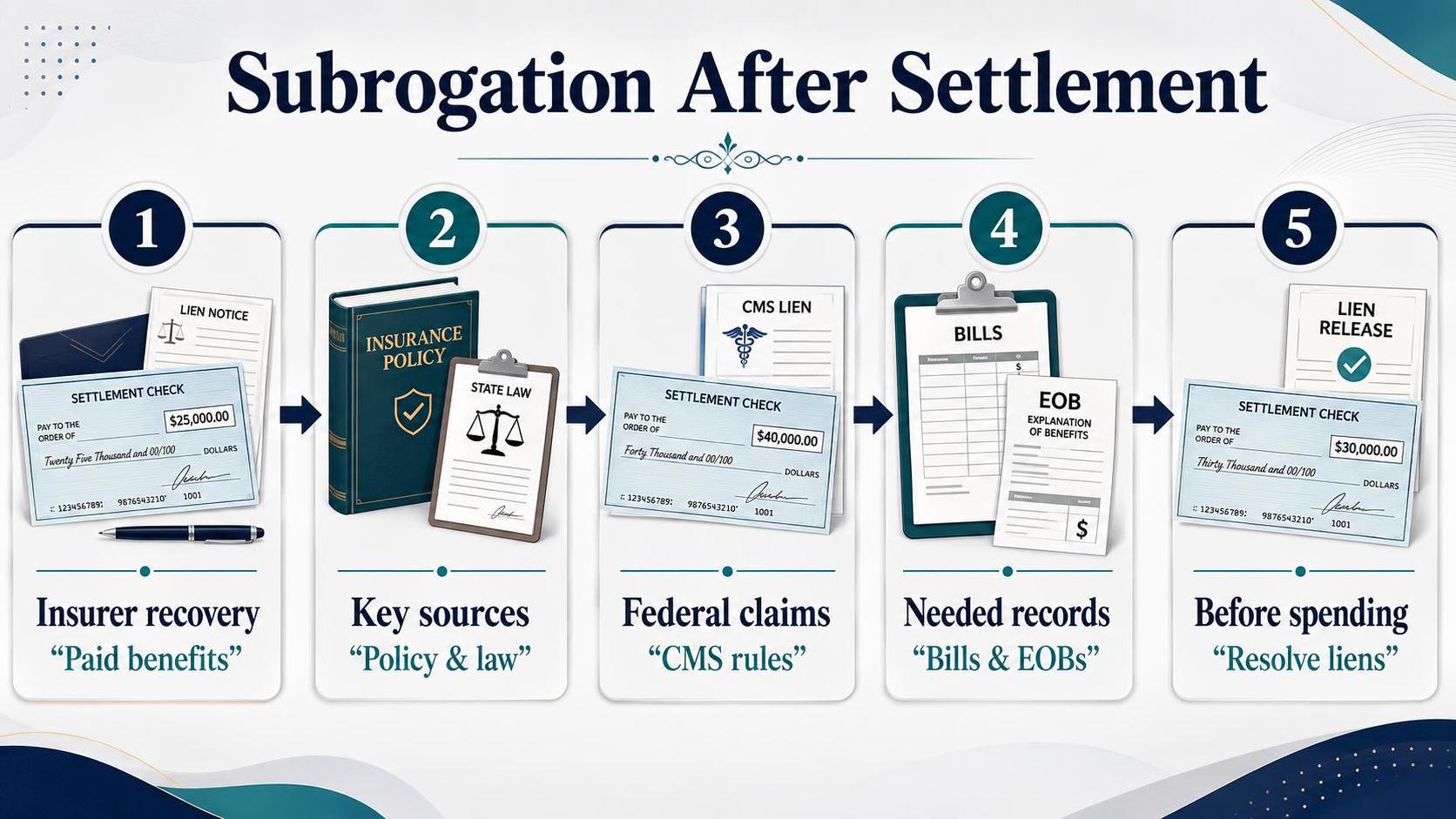
How insurance subrogation works after settlement
Insurance subrogation is a reimbursement right, not extra coverage. After an injury settlement, an insurer that paid accident-related bills may seek repayment from the settlement if the policy or law allows it.
The key questions are who paid first, what bills were injury-related, and whether the plan has a valid recovery clause.
Those answers can change by state, by plan type, and by whether Medicare, Medicaid, auto coverage, or employer health coverage was involved.
In practice, medical providers often bill available coverage before the liability case ends.
Health insurance may pay under its contract, auto MedPay or PIP may pay first in some no-fault systems, and Medicare may make “conditional payments” when another payer is expected later, according to CMS.
- What the policy covers: The insurer pays covered medical expenses under the policy terms. It does not pay because a settlement exists.
- What the policy may not cover: Deductibles, copays, excluded treatment, out-of-network charges, or care the insurer finds unrelated to the injury.
- What subrogation does: It lets the payer try to recover what it already paid for the same injury.
Medicare is the clearest example. CMS states that Medicare can recover conditional payments from a beneficiary’s settlement, judgment, award, or other payment.
After CMS issues a final demand, payment is due within 60 days, and CMS states interest may accrue if repayment is late.
| Payer or rule | What happens after settlement | Primary source |
| Medicare | Conditional payments must be repaid if the settlement includes the same injury-related medical expenses; repayment is due within 60 days after CMS final demand. | CMS, Medicare Secondary Payer recovery guidance |
| Private health insurance | Repayment depends on the plan language, state law, and whether the plan is fully insured or self-funded. | Plan documents; state department of insurance; NAIC consumer resources |
| Auto PIP or MedPay | Priority and reimbursement rights vary by state no-fault rules and policy wording. | State department of insurance; policy declarations and endorsements |
A claimant should keep the settlement agreement, itemized medical bills, explanation of benefits, lien notices, policy booklet, and any CMS correspondence.
Those records help show which bills were paid, by whom, and whether the claimed reimbursement matches injury-related treatment.
Caution: do not assume every insurer can take the same share of a settlement. State anti-subrogation rules, plan language, and federal program rules can change the result.
Check the state department of insurance, CMS, and the exact plan documents before signing a release or distributing settlement funds.

Who pays first after an injury claim
After an injury claim, the first payer is usually the coverage that is primary under the policy and federal or state coordination rules.
A settlement does not automatically erase that order, and paying the wrong party can leave the claimant owing money back.
The key question is not who caused the injury first. The key question is which plan had the legal duty to pay medical bills now, and which payer can seek reimbursement later through subrogation, reimbursement, or lien rights.
In an auto or premises injury case, a claimant often uses available medical coverage first, then resolves reimbursements after settlement.
The exact order depends on the policy language, state insurance rules, and whether Medicare, Medicaid, or workers’ compensation is involved.
| Coverage | Typical order | Primary source |
| Workers’ compensation | Pays first for covered work injuries; Medicare is secondary | CMS, Medicare Secondary Payer rules |
| No-fault or PIP | Usually pays first up to policy limits for auto injuries in no-fault states | State department of insurance; policy contract |
| Liability insurer for the at-fault party | Usually pays last, after settlement or judgment, not as day-to-day health coverage | Liability policy and claim settlement |
| Medicare | May make conditional payments, then must be reimbursed when another payer was primary | CMS |
| Employer or private health plan | Order depends on coordination-of-benefits terms and state insurance rules | NAIC COB model; state department of insurance; plan documents |
Medicare’s role is strict. Under CMS Medicare Secondary Payer rules, Medicare generally does not pay first when workers’ compensation, liability insurance, or no-fault insurance has responsibility.
If Medicare makes a conditional payment, CMS can demand repayment from the settlement.
Some private health plans also reserve reimbursement rights. Fully insured plans are often governed by state insurance rules. Self-funded employer plans may rely on ERISA plan language instead.
The claimant must read the summary plan description and reimbursement provisions, not assume state rules control.
Documentation matters. Keep itemized medical bills, explanations of benefits, the police or incident report, the settlement agreement, lien notices, and all letters from Medicare, Medicaid, or the health plan.
A claimant should also document dates of treatment, accident details, and what each insurer paid. That record helps separate injury-related charges from unrelated care and reduces disputes over the amount claimed back.
Do not spend settlement funds until reimbursement claims are verified. Amounts and deadlines vary by state and plan.
Check the state department of insurance, CMS’s Medicare Secondary Payer guidance, and NAIC coordination-of-benefits materials before acting.

What your policy may recover
After a settlement, an insurer may try to recover money it paid because of the same injury. That right is usually called subrogation or reimbursement, but the amount and method depend on the policy, the plan type, and state or federal law.
The key question is not whether a settlement exists. The key question is what the policy language allows, what the plan paid first, and whether another payer had primary responsibility.
A claimant should not assume every dollar in a settlement is available to the insurer.
Most health, auto, workers’ compensation, and government plans can pursue repayment for covered benefits tied to the accident. The claim usually focuses on amounts actually paid, not billed charges.
Explanation of Benefits forms, payment ledgers, lien notices, and the settlement breakdown matter.
| Payer or plan | What it may try to recover | Primary source to check |
| Private health insurance | Medical benefits the insurer paid for accident-related care, if the policy includes subrogation or reimbursement language | Policy booklet; state department of insurance; NAIC consumer guidance |
| Self-funded ERISA health plan | Amounts the plan paid, subject to plan terms and federal ERISA rules | Summary Plan Description; U.S. Department of Labor; state insurance rules may not control |
| Medicare | Conditional payments Medicare made when another payer should have paid first | CMS Medicare Secondary Payer guidance |
| Medicaid | Usually the medical-expense portion of a settlement, under federal and state Medicaid rules | State Medicaid agency; state department of insurance; federal Medicaid law |
| Auto insurer | Medical payments or other first-party benefits paid under the auto policy, if state law and policy terms allow recovery | Auto policy; state department of insurance |
| Workers’ compensation | Benefits paid for the work injury, often from the third-party recovery | State workers’ compensation agency |
Who pays first matters. Under CMS’s Medicare Secondary Payer rules, liability insurance, no-fault insurance, and workers’ compensation are primary to Medicare for covered accident-related expenses.
Medicare can seek reimbursement for conditional payments after a settlement.
State rules can change the result. Some states limit health-plan reimbursement by statute or by “made whole” or “common fund” doctrines.
Self-funded ERISA plans can be different because federal law may preempt state insurance limits. Check the plan document and the relevant state insurance department.
A claimant should keep the policy, Summary Plan Description, EOBs, medical bills, proof of payments, accident reports, lien letters, and the settlement agreement.
If the settlement does not allocate damages, ask counsel whether a written allocation is needed. Acting without the governing plan or state rule can cost money.

Health plan liens and reimbursement rights
After an injury settlement, a health plan may seek repayment for medical bills it already paid that were caused by the third party.
The rule depends on the payer and the plan document, not on a general assumption that every insurer automatically has a lien.
The claimant should not spend settlement funds until all reimbursement claims are identified and verified. A mistake here can create a second debt after the case ends.
Who pays first matters.
Medicare is generally a secondary payer when another insurer or liability settlement should pay, and it can recover “conditional payments” it made from the settlement under the Medicare Secondary Payer rules administered by CMS.
Medicaid recovery is narrower and is tied to state and federal rules, so the claimant should check the state Medicaid agency and state department of insurance for local requirements.
| Payer or plan type | What creates the reimbursement right | Primary source to check |
| Medicare | Federal Medicare Secondary Payer law; CMS may recover conditional payments tied to the injury | CMS, Benefits Coordination & Recovery Center, Medicare Secondary Payer guidance |
| Medicaid | Federal and state Medicaid recovery rules; scope varies by state and by what portion of settlement is allocated to medical costs | State Medicaid agency, CMS Medicaid guidance |
| Employer self-funded health plan | ERISA plan terms may create reimbursement rights; state insurance rules often do not apply to the plan itself | Plan document and summary plan description; U.S. Department of Labor ERISA materials |
| Fully insured health plan | Policy language plus state insurance law may limit or regulate subrogation or reimbursement | Policy, state department of insurance, NAIC consumer resources |
The claimant should collect the itemized payment ledger, the policy or plan language, the settlement release, and any allocation showing what the settlement did and did not pay for.
Plans commonly ask for accident details, provider bills, EOBs, and the attorney’s fee and cost breakdown.
For Medicare, CMS states that a final conditional payment amount must be resolved before funds are safely distributed.
For employer plans, the Supreme Court has recognized that ERISA plans may enforce reimbursement terms against specifically identifiable settlement funds, so the exact plan language matters.
A health insurer usually does not get more than the law or the policy allows. State limits, made-whole rules, common-fund rules, and anti-subrogation restrictions vary.
Check the state department of insurance, CMS, and NAIC materials before agreeing to any payoff amount.
Caution: Do not rely on a settlement statement alone to decide what is owed. A wrong payoff can trigger collection, benefit offsets, or litigation.

Medicare Medicaid and CMS reporting rules
Medicare and Medicaid can seek repayment after an injury settlement, but the rules are not identical. Medicare’s recovery process is federal and centrally administered by the Centers for Medicare & Medicaid Services (CMS).
Medicaid recovery is state-run under federal law, so the exact lien and appeal rules vary by state.
Medicare is a “secondary payer” when liability insurance, no-fault insurance, or workers’ compensation should pay first. That rule comes from the Medicare Secondary Payer statute, 42 U.S.C. 1395y(b), and CMS guidance.
If Medicare pays conditionally, it can demand reimbursement from the settlement.
In practice, the insurer or self-insured entity usually pays the claimant first under the settlement.
Then Medicare may seek repayment of related “conditional payments.” A claimant should not assume the insurer handled that issue unless the settlement documents and CMS correspondence show it.
| Rule | Figure | Primary source |
| Time to repay Medicare after a Final Demand | 60 days | CMS Medicare Secondary Payer Recovery Portal guidance |
| Interest if Medicare is not repaid on time | Interest may accrue from the date of the demand if payment is not received within 60 days | CMS recovery guidance |
| Government remedy against a primary plan that fails to reimburse Medicare | Double damages | 42 U.S.C. 1395y(b)(2)(B)(iii) |
Section 111 of the Medicare, Medicaid, and SCHIP Extension Act requires certain insurers and self-insured entities to report settlements, judgments, awards, and other payments involving Medicare beneficiaries to CMS.
That reporting duty belongs to the responsible reporting entity, not to the injured person, but a claimant should still confirm whether Medicare status was checked and reported correctly.
A claimant should keep documents that let CMS match treatment to the claim.
That usually includes the settlement agreement, release, insurer letters, payment breakdown, dates of injury, attorney fee statement, medical bills, and any dispute showing charges were unrelated to the injury.
Medicaid is different. State Medicaid programs must pursue liable third parties under federal Medicaid third-party liability rules, but recovery limits, compromise procedures, and notice rules can differ.
The claimant should check the state Medicaid agency, the state department of insurance, and NAIC consumer resources for state-specific guidance.
Caution: do not spend settlement funds assuming Medicare or Medicaid has no claim. A mistaken payoff can create collection risk, interest, or reduced future benefits.
Check CMS for Medicare issues and the state Medicaid agency for Medicaid lien rules before distributing funds.

State rules that can reduce repayment
Repayment is not always the full amount an insurer paid. State law can cut or block subrogation through made-whole rules, common-fund fee sharing, or no-subrogation rules for specific coverages such as auto PIP.
The exact result depends on the policy language, the type of coverage, and state law.
A claimant should not assume the insurer’s demand is final.
Ask for the plan language, the payment ledger, and the legal basis for reimbursement, then compare that with the controlling statute, regulation, or court rule in the state where the claim is being resolved.
| Rule | What it can do | Example | Primary source |
| Made-whole rule | Can bar reimbursement until the injured person is fully compensated for all losses. | Georgia generally bars benefit providers from reimbursement unless the injured person has been “completely compensated.” | O.C.G.A. § 33-24-56.1 |
| Common-fund rule | Can require the insurer to pay part of the claimant’s attorney’s fees and costs. | Georgia’s statute requires a reduction for the insurer’s pro rata share of attorney’s fees and expenses when recovery is allowed. | O.C.G.A. § 33-24-56.1 |
| No-subrogation rule for a coverage type | Can eliminate repayment entirely for that coverage. | Texas bars subrogation for Personal Injury Protection benefits. | Texas Insurance Code § 1952.155 |
| Medicaid allocation limits | Can limit recovery to the part of the settlement allocated to medical expenses. | States cannot take the non-medical portion of a settlement for Medicaid reimbursement. | CMS guidance; Arkansas Dept. of Health and Human Services v. Ahlborn, 547 U.S. 268 (2006); Wos v. E.M.A., 568 U.S. 627 (2013) |
Documentation matters. Keep the settlement agreement, release, itemized medical bills, insurer payment log, attorney fee contract, and any allocation showing what part of the settlement represents medical expenses, wage loss, and pain and suffering.
For Medicaid or Medicare-related claims, allocation is critical. CMS requires reporting and has separate recovery rules; a claimant should verify current requirements with CMS and the state Medicaid agency before distributing settlement funds.
- Check the state department of insurance for consumer bulletins on subrogation, auto PIP, MedPay, and unfair claims practices.
- Check NAIC consumer material for definitions and state-contact information.
- Check CMS for Medicare Secondary Payer and Medicaid recovery rules, because federal programs follow separate procedures.
Caution: a claimant who ignores a valid lien or reimbursement right can face collection action or delayed settlement disbursement.
State rules vary sharply, and self-funded ERISA plans may preempt some state limits, so the plan document and governing law must be reviewed together.

Documents claimants should keep before settling
Before signing a release, a claimant should keep a complete paper trail for every medical bill, insurance payment, and lien notice tied to the injury.
Subrogation and reimbursement claims often turn on proof: what treatment was related, who paid first, and whether the insurer had a legal right to recover.
A settlement can end the injury claim, but it does not automatically erase Medicare, Medicaid, ERISA plan, or health-insurer reimbursement demands.
Because rules differ by policy and state, claimants should verify requirements with the plan document, the state department of insurance, CMS, and NAIC consumer guidance before acting.
The core file should show the accident, the treatment, and the money flow from first bill to proposed settlement. Missing records can weaken negotiations over unrelated charges, duplicate payments, or reductions.
| Document | Why it matters |
| Health insurance policy, Summary Plan Description, and reimbursement/subrogation language | Shows whether the plan claims reimbursement, whether ERISA may apply, and what procedures or deadlines the plan requires. |
| Itemized medical bills and CPT/HCPCS-coded statements | Helps match each charge to the injury and dispute unrelated or duplicate charges. |
| Explanation of Benefits for every claim | Shows billed amount, allowed amount, insurer payment, patient responsibility, and denial codes. |
| Payment ledger from providers and insurers | Confirms what was actually paid, adjusted, written off, or still owed. |
| Liens, notices, and correspondence from Medicare, Medicaid, workers’ compensation, or private plans | Identifies who is asserting recovery rights and on what basis. |
| Settlement draft, release, and attorney disbursement sheet if represented | Shows gross settlement, fees, costs, and net proceeds for lien resolution. |
For Medicare, keep every Conditional Payment Letter, payment summary, and Final Demand letter. CMS states the Final Demand amount must generally be paid within 60 days of the demand date to avoid interest.
Claimants can review reported payments through the Medicare Secondary Payer Recovery Portal and should save screenshots or PDFs.
If Medicaid paid injury-related expenses, keep state Medicaid notices and any third-party liability forms.
Medicaid recovery rules vary by state and are limited by federal law and court decisions, so the correct primary source is the state Medicaid agency and state department of insurance, not a generic settlement estimate.
Keep proof of out-of-pocket costs, too: receipts, mileage logs, pharmacy printouts, and premium statements if a plan seeks recovery from medical payments. A plain caution: do not rely on a phone call alone before settling.
Ask for the reimbursement claim in writing and compare it against the policy, EOBs, and the primary-source guidance from CMS, NAIC, and the relevant state agency.
What the editorial team reviewed
We reviewed primary-source rules on subrogation after an injury settlement, then checked how those rules answer three consumer questions: what the policy covers, who pays first, and what documents a claimant must keep.
We did not test claim outcomes or negotiate liens, because those results turn on policy language, state law, plan terms, and settlement facts.
Our review focused on sources that control or summarize those rules: CMS for Medicare recovery, the NAIC for consumer insurance standards, and state departments of insurance for state-specific subrogation limits and notice rules.
Where a rule varies by plan or state, this section points readers back to the primary source.
| Source reviewed | What it establishes |
| CMS, Medicare Secondary Payer materials and recovery guidance | Medicare is generally a secondary payer when a liability insurer, no-fault insurer, or workers’ compensation plan is responsible, and Medicare may seek reimbursement from a settlement. |
| 42 U.S.C. § 1395y(b)(2) | The federal Medicare Secondary Payer statute sets the legal basis for Medicare’s repayment rights. |
| NAIC consumer materials on health coverage and claims | Policy terms, coordination of benefits, and subrogation language differ by product and state, so consumers must read the plan document and state guidance. |
| State department of insurance bulletins and consumer pages | State law may limit health-plan reimbursement, regulate auto subrogation, or require notice and appeal rights. |
We checked one point carefully: insurance subrogation is not the same as settlement funding, and it does not create new coverage. A policy pays only claims the contract covers.
It does not usually pay uncovered losses, deductibles beyond the contract, or amounts excluded by coordination, liens, or policy exclusions.
We also reviewed who pays first. In Medicare cases, CMS states that Medicare does not pay first when another responsible payer exists. In private insurance, the answer can change by line of coverage.
Auto medical payments, health insurance, liability coverage, and workers’ compensation can interact differently under state law and plan language.
For documentation, we found a consistent pattern across primary sources.
Claimants should keep the settlement agreement, release, itemized medical bills, insurer explanation-of-benefits forms, correspondence about any lien or reimbursement claim, and proof of attorney fees and costs.
Those records matter because reimbursement amounts, reductions, and dispute rights often depend on the exact allocation and payment record.
Caution: Do not assume a settlement check ends the matter. Before spending funds, check CMS guidance, the plan document, and the state department of insurance. A repayment claim, lien, or appeal deadline can change what the claimant keeps.
Frequently Asked Questions
What does insurance subrogation mean after a settlement?
Subrogation is the process that lets an insurer seek repayment from a third party, or from a settlement tied to that third party, after the insurer paid covered losses.
The Insurance Information Institute describes subrogation as the insurer “stepping into the shoes” of the policyholder to recover money from the at-fault party.
Readers should review their policy language because subrogation rights vary by contract and state law.
Can a health insurer take part of a personal injury settlement?
Yes, a health insurer may assert a reimbursement or subrogation claim against settlement proceeds if the plan documents or policy allow it.
This area can materially reduce net recovery, and federal rules may apply to ERISA plans, Medicare, or Medicaid, so acting on settlement funds without checking plan terms, lien notices, and applicable law can cause financial harm.
Does subrogation apply if the settlement does not fully cover all losses?
Sometimes not, because some states recognize limits such as the “made whole” doctrine, which can restrict an insurer’s recovery until the injured person is fully compensated.
The National Association of Subrogation Professionals and court decisions note that these rules are state-specific and can be overridden by policy or plan language, so the controlling source is the governing contract and state or federal law.
Related Reading
- What an Insurance Adjuster Actually Does With an Injury Claim
- Med-Pay vs PIP: Which One Pays Your Medical Bills After a Crash
- Does Health Insurance Cover Injuries From a Car Accident
- Health Insurance Liens on Personal Injury Settlements
- What Insurance Company Covers Mounjaro?
- Which Insurance Is Primary?
- Uninsured and Underinsured Motorist Coverage, Explained
- What Insurance Does Walgreens Accept?
- All Blog Guides
- Centers for Medicare & Medicaid Services, Medicare Secondary Payer Recovery Portal (2025)
- Medicare.gov, How Medicare works with other insurance (2025)
- Cornell Law School Legal Information Institute, Subrogation (2022)
- Nolo, Subrogation Claims After a Personal Injury Settlement or Verdict (2024)
- NOLO, How Health Insurance Liens and Reimbursement Claims Work (2024)
- FindLaw, What Is an Insurance Subrogation Claim? (2021)
- U.S. Department of Labor, Employee Benefits Security Administration, FAQs About The Health Insurance Portability and Accountability Act (HIPAA) Portability and Nondiscrimination Requirements (2024)