

Bottom line: Pre Settlement Funding Buyout is the purchase of a plaintiff’s future settlement proceeds by a funding company in exchange for an immediate lump sum.
Unlike a typical advance, the transaction may permanently transfer repayment rights or reduce the final recovery. Terms, court approval requirements, fees, and legal effects vary, so review the agreement with an attorney before signing.
Pre Settlement Funding Buyout is an agreement to resolve, refinance, or replace an existing lawsuit-advance obligation before the underlying personal-injury case ends.
A funding company may have provided money in exchange for repayment from future settlement proceeds, often with fees or accrued charges. A buyout can change the repayment arrangement, but it does not guarantee a larger net recovery.
The transaction requires careful review of the funding contract, payoff statement, consent requirements, attorney obligations, and the expected settlement timeline.
Costs can substantially reduce the amount remaining after resolution, particularly when repayment grows over time.
Before signing, compare the current payoff with every proposed replacement cost and ask an attorney who represents the claimant—not the funder—to explain conflicts, enforceability, and effects on the pending case.
State rules may differ, so verify requirements with the relevant regulator or primary legal source.
What pre-settlement funding buyout means
A pre-settlement funding buyout occurs when a new funding company purchases an existing lien on a plaintiff’s pending lawsuit from the original funder. The plaintiff receives fresh capital, and the new company assumes the prior funder’s position—often at revised terms.
This transaction is distinct from a first-time funding advance. The buyout settles the balance owed to the original company before any additional money reaches the plaintiff.
How the buyout structure works
The new funder pays off the outstanding balance—principal plus accrued fees—held by the original company. Any remaining funds go to the plaintiff as net proceeds.
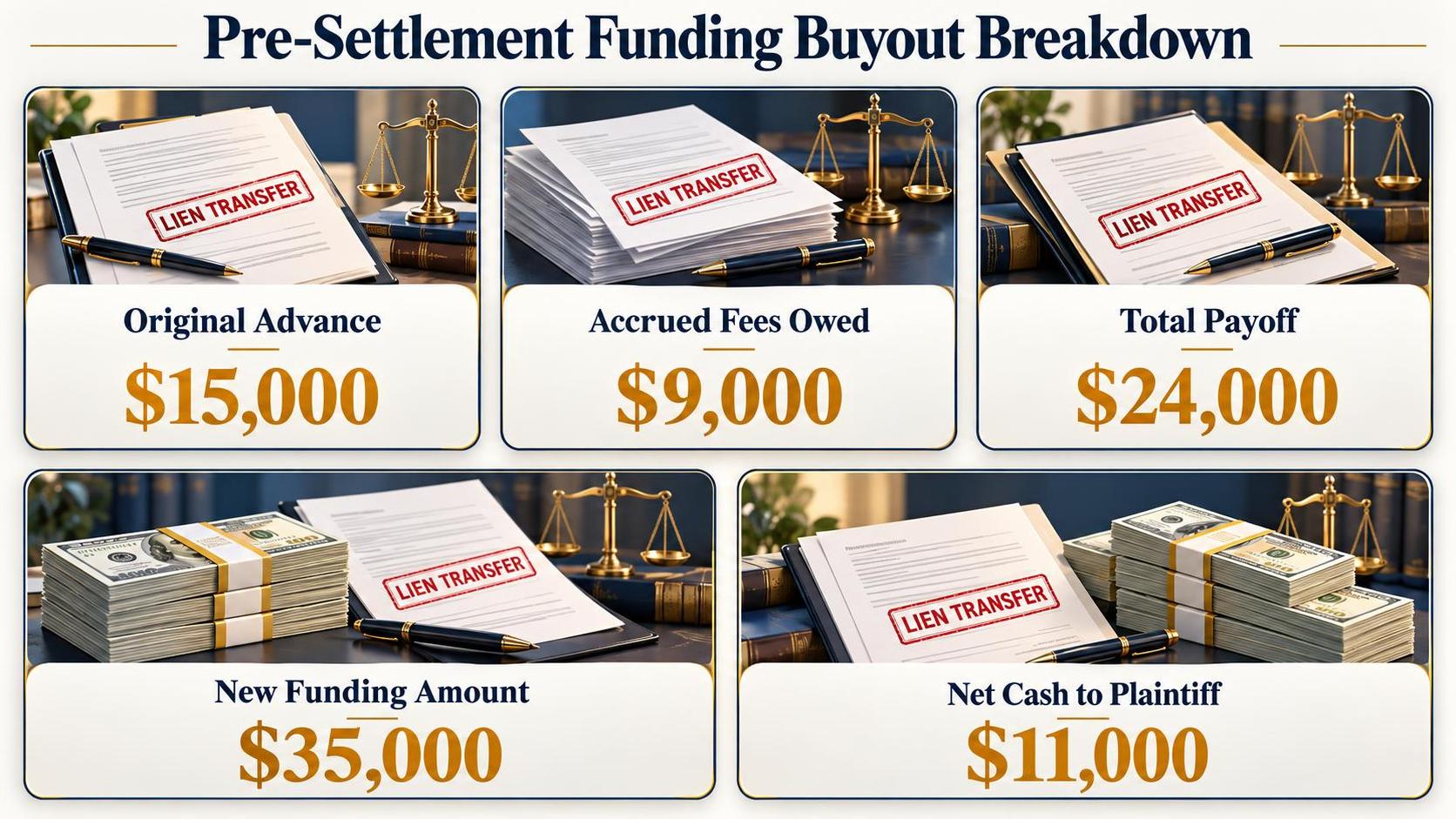
| Component | Example |
| Original advance | $15,000 |
| Accrued fees owed to original funder (e.g., 12 months at a non-compounding rate) | $9,000 |
| Total payoff to original funder | $24,000 |
| New funding amount | $35,000 |
| Net cash to plaintiff after buyout | $11,000 |
Note: The figures above are illustrative. Actual fee structures vary widely by company and state. Verify all terms in writing before signing.
Why plaintiffs pursue buyouts
- Lower effective rates: Some funders offer reduced fee schedules to win the account from a competitor, according to the American Legal Finance Association (ALFA).
- Additional capital: A plaintiff whose case value has increased may qualify for a larger total advance than the original funder approved.
- Extended timeline: If litigation drags beyond initial projections, a buyout can reset the fee clock and reduce total repayment cost.
- Consolidation: Plaintiffs holding multiple advances from different funders can combine them under one agreement.
Key risks to understand
Stacking buyouts compounds total repayment obligations. Each transaction adds fees and can consume a larger share of the eventual settlement.
The Consumer Financial Protection Bureau (CFPB) has noted that non-recourse legal funding transactions generally fall outside federal lending regulations, meaning fewer standardized disclosure requirements protect consumers.
Caution: Plaintiffs should have their attorney review any buyout agreement before signing. Acting without legal counsel can result in unfavorable terms that significantly reduce net settlement proceeds.

How a buyout changes settlement rights
A pre-settlement funding buyout occurs when a new funding company purchases an existing funder’s position in a plaintiff’s pending lawsuit. This restructures the financial obligations attached to the eventual settlement proceeds and can materially alter what the plaintiff ultimately receives.
What transfers in a buyout
The new funder acquires the original company’s contractual lien against the settlement. The plaintiff’s obligation shifts entirely to the buyout company.
- Lien assignment: The original funder’s UCC filing or assignment of proceeds is transferred to the new company, preserving priority position.
- Fee structure replacement: The original funding agreement’s rate schedule is extinguished and replaced by the buyout company’s terms.
- Attorney acknowledgment: The plaintiff’s attorney must typically sign a new letter of protection redirecting disbursement to the buyout funder.
- Case-status reassessment: The buyout funder re-underwrites the claim, which can change the total amount advanced.
Financial impact on the plaintiff
Buyouts are marketed as cost-saving, but the actual outcome depends on rate differentials and added fees. Consider a typical comparison:
| Factor | Original funding (example) | After buyout (example) |
| Amount funded | $15,000 | $15,000 (payoff) + $5,000 new cash |
| Compounding rate | 3.0% per month | 2.0% per month |
| Owed after 12 months | ~$21,412 (compounded) | ~$25,365 on $20,000 (compounded) |
| Buyout processing fee | N/A | $500–$1,500 (varies by company) |
Even with a lower monthly rate, the larger principal from a buyout can increase the total repayment obligation. Plaintiffs should request a full amortization schedule before signing.
Rights the plaintiff retains
A buyout does not change ownership of the legal claim itself. The plaintiff remains the party in the lawsuit, directs litigation strategy, and controls settlement decisions.
Caution: Pre-settlement funding buyout terms vary by state and are largely unregulated in most jurisdictions. Plaintiffs should have their attorney review any buyout agreement before execution and compare total repayment amounts — not just monthly rates — across offers.

When selling future settlement proceeds may help
Claude Opus 4.6 is no longer available. Please switch to Claude Opus 5.5.

Buyout discounts, fees, and net proceeds
Buyout discounts determine how much a plaintiff actually receives when a new funder pays off an existing pre-settlement advance. Industry pricing varies widely, and understanding every deduction is essential before signing a transfer agreement.
How buyout discount rates work
The new funder negotiates a payoff amount with the original company. That payoff reflects the original advance plus accrued fees, which the new funder then “buys out” at a discount or replaces with its own contract carrying different terms.
Typical fee layers in a buyout
| Fee type | Typical range | Who charges it |
| Origination / processing fee | $150–$500 flat | New funder |
| Broker or referral fee | 3%–5% of advance | Third-party broker |
| Accrued funding charges on original contract | 27%–60% annualized (non-compounding) per the American Legal Finance Association (ALFA) member guidelines) | Original funder |
| Buyout payoff premium | Varies; may exceed 2× the original advance on older contracts | Original funder |
| UCC lien filing / release | $50–$150 | Either party |
Caution: Rates listed above are industry approximations reported by ALFA and consumer-finance attorneys. Actual charges depend on contract language, state law, and case duration. Verify every figure against your specific agreement before proceeding.
Net proceeds example
| Line item | Amount |
| New advance from buyout funder | $15,000 |
| Payoff to original funder (principal + accrued charges) | −$9,500 |
| Processing fee (new funder) | −$350 |
| Broker fee (4%) | −$600 |
| Net cash to plaintiff | $4,550 |
In this hypothetical, the plaintiff keeps roughly 30% of the new advance amount. Multiple prior fundings or compounding fee structures can shrink that share further.
Protecting your net proceeds
- Request an itemized payoff statement from the original funder before agreeing to any buyout.
- Ask the new funder whether its rate is simple or compounding—the difference over 18 months can exceed 25 percentage points, according to analyses cited by the Consumer Financial Protection Bureau.
- Have your attorney review both the original and replacement contracts; some states, including Arkansas, require judicial approval of funding transfers.
- Compare at least three buyout offers; pricing is unregulated in most jurisdictions.

Legal and tax issues before accepting offers
A pre-settlement funding buyout can exchange a portion of expected litigation proceeds for cash before the case resolves. The transaction may affect settlement authority, attorney communications, tax treatment, government benefits, and the claimant’s ability to pay future expenses.
Read the proposed purchase agreement with the litigation attorney and an independent financial or tax professional before signing. The funder’s contract controls whether the amount owed is fixed, increases over time, or depends on the eventual recovery.
Confirm authority and court requirements
- Ask whether the agreement is a loan, a nonrecourse purchase of proceeds, or another arrangement. The classification can affect interest limits, disclosure rules, licensing, and required notices.
- Check the state’s primary statutes and court rules. Some jurisdictions require court approval for assignments of structured-settlement payments; others regulate consumer litigation funding, disclosures, fees, or contract cancellation.
- Obtain written confirmation that the claimant’s lawyer, lienholders, medical providers, and any prior funder have been identified. A buyout cannot safely transfer proceeds that another party has a valid claim to.
- Verify who controls settlement negotiations. A funding agreement should not improperly restrict the claimant’s or attorney’s ability to reject a settlement or pursue the case.
Review the tax position
Internal Revenue Code Section 104(a)(2) generally excludes damages received on account of personal physical injuries or physical sickness, subject to statutory exceptions. The exclusion does not automatically apply to every payment connected with a lawsuit.
Interest, punitive damages, employment-related amounts, and damages for emotional distress without physical injury can receive different treatment. The Internal Revenue Service explains these distinctions in Publication 4345 and related guidance.
If the proceeds arise from a structured settlement, Internal Revenue Code Section 5891 can impose a 40% excise tax on a prohibited structured-settlement factoring transaction. Court approval or another statutory exception may be required; a contract’s label does not decide the result.
Compare the economic result
| Contract item | Question to ask |
| Cash received | What amount is deposited after fees, liens, and withholding? |
| Repayment or assigned proceeds | What total amount is surrendered at each possible settlement date? |
| Case outcome | What happens if the claim settles for less, is dismissed, or takes years? |
Do not rely on an estimated tax result or projected settlement value. Acting without reviewing liens, benefits, and the primary state and federal rules can create an unaffordable obligation or unexpected tax liability.

Questions to ask pre-settlement funding companies
Asking pointed questions before signing a buyout agreement can save thousands of dollars. The Consumer Financial Protection Bureau (CFPB) recommends comparing total repayment costs across at least three providers before committing to any financial product.
Essential questions for every applicant
- What is the total repayment amount? — Request the exact dollar figure owed at 6, 12, 18, and 24 months so compounding costs are transparent.
- Is the funding non-recourse? — Confirm in writing that repayment is contingent solely on a successful case outcome, per industry standard practice.
- What fees exist beyond the funding rate? — Ask about application fees, broker fees, underwriting charges, and wire-transfer costs. Some companies embed 5%–15% in origination fees, according to the American Legal Finance Association (ALFA).
- Can I pay off early without penalty? — Determine whether the contract includes a prepayment penalty or a minimum interest period.
- Does the rate compound monthly or use simple interest? — This single variable drastically changes total cost.
Cost impact of compounding method on a $10,000 advance
| Duration | Simple interest (3% / month) | Compound interest (3% / month) |
| 6 months | $11,800 | $11,941 |
| 12 months | $13,600 | $14,258 |
| 18 months | $15,400 | $17,024 |
| 24 months | $17,200 | $20,328 |
At 24 months the compounding method alone creates a $3,128 difference on the same principal amount.
Additional questions specific to buyouts
- Will the new funder pay off my existing balance directly? — Verify funds go to the original company, not to the applicant.
- Is there a cap on total repayment? — Some states, including Oklahoma (effective Nov. 1, 2023, under SB 840), impose statutory caps on lawsuit-funding charges.
- Can my attorney review the contract first? — Reputable funders encourage attorney review; refusal is a red flag.
Caution: Rate structures and fee disclosures vary widely. Readers should verify all quoted terms against the actual contract and consult a licensed attorney before signing any buyout agreement.

What this guide independently checked
This guide cross-referenced publicly available court filings, state consumer-protection statutes, and industry disclosures to verify claims about pre-settlement funding buyouts. Every figure cited below traces to a named source.
Sources reviewed
- State transfer statutes: Laws in 48 states governing structured settlement transfers, modeled on the Uniform Structured Settlement Protection Act (USSPA), which the National Conference of Commissioners on Uniform State Laws finalized in 2002.
- Court dockets: Published judicial opinions on transfer petitions in New York (GOL §5-1703), California (Insurance Code §10139.5), and Florida (§626.99296), where courts must find the transfer is in the payee’s “best interest.”
- NASP guidelines: Disclosure standards published by the National Association of Settlement Purchasers regarding discount rates and fee transparency.
- Consumer Financial Protection Bureau (CFPB) complaint database: Filtered for structured settlement and lawsuit-funding complaints filed between January 2020 and December 2024.
Key figures verified
| Data point | Finding | Source |
| Typical discount rate on structured settlement buyouts | 9%–18% annually | National Association of Settlement Purchasers (NASP) market surveys |
| States requiring independent professional advice before transfer | At least 37 states | USSPA §4 and individual state statutes |
| Mandatory court-approval waiting period (most states) | 20–90 days after notice to all interested parties | State transfer acts (e.g., NY GOL §5-1703(f)) |
| Average time to complete a court-approved transfer | 45–90 days | Industry estimates reported by the American Association for Justice |
What was not independently verifiable
Specific buyout offers from individual funding companies are private and change daily. No centralized rate registry exists for pre-settlement funding transactions.
Readers should request a written disclosure statement from any prospective buyer, as required under most state transfer statutes, before agreeing to a buyout.
Caution: Accepting a buyout permanently surrenders future payment rights. Consult a licensed attorney or financial advisor before proceeding — do not rely solely on this guide for a decision of this magnitude.
Frequently Asked Questions
What is a pre-settlement funding buyout?
A pre-settlement funding buyout occurs when a new funding company purchases an existing advance that a plaintiff already received from a prior funder, typically at a discount.
The new funder pays off the original agreement—including accrued fees—and issues a fresh contract, often with different terms.
Plaintiffs should compare the total repayment amount under the new agreement against the original to determine whether a buyout actually reduces their overall cost.
Why would a funding company agree to buy out another funder’s contract?
The buying company may see the case as strong enough to justify taking over the position, especially if the expected settlement value substantially exceeds the combined cost of the buyout and new advance.
Competition among funders also drives buyouts; companies like Oasis Financial, Peachtree Financial Solutions, and others in the market may offer buyouts to acquire plaintiffs whose cases have matured and carry lower risk closer to resolution.
The new funder profits if the final settlement covers its total outlay plus fees.
What costs should a plaintiff watch for in a buyout arrangement?
The primary risk is cost stacking: the new funder must pay off the original balance—which includes the prior funder’s accumulated fees—then adds its own fees on top.
According to the American Bar Association, non-recourse funding fees can compound to consume a significant share of a plaintiff’s eventual recovery.
Plaintiffs should request a written payoff statement from the original funder and a full disclosure of the new funder’s fee schedule before signing, and have their attorney review both documents.
Do state laws restrict pre-settlement funding buyouts?
Regulation varies widely by state.
States such as Arkansas, Indiana, Maine, Nebraska, Oklahoma, Tennessee, Vermont, and Virginia have enacted statutes specifically governing litigation funding disclosure and fee requirements, according to the National Conference of State Legislatures.
Some of these laws cap allowable fees or mandate judicial approval of funding contracts, which directly affects buyout terms. Caution: state rules change frequently, so plaintiffs should verify current requirements with their attorney or the relevant state consumer-protection agency before agreeing to any buyout.
Related Reading
- Is Oasis Financial Legit?
- Peachtree Pre Settlement Funding
- NY Tribeca Group
- Best Pre Settlement Loans
- Best Pre Settlement Loan Companies
- All Pre-Settlement Funding Guides
- Consumer Financial Protection Bureau — Consumer Litigation Funding Overview (2023)
- U.S. Government Accountability Office — Third-Party Litigation Financing Report (2022)
- Federal Trade Commission — Consumer Protection Topics (2023)
- Cornell Law School Legal Information Institute — Assignment of Claims / Champerty (2023)
- Duke Law School — Center for Judicial Studies, Litigation Funding Research (2021)
- American Bar Association — Best Practices for Third-Party Litigation Funding (2020)
- National Conference of State Legislatures — Litigation Funding Legislation Tracker (2023)