
Put simply: Medical payments vs PIP: Medical payments coverage generally pays accident-related medical expenses for the policyholder and passengers, regardless of fault, but usually does not cover lost income.
PIP typically provides broader no-fault protection, potentially covering medical bills, rehabilitation, lost wages, and essential services. Benefits and availability vary by state and policy.
Medical payments vs pip: medical payments coverage generally pays reasonable medical expenses for covered crash injuries, regardless of fault, while PIP can also cover medical care plus lost wages, replacement services, and related costs when state law or the policy permits.
Neither coverage automatically pays vehicle damage, pain and suffering, or every treatment bill.
Medical payments coverage usually pays accident-related medical providers or reimburses the insured, often without deductibles or wage benefits; PIP rules determine who pays first, including coordination with health insurance, workers’ compensation, or another auto policy.
Claimants should document the crash, injuries, treatment, bills, travel, lost income, and insurer communications. Coverage, priority, exclusions, deadlines, and required benefits vary by state and plan.
Check the state department of insurance, CMS, or NAIC, and do not rely on this summary before delaying treatment or filing a claim.
Medical payments coverage versus PIP
Medical payments coverage (MedPay) and personal injury protection (PIP) both pay medical bills after a car accident regardless of fault, but they differ in scope, required documentation, and availability. Understanding each helps drivers avoid coverage gaps.
Core differences at a glance
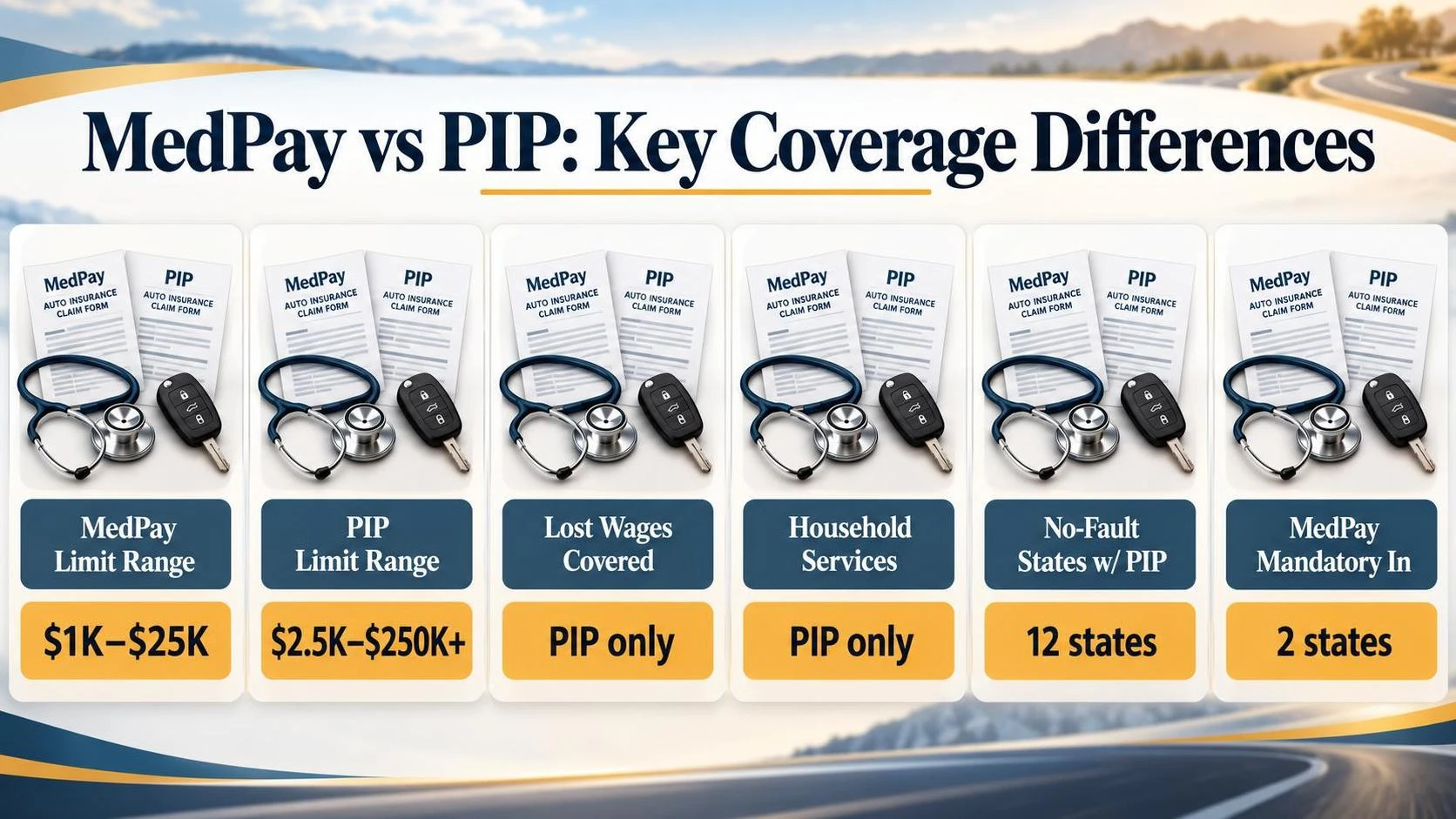
| Feature | MedPay | PIP |
| Covers lost wages | No | Yes |
| Covers funeral expenses | Sometimes (varies by insurer) | Yes |
| Covers household services | No | Yes, in most PIP states |
| Fault determination required | No | No |
| Typical limit range | $1,000–$25,000 | $2,500–$250,000+ |
| Mandatory in any state | Only in Maine and New Hampshire (per NAIC data) | Yes, in 12 no-fault states plus Puerto Rico |
Who pays first
MedPay and PIP are primary to the policyholder’s health insurance, meaning the auto policy pays before a health plan. According to CMS coordination-of-benefits rules, auto no-fault coverage is primary to Medicare.
If a claimant carries both MedPay and PIP, the PIP benefit generally pays first because it is broader and often state-mandated. Any remaining eligible medical expenses may then be submitted under MedPay.
What claimants must document
- MedPay: Itemized medical bills, proof the treatment relates to the covered accident, and the police report or incident documentation.
- PIP: All of the above, plus wage-loss verification (pay stubs, employer letter), receipts for replacement household services, and — in some states — an application filed within a statutory deadline (e.g., Michigan requires written notice to the insurer within one year, per MCL §500.3145).
State-by-state variation
PIP minimum limits, benefit periods, and fee schedules differ sharply among the 12 no-fault states. Florida, for example, requires $10,000 in PIP but ended its no-fault mandate effective January 1, 2022, replacing PIP with mandatory bodily injury liability under SB 54.
For current requirements in a specific state, consult that state’s department of insurance or the NAIC’s Auto Insurance Database Report, the most comprehensive public compilation of state-by-state mandates.
Caution: Coverage terms, limits, and filing deadlines vary by state and insurer. Do not rely solely on this overview when making coverage decisions — review the actual policy language and contact the relevant state department of insurance for binding guidance.

What medical payments coverage pays
Medical payments coverage (MedPay) reimburses reasonable medical expenses resulting from an auto accident, regardless of who caused the crash. It pays the policyholder, passengers, and sometimes pedestrians struck by the insured vehicle.
MedPay is a no-fault coverage. The insured files a claim with their own carrier, not the at-fault driver’s insurer.
Typical MedPay limits
Insurers sell MedPay in fixed per-person limits. According to the Insurance Information Institute (III), common limit options are:
| MedPay limit | Typical availability |
| $1,000 | Entry-level; widely available |
| $5,000 | Most commonly purchased tier (III) |
| $10,000 | Widely available |
| $25,000 | Available from most major carriers |
| $50,000–$100,000 | Available but less common |
These limits apply per person, per accident—not as an aggregate for all occupants.
Covered expenses
- Emergency-room visits, ambulance transport, and hospital stays
- Surgery and physician fees
- X-rays, MRIs, and diagnostic imaging
- Dental treatment for injuries sustained in the crash
- Prosthetics, eyeglasses, and hearing aids damaged in the accident
- Funeral and burial costs (in most states, up to the policy limit)
What MedPay does NOT cover
- Lost wages or income replacement
- Household services or rehabilitation assistance
- Pain-and-suffering or non-economic damages
- Injuries unrelated to the covered auto accident
This is the key distinction from PIP: MedPay is limited to medical bills and funeral costs. It never pays lost income or essential-services benefits.
Documentation a claimant must provide
Insurers require itemized medical bills, proof the treatment relates to the accident, and the police or incident report number. Claims must typically be filed within one to three years, depending on the policy and state statute.
Caution: MedPay availability, required minimum limits, and filing deadlines vary by state. Readers should verify rules through their state’s department of insurance. The NAIC consumer map at content.naic.org links to every state regulator.

What PIP Coverage Pays
Personal injury protection (PIP) is broader than medical payments coverage. PIP reimburses medical bills and non-medical economic losses after a car accident, regardless of who caused the crash.
PIP is mandatory in no-fault states. According to the Insurance Information Institute (III), 12 states plus Puerto Rico operate under a no-fault auto insurance system as of 2024.
Expenses PIP Typically Covers
- Medical and surgical expenses — hospital stays, physician visits, prescription drugs, diagnostic imaging, rehabilitation, and prosthetics
- Lost wages — typically 80% of gross income up to the policy’s sublimit, though the exact percentage varies by state statute
- Replacement services — costs to hire help for household tasks the injured person can no longer perform (e.g., childcare, cleaning)
- Funeral and burial expenses — subject to a separate sublimit, often $1,000–$5,000 depending on the state
- Essential services loss — recognized in states such as Michigan and New Jersey
State-Mandated Minimum PIP Limits
Minimum required PIP limits differ sharply across no-fault states. The table below lists selected minimums drawn from each state’s insurance code.
| State | Minimum PIP Limit | Statutory Source |
| Florida | $10,000 | Fla. Stat. § 627.736 |
| Michigan | Unlimited (prior to 7/2/2020); tiered options after reform | MCL § 500.3107 |
| New Jersey | $15,000 (standard); $250,000 available | N.J.S.A. 39:6A-4 |
| New York | $50,000 | NY Ins. Law § 5103 |
| Kansas | $4,500 medical / $900 per month lost income | K.S.A. § 40-3107 |
| Utah | $3,000 | Utah Code § 31A-22-307 |
Caution: Michigan’s 2019 reform (PA 21 of 2019) introduced multiple coverage tiers. Drivers choosing lower PIP limits may face significant out-of-pocket medical costs. Verify current tier options with the Michigan Department of Insurance and Financial Services (DIFS).
What a Claimant Must Document
Insurers require itemized medical bills, proof of lost earnings (pay stubs or employer verification), and a physician’s statement linking the treatment to the accident.
Florida’s statute imposes a 14-day deadline: an injured person must seek initial medical treatment within 14 days of the crash or forfeit PIP benefits entirely (Fla. Stat. § 627.736(1)).
Because PIP rules, sublimits, and filing deadlines vary by state, readers should confirm current requirements through their state department of insurance or the NAIC consumer resources portal at content.naic.org.

Who pays medical bills first
The order in which insurers pay medical bills after a car accident depends on the state’s fault system and the specific coverages on the policy. Getting this wrong can result in denied claims or unexpected out-of-pocket costs.
No-fault (PIP) states
In the 12 no-fault states plus Puerto Rico, PIP pays first regardless of who caused the accident. The Insurance Information Institute (III) confirms that PIP is the primary payer before health insurance or the at-fault driver’s liability coverage in these jurisdictions.
| State | Minimum PIP Requirement |
| Florida | $10,000 |
| Michigan | Unlimited (pre-2020 reform); tiered options after July 2020 per MCL §500.3107c |
| New York | $50,000 |
| New Jersey | $15,000 |
| Kansas | $4,500 |
| Minnesota | $20,000 (medical) + $20,000 (non-medical) |
Once PIP limits are exhausted, the claimant’s health insurance typically becomes the secondary payer. The at-fault driver’s bodily injury liability coverage may reimburse remaining costs through a third-party claim.
Tort (at-fault) states
In at-fault states, MedPay or the claimant’s health insurance generally pays first. MedPay covers the policyholder’s medical expenses without a fault determination, functioning as a gap-filler.
If MedPay is on the policy, it usually pays before health insurance. After MedPay limits are reached—commonly $1,000 to $25,000 according to the NAIC—the claimant’s health insurer steps in as the next payer.
Coordination-of-benefits rules
- Medicare: Under the Medicare Secondary Payer Act (42 U.S.C. §1395y), Medicare is almost always the secondary payer when auto insurance applies. CMS requires conditional payments to be repaid once the auto claim settles.
- Medicaid: Medicaid is the payer of last resort by federal law (42 U.S.C. §1396a(a)(25)).
- Employer health plans: ERISA-governed plans set their own coordination-of-benefits language. Read the Summary Plan Description to determine payment order.
Caution: Payment priority rules vary significantly by state. Verify the specific order with the state department of insurance before assuming which policy pays first. Acting on general guidance alone may lead to claim denials or repayment demands.
Documents needed for an insurance claim
Both Medical Payments (MedPay) and Personal Injury Protection (PIP) require claimants to submit documentation proving the injury, treatment costs, and connection to a covered auto accident.
PIP claims demand additional paperwork because PIP covers lost wages and other non-medical expenses that MedPay does not.
Core documents required for both MedPay and PIP
- Police accident report — Most insurers require the official report number. Many states mandate filing a report when injuries occur or damage exceeds a threshold (e.g., $1,000 in property damage in Florida per Fla. Stat. § 316.066).
- Proof of insurance — The declarations page showing active MedPay or PIP coverage on the date of the accident.
- Itemized medical bills — Each provider must list CPT/HCPCS procedure codes, dates of service, and billed amounts. Insurers cross-reference these against usual-and-customary rate databases.
- Medical records and diagnostic reports — Hospital admission notes, imaging results (X-ray, MRI), and physician narratives linking the diagnosis to the collision.
- Proof of payment or explanation of benefits (EOB) — If health insurance paid first, the EOB shows the remaining balance the auto policy may cover.
- Signed claim form — The insurer’s own first-party claim form, typically requiring a notarized or electronically verified signature.
Additional documents for PIP claims only
- Employer wage verification — A letter or pay stubs covering at least 13 weeks before the accident, documenting gross income for the lost-wage benefit (typically 60%–80% of lost earnings, depending on the state).
- Disability or work-status certificate — A treating physician’s statement specifying the period the claimant cannot work.
- Receipts for essential services — PIP in states such as Florida, Michigan, and New Jersey may reimburse household help or transportation costs. Original receipts are required.
Caution: Filing deadlines vary significantly. Florida requires PIP claims to begin treatment within 14 days of the accident (Fla. Stat. § 627.736). Missing a state-specific deadline can void coverage entirely.
Verify exact documentation requirements and deadlines with the applicable state department of insurance or the NAIC’s consumer resources page, as rules differ by jurisdiction.

State and policy rules that vary
Coverage requirements for Medical Payments (MedPay) and Personal Injury Protection (PIP) differ sharply by state. Some states mandate one or both; others make both optional. Minimum coverage limits, benefit types, and election rules depend entirely on state law.
No-fault PIP mandate states
As of 2024, twelve states plus Washington, D.C. and Puerto Rico operate under no-fault auto insurance systems that require PIP coverage, according to the Insurance Information Institute (III). The following table lists selected state PIP minimums.
| State | Minimum PIP limit | Key detail |
| Florida | $10,000 | Covers 80% of medical expenses; wage-loss benefits included. PIP is required; state eliminated the mandate briefly but reinstated it. Initial treatment must begin within 14 days of the accident per Fla. Stat. § 627.736. |
| Michigan | Varies (tiered after 2019 reform) | Under MCL § 500.3107c, drivers choose from unlimited, $500,000, $250,000, or $50,000 PIP medical limits. A $50,000 option is available only to those with qualifying health coverage. |
| New York | $50,000 | Covers medical costs, 80% of lost wages (capped at $2,000/month), and $25/day for other reasonable expenses per N.Y. Ins. Law § 5102. |
| New Jersey | $15,000 (standard policy) | Drivers may elect $250,000 or higher. Verbal or limitation-on-lawsuit threshold applies per N.J.S.A. 39:6A-4. |
| Kansas | $4,500 medical / $900/month lost wages | Per K.S.A. § 40-3107; rehabilitation expenses covered separately. |
MedPay-only or choice states
States that do not require no-fault PIP — such as California, Texas, and Ohio — typically offer MedPay as an optional add-on. Some require insurers to offer it but let drivers decline in writing.
- Oregon requires insurers to include $15,000 in PIP by default (ORS § 742.520), but policyholders may reject it. MedPay is separate and optional.
- Maine mandates a minimum $2,000 MedPay under 24-A M.R.S. § 2902, one of the few states that make MedPay — rather than PIP — compulsory.
- Washington state requires $10,000 in PIP per WAC 284-30-395, but drivers may reject coverage in writing.
How to verify your state’s rules
Requirements change through legislation. Readers should confirm current mandates and minimum limits directly with their state’s department of insurance or the NAIC consumer database at naic.org.
Caution: Acting on outdated or incorrect coverage limits can leave a driver financially exposed after an accident. Always verify minimums with the issuing insurer and your state regulator before selecting or declining coverage.

What this guide independently reviewed
This guide examined the structural differences between Medical Payments coverage (MedPay) and Personal Injury Protection (PIP) across all 50 states.
The analysis drew on state insurance department bulletins, NAIC model laws, and current statutory requirements to clarify what each coverage type does and does not pay.
State mandate landscape
PIP is mandatory in 12 no-fault states plus Puerto Rico, according to the Insurance Information Institute (III). MedPay is generally optional nationwide but required as an offered coverage in several states.
| Feature | MedPay | PIP |
| Lost wages | Not covered | Covered (typically 80% of gross income) |
| Medical expenses | Covered | Covered |
| Funeral costs | Sometimes covered | Covered |
| Essential services (household help) | Not covered | Covered |
| Fault determination required | No | No |
| Typical coverage limits | $1,000–$25,000 | $10,000–$250,000+ |
| Coordination with health insurance | Pays regardless of other coverage | Varies by state election |
Key statutory thresholds reviewed
- Florida: Requires $10,000 PIP under Fla. Stat. § 627.736; MedPay is optional.
- Michigan: PIP reform (effective July 2020) allows policyholders to choose from eight benefit levels, including unlimited, per the Michigan Department of Insurance and Financial Services (DIFS).
- New York: Mandates $50,000 minimum PIP under N.Y. Ins. Law § 5103.
- Texas: Requires insurers to offer $2,500 PIP (called Personal Injury Protection) under Tex. Ins. Code § 1952.152; policyholders may reject it in writing.
Payment priority
MedPay generally pays secondary to health insurance unless the policy states otherwise. PIP priority rules are state-specific.
Caution: Coverage limits, coordination-of-benefits rules, and mandate requirements vary significantly by state and policy. Verify current requirements through your state’s department of insurance before making coverage decisions.
The NAIC Consumer Information Source (content.naic.org) provides regulator contact details for every jurisdiction.

Frequently Asked Questions
What is the difference between MedPay and PIP coverage?
Medical Payments coverage (MedPay) pays only for medical expenses resulting from a car accident, regardless of fault.
Personal Injury Protection (PIP) covers medical bills plus additional losses such as lost wages, funeral costs, and essential services like childcare, according to the Insurance Information Institute (III).
PIP is sometimes called “no-fault” coverage because it pays out under the policyholder’s own policy regardless of who caused the crash.
Which states require PIP insurance instead of MedPay?
Roughly a dozen states operate under no-fault auto insurance systems that mandate PIP coverage, including Florida, Michigan, New Jersey, New York, and Kansas, per the III.
MedPay is generally optional in most states, though a few states such as Maine and New Hampshire require insurers to offer it. Readers should verify current mandates with their state’s department of insurance, as requirements change.
Does MedPay or PIP cover passengers in the vehicle?
Both MedPay and PIP typically extend coverage to passengers in the policyholder’s vehicle at the time of an accident, as noted by the National Association of Insurance Commissioners (NAIC).
Coverage may also apply when the policyholder is a passenger in someone else’s car or is struck as a pedestrian, depending on the policy terms. Specific passenger limits vary by insurer and state law.
Can you carry both MedPay and PIP on the same auto policy?
In most no-fault states, PIP is mandatory and MedPay is either unavailable or unnecessary because PIP already covers medical expenses. In at-fault states that do not require PIP, MedPay is the standard medical coverage option.
A small number of states allow drivers to carry both, but this is uncommon; policyholders should consult their insurer to confirm what combinations their state permits.
How do MedPay and PIP interact with health insurance after an accident?
MedPay and PIP both pay regardless of whether the insured has separate health insurance, and they can help cover deductibles and copays that health insurance does not pay, according to the III.
MedPay and PIP generally pay first as the primary payer for accident-related medical bills. However, coordination-of-benefits rules differ by state and policy, so claimants should review their specific policy language.
Is there a deductible on MedPay or PIP claims?
MedPay policies almost never carry a deductible; the coverage pays from the first dollar of eligible medical expenses, per the III.
PIP policies may include a deductible option—Michigan, for example, allows PIP deductibles of $250, $500, or $1,000 under reforms enacted in 2019 (Michigan Public Act 21 of 2019).
Choosing a higher PIP deductible lowers the premium but increases the out-of-pocket cost after a crash.
What are the typical coverage limits for MedPay versus PIP?
MedPay limits commonly range from $1,000 to $25,000 per person, with $5,000 being a frequently selected amount, according to industry data cited by the III.
PIP limits vary widely by state mandate—New York requires a minimum of $50,000 in PIP benefits (New York Insurance Law §5103).
while other states set different floors. Caution: medical costs from a serious accident can far exceed minimum limits, so drivers should evaluate whether higher coverage amounts are appropriate for their situation.
Related Reading
- Health Insurance Liens on Personal Injury Settlements
- What an Insurance Adjuster Actually Does With an Injury Claim
- How Insurance Subrogation Works After an Injury Settlement
- Uninsured and Underinsured Motorist Coverage, Explained
- What Insurance Does Walgreens Accept?
- Does Health Insurance Cover Injuries From a Car Accident
- Which Insurance Is Primary?
- All Insurance Guides
- Insurance Information Institute (2024)
- National Association of Insurance Commissioners (2024)
- Florida Office of Insurance Regulation — Department of Financial Services (2024)
- Michigan Department of Insurance and Financial Services (2024)
- Cornell Law Institute — Legal Information Institute, 28 CFR Part 90 / No-Fault Overview (2024)
- National Conference of State Legislatures (2023)