

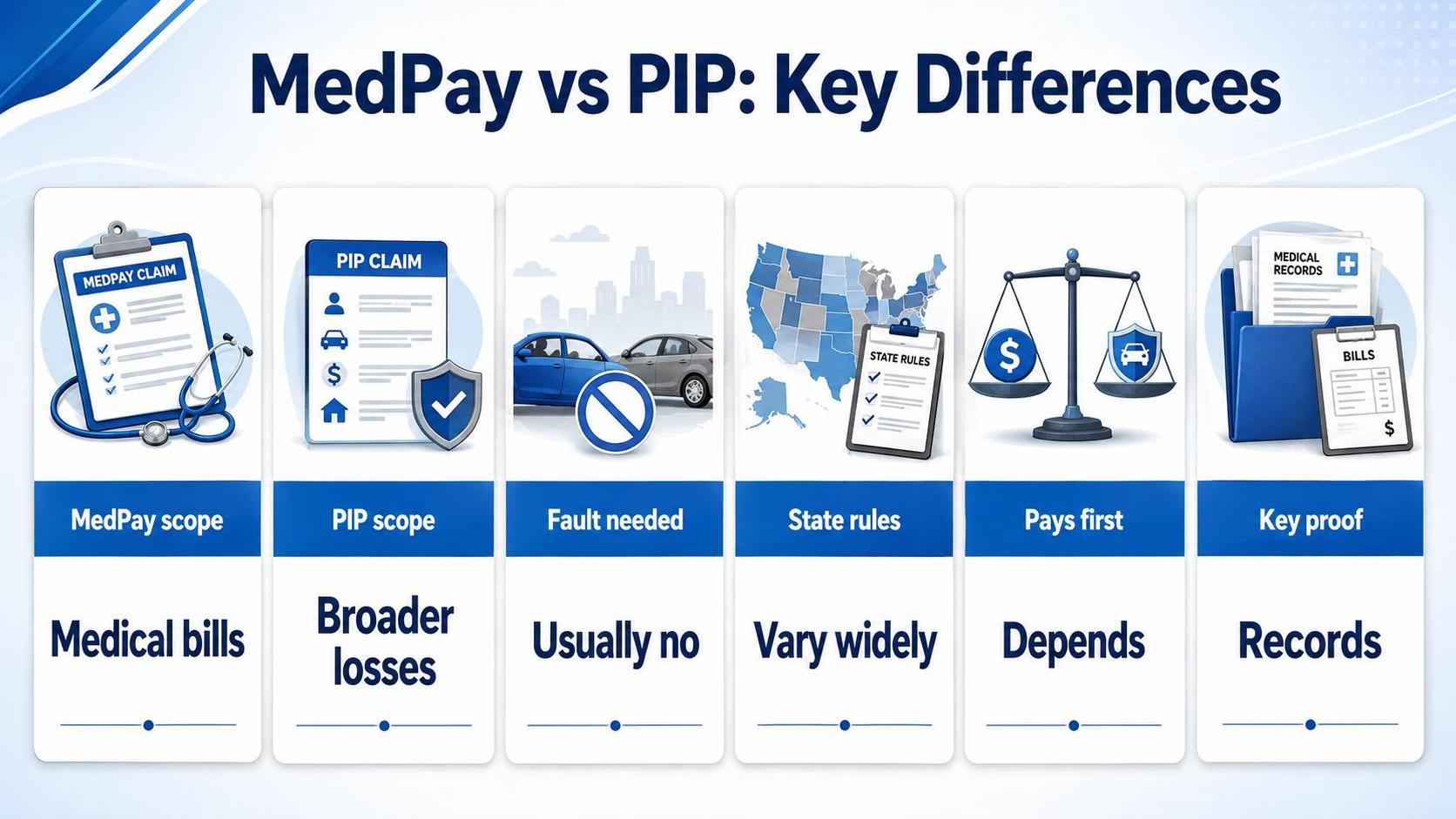
Quick answer: Med Pay vs PIP: MedPay covers reasonable medical expenses after a car accident, usually regardless of fault.
PIP generally covers medical bills plus broader losses, such as lost wages, essential services, and funeral costs, depending on state law. Coverage rules, limits, and availability vary by state; check your policy and state insurance department.
med pay vs pip is a comparison between optional medical payments coverage and personal injury protection: MedPay usually pays accident-related medical bills regardless of fault, while PIP may also cover lost wages, essential services,.
Or funeral costs where state law or the policy allows.
Which coverage pays first depends on state no-fault rules, policy language, health insurance coordination, and Medicare/Medicaid interests. Document bills, treatment records, wage loss, police reports, and insurer notices.
Check the state department of insurance, NAIC, and CMS for plan-specific or state-specific rules.
Med pay vs PIP coverage basics
Medical payments coverage, usually called MedPay, and personal injury protection, or PIP, both help pay injury-related costs after a car crash. They are not the same product.
The main difference is scope: MedPay is narrow medical-expense coverage, while PIP is broader no-fault coverage in states that require or offer it.
MedPay typically pays reasonable and necessary medical and funeral expenses for the named insured, household members, and passengers injured in a covered auto accident, regardless of fault.
The National Association of Insurance Commissioners describes MedPay as coverage for medical or funeral expenses from an accident.
PIP usually pays medical expenses too, but it can also cover lost wages, essential services, and death benefits, depending on state law. The NAIC states that PIP is broader than medical payments coverage and is required in some no-fault states.
| Feature | MedPay | PIP |
| Fault required? | No. It generally pays regardless of fault. | No. It generally pays regardless of fault under no-fault rules. |
| Usually covers | Medical bills and sometimes funeral expenses. | Medical bills, and in many states lost wages, replacement services, and death benefits. |
| Required by state law? | Usually optional, but rules vary by state. | Required or offered in certain no-fault states, depending on state law. |
| Primary source to verify | State department of insurance and policy form. | State department of insurance, no-fault statute, and policy form. |
Who pays first depends on state law, the policy language, and the injured person’s health coverage. That point matters.
Some policies coordinate benefits with health insurance, Medicare, Medicaid, workers’ compensation, or another auto policy.
If Medicare is involved, the Centers for Medicare & Medicaid Services says Medicare is generally secondary when another insurer is responsible under Medicare Secondary Payer rules.
A claimant should not assume MedPay or PIP automatically replaces health insurance or pays before it.
Documentation matters for both coverages.
Claimants should keep the crash report, policy number, date and location of loss, itemized medical bills, diagnosis and treatment records, proof the care was accident-related, and receipts for out-of-pocket costs.
For PIP wage-loss claims, insurers often require employer verification, tax records, and disability notes.
State rules vary sharply. Coverage triggers, benefit limits, time limits, and whether lawsuits are restricted under no-fault law depend on the state.
Verify details with the state department of insurance, the NAIC consumer glossary, CMS for Medicare coordination, and the actual policy contract before acting.

What medical payments coverage pays
Medical payments coverage, usually called MedPay, helps pay reasonable and necessary medical and funeral expenses after a car accident, up to the policy limit.
It is fault-blind in most standard forms, which means it can pay for covered treatment regardless of who caused the crash.
MedPay is narrower than personal injury protection. It pays medical-type bills, not wage loss, replacement services, or broad rehabilitation benefits unless the policy wording adds them.
Exact rules and required offers vary by state, so readers should check their state department of insurance and their own policy declarations.
What MedPay usually pays is the injured person’s out-of-pocket medical cost, subject to policy language, exclusions, and the coverage limit.
Covered people commonly include the named insured and household family members, plus occupants of the covered auto. Some policies also cover the insured when struck as a pedestrian.
| Item | How MedPay usually treats it |
| Ambulance and EMT charges | Usually covered if medically necessary and tied to the auto accident. |
| Hospital, surgery, X-rays, doctor visits | Usually covered up to the MedPay limit. |
| Health insurance copays and deductibles | Often covered because they are medical expenses the claimant owes. |
| Funeral expenses | Often covered if the policy includes funeral benefits. |
| Lost wages, child care, housekeeping | Usually not covered; those are more typical of PIP, if available. |
| Vehicle damage | Not covered; that is handled by collision or property damage liability. |
Who pays first depends on the other coverage in play and the policy wording. If Medicare is involved, the Centers for Medicare & Medicaid Services says no-fault insurance is primary to Medicare.
CMS tells beneficiaries to report the claim because Medicare may make conditional payments and later seek recovery.
State regulators also show that limits are modest. For example, the Washington Office of the Insurance Commissioner describes MedPay limits that commonly range from $1,000 to $10,000, while exact offerings depend on the insurer and state rules.
Do not assume those numbers apply in every state.
To claim MedPay, document the accident date, claimant identity, police report if available, provider names, itemized bills, diagnosis and treatment records, proof the expense was incurred, and any health-plan explanation of benefits.
Keep receipts and mileage logs if the policy reimburses them. Missing records can delay or reduce payment.
Caution: Do not rely on a general article to decide whether to bill Medicare, Medicaid, or private health insurance first.
Check the policy and the primary source for your state and plan: your state department of insurance, CMS Medicare Secondary Payer guidance, and NAIC consumer materials.

What personal injury protection pays
Personal injury protection, or PIP, is no-fault auto coverage for the insured driver and, depending on the policy and state, passengers, household members, and sometimes pedestrians.
It pays covered losses after a crash without waiting to prove fault, but the benefits, deadlines, and exclusions vary by state law and policy language.
PIP usually pays medical expenses first, then may pay lost wages, replacement services, and a death benefit.
The National Association of Insurance Commissioners says no-fault systems generally require each driver’s own insurer to pay covered injury costs up to the policy limit, regardless of who caused the accident.
| Expense type | Common PIP treatment | What to verify |
| Medical bills | Doctor visits, hospital care, surgery, imaging, rehabilitation, and sometimes dental care | State fee schedules, treatment limits, deductibles, and provider rules in the policy and state insurance rules |
| Lost income | Often a percentage of wages, subject to a weekly or total cap | State percentage limits and maximums from the state department of insurance or no-fault statute |
| Replacement services | Household help such as cleaning, childcare, or transport if injuries prevent normal tasks | Daily caps, proof requirements, and whether family-provided services qualify |
| Funeral or death benefit | May pay burial costs or a fixed death benefit | Exact limit in the declarations page and state law |
PIP does not usually pay property damage to vehicles or other cars. It also may exclude pain and suffering, vehicle repairs, and treatment the insurer deems unrelated, unnecessary, or not timely under state no-fault rules.
Who pays first depends on state law and the health plan.
Medicare generally cannot pay for services when payment has been made or can reasonably be expected under no-fault insurance, according to the Centers for Medicare & Medicaid Services.
A claimant with Medicare should check Medicare Secondary Payer rules and report the claim promptly.
Documentation matters. Claimants should keep the crash report, policy declarations, medical records, itemized bills, proof of health insurance submissions, wage statements, employer disability forms, and receipts for replacement services.
Timing matters too. Some no-fault states impose short notice and treatment deadlines. Florida’s statute, for example, ties basic PIP medical eligibility to initial services received within 14 days after the motor vehicle accident.
Check the state department of insurance, the state no-fault statute, and the policy itself before relying on any deadline or dollar amount.
Caution: acting on a summary alone can cost benefits. Coverage order, offsets, and documentation standards vary by state, insurer, and health plan.
Use the policy, the state insurance regulator, CMS guidance for Medicare, and NAIC consumer material as the primary sources.
Who pays first after a crash
After a crash, the first payer usually depends on state no-fault rules and the policy language. In many no-fault states, Personal Injury Protection (PIP) pays first for covered injuries.
Medical Payments coverage (Med Pay) usually pays medical bills only and often applies after PIP or alongside health insurance, depending on the contract and state rules.
Check three documents before assuming an insurer is primary: the auto policy declarations page, the policy form’s “other insurance” language, and the state insurance department’s explanation of no-fault or Med Pay rules.
State priority rules vary. The National Association of Insurance Commissioners (NAIC) explains that PIP is associated with no-fault coverage and Med Pay is generally narrower.
| Coverage | Usually pays first? | What it generally covers | What to verify |
| PIP | Yes, in many no-fault states | Medical expenses and, in some states, lost wages and essential services | State law, policy limit, deductible, coordination language |
| Med Pay | Often after PIP, or as secondary/excess coverage | Medical and funeral expenses only, up to the purchased limit | Whether it is primary, excess, or coordinated with health insurance |
| Health insurance or Medicare | Often after auto coverage that is primary under state law or policy terms | Covered medical treatment under the health plan | Plan coordination rules and Medicare Secondary Payer rules from CMS |
If PIP is primary, a claimant usually sends bills there first until the PIP limit is exhausted or the treatment falls outside PIP rules.
Med Pay may then reimburse remaining eligible medical charges, copays, deductibles, or treatment not fully paid by PIP, if the policy allows it.
If Medicare is involved, CMS treats Medicare as a secondary payer when another insurer is responsible. Medicare can make a conditional payment, then seek repayment. CMS says repayment is due within 60 days of the demand letter.
Do not assume a settlement can be spent before Medicare’s claim is resolved.
A claimant should document the crash report, policy numbers, date of loss, treatment dates, itemized bills, diagnosis codes, proof of payment, wage-loss forms if PIP covers income loss, and any explanation of benefits from health insurance.
Missing records can delay payment or trigger denials.
Caution: do not rely on a generic coverage order. Priority can change by state, policy wording, employer health plan terms, and Medicare status.
Check the state department of insurance, the full policy, NAIC consumer materials, and CMS Medicare Secondary Payer guidance before acting.

Documents claimants need to submit
MedPay and PIP claims usually require the same core records: proof of coverage, proof of the crash, and itemized medical expenses tied to the injury.
The exact form set, deadline, and whether wage-loss records are required depend on state law and the policy, so claimants should check the insurer’s claim packet and the state department of insurance.
Documentation matters because MedPay typically reimburses medical bills only, while PIP can also pay lost wages, replacement services, or funeral expenses in some states.
The National Association of Insurance Commissioners states that PIP benefits vary by state, and state insurance regulators publish the controlling rules.
| Document | Why it is needed | Usually needed for |
| Policy number and insured’s information | Lets the insurer confirm active coverage, vehicle, and covered person status | MedPay and PIP |
| Crash report or incident details | Shows date, location, vehicles, and parties involved | MedPay and PIP |
| Completed claim form or application for benefits | Starts the claim and captures the sworn loss statement | MedPay and PIP |
| Itemized medical bills and records | Shows diagnosis, treatment dates, CPT or service details, and charges | MedPay and PIP |
| Health insurance EOBs or Medicare notices | Shows what another payer processed or denied and what balance remains | Often MedPay; sometimes PIP |
| Employer wage statement | Documents time missed, pay rate, and disability period | PIP where wage loss is covered |
| Proof of replacement services | Shows amounts paid for household help or similar services | PIP in states that allow it |
Claimants should expect to submit itemized bills, not only balance-due statements. Itemization should identify the provider, patient, date of service, diagnosis or treatment description, and the amount charged.
If the insurer asks for records, send treatment notes that connect the injuries to the crash.
If health insurance, Medicare, or Medicaid also paid, include the payer’s explanation of benefits or other payment notice.
CMS states that Medicare is generally a secondary payer to no-fault or liability insurance, and claim handling can change if another insurer should pay first.
Check CMS Medicare Secondary Payer guidance before submitting a Medicare-related claim.
Deadlines can be strict. Some no-fault states require prompt written notice and a formal application for benefits soon after the accident.
Because deadlines and benefit priorities vary, claimants should verify the notice rule with the state department of insurance and the policy itself before relying on a summary.
- Keep every receipt, prescription record, mileage log, and provider note.
- Ask employers for a signed wage-loss statement if PIP includes income benefits.
- Submit complete copies and keep a dated file of everything sent.
- If an insurer requests an examination under oath or independent medical exam, read the policy and get legal advice before responding.

State rules and plan limits
MedPay and PIP are state-driven products. Coverage triggers, minimum limits, and coordination rules can change by state, insurer form, and health plan terms.
Check the state insurance department, the NAIC consumer guides, and Medicare rules from CMS before relying on any one summary.
PIP is mandatory in some no-fault states and usually comes with a stated dollar limit. MedPay is more often optional and narrower, usually paying medical bills after an auto injury without covering wage loss or replacement services.
The table shows examples of state PIP rules using primary state sources. These are examples, not a 50-state rulebook.
| State | What the state requires | Primary source |
| Florida | PIP minimum is $10,000. Florida also requires $5,000 in death benefits under PIP. Emergency medical condition rules can affect access to the full $10,000. | Florida Highway Safety and Motor Vehicles; Florida Office of Insurance Regulation; Fla. Stat. 627.736 |
| Michigan | Drivers must carry PIP but may choose medical benefit limits of unlimited, $500,000, $250,000, or in some cases $50,000 or an opt-out if eligibility rules are met. | Michigan Department of Insurance and Financial Services; Mich. Comp. Laws 500.3107c and 500.3107d |
| New York | Basic No-Fault requires up to $50,000 per person for economic loss, which includes necessary medical expenses, lost earnings, and certain other reasonable expenses. | New York Department of Financial Services; N.Y. Ins. Law Article 51 |
Who pays first also varies. In many no-fault states, PIP pays first for covered auto-injury expenses up to the policy limit.
MedPay may pay after PIP is exhausted, or it may be excess to health insurance, depending on the policy language and state coordination rules.
If the claimant has Medicare, CMS says Medicare is generally secondary to no-fault or liability insurance. That means auto coverage that is primary under state law usually must be billed first.
Check CMS Medicare Secondary Payer guidance and the plan’s evidence of coverage.
- Keep the crash report, policy declarations page, and all endorsements.
- Save itemized medical bills, diagnosis records, treatment notes, and proof the injury came from the auto accident.
- Track wage-loss claims with employer statements and pay records if PIP includes lost income.
- Meet notice deadlines. Some states and policies require prompt filing, medical proof, or specific forms.
Do not assume MedPay and PIP stack automatically or cover every bill. A wrong assumption can leave treatment unpaid or delay reimbursement.
Verify limits, exclusions, and coordination rules with the state insurance department, the insurer’s policy form, and CMS or the health plan administrator.
What our editors independently reviewed
Medical Payments coverage, usually called Med Pay, and Personal Injury Protection, usually called PIP, both help pay injury-related costs after a car crash. They are not the same product.
The differences matter because they affect what expenses are covered, whether lost wages are included, and which insurer pays first.
Editors reviewed the NAIC consumer guide to auto insurance, state department of insurance explanations, and Medicare coordination rules from CMS.
Those sources show a consistent baseline: Med Pay is narrower, while PIP is broader and often tied to a state’s no-fault system.
Med Pay generally pays reasonable medical and funeral expenses for covered occupants after an auto accident, up to the policy limit. It usually does not pay lost wages, replacement services, or broader no-fault benefits.
The NAIC describes medical payments coverage as limited protection for medical and funeral bills.
PIP usually pays medical expenses and may also pay lost income, essential services, and funeral costs, depending on state law and policy language. The NAIC explains that PIP is broader than Med Pay and is required in some no-fault states.
Exact benefits vary by state. Readers should verify details with the applicable state department of insurance.
| Feature | Med Pay | PIP |
| Medical bills | Yes, up to policy limit | Yes, up to policy limit |
| Lost wages | Usually no | Often yes, if state law or policy provides it |
| Essential services | Usually no | Often yes in no-fault states |
| Fault required | No immediate fault finding for payment | No immediate fault finding for payment |
| State-law variation | Moderate | High |
Who pays first depends on the policy, state rules, and health plan terms. Auto coverage may pay before health insurance in some cases.
CMS states Medicare is generally the secondary payer when payment can reasonably be expected from no-fault insurance, including auto insurance such as PIP. That rule can affect reimbursement and settlement handling.
A claimant should document the crash date, vehicle information, police report number if available, diagnosis codes, provider bills, treatment dates, receipts, wage-loss records, and any health-plan explanations of benefits.
Insurers often require prompt notice, proof of injury, and signed medical authorizations before paying.
Consumers should not assume Med Pay and PIP stack the same way in every state. Deductibles, benefit coordination, and exhaustion rules vary.
Before relying on coverage, check the policy declarations page, the insurer’s policy form, the state department of insurance, and CMS or plan documents for Medicare or other health coverage.
Frequently Asked Questions
What is the main difference between MedPay and PIP?
Medical Payments coverage, usually called MedPay, generally helps pay medical and funeral expenses after a car accident regardless of fault, while Personal Injury Protection, or PIP, usually covers medical bills and may also cover lost wages.
Replacement services, and funeral benefits depending on state law.
The Insurance Information Institute describes MedPay as narrower than PIP, and the National Association of Insurance Commissioners explains that PIP is required in some no-fault states and can include broader injury-related costs.
Readers should check their own policy and state insurance department because benefits vary by state and contract.
Does MedPay or PIP cover lost wages?
PIP often can cover part of lost income if injuries prevent a person from working, but MedPay usually does not and is generally limited to medical and funeral expenses, according to the Insurance Information Institute and state insurance regulators.
Because wage-loss rules, waiting periods, and benefit caps differ by state, no one should rely on a summary alone before filing a claim or declining coverage.
The safest next step is to read the declarations page and the state’s official auto insurance guide.
Which coverage pays first if a driver has health insurance too?
The order can depend on the state, the policy language, and whether the health plan excludes auto-related injuries, so there is no single nationwide rule.
The National Association of Insurance Commissioners and multiple state departments of insurance note that coordination of benefits varies.
Which means a driver should verify with the auto insurer and health insurer before assuming one policy will pay first; acting on the wrong assumption can delay treatment billing or reimbursement.
Related Reading
- Which Insurance Is Primary?
- Health Insurance Liens on Personal Injury Settlements
- What an Insurance Adjuster Actually Does With an Injury Claim
- How Insurance Subrogation Works After an Injury Settlement
- Uninsured and Underinsured Motorist Coverage, Explained
- What Insurance Does Walgreens Accept?
- What Insurance Company Covers Mounjaro?
- Does Health Insurance Cover Injuries From a Car Accident
- All Blog Guides
- Texas Department of Insurance (2024)
- Washington State Office of the Insurance Commissioner (2024)
- Michigan Department of Insurance and Financial Services (2024)
- Colorado Division of Insurance (2024)
- National Cancer Institute
- U.S. Department of the Treasury
- U.S. Department of Justice – Civil Division