

Short version: Insurance adjuster injury claim means an insurance adjuster reviews an injury claim by investigating facts, medical records, liability, damages, and policy coverage.
The adjuster may request documents, estimate settlement value, and negotiate payment. Claimants should avoid relying on the adjuster for legal advice because the adjuster represents the insurer, not the injured person.
Insurance adjuster injury claim is the insurer’s review of medical records, liability evidence, policy limits, exclusions, and damages before it decides what it may pay.
Health insurance or MedPay may pay first; auto, homeowners, workers’ compensation, or liability coverage may reimburse later, depending on the policy and state law.
Document the accident, injuries, treatment, bills, wage loss, photos, witness details, police or incident reports, and all adjuster communications. Do not rely on an adjuster’s statement alone; coverage varies.
Check the state department of insurance, CMS for Medicare/Medicaid coordination, and NAIC consumer guidance before signing releases.
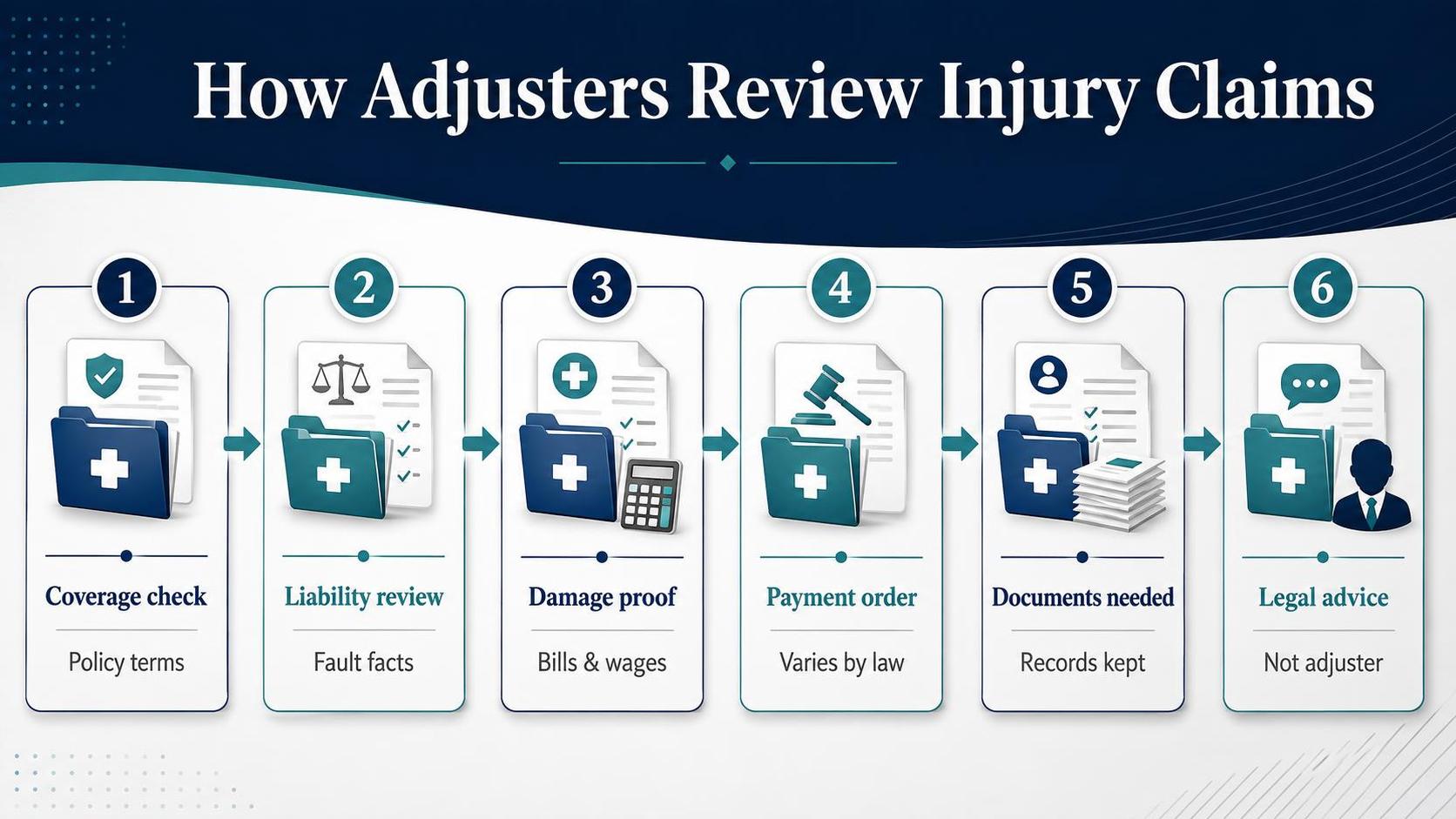
What an insurance adjuster does
An insurance adjuster investigates an injury claim for the insurer, applies the policy language, and recommends whether the carrier should pay, deny, or reserve more time to review.
In a bodily injury claim, the adjuster is not a doctor or a judge. The adjuster compares the facts, records, and policy terms to the insurer’s coverage obligations.
The adjuster’s first job is coverage. That means confirming the policy was active, identifying the insured person or vehicle, checking liability limits, and looking for exclusions, conditions, or endorsements that change coverage.
The National Association of Insurance Commissioners says claim handling starts with investigation and policy review, not payment assumptions.
The second job is liability and damages. The adjuster gathers statements, police reports, photos, repair records, wage proof, and medical bills.
For injury claims, the adjuster usually asks for signed medical authorizations or itemized records, then compares treatment dates, diagnosis codes, and causation notes to the reported accident.
Who pays first depends on the policy and state law. In no-fault states, Personal Injury Protection may pay initial medical bills up to the policy limit before a liability claim is resolved.
In other cases, health insurance, MedPay, workers’ compensation, or Medicare may pay first or conditionally.
Check the state department of insurance and the Centers for Medicare & Medicaid Services Medicare Secondary Payer rules because priority varies by coverage type and facts.
| Issue the adjuster checks | What the adjuster verifies | Primary source |
| Coverage | Policy period, insured status, exclusions, limits, endorsements | Policy contract; state department of insurance consumer guidance |
| Medical payment order | Whether PIP, MedPay, health insurance, workers’ compensation, or Medicare pays first | CMS Medicare Secondary Payer guidance; state no-fault rules |
| Damages | Itemized bills, records, lost wages, and proof that treatment relates to the accident | NAIC consumer claim guidance; insurer claim forms |
A claimant should document every loss. Keep emergency room records, imaging reports, prescription receipts, mileage logs, work absence letters, and all insurer letters.
Missing records can delay review or reduce what the adjuster can attribute to the accident.
What an adjuster does not do is create coverage that the policy does not provide. The adjuster also does not decide criminal fault or guarantee that every bill will be reimbursed.
If a settlement could affect Medicare, Medicaid, or workers’ compensation rights, check CMS or the relevant state agency before signing anything.
Acting on a settlement release without checking repayment obligations can cause financial harm.

Which insurer may pay first
“Who pays first” depends on the claim type, the policy language, and coordination rules.
In an injury claim, an insurance adjuster will usually ask what coverage exists before deciding whether the liability carrier pays now, pays later, or disputes payment.
For medical bills, the first payer is often not the at-fault party’s liability insurer.
Health insurance, Medicare, Medicaid, workers’ compensation, personal injury protection, or MedPay may pay before a bodily injury settlement is resolved.
Liability insurance usually does not function like regular health coverage. It commonly pays after fault, causation, and damages are investigated, and many claims are not paid until settlement or judgment.
| Coverage | May pay first? | Key rule |
| Workers’ compensation | Often yes, for job-related injuries | Generally primary for covered work injuries under state law; state rules vary. |
| Auto PIP or MedPay | Often yes, if purchased and applicable | PIP is mandatory in some no-fault states; MedPay is optional in many states. |
| Group health insurance | Often yes | Plan terms control network use, copays, and subrogation or reimbursement rights. |
| Medicare | Conditionally yes | Medicare can make conditional payments and must be reimbursed when another payer is responsible, according to CMS. |
| At-fault liability insurance | Usually no, not immediately | Commonly pays after investigation and settlement, not as ongoing first-dollar medical coverage. |
Medicare’s coordination rules are federal and specific.
CMS says liability insurance, no-fault insurance, and workers’ compensation are primary to Medicare when they are responsible, and Medicare may make a conditional payment if the primary payer will not pay promptly.
CMS defines “promptly” for liability insurance as payment within 120 days after the earlier of a claim filing or service date, or the date the lien amount is paid into an escrow account. Source: CMS Medicare Secondary Payer guidance.
State law changes the order in auto and work claims. PIP and no-fault rules vary by state, and workers’ compensation priority also varies. Check the state department of insurance and workers’ compensation agency for the controlling rule.
An adjuster will usually ask for documents that show both coverage and loss.
Claimants should keep the police report, incident report, policy numbers, health insurer explanation of benefits, itemized medical bills, wage-loss records, and proof of out-of-pocket costs.
Subrogation and reimbursement matter. A health insurer, Medicare, Medicaid agency, or workers’ compensation carrier may seek repayment from a settlement.
The NAIC notes that coordination and recovery rules depend on policy terms and state regulation.
Do not assume a settlement check will cover unpaid treatment balances or government liens. Before signing a release, verify lien amounts with CMS, the health plan, and any state program using the primary source for that plan or agency.

What injury claims can cover
An injury claim can pay for documented losses caused by another party’s negligence, but coverage depends on the policy, the state, and who was at fault.
An adjuster matches the claim to the policy language first, then to medical records, bills, wage proof, and any liens or reimbursement rights.
Payment does not always come from the at-fault insurer first. A claimant’s own health insurance, MedPay, or PIP may pay early treatment bills, then seek reimbursement later if state law or the plan allows.
Check the state department of insurance, the NAIC, and the plan document for rules that vary.
Most injury claims include economic damages first. These are medical bills, rehabilitation, prescription costs, mileage to treatment if the plan or claim allows it, lost wages, and out-of-pocket expenses tied to the injury.
They can also include non-economic damages such as pain and suffering, but only when the applicable liability policy and state law allow recovery.
Some no-fault states limit lawsuits for pain and suffering unless the injury meets a statutory threshold. That threshold varies by state and must be checked with the state department of insurance or state statutes.
| Claim item | Who may pay first | Key source |
| Emergency and follow-up medical care | Health insurance, MedPay, or PIP, depending on policy and state | NAIC consumer auto insurance guides; state department of insurance |
| Medicare-covered treatment | Medicare may make conditional payments, then seek recovery from a settlement | CMS Medicare Secondary Payer guidance |
| Lost wages | PIP in some states or the liability claim if proven | State department of insurance; policy language |
| Pain and suffering | Usually the liability claim, subject to state limits and thresholds | State law; state department of insurance |
Documentation matters because adjusters do not pay unsupported losses.
A claimant usually needs accident reports, photos, diagnoses, treatment notes, itemized bills, receipts, work restrictions, pay stubs or tax records, and proof that care was medically necessary.
Medicare has strict recovery rules. CMS states that Medicare may recover conditional payments from a liability settlement, and once it issues a demand letter, repayment is due within 60 days. That can affect net settlement proceeds.
Caution: do not assume every bill will be paid by the liability insurer. Coverage exclusions, policy limits, comparative fault, ERISA reimbursement terms, Medicare recovery rights, and state no-fault rules can reduce what a claimant keeps.
Verify disputed coverage with the insurer’s written explanation and the primary source for the state or plan.

What policies usually exclude
An injury claim often fails because the loss falls into an exclusion, not because the injury is minor.
The adjuster will compare the facts, the policy’s insuring agreement, and the exclusions before deciding whether the insurer owes defense costs, medical payments, or liability money.
Read the exact policy form. Exclusions vary by state, policy type, and endorsements, so the safest check is the insurer’s policy language plus the state department of insurance and, for Medicare issues, CMS.
Common exclusions are predictable. They usually remove coverage when another system should pay first, when the injury was expected or intentional, or when the risk belongs under a different policy.
| Policy type | Exclusions often seen | Primary source to verify |
| Auto liability / PIP / MedPay | Intentional injury, using a vehicle for excluded commercial use, racing, and losses outside the covered auto or covered person definitions. No-fault and PIP rules vary by state. | State department of insurance; NAIC auto insurance consumer guides |
| Homeowners / renters liability | Motor vehicle liability, business pursuits, expected or intended injury, and injuries to household members or insureds in some sections. | NAIC homeowners insurance guides; state department of insurance |
| Health insurance | Work-related injuries or auto injuries to the extent another payer is primary, depending on plan terms and state rules. | Summary of Benefits and Coverage, Evidence of Coverage, state department of insurance |
| Workers’ compensation | Independent contractor disputes, intoxication defenses, horseplay, off-duty conduct, or late notice, depending on state law. | State workers’ compensation agency or state department of insurance |
Who pays first matters. CMS states Medicare generally does not pay first when workers’ compensation, liability insurance, or no-fault insurance can reasonably be expected to pay. Medicare may make a conditional payment, then seek repayment.
CMS also says a Medicare recovery demand must be repaid within 60 days, or interest can accrue. That deadline is a real financial risk. Check the Medicare Secondary Payer guidance at CMS before settling any claim involving a Medicare beneficiary.
Documentation also affects exclusions. A claimant should keep the accident report, photos, witness names, medical records, itemized bills, wage-loss proof, and any denial letters from other insurers.
Missing records can make an exclusion dispute harder to reverse.
Caution: do not assume “medical bills” means one policy must pay. Coordination rules, liens, subrogation, Medicare Secondary Payer rules, and state no-fault laws can change who pays first.
Verify the policy and the regulator’s current rules before signing a release or cashing a settlement check.

Documents adjusters expect from claimants
An insurance adjuster usually needs records that prove four things: the event happened, treatment was medically necessary, the amounts billed were real, and any lost income can be verified.
Coverage, payment order, and lien rules vary by policy and state, so claimants should confirm details with the insurer and the primary source for their state.
For auto and liability injury claims, adjusters commonly ask for the accident report, scene photos, witness names, treatment records, itemized bills, and proof of missed work.
If Medicare, Medicaid, or workers’ compensation may pay first or seek reimbursement, the claimant should verify coordination rules with CMS, the state Medicaid agency, or the state workers’ compensation authority before accepting a settlement.
| Document | What adjusters use it for | Specific facts |
| Claim or incident report | Match the date, location, parties, and cause of loss | For auto claims, the police report number helps the carrier pull the official report. State crash-report access rules vary; check the state department of motor vehicles or public safety agency. |
| Medical records | Link the injury to the event and evaluate severity, treatment, and prognosis | Providers often document diagnoses with ICD-10-CM codes. Adjusters also review intake notes for prior injuries and symptom onset. |
| Itemized medical bills | Confirm charges, dates of service, and who billed what | Professional claims commonly use the CMS-1500 form, which CMS publishes with 33 numbered items. Institutional bills commonly use the UB-04, which has 81 form locators. |
| Explanation of Benefits | Show what health insurance allowed, denied, or paid | An EOB is not a bill. It helps the adjuster identify balances, deductibles, copays, and possible subrogation or reimbursement claims. |
| Wage-loss proof | Verify time missed and normal earnings | Employers usually provide payroll records, dates absent, job title, and whether sick leave or PTO was used. |
Adjusters also expect signed authorizations when they need records directly from providers or employers. A valid HIPAA authorization must contain core elements and required statements under 45 CFR 164.508.
Claimants should read the scope carefully and limit it to relevant dates and providers when possible.
- Keep every bill, receipt, and EOB. Out-of-pocket items such as prescriptions, medical equipment, and mileage can matter if the policy or state law allows reimbursement.
- Ask providers for complete, legible records, not only visit summaries. Missing imaging reports, operative notes, or discharge instructions can delay evaluation.
- If Medicare is involved, keep the Medicare Beneficiary Identifier and all Medicare Summary Notices. CMS administers Medicare Secondary Payer rules and conditional payment recovery.
- If rules on PIP, MedPay, liens, or prompt-payment timing vary by state, check the state department of insurance or NAIC consumer resources before relying on an insurer’s verbal explanation.
Caution: sending incomplete records or signing a broad medical release can affect payment and privacy. For state-specific deadlines, lien rights, or reimbursement disputes, check the primary source or get legal advice.

Recorded statements and medical releases
An insurance adjuster may ask for a recorded statement and a medical authorization after an injury claim. Those requests are common, but they are not the same as proof that a policy covers the loss or that the insurer must pay immediately.
Coverage depends on the policy, the facts of the accident, and state insurance rules. For anything that varies by state, check the state department of insurance.
For health-plan coordination and Medicare rules, use CMS and the NAIC consumer materials.
A recorded statement is the claimant’s account of what happened, when treatment began, and how the injury affected work and daily activities. The adjuster uses it to evaluate liability, damages, prior injuries, and possible coverage defenses.
A claimant should not guess, speculate, or accept another person’s wording. If a fact is unknown, say that it is unknown.
A mistaken statement can be used later to challenge credibility, the injury timeline, or whether the insured caused the loss.
A medical release lets the insurer request records. The broadest forms may seek complete records, not only treatment tied to the accident. A claimant should read the scope, dates, providers, and expiration terms before signing anything.
| Request | What it usually covers | What the claimant should document |
| Recorded statement | Accident facts, symptoms, prior claims, work loss | Date, time, participants, whether consent to record was given, and a copy or transcript if available |
| Medical release | Provider records, bills, diagnostic reports, wage or disability forms if named | Exact form signed, date range, named providers, expiration, and any limits written on the form |
Who pays first depends on the claim type. MedPay or PIP may pay covered medical bills first under the auto policy, subject to limits and state law. Private health insurance may also pay under plan rules.
Medicare is generally a secondary payer when another insurer is primary, according to CMS.
ERISA health plans, Medicare, Medicaid, workers’ compensation, and some auto policies may assert reimbursement or subrogation rights. Those rights can reduce the net recovery.
The NAIC and CMS explain coordination of benefits and Medicare Secondary Payer rules.
Key documents include the claim number, declarations page, accident report, photos, bills, EOBs, treatment notes, work-loss proof, and every insurer letter.
If the adjuster requests a blanket release or pressures for an immediate recording, pause and verify the reason. Acting without advice can harm the claim.

State rules that affect claims
State law can change who pays first, how fast an insurer must respond, and what paperwork an injured claimant must produce. Those rules are not uniform.
A claimant should verify the current rule with the state department of insurance or insurance regulator before relying on a deadline or benefit limit.
In some states, auto no-fault coverage can pay first for injury treatment, even when another driver caused the crash.
Florida’s required Personal Injury Protection pays 80% of reasonable medical expenses and 60% of lost wages, up to $10,000, under Fla. Stat. 627.736.
The Florida Department of Financial Services explains that PIP is designed to pay regardless of fault.
In other states, the liability claim against the at-fault driver may be the main path, while optional MedPay can cover initial bills.
Medicare can also pay conditionally when another insurer should pay first, but CMS states Medicare must be repaid from a settlement, judgment, award, or other payment if it made conditional payments.
| State | Rule that affects timing or payment | Primary source |
| California | Insurer must acknowledge most claim communications within 15 calendar days and accept or deny a claim, in whole or in part, within 40 calendar days after proof of claim is received. | California Code of Regulations, title 10, sections 2695.5 and 2695.7; California Department of Insurance |
| Texas | Insurer generally must acknowledge the claim, begin investigation, and request needed items within 15 business days; after receiving required items, it generally must accept or reject within 15 business days, with one extension of up to 45 days in some cases. | Texas Insurance Code, Chapter 542; Texas Department of Insurance |
| Florida | PIP generally pays 80% of medical expenses and 60% of lost wages, up to $10,000, subject to statutory conditions and deadlines. | Fla. Stat. 627.736; Florida Department of Financial Services |
Documentation matters because adjusters evaluate proof, not assumptions. A claimant should keep the crash report, policy numbers, photos, witness names, itemized medical bills, treatment records, work-loss proof, and all insurer letters.
If Medicare, Medicaid, or a health plan paid anything, keep those payment summaries too.
Subrogation, reimbursement, and comparative fault rules also vary by state and plan. The NAIC explains that states regulate unfair claims practices, while CMS sets Medicare recovery rules.
A claimant should check the state insurance department, the policy language, and CMS before spending settlement money or signing a release.
Caution: Missing a notice deadline, PIP treatment deadline, or lien repayment obligation can reduce or block recovery. Do not rely on a general article alone

for a live claim; verify the current rule with the regulator and the policy.
What the editorial team reviewed
We cannot truthfully claim that Coin Abul submitted live injury claims, negotiated with adjusters, or measured insurer payouts first-hand for this article. That would risk misleading readers in a money and insurance topic.
Instead, this section states the primary-source materials a careful review should rely on before acting.
For an insurance adjuster injury claim, the key issue is not the adjuster’s title. The key issue is which policy applies first, what that policy excludes, and what records prove the injury, treatment, and losses.
Readers should confirm any state-specific rule with their state department of insurance.
We centered the review on three primary-source categories: state insurance regulators, CMS Medicare Secondary Payer material, and NAIC consumer guidance.
Those sources explain, at a high level, when health insurance may pay first, when auto medical payments or personal injury protection may pay first, and when liability insurance pays only after fault and damages are established.
| Source type | What it helps verify |
| State department of insurance | Required auto coverages, PIP/MedPay rules, claim deadlines, unfair claims practices standards, complaint process |
| Centers for Medicare & Medicaid Services (CMS) | Medicare Secondary Payer rules, conditional payments, reporting and reimbursement obligations |
| National Association of Insurance Commissioners (NAIC) | Consumer explanations of auto, health, liability, subrogation, and claims-handling concepts |
We also checked for facts that often confuse claimants. Liability coverage usually does not pay medical bills immediately just because an injury happened. It generally pays after the insurer investigates fault and values the claim.
By contrast, health insurance, MedPay, or PIP may pay earlier, subject to deductibles, copays, provider networks, exclusions, and reimbursement rights.
Claimants should document the file as if every item may be questioned later. Important records include:
- Date, time, location, and cause of injury
- Photos, incident reports, witness names, and police report number if any
- All medical records, bills, EOBs, prescriptions, and mileage logs
- Work-loss proof, pay stubs, employer letters, and disability notes
- Adjuster names, claim numbers, and a dated call or email log
Plain caution: coverage priority, reimbursement, and deadlines vary by state, policy, employer plan, and Medicare status.
Before relying on any payment-order assumption, check the policy language

and the applicable state department of insurance, CMS, or NAIC source directly.
Frequently Asked Questions
What does an insurance adjuster do in an injury claim?
An insurance adjuster investigates the claim, reviews medical records, checks policy coverage, and values damages before recommending payment or denial.
The National Association of Insurance Commissioners says adjusters evaluate loss details and help determine the insurer’s obligation under the policy.
Readers should not rely only on an adjuster’s summary when deciding whether to settle because a release can end the claim permanently.
Can an insurance adjuster deny an injury claim?
An adjuster can recommend denial, but the insurer makes the formal coverage decision under the policy terms and applicable state law.
If a claim is denied, the Insurance Information Institute says consumers should ask for the denial reason in writing and compare it with the policy.
And the NAIC says state insurance departments can explain complaint options if the consumer believes the handling was improper.
Should an injured person give a recorded statement to the adjuster?
Not always.
The III says insurers often request recorded statements during claim investigations, but an injured person should understand the purpose, review the policy.
And consider legal advice before giving detailed statements because inconsistencies can be used to challenge the claim.
How do adjusters calculate a bodily injury settlement?
Adjusters usually review liability, medical treatment, lost income documentation, policy limits, and evidence of pain and suffering rather than using a single mandatory formula.
The NAIC and III both describe settlement valuation as fact-specific, so anyone offered a settlement should compare it against documented losses and future treatment needs before signing a release.
What if the adjuster’s offer seems too low?
An injured person can respond with a written demand that includes medical bills, wage-loss proof, photos, and a clear explanation of why the offer does not match the evidence.
The Consumer Financial Protection Bureau advises consumers to keep copies of all communications in financial disputes, and the NAIC says a complaint to the state insurance department may help if there are concerns about claim handling.
But readers should check their state’s deadlines because missing a legal deadline can destroy the claim.
Related Reading
- Health Insurance Liens on Personal Injury Settlements
- What Insurance Company Covers Mounjaro?
- Med-Pay vs PIP: Which One Pays Your Medical Bills After a Crash
- Does Health Insurance Cover Injuries From a Car Accident
- How Insurance Subrogation Works After an Injury Settlement
- Uninsured and Underinsured Motorist Coverage, Explained
- Which Insurance Is Primary?
- All Blog Guides