
The short answer: Health insurance car accident injuries are often covered, but auto insurance may pay first depending on state law, fault, MedPay, or personal injury protection.
Health plans can deny or delay claims pending auto-insurance coordination and may seek reimbursement from any settlement. Check the policy, accident benefits, and state rules before relying on coverage.
Health insurance car accident injuries are usually covered as medically necessary care under the injured person’s health plan, but the auto policy, workers’ compensation,.
Or another liable party may have to pay first depending on state law and plan terms.
Document the crash report, injuries, bills, Explanation of Benefits, auto claim number, and any denials.
Coverage, coordination of benefits, PIP/MedPay rules, liens, and reimbursement rights vary; check the state department of insurance, CMS for Medicare/Marketplace rules, and NAIC consumer guidance.
Who pays medical bills after a car crash
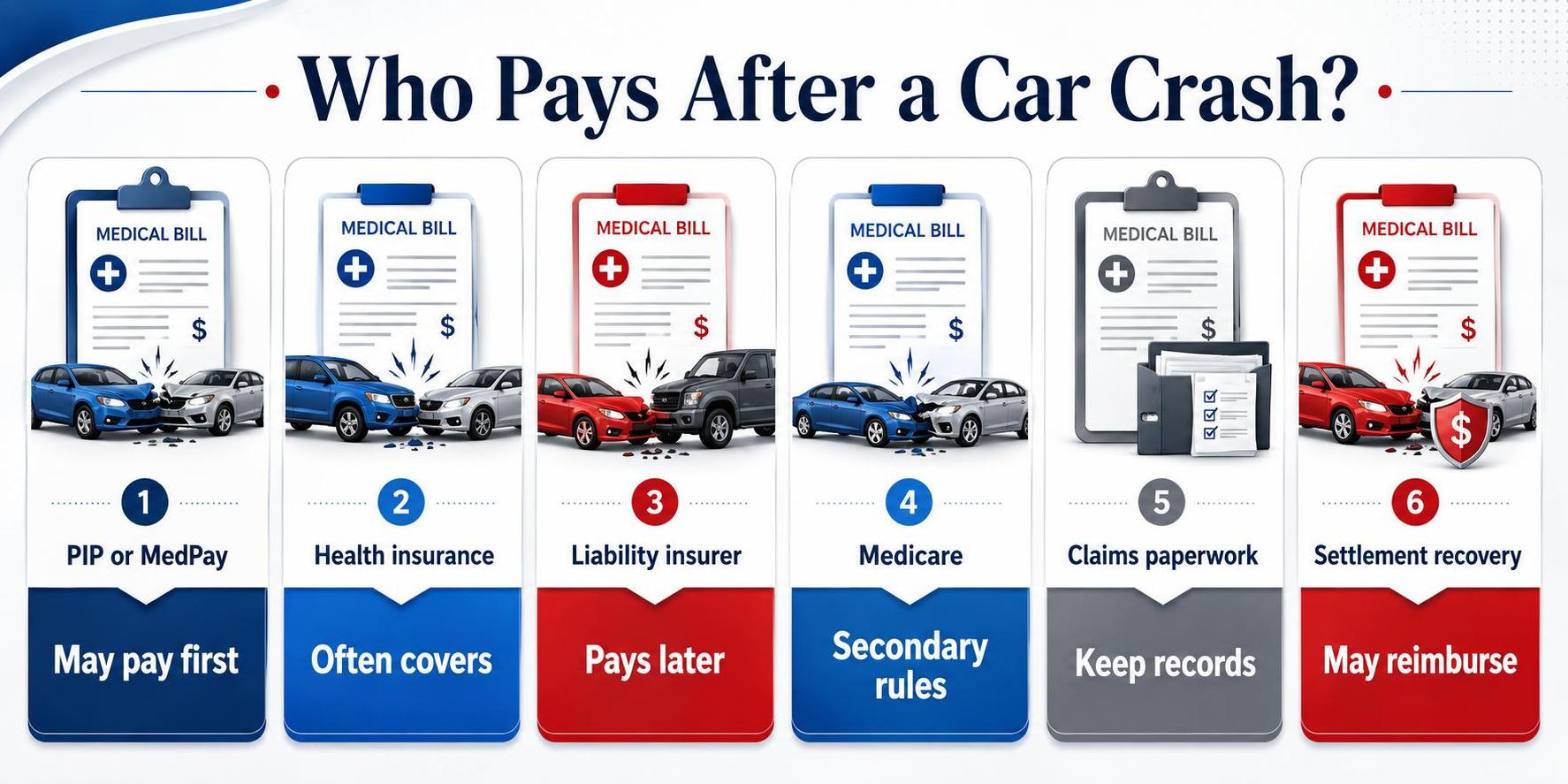
The first payer depends on the state, the auto policy, and the health plan. In no-fault states, Personal Injury Protection or MedPay may pay before health insurance.
In fault-based states, health insurance often pays first for treatment, then seeks repayment if an auto insurer later pays.
Two rules matter most: the coordination-of-benefits language in the policies and state insurance law.
Because both vary, claimants should check the state department of insurance, the auto policy, and the health plan’s summary of benefits and coverage before assuming a bill is covered.
| Payer | Usually pays first when | What it commonly covers | Key limits |
| Personal Injury Protection (PIP) | No-fault states or policies with PIP | Medical bills, and sometimes lost wages and replacement services | State rules vary. Florida requires at least $10,000 in PIP, subject to statutory conditions, under Fla. Stat. 627.736. |
| Medical Payments Coverage (MedPay) | If purchased and no PIP applies, or after PIP is exhausted | Medical expenses for occupants, regardless of fault | Optional in many states. Limits are the purchased amount. |
| Health insurance | When auto coverage is absent, excluded, delayed, or exhausted | Covered medically necessary treatment under plan rules | Deductibles, copays, network limits, prior authorization, and exclusions apply. |
| Liability insurer of the at-fault driver | Usually later, after fault and damages are investigated | Reimbursement through settlement or judgment | Not immediate bill payment. Policy limits can cap recovery. |
Health insurance does not replace every auto benefit. It usually pays only covered medical care. It does not usually pay vehicle damage, pain and suffering, or wage loss unless the policy includes a separate disability benefit.
If Medicare is involved, federal Medicare Secondary Payer rules apply. Medicare generally does not pay first when payment can reasonably be expected from auto or no-fault insurance, according to CMS.
If Medicare makes a conditional payment, it must be reimbursed from a later settlement.
Documentation decides whether a bill is paid or denied.
Keep the crash report, claim numbers, insurance cards, itemized bills, diagnosis codes, EOBs, receipts, mileage logs, wage-loss proof, and every letter showing denials, liens, or subrogation claims.
- Ask each insurer, in writing, whether it is primary or secondary.
- Request the exact coverage section or statute if a claim is denied.
- Check state-specific PIP or MedPay rules with the state department of insurance.
- Check Medicare coordination rules with CMS and consumer guidance from NAIC.
Caution: do not delay emergency care while insurers argue over priority. A missed filing deadline, out-of-network visit, or settlement signed without resolving Medicare, Medicaid, or plan reimbursement rights can leave the patient owing money.
When health insurance covers accident injuries
Health insurance can cover car accident injuries when the treatment is medically necessary and the policy covers the service.
Coverage usually applies to emergency care, hospital treatment, imaging, surgery, follow-up visits, rehabilitation, and prescription drugs, but the member still owes deductibles, copays, or coinsurance under the plan.
Who pays first depends on the health plan, the auto policy, and state rules.
Because those rules vary, a claimant should verify coordination-of-benefits rules with the insurer and check the state department of insurance, the National Association of Insurance Commissioners (NAIC), and, for Medicare.
The Centers for Medicare & Medicaid Services (CMS).
Health insurance usually pays when the bill is submitted correctly and no other payer is primary for that service.
Many policies require the provider to bill auto medical payments coverage, personal injury protection, or liability coverage first if those coverages apply under state law or the policy contract.
Emergency services have special federal protections.
Under the Affordable Care Act, most ACA-compliant plans must cover emergency services without prior authorization and cannot impose higher cost-sharing for out-of-network emergency care than for in-network emergency care.
Source: CMS and Healthcare.gov.
| Rule or figure | What it means after a car accident | Primary source |
| 2025 ACA out-of-pocket maximum: $9,200 self-only; $18,400 other than self-only | For in-network essential health benefits under non-grandfathered plans, member cost sharing generally cannot exceed these annual limits | CMS, 2025 Notice of Benefit and Payment Parameters |
| Medicare Part B deductible: $257 in 2025 | After the deductible, Medicare Part B generally pays 80% of the Medicare-approved amount for covered doctor and outpatient services, and the beneficiary typically owes 20% | CMS, Medicare costs at a glance for 2025 |
Documentation matters.
A claimant should keep the police report, claim number, health insurance ID card, auto insurance information, emergency records, itemized bills, explanation of benefits forms, diagnostic reports, physician notes.
And proof that the injuries are related to the crash.
- Date, time, and location of the crash
- Symptoms that started immediately and later
- All providers seen and all treatment dates
- Whether the provider is in network
- Whether the auto insurer denied or limited payment
Health insurance does not erase every bill. Out-of-network care, non-covered services, balance billing allowed under applicable law, and treatment judged not medically necessary may still leave the patient owing money.
Plan exclusions and state protections differ, so the policy documents and regulator guidance control.
Caution: do not assume health insurance is primary or that a settlement will end the matter. Insurers may seek reimbursement or assert subrogation rights after paying accident-related claims.
Check the plan document, CMS Medicare Secondary Payer rules if Medicare is involved, and the state department of insurance before signing releases or spending settlement funds.

How auto medical coverage pays first
After a crash, the first payer is often auto insurance, not health insurance.
Which auto coverage pays depends on the state and the policy: personal injury protection (PIP) in no-fault systems, or Medical Payments coverage (MedPay) where it was purchased.
Health insurance usually pays after applicable auto medical coverage is billed first.
Because state rules and plan language vary, claimants should verify payment order with the state department of insurance, the policy certificate, and the plan’s coordination-of-benefits rules.
PIP is broader than MedPay in many states.
The National Association of Insurance Commissioners (NAIC) explains that PIP generally covers medical expenses and may also cover lost wages and essential services, while MedPay is usually limited to medical and funeral expenses.
| Coverage | Usually pays first for crash treatment? | What it commonly covers | Key limits |
| PIP | Yes, if required or applicable under state no-fault rules | Medical bills; often lost wages and replacement services | Benefits stop at the policy limit and may be time-limited by state law |
| MedPay | Often yes, if purchased and the policy says it is primary | Medical bills related to the auto accident | No wage loss coverage in standard MedPay; benefits stop at the purchased limit |
| Employer or ACA health plan | Usually after PIP or MedPay is applied | Covered medical treatment under plan terms | Deductibles, copays, network rules, exclusions, and reimbursement rights may apply |
| Medicare | No, when no-fault or liability insurance should pay | Conditional payment if the primary payer does not pay promptly | CMS can seek recovery from any settlement, judgment, award, or other payment |
Medicare’s order of payment is a federal rule, not a state option.
Under the Medicare Secondary Payer statute, no-fault insurance and liability insurance are primary to Medicare, and Medicare can make a conditional payment only when the primary payer does not pay promptly.
CMS states the recovery threshold for liability settlements is generally $750.
Claimants should document five things from day one:
- The auto policy declarations page showing PIP or MedPay limits.
- Hospital, ambulance, physician, pharmacy, and therapy bills with diagnosis codes.
- The crash report, claim number, and insurer adjuster contact information.
- Explanation of Benefits forms from the health plan or Medicare.
- Any lien, subrogation, or reimbursement notices.
Caution: a provider may bill health insurance first out of habit. That can create reimbursement problems later.
Check the plan and state rules before relying on payment order alone; the state department of insurance, CMS, and NAIC are the primary sources to confirm what applies.

Medicare and Medicaid accident payment rules
Medicare and Medicaid can pay for car-accident treatment, but they usually do not act as the final payer if another source is responsible.
The key rule is coordination: auto insurance, liability coverage, no-fault benefits, MedPay, or a settlement may have to pay first or reimburse the program later.
Readers should verify state-specific Medicaid rules with their state Medicaid agency or state department of insurance.
Medicare rules are federal, but billing details and recovery steps should be checked with CMS and the Medicare Secondary Payer guidance.
Medicare is generally a secondary payer when payment can reasonably be expected from auto or liability insurance.
CMS calls these “conditional payments.” Medicare may pay promptly for covered care, then seek repayment after a settlement, judgment, award, or other insurance payment.
For Part B-covered services, a beneficiary still faces normal Medicare cost sharing unless another payer covers it.
CMS states the standard 2025 Part B deductible is $257, and Part B generally pays 80% of the Medicare-approved amount after the deductible. Source: CMS, “2025 Medicare Parts A & B Premiums and Deductibles.”.
| Program | Who pays first | Key payment rule | Claimant must document |
| Medicare | Usually auto, no-fault, liability, or workers’ compensation if available | CMS may make a conditional payment and recover it later; repayment is generally due within 60 days of the demand letter | Accident date, claim numbers, insurers, attorney information, itemized medical bills, settlement documents |
| Medicaid | Usually other liable third parties first under Medicaid third-party liability rules | State Medicaid programs may pay and then pursue reimbursement from the liable insurer or settlement, subject to federal and state limits | Policy details, police report if available, bills, EOBs, settlement terms, and any state Medicaid notice forms |
For Medicare, report the accident and all insurance promptly. CMS and the Benefits Coordination & Recovery Center use that information to track conditional payments.
If a settlement includes medical expenses, Medicare’s recovery claim can reduce what the injured person keeps.
Medicaid works differently because it is state-administered. Federal Medicaid law requires states to seek payment from liable third parties, but lien, recovery, and notice procedures vary.
Check Medicaid.gov, the state Medicaid agency, and the state department of insurance for the controlling rules.
- Keep every bill, explanation of benefits, and provider record tied to the crash.
- Save settlement releases, demand letters, and payment breakdowns.
- Do not assume a lawyer, insurer, or provider already resolved Medicare or Medicaid reimbursement.
Caution: spending settlement funds before Medicare or Medicaid reimbursement is resolved can create collection risk. Confirm the payoff amount with CMS or the state Medicaid agency before distributing money.
Subrogation and reimbursement after settlements
After a car-accident settlement, a health insurer may claim repayment for bills it already paid. This is usually called subrogation or reimbursement, and the rules change by payer type, plan language, and state law.
Do not spend settlement funds until all liens and repayment claims are confirmed. A mistake here can leave the claimant owing money after the case appears finished.
Who can seek repayment, and how, differs materially. Medicare follows federal secondary-payer rules. Medicaid follows federal and state Medicaid recovery rules. Private plans depend on the policy and, for many job-based self-funded plans, ERISA.
| Payer | What usually happens after settlement | Primary source |
| Medicare | Medicare can recover conditional payments when another payer was responsible. CMS states payment is due within 60 days of the final demand letter, and interest may accrue if it is not paid in time. | CMS, Medicare Secondary Payer Recovery |
| Medicaid | Medicaid may seek recovery, but federal limits and state rules matter. Recovery often focuses on the medical-expense portion of a settlement, and state Medicaid agency procedures control. | CMS Medicaid third-party liability materials; state Medicaid agency |
| Private or employer plan | The plan may assert subrogation or reimbursement if the policy allows it. Self-funded employer plans may be governed by ERISA, so federal plan terms can override some state restrictions. | U.S. Department of Labor ERISA guidance; plan document; state department of insurance for insured plans |
Documentation decides many disputes. Keep the health insurer’s explanation of benefits, itemized medical bills, proof of accident date, police report if available, and the settlement release.
The claimant should also keep any allocation showing what part of the settlement was for medical expenses, lost wages, or pain and suffering.
For Medicare, CMS uses a recovery process that starts with reported claims and conditional payments. CMS publishes the amount it believes is related to the accident, then issues a final demand after settlement details are reported.
For private insurance, read the full policy, summary plan description, and reimbursement clause.
The National Association of Insurance Commissioners explains that subrogation rules vary by state, and state departments of insurance publish state-specific requirements for insured health policies.
- Ask for an itemized lien or reimbursement statement.
- Match every charge to accident-related treatment dates.
- Check whether the policy reduces repayment for attorney’s fees or procurement costs if state law or plan terms allow it.
- Verify whether the plan is self-funded ERISA or fully insured, because that changes which rules apply.
If any amount is disputed, use the payer’s formal appeal or waiver process and check the primary source before acting.
For state-specific limits, use the state department of insurance, state Medicaid agency, CMS, or NAIC consumer materials rather than a generic settlement estimate.

Documents claimants need for injury bills
Injury billing disputes turn on paperwork, not memory. A claimant usually needs documents that show four things: what treatment was received, who was billed, who paid first, and what balance remains.
Coverage order can change by state, policy language, and program rules.
For auto-related medical bills, claimants should verify coordination rules with the health plan, the auto insurer, the state department of insurance, and, if applicable, CMS for Medicare.
Core records to collect
- Itemized medical bills for each provider. These should show service dates, procedure codes, diagnosis codes, provider name, tax ID or NPI, charges, payments, adjustments, and current balance.
- Explanation of Benefits (EOB) from the health insurer. An EOB shows what the plan allowed, denied, or applied to deductible, copay, or coinsurance. It is not the bill, but it proves how the claim was processed.
- Auto claim documents such as the claim number, adjuster contact, declarations page, and any Personal Injury Protection (PIP) or Medical Payments coverage notices. Whether auto coverage pays first often depends on state law and policy terms.
- Medical records linking the injuries to the crash. Request emergency records, imaging reports, operative notes, therapy notes, discharge summaries, and physician causation statements when available.
- Proof of payment including receipts, card statements, canceled checks, payment-plan records, and health savings account records.
- Accident records such as the police crash report, photos, witness information, and the date and place of loss.
Deadlines and record-request facts
| Rule or document | Specific fact | Primary source |
| Medical record request | HIPAA generally requires a covered entity to act on a records request within 30 days, with one 30-day extension if it gives a written reason. | HHS, 45 CFR 164.524 |
| Medicare claim filing | Medicare claims generally must be filed within 12 months of the date of service. | CMS, Medicare claims filing rules |
| Good faith estimate for uninsured or self-pay | If scheduled 10 or more business days ahead, the estimate is due within 3 business days; if scheduled 3 to 9 business days ahead, within 1 business day. | CMS, No Surprises Act guidance |
What claimants should match before sending bills
- Dates of service on the bill, EOB, and crash report should align.
- Provider names should match the treating facility and clinician records.
- Diagnosis and treatment should be consistent with the injury narrative.
- Any health-plan reimbursement or subrogation notice should be saved. Rights vary by plan type and state, so check the plan documents, NAIC consumer guidance, and the state department of insurance.
Do not pay, dispute, or sign a reimbursement agreement based on this section alone. A billing error, lien, Medicare issue, or state PIP rule can change who pays first and what a claimant ultimately owes.

State rules readers must verify
After a car crash, state law often decides whether auto insurance or health insurance pays first. The answer can change by state, by policy language, and by whether Medicare, Medicaid, or an employer health plan is involved.
Do not assume a national rule applies. Readers should verify current requirements with the state department of insurance, the insurer’s policy form, and, for Medicare issues, CMS.
State rules matter most in four areas: mandatory auto medical coverage, who pays first, reimbursement rights, and claim deadlines.
NAIC explains that auto and health coordination depends on state insurance rules and the policy contract, not a single nationwide standard.
| State | Rule to verify | Primary source |
| Michigan | Drivers choose a Personal Injury Protection medical benefit limit: unlimited, $500,000, $250,000, $50,000 for certain Medicaid enrollees, or an opt-out for some people with Medicare Parts A and B. | Michigan Department of Insurance and Financial Services consumer guidance |
| New Jersey | The standard policy generally includes up to $250,000 in PIP medical benefits for very serious injuries, with lower limits for other claims depending on the policy. | New Jersey Department of Banking and Insurance buyer guides |
| Pennsylvania | Auto policies must include at least $5,000 in first-party medical benefits unless the insured selects higher limits. | Pennsylvania Insurance Department auto insurance materials |
That table shows why “health insurance covers car accident injuries” is incomplete. In some states, auto medical coverage such as PIP or MedPay may pay first.
In others, health insurance may pay sooner, then seek reimbursement if a settlement later includes medical costs.
- Check whether the state uses no-fault or fault-based auto rules through the state insurance department or NAIC consumer guides.
- Check the health plan’s subrogation or reimbursement clause. Self-funded employer plans may have separate federal ERISA rights.
- Check whether Medicaid has a state recovery program. Medicaid rules are state-administered and can differ.
- Check Medicare’s status with CMS. Medicare is generally a secondary payer when another insurer is primary.
Document the crash date, police report number, diagnosis codes, provider bills, EOBs, auto claim number, and any settlement demand. Missing records can delay payment or create double-payment disputes.
Caution: do not settle injury claims before confirming lien or reimbursement rights. A settlement can leave the claimant responsible for repaying Medicare, Medicaid, or a pri
vate plan from the settlement proceeds.
What the editorial team reviewed
This section does not rely on staged claims or invented case studies. It is based on primary-source rules that determine whether health insurance, auto insurance, or Medicare pays first after a car accident injury.
The review focused on what changes by state, what changes by plan, and what a claimant must document. Where rules vary, readers should confirm the current requirement with the state department of insurance, CMS, or the plan document itself.
The editorial team reviewed three primary source categories: state insurance regulators, federal Medicare guidance, and NAIC consumer guidance.
That matters because payment order can change with no-fault rules, MedPay, PIP, ERISA plan terms, and Medicare Secondary Payer rules.
| Source type | What it establishes |
| State department of insurance | Whether the state uses no-fault rules, requires PIP, allows MedPay, or sets claim-notice and proof standards. |
| CMS | Whether Medicare pays first or second, when it may make a conditional payment, and when reimbursement may be required. |
| NAIC | Standard consumer definitions for liability, PIP, MedPay, deductibles, exclusions, and coordination issues. |
For Medicare, the key rule reviewed was CMS’s Medicare Secondary Payer framework.
CMS states that liability insurance, no-fault insurance, and workers’ compensation are primary to Medicare for accident-related care, while Medicare may make a conditional payment if the primary payer will not pay promptly.
For private health insurance, the team reviewed insurer-facing and consumer-facing guidance showing a narrower point: a health plan may cover treatment.
But it usually does not replace auto liability coverage for the at-fault driver’s legal responsibility.
Subrogation and reimbursement terms often appear in the policy or summary plan description.
For state variation, the team treated state regulator pages as the primary source because no-fault and PIP rules are not nationally uniform.
Readers should verify current rules with the relevant department of insurance before assuming that health insurance, PIP, or MedPay pays first.
- Claimants should keep the crash report, claim number, medical records, itemized bills, EOBs, and any lien or subrogation notices.
- They should document the date of injury, treating providers, diagnosis codes if available, and whether treatment was billed to auto insurance or health insurance first.
- Caution: acting on the wrong payer order can trigger denied claims, delayed treatment billing, or reimbursement demands. Confirm the order with the ins

What Does Health Insurance Cover Injuries From a Car Accident looks like in practice urer and the governing primary source.

Frequently Asked Questions
Will health insurance pay for injuries from a car accident?
Usually, yes, but payment often depends on the policy terms, network rules, and whether another insurer is primary first.
The National Association of Insurance Commissioners explains that auto medical coverage such as MedPay or Personal Injury Protection may pay before or alongside health insurance.
So a claimant should check both policies and confirm billing order with the insurer.
What if the car insurer says health insurance should pay first?
That can happen when the auto policy has limited medical benefits or state rules make health insurance secondary only after auto coverage is used.
Because coordination rules vary by policy and state, the safest step is to ask the health plan, the auto insurer, and the medical provider for a written explanation before agreeing to pay a bill personally.
Can a health insurer take money from a car accident settlement?
Often, yes, through subrogation or reimbursement rights written into the policy, and employer-sponsored plans may have additional rights under ERISA, a federal law.
The U.S. Department of Labor oversees ERISA-covered plans, and readers should review the plan document or ask a lawyer because settlement repayment disputes can materially reduce the amount kept.
Will going out of network after a crash affect coverage?
Yes, especially after emergency care ends, because the Affordable Care Act requires coverage for emergency services without prior authorization, but follow-up treatment can still be subject to network and cost-sharing rules.
The Centers for Medicare & Medicaid Services states emergency services have specific protections, so a patient should confirm whether ongoing specialists, imaging, or therapy are in network before continuing care.
Do I still owe deductibles and copays if health insurance covers crash injuries?
In many cases, yes, because health insurance usually applies the same deductible, copay, and coinsurance terms unless another coverage source pays them.
The Centers for Medicare & Medicaid Services notes that cost sharing is a standard part of many plans.
So a patient should not assume accident-related treatment is free and should request an itemized explanation of benefits before paying disputed charges.
Related Reading
- What an Insurance Adjuster Actually Does With an Injury Claim
- Which Insurance Is Primary?
- What Insurance Company Covers Mounjaro?
- Health Insurance Liens on Personal Injury Settlements
- What Insurance Does Walgreens Accept?
- Uninsured and Underinsured Motorist Coverage, Explained
- Med-Pay vs PIP: Which One Pays Your Medical Bills After a Crash
- How Insurance Subrogation Works After an Injury Settlement
- All Blog Guides
- Centers for Medicare & Medicaid Services – Coordination of Benefits & Recovery Overview (2024)
- MedlinePlus – After a Motor Vehicle Accident: MedlinePlus Medical Encyclopedia (2023)
- Insurance Information Institute – Health Insurance Issues Arising After a Car Crash (2024)
- National Association of Insurance Commissioners – Medical Payments Coverage (2024)
- Healthcare.gov – Health Coverage if You’re Injured or Become Sick (2024)
- PubMed – The Economic Burden of Motor Vehicle Crashes, 2019 (2024)
- University of Michigan Institute for Healthcare Policy & Innovation – Medical Debt Among People With Health Insurance After Injury (2023)
- USA.gov – Benefits and financial assistance
- Federal Trade Commission – Consumer Advice