

Quick answer: Health insurance lien on settlement means a health insurer claims repayment from injury settlement funds for medical bills it paid related to the claim.
The lien may arise from an ERISA plan, Medicare, Medicaid, or state insurance rules. Do not distribute settlement money until liens are verified, negotiated, and resolved with legal guidance.
Health insurance lien on settlement is a repayment claim by a health plan against injury-settlement money for medical bills it paid that another party may legally owe.
The policy pays covered care first, but it may exclude noncovered treatment, deductibles, copays, or out-of-network charges. Document bills, explanations of benefits, payments, denials, and lien notices.
Check CMS, NAIC, or the state department of insurance for rules that vary by plan or state.
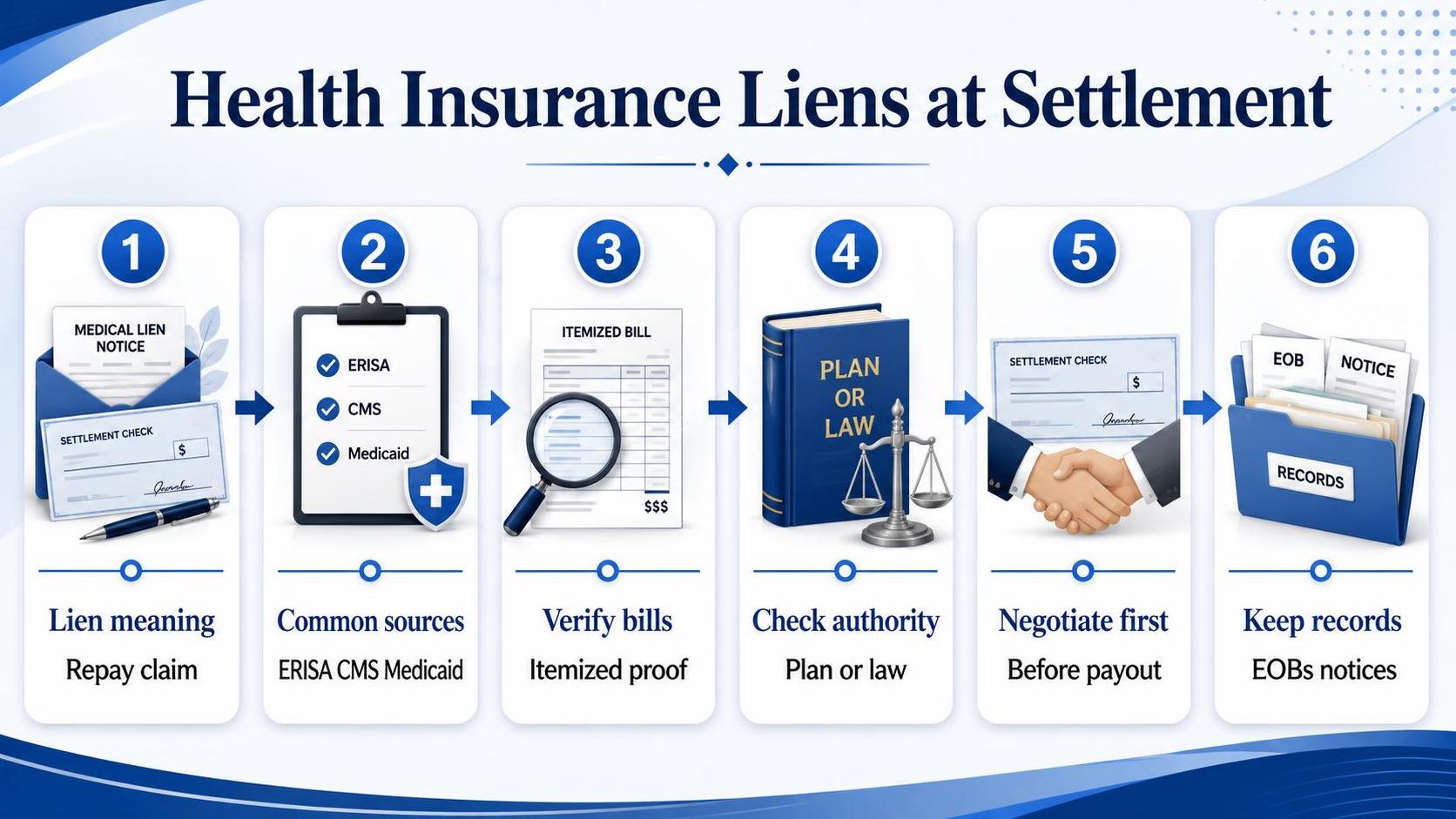
How health insurance liens affect settlements
A health insurance lien or reimbursement claim can reduce the amount an injured person keeps from a settlement.
The key issue is not whether health insurance paid bills, but whether the policy, plan document, or law gives the payer a right to recover those payments afterward.
Who pays first depends on the coverage involved.
Private health insurance often pays medical providers during treatment, then seeks reimbursement from a later liability settlement if the plan allows it; Medicare has separate recovery rights under the Medicare Secondary Payer rules administered by CMS.
Medicare’s recovery process is the clearest example.
Under CMS, liability insurance, no-fault insurance, and workers’ compensation are generally primary to Medicare, and Medicare may make “conditional payments” that must be repaid when a settlement, judgment, award.
Or other payment is received.
| Payer type | Who typically pays bills first | Possible recovery right | Primary source to check |
| Private health insurance | The health plan may pay providers under the policy while the injury claim is pending | Depends on the policy, summary plan description, and state law | Policy documents, state department of insurance, NAIC consumer materials |
| Medicare | Medicare may make conditional payments when another payer should pay first | Yes; CMS can recover conditional payments from the settlement | CMS Medicare Secondary Payer guidance |
| Medicaid | State Medicaid program may pay covered treatment | Limited to the medical-expense portion under federal law as interpreted by courts | State Medicaid agency and state law |
For Medicare, reporting can be mandatory.
CMS requires reporting of certain liability settlements, judgments, awards, or other payments through Section 111 reporting rules, and a Medicare beneficiary should verify whether Medicare made conditional payments before money is distributed.
A claimant should document four things. First, all explanation-of-benefits forms and medical bills. Second, the policy, summary plan description, or plan reimbursement language.
Third, the settlement breakdown, especially any allocation to medical expenses. Fourth, correspondence from Medicare, Medicaid, or the insurer asserting repayment rights.
- Ask for an itemized lien statement or conditional payment letter.
- Check whether unrelated treatment was included.
- Compare the claim to the settlement terms and medical records.
- Confirm deadlines, appeal rights, and reduction rules in the governing documents.
State rules and plan terms vary. ERISA self-funded plans, fully insured plans, Medicare, and Medicaid do not follow identical reimbursement rules.
Check the primary source: CMS for Medicare, the state department of insurance for insured plans, and the plan documents for employer coverage.
Caution: do not spend settlement funds before confirming lien amounts and disputes. A repayment obligation can survive disbursement, and mistakes can trigger collection, interest, or delays.
If the claim is large or unclear, a claimant should get plan-specific legal or claims advice.

Who pays medical bills before settlement
Before a personal injury settlement is paid, medical providers usually expect payment under whatever coverage is available now, not after the case ends.
The order depends on the type of claim, the health plan terms, and whether a government program or auto policy has primary payment rules.
For most non-work injuries, the first practical payer is the patient’s health insurance, if the policy covers the treatment and the provider bills it.
That usually means the patient still owes deductibles, copayments, coinsurance, and any noncovered charges under the policy.
Employer or individual health insurance may pay first for treatment, then assert reimbursement or subrogation rights if the patient later recovers from the at-fault party.
Whether the plan can recover, and how much, depends on the policy language, ERISA status, and state insurance rules. Check the plan document and the state department of insurance.
Medicare has separate federal rules. Under the Medicare Secondary Payer statute, Medicare generally does not pay first when another responsible payer exists, but it may make a conditional payment so treatment is not delayed.
If the claim later settles, Medicare must be reimbursed for related conditional payments. CMS is the primary source.
Medicaid can also seek recovery, but limits vary by state and by what portion of a settlement is allocated to medical expenses.
The U.S. Supreme Court has restricted states from taking portions unrelated to medical care, but state recovery procedures still differ. Check the state Medicaid agency and department of insurance.
| Coverage source | Who usually pays before settlement | What the claimant must document |
| Private health insurance | Often pays covered treatment first, subject to cost-sharing | Insurance card, itemized bills, EOBs, policy terms, lien or subrogation notices |
| Medicare | May make conditional payments | Medicare claim summary, conditional payment letter, settlement details |
| Medicaid | May pay first under state rules, then seek recovery | Billing records, Medicaid notices, state recovery claim |
| Auto MedPay or PIP | May pay early medical bills if the auto policy provides it | Auto policy, accident report, provider bills |
| Workers’ compensation | Usually pays first for work-related injuries | Claim number, employer report, approved treatment records |
Auto coverage can change the order. In no-fault states, Personal Injury Protection may pay medical bills first up to the policy limit. Medical Payments coverage can also pay regardless of fault, but limits are often low and vary by policy.
The NAIC and state insurance regulators explain those differences.
Do not assume a settlement will automatically clear every bill or lien.
Claimants should keep itemized bills, explanation-of-benefits forms, lien notices, and every payment ledger, then confirm payoff amounts directly with the insurer, CMS, or state agency before disbursing settlement funds.

Plans that may claim reimbursement
A health insurance lien usually means a plan paid accident-related medical bills first and then seeks repayment from a settlement. Whether repayment is allowed depends on the plan type, the policy language, and federal or state law.
Do not assume every insurer has the same rights; check the plan documents and the primary regulator.
Medicare can claim reimbursement when it makes “conditional payments” for treatment another payer should have covered.
The Centers for Medicare & Medicaid Services says Medicare is generally secondary to liability insurance, no-fault insurance, and workers’ compensation, and it must be repaid from the settlement if those payments should have been primary.
Medicaid may also recover, but limits are stricter. In Ahlborn and later cases, the U.S. Supreme Court limited state Medicaid recovery to the part of a settlement allocated to medical expenses, not the entire settlement.
Because Medicaid recovery rules are administered by each state, claimants should check the state Medicaid agency and the state department of insurance.
Employer-sponsored health plans often assert reimbursement under ERISA. Self-funded ERISA plans usually have the strongest recovery rights because federal law often preempts state anti-subrogation rules.
Fully insured employer plans are different; state insurance law may restrict subrogation or reimbursement, so the policy and the state department of insurance matter.
Individual and family major medical policies may contain subrogation or reimbursement clauses, but state law can limit enforcement. The National Association of Insurance Commissioners notes that subrogation rules vary by state.
Accident, hospital indemnity, critical illness, and fixed-indemnity policies are different because they pay stated benefits, not necessarily actual medical charges, and many do not operate like major medical plans.
| Plan type | Who usually pays first | Possible reimbursement basis |
| Medicare | Secondary to liability, no-fault, and workers’ compensation, per CMS | Medicare Secondary Payer conditional payment recovery |
| Medicaid | Varies by claim and state program rules | State recovery, limited to medical-expense share under federal case law |
| Self-funded ERISA plan | Depends on plan terms | Plan reimbursement language; federal preemption often important |
| Fully insured health plan | Depends on policy terms | Policy clause plus state insurance law limits |
Claimants should document every accident-related charge, insurer payment, denial, Explanation of Benefits, and settlement allocation. Keep the summary plan description, full policy, lien notices, and itemized medical bills.
If the settlement separates medical expenses from wage loss or pain and suffering, that allocation can matter.
Caution: paying a lien or refusing one without checking the governing documents can cost money. For Medicare, use CMS Medicare Secondary Payer materials.
For Medicaid and insured plans, use the state Medicaid agency, state department of insurance, and the NAIC’s state-regulation resources.

What your policy may exclude
A health insurance lien usually starts with what the policy paid, but the policy’s exclusions matter first. If a service was excluded, the plan may refuse payment, and there may be no plan-paid amount to recover from a settlement.
Read the certificate of coverage, summary plan description, and subrogation or reimbursement clause. Those documents control what the plan covers, what it can deny, and what records the claimant must keep.
Many policies exclude or limit care that is not medically necessary, experimental or investigational, or received outside the plan’s network without required authorization.
Those limits are common in issuer forms reviewed under state insurance rules, but the exact wording varies by policy and state. Check the policy and the state department of insurance for approved form rules.
Some policies also exclude services when another payer should pay first. Medicare is the clearest example.
Under the Medicare Secondary Payer rules, Medicare generally does not pay primary when payment has been made or can reasonably be expected from liability insurance, no-fault insurance, or workers’ compensation, according to CMS.
| Coverage issue | What may be excluded or limited | Primary source |
| Liability or no-fault injury claims | Plan may deny, conditionally pay, or seek reimbursement if another payer is primary | CMS Medicare Secondary Payer guidance |
| Out-of-network care | Lower payment or no coverage without plan rules being met | Policy documents; state department of insurance |
| Experimental treatment | Often excluded unless the policy defines it as covered | Policy documents; NAIC consumer materials |
| Workers’ compensation injuries | Health plan may exclude treatment that workers’ compensation should cover | Policy documents; state workers’ compensation agency |
| Grandfathered or self-funded plans | Different protections may apply than fully insured state-regulated plans | CMS; U.S. Department of Labor |
Federal law also draws lines by market type. CMS states that non-grandfathered individual and small-group plans must cover essential health benefits and cannot impose lifetime or annual dollar limits on those benefits.
That rule does not mean every treatment is covered, and it does not apply the same way to all large-group or self-funded plans.
A claimant should keep the EOB, itemized bills, diagnosis and procedure codes, accident date, police report if any, and settlement documents.
Plans often ask for proof of causation, proof another insurer denied or paid, and the settlement breakdown before deciding payment or reimbursement.
Use caution. Do not assume a medical bill is covered or lienable because it followed an accident.
For plan-specific or state-specific exclusions, verify with the insurer’s policy, the state department of insurance, CMS, or NAIC consumer guidance before relying on a settlement estimate.

Documents claimants should keep and request
A health insurance lien or reimbursement claim turns on paperwork. The claimant should keep every document showing what treatment was accident-related, what the health plan paid, and what the settlement did and did not compensate.
Do not rely on a verbal statement from an insurer, employer plan, or claims adjuster. Lien rules vary by policy type, state law, and whether the plan is self-funded under ERISA, so the claimant should match each document to the primary source.
| Document | What it proves | Primary source to verify |
| Insurance policy, certificate of coverage, or summary plan description | Whether the plan has subrogation or reimbursement language, and whether it claims first-priority repayment | Plan documents; state department of insurance for fully insured plans; U.S. Department of Labor for ERISA plan disclosures |
| Explanation of Benefits (EOB) for each accident-related claim | Amount billed, amount allowed, amount paid, patient responsibility, denial reasons | Health insurer or plan administrator |
| Itemized provider bills and medical records | Dates of service, diagnosis codes, and whether charges relate to the accident | Provider records; claimant should request complete itemized statements |
| Medicare conditional payment letters, if applicable | What Medicare says it paid conditionally and seeks to recover | CMS Medicare Secondary Payer recovery process |
| Settlement release, demand, and allocation papers | Whether the settlement includes medical expenses, lost wages, or non-medical damages | Settlement documents and court papers, if any |
The claimant should request a current lien statement in writing. It should identify each charge, service date, provider, and payment amount. Without an itemized statement, it is hard to test whether unrelated care was included.
If Medicare is involved, keep every notice from CMS or its recovery contractor. CMS states that interest may begin if the Final Demand is not paid within 60 days.
The claimant should verify deadlines directly through CMS because recovery status changes over time.
For private insurance, keep denial letters, appeal decisions, and all correspondence about reimbursement reductions.
Some states limit subrogation or require fairness review for insured plans, but self-funded employer plans can follow different federal rules. The NAIC and the state department of insurance are the best starting points for insured-plan rules.
Plain caution: a claimant should not sign a release, disburse settlement funds, or ignore a reimbursement notice based on an article alone. A wrong payoff can trigger collections, interest, or a dispute over settlement proceeds.
- Ask for the full plan language, not a short benefits summary alone.
- Match every lien charge to an EOB and an itemized medical bill.
- Separate accident-related treatment from unrelated care.
- Keep proof of any payment sent to Medicare, Medicaid, or a private plan.

State rules that change lien rights
Health insurance lien and reimbursement rights are not uniform. They can change based on state statute, the policy form, and whether coverage is private insurance, an ERISA self-funded plan, Medicare, or Medicaid.
A settlement does not automatically mean every insurer can take money from it.
The claimant should confirm the governing plan document and check the controlling state rule with the state department of insurance, CMS, and NAIC consumer materials before paying any demand.
State law often matters most for fully insured health plans regulated by state insurance rules.
It can limit subrogation, require the insurer to reduce its claim for attorney fees, or bar recovery from parts of a settlement that were not paid for medical care.
| State or program | Rule that affects lien rights | Primary source |
| California | For many health care service plans and disability insurers, reimbursement from a personal injury recovery is capped. If the claimant had an attorney, the carrier is generally limited to the lesser of: the amount it paid, 33.3% of the recovery, or 50% of the recovery after deducting attorney fees and costs. Without an attorney, the cap is generally the lesser of the amount paid or 50% of the recovery. | California Civil Code §3040 |
| New York | In many personal injury settlements, the law presumes the settlement does not include amounts for benefit providers seeking reimbursement, and benefit providers generally have no lien or subrogation right against that recovery unless another law creates one. | New York General Obligations Law §5-335 |
| Medicaid state programs | States can pursue recovery tied to medical expenses, but federal law limits recovery. The U.S. Supreme Court has held that states cannot take portions of a settlement allocated to non-medical damages. | CMS Medicaid third-party liability materials; Arkansas Dept. of Health and Human Services v. Ahlborn, 547 U.S. 268 (2006) |
These examples do not control every claim. Self-funded ERISA plans often argue that federal law preempts state anti-subrogation limits, while Medicare recovery follows federal MSP rules rather than state insurance law.
CMS is the primary source for Medicare and Medicaid recovery guidance.
- Get the summary plan description, full policy, or plan document.
- Request an itemized payment ledger showing what the plan actually paid.
- Keep the complaint, settlement agreement, release, and any allocation of medical versus non-medical damages.
- Keep attorney fee contracts and case costs because some states reduce reimbursement for those amounts.
- Check the state department of insurance and NAIC consumer resources for state-specific rules on subrogation, reimbursement, and external appeals.
Caution: do not pay a lien notice on the assumption it is valid. A mistaken payment can be hard to recover, and deadlines for disputing Medicare, Medicaid, or plan reimbursement claims can be short.

How lien negotiations usually work
Health insurance lien negotiations usually start after the claimant receives a settlement offer and the health plan asserts repayment rights.
The core question is not whether the insurer paid bills, but whether the plan contract, state law, or federal law lets the plan recover from the settlement.
The first step is identifying the payer. Medicare is a secondary payer under the Medicare Secondary Payer statute, 42 U.S.C. 1395y(b), so it can seek reimbursement when a liability settlement pays for medical expenses.
Many employer plans and insurers also claim reimbursement or subrogation, but the exact right depends on plan language and state rules.
The claimant or attorney usually requests an itemized payment ledger, the plan document, and the lien basis in writing.
That matters because a demand should match actual accident-related payments, not unrelated treatment, duplicate charges, or bills outside the injury period.
| Issue | What negotiators check | Primary source |
| Who paid first | Whether Medicare, Medicaid, employer coverage, or private insurance was primary or secondary under the policy and coordination rules | CMS Medicare Secondary Payer guidance; NAIC coordination of benefits materials; state department of insurance |
| What amount is claimed | Only accident-related payments supported by dates of service, CPT/HCPCS descriptions, and provider names | Plan payment ledger; CMS conditional payment letter for Medicare |
| Whether reductions apply | Procurement-cost reductions, policy limits, disputed causation, and state anti-subrogation limits | CMS; plan document; state law and insurance regulator guidance |
For Medicare, CMS applies a procurement-cost reduction. If an attorney fee and case costs reduced the recovery, Medicare usually reduces its reimbursement proportionally under CMS recovery rules.
A claimant should compare the Conditional Payment Letter, the Final Demand, and the settlement release before paying.
For private coverage, negotiations often focus on contract defenses and state limits. Fully insured plans may be limited by state insurance law, while many self-funded employer plans may rely on ERISA preemption.
The U.S. Supreme Court addressed equitable recovery limits in Montanile v. Board of Trustees, 577 U.S. 136 (2016), and reimbursement terms in US Airways v. McCutchen, 569 U.S. 88 (2013).
- Request the summary plan description, full policy, and reimbursement/subrogation clause.
- Match every claimed charge to the injury, provider, and treatment date.
- Document attorney fees, litigation costs, and any policy-limits settlement.
- Check whether state law limits subrogation, made-whole claims, or reimbursement from pain-and-suffering allocations.
State rules vary. For plan-specific or state-specific limits, verify with the state department of insurance, CMS for Medicare, Medicaid’s state agency, and NAIC consumer resources.
Do not pay a lien based on a summary alone; an incorrect payoff can reduce net settlement proceeds and be hard to reverse.

What the editorial team independently reviewed
This section avoids claims of hands-on settlement, insurance, or legal services.
It summarizes the primary-source materials the editorial team reviewed to verify how health insurance liens, reimbursement rights, and payment order work in US injury settlements.
Readers should not rely on a general explainer alone to resolve a lien. Plan type, state insurance rules, ERISA status, and Medicare or Medicaid involvement can change the result, so the underlying plan documents and agency rules matter.
We independently reviewed federal Medicare guidance because Medicare Secondary Payer rules can control who pays first and when Medicare may seek reimbursement.
CMS states that Medicare generally does not pay primary when another insurer or settlement is responsible, and recovery may apply after a settlement, judgment, award, or other payment.
We also reviewed NAIC consumer guidance on subrogation and coordination of benefits.
Those materials help separate two issues that readers often confuse: a health plan paying medical bills up front under the policy, and a carrier later asserting reimbursement or subrogation rights against a settlement.
For state-law points that vary, we checked state department of insurance materials rather than relying on secondary summaries.
That matters because anti-subrogation limits, notice rules, and policy approval standards can differ by state, and some disputes turn on exact policy language approved for that market.
| Source reviewed | What it verifies |
| CMS Medicare Secondary Payer guidance | When Medicare is secondary, when conditional payments can arise, and why repayment may be required from settlement proceeds |
| CMS Medicare recovery materials | That parties may need to report and resolve Medicare reimbursement before final net proceeds are clear |
| NAIC consumer materials | How subrogation and coordination of benefits differ, and why policy language matters |
| State department of insurance publications | Whether state-specific limits or consumer complaint guidance apply to fully insured plans |
We specifically checked for three consumer-risk points. First, a health insurance policy may cover treatment under its terms without waiving later reimbursement rights.
Second, settlement funds do not always go to the claimant first when a valid Medicare, Medicaid, or plan reimbursement claim exists. Third, documentation gaps can delay resolution.
- Current insurance ID cards and the full policy or summary plan description
- Itemized medical bills and explanation of benefits forms
- Any lien, subrogation, or reimbursement notice
- The settlement statement and injury-related payment records
- Medicare or Medicaid correspondence, if applicable
Caution: employer self-funded ERISA plans, Medicare, and Medicaid can follow different rules than fully insured state-regulated plans.
Readers should confirm plan status and state-specific rules with the primary source, including CMS, the state department of insurance, or the plan administrator.
Frequently Asked Questions
What is a health insurance lien on a settlement?
A health insurance lien is a claim for repayment from settlement proceeds after a health plan paid medical bills related to the injury.
The legal basis often comes from the insurance policy, ERISA for many employer plans, state subrogation rules, or federal statutes for programs like Medicare and Medicaid.
Readers should check the plan documents and applicable law before paying or disputing any claim.
Can a private health insurer take part of a personal injury settlement?
Sometimes, yes.
A private insurer may assert reimbursement or subrogation rights if the settlement includes compensation tied to medical expenses the insurer paid, but the scope of that right depends on the policy language and state law.
And self-funded ERISA plans can follow different rules than fully insured plans; the U.S. Department of Labor explains ERISA plan governance, and state insurance departments publish state-specific requirements.
How are Medicare and Medicaid liens different from private insurance claims?
Medicare and Medicaid are governed by separate federal and state rules, and their recovery processes are often more formal than those of private insurers.
Medicare’s recovery rights are administered under the Medicare Secondary Payer framework by the Centers for Medicare & Medicaid Services.
While Medicaid recovery is limited by federal law and Supreme Court decisions such as Arkansas Department of Health and Human Services v.
Ahlborn and Gallardo v. Marstiller; acting without checking the current agency guidance can cause repayment errors or delays.
Can a health insurance lien be reduced or challenged?
Often, yes.
A claimant may dispute unrelated charges, argue that the settlement did not compensate the same category of damages, or seek a reduction based on attorney’s fees, procurement costs, plan terms, or state anti-subrogation limits.
But the outcome depends on the governing documents and law; legal counsel should review the lien before funds are disbursed because paying too much or too little can create financial and legal risk.
What should someone do before spending settlement money if a lien may exist?
Confirm in writing whether Medicare, Medicaid, a private insurer, a hospital, or another payer claims reimbursement rights, and compare the claim against the itemized medical payments and settlement terms.
Do not assume the lien amount is correct or that no lien exists; settlement funds may need to be held until the claim is resolved, and the safest next step is to verify the demand with the payer and the primary legal documents.
Related Reading
- Which Insurance Is Primary?
- Does Health Insurance Cover Injuries From a Car Accident
- What Insurance Does Walgreens Accept?
- What an Insurance Adjuster Actually Does With an Injury Claim
- Uninsured and Underinsured Motorist Coverage, Explained
- What Insurance Company Covers Mounjaro?
- How Insurance Subrogation Works After an Injury Settlement
- Med-Pay vs PIP: Which One Pays Your Medical Bills After a Crash
- All Blog Guides
- Centers for Medicare & Medicaid Services – Medicare Secondary Payer Recovery Portal (2025)
- Congressional Research Service – Medicare Secondary Payer (MSP) and Liability Insurance: Legal and Administrative Basics (2024)
- Medicaid.gov – Third Party Liability and Coordination of Benefits (2025)
- Legal Information Institute, Cornell Law School – 42 U.S. Code § 1396a – State plans for medical assistance (2024)
- PubMed – Ahlborn, Wos, and the future of Medicaid recovery from personal injury settlements (2014)
- U.S. Department of Justice – Civil Division
- Medicare.gov
- USA.gov – Benefits and financial assistance