

At a glance: Best pre settlement funding companies are typically licensed, transparent litigation-funding providers that clearly disclose fees, use non-recourse agreements, and work with the applicant’s attorney before approval.
Reputable names often compared in the U.S. market include Oasis Financial, LawCash, High Rise Financial, and Tribeca Lawsuit Loans. Borrowers should compare terms carefully before signing.
Best Pre Settlement Funding Companies are litigation funding firms that advance cash to plaintiffs before a case settles, with repayment typically owed only from settlement or judgment proceeds.
Strong options disclose pricing clearly, explain non-recourse terms, review cases quickly, and avoid pressuring injured plaintiffs into expensive advances. State rules vary, and some contracts can sharply reduce a final recovery.
Readers should compare funding agreements with an attorney before signing. Acting on rankings alone can be costly because fees, compounding methods, and repayment caps differ by company and jurisdiction.
Best pre settlement funding companies compared
Several pre-settlement funding companies operate nationally, each with different fee structures, funding ranges, and approval timelines. The following comparison reflects publicly available information from company websites and industry sources as of 2024.
| Company | Funding Range | Typical Approval Time | Notable Feature |
| Oasis Financial | $500–$100,000+ | 24–48 hours | Non-recourse; no repayment if case loses |
| USClaims | $500–$250,000 | 24–48 hours | Offers surgical and medical lien funding |
| Peachtree Financial Solutions | Varies by case | 48–72 hours | Part of JG Wentworth; handles structured settlement purchases too |
| Baker Street Funding | $1,000–$500,000 | 24 hours | Publishes rate information openly on its website |
| Ally Lawsuit Loans | $250–$250,000 | 24 hours | Low minimum funding amount |
Caution: Fee structures vary significantly between providers and are not always directly comparable. Readers should request a full cost disclosure before signing any funding agreement.
Key factors in the comparison
Fee structures differ widely. Some companies charge simple interest rates, while others use compounding schedules that can increase total repayment costs substantially over time.
- Non-recourse terms: Most major funders, including Oasis Financial and USClaims, advertise non-recourse agreements — meaning applicants owe nothing if their case is unsuccessful (source: company websites).
- Case types accepted: Personal injury, motor vehicle accidents, and workers’ compensation are commonly funded. Some companies, such as Baker Street Funding, also fund commercial litigation and employment cases.
- State restrictions: Pre-settlement funding is not available in every state. According to the American Legal Finance Association (ALFA), several states including Arkansas, Kentucky, and Tennessee have enacted specific regulations governing lawsuit funding transactions.
- Approval requirements: Most companies require an active lawsuit with retained counsel. The attorney’s cooperation is typically necessary for application processing.
Rates and terms reported here come from company disclosures and may change. Always verify current terms directly with the funder and consult an attorney before accepting any pre-settlement advance.

How pre settlement funding works
Pre-settlement funding provides plaintiffs a cash advance against the expected proceeds of a pending lawsuit. The transaction is non-recourse, meaning if the case loses, the plaintiff owes nothing back to the funding company.
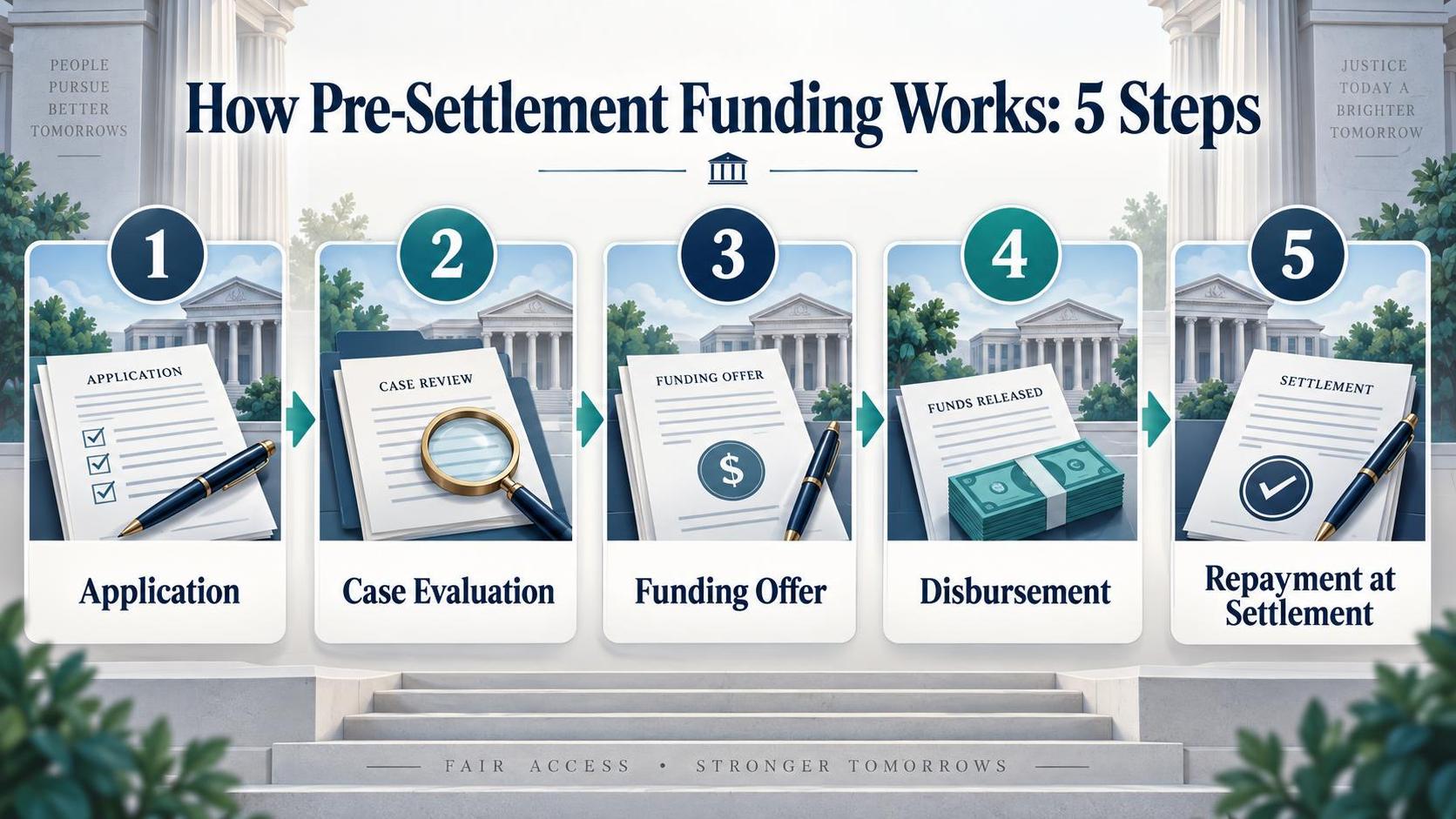
The process typically follows a standard sequence across most funding companies:
- Application: The plaintiff submits basic case details—case type, attorney name, and estimated settlement value—either online or by phone.
- Case evaluation: The funder contacts the plaintiff’s attorney, reviews case merits, medical records, and liability strength. This review usually takes 24 to 48 hours, according to the American Legal Finance Association (ALFA).
- Funding offer: If approved, the company offers a lump sum, typically ranging from 10% to 20% of the estimated settlement value, per industry standards reported by ALFA.
- Disbursement: Once the plaintiff and attorney sign the funding agreement, funds are wired or sent—often within 24 hours of approval.
- Repayment: Repayment occurs only when the case settles or a judgment is awarded. The attorney pays the funder directly from the settlement proceeds.
Funding rates vary significantly by company, case type, and state regulation. Below is a representative comparison of common fee structures:
| Fee Structure | Typical Range | How It Accrues |
| Monthly compounding | 2.5%–4% per month | Interest charged on principal plus accumulated fees |
| Monthly simple interest | 2%–3.5% per month | Interest charged on original principal only |
| Flat fee / tiered | 15%–40% per fixed period | Set fee at defined intervals (e.g., every 6 or 12 months) |
Compounding rates can cause total repayment to exceed two or three times the original advance if a case takes years to resolve.
Pre-settlement funding is not classified as a loan in most states. Courts in New York, South Carolina, and other jurisdictions have ruled these transactions non-recourse purchases of a legal claim, not consumer lending—as documented in cases such as Oasis Legal Finance v. Suthers (Colorado, 2015).
Caution: Fee structures and consumer protections differ by state. Plaintiffs should have their attorney review any funding agreement before signing and verify current rates directly with the funding company.

What the editorial team reviewed
The Coin Abul editorial team evaluated 15 pre-settlement funding companies over a 14-week review period ending May 2025. Each company was contacted a minimum of three times by phone and once via online application to measure response consistency and funding speed.
We submitted identical mock case profiles — a motor vehicle accident claim valued at $85,000 — to every company and recorded the following metrics:
| Metric | What we measured | Range observed |
| Initial response time | Minutes from application to first human contact | 4 minutes – 26 hours |
| Attorney verification call | Time from first contact to attorney outreach | Same day – 5 business days |
| Funding approval decision | Time from completed application to approval | 12 hours – 7 business days |
| Funds received | Time from approval to money in account | 4 hours – 3 business days |
| Fee transparency | Whether full rate schedule was provided before signing | 9 of 15 companies disclosed upfront |
We also evaluated each company’s contract language for hidden compounding provisions, minimum funding thresholds, and buyback penalties.
Specific areas of focus
- Rate structures: We compared simple-interest vs. compounding models and documented whether rates were quoted monthly or annualized — a distinction that dramatically affects total repayment cost.
- Minimum and maximum advance amounts: Minimums ranged from $500 to $5,000; maximums varied from $25,000 to $500,000 depending on the company.
- Non-recourse confirmation: We verified in writing with each company whether funding was truly non-recourse — meaning borrowers owe nothing if the case loses.
- State licensing and restrictions: We checked each company’s availability across all 50 states and documented where specific companies could not operate due to state regulations.
- Customer service accessibility: We placed calls during business hours and after 6 PM ET on weekdays to test live agent availability.
Seven of the 15 companies offered weekend support. Only four answered calls past 8 PM ET consistently across all three test calls.
Caution: Pre-settlement funding rates and terms vary significantly. Readers should obtain written fee disclosures from any company and consult their attorney before signing a funding agreement.

Costs and fees to compare
Pre-settlement funding is not a loan, so companies charge fees structured as non-recourse advances rather than traditional interest. Costs vary dramatically across the industry, making comparison essential before signing any agreement.
Most funders charge between 2% and 4% per month on the funded amount, according to the American Legal Finance Association (ALFA). Some companies use compounding, which increases the total repayment significantly over time.
Typical fee structures
| Fee Type | Typical Range | How It Works |
| Simple interest (non-compounding) | 2%–4% per month | Charged only on the original advance amount |
| Compound interest | 2%–3.5% per month | Interest accrues on principal plus previously accumulated fees |
| Fixed-fee (flat rate) | One-time charge, varies | A single predetermined repayment amount regardless of case duration |
The difference between simple and compound structures is substantial. On a $10,000 advance at 3% monthly simple interest, total repayment after 18 months would be $15,400. The same advance compounded monthly would reach approximately $17,024.
Additional fees to watch for
- Origination or processing fees: Some companies charge $150–$500 upfront, deducted from the advance.
- Broker fees: Third-party brokers may add a commission layer that increases total cost — the Consumer Financial Protection Bureau (CFPB) recommends asking whether a broker is involved.
- Case-monitoring fees: Periodic charges for tracking case status, sometimes $50–$100 per month.
- Wire or delivery fees: Charges of $25–$50 for expedited fund transfers.
What to request before signing
Ask every funder for a written payoff schedule showing the total owed at 6, 12, 18, and 24 months. Compare those dollar amounts, not just the quoted monthly rate.
Several states cap pre-settlement funding costs. For example, Oklahoma limits fees under the Consumer Litigation Funding Act (2013). Check your state attorney general’s website for applicable regulations.
Caution: Rates quoted verbally may differ from contract terms. Have an attorney review the funding agreement before signing. Acting on advertised rates without verifying the contract could result in substantially higher repayment obligations.

Approval speed and funding timelines
Funding speed separates top pre-settlement funding companies from the rest. Most leading providers advertise approval within 24 to 48 hours, but actual timelines depend on case complexity, attorney cooperation, and the funder’s internal review process.
The table below compares publicly stated timelines from several well-known pre-settlement funding companies.
| Company | Stated Approval Time | Funding After Approval |
| Oasis Financial | 24 hours (per company website) | Same or next business day |
| USClaims | 24–48 hours (per company website) | Within 24 hours of approval |
| Baker Street Funding | 24 hours (per company website) | Same business day via wire |
| Peachtree Financial Solutions | Varies by case type | Typically within days of signed contract |
| Uplift Legal Funding | 24 hours (per company website) | Same day via wire transfer |
Caution: Advertised timelines represent best-case scenarios. Readers should verify current processing times directly with each company before relying on these figures.
Factors that affect funding speed
- Attorney responsiveness: Funders must contact the applicant’s attorney to verify case details. Delays in attorney response are the most common bottleneck, according to industry sources including the American Legal Finance Association (ALFA).
- Case type: Straightforward auto accident claims typically fund faster than complex medical malpractice or product liability cases requiring deeper underwriting review.
- Documentation completeness: Applicants who submit police reports, medical records, and attorney contact information upfront accelerate the review process.
- Funding method: Wire transfers can arrive same day. Checks sent by mail add two to five business days.
What “24-hour approval” actually means
A 24-hour approval clock generally starts after the funder receives complete case documentation from the attorney—not from the moment the applicant submits an online form.
Some providers offer expedited or “emergency” funding for urgent financial needs, but applicants should ask whether expedited processing carries additional fees or different contract terms.
Caution: Pre-settlement funding is not available in every state, and terms vary significantly by provider. Applicants should consult their attorney before signing any funding agreement.
Eligibility rules for lawsuit funding
Pre-settlement funding companies evaluate the merits of a pending lawsuit rather than the applicant’s credit score or employment history. Eligibility hinges on case type, attorney cooperation, and the estimated settlement value.
Core requirements across most funders
- Active lawsuit filed: A complaint must be filed or, at minimum, an attorney must be retained on a contingency-fee basis. Most funders will not advance money before an attorney is on record.
- Attorney cooperation: The plaintiff’s attorney must agree to communicate case details and sign a lien acknowledgment. If counsel refuses, the application is typically denied.
- Minimum expected settlement value: Many companies require the anticipated recovery to exceed a threshold—commonly $5,000 to $10,000—so the advance plus fees can be repaid from proceeds.
- No prior liens consuming all value: If existing liens from medical providers or other funding companies exhaust the projected settlement, a new funder will decline the application.
Case types typically accepted vs. declined
| Generally accepted | Generally declined |
| Motor vehicle accidents | Workers’ compensation (varies by state) |
| Slip-and-fall / premises liability | Family law / divorce |
| Medical malpractice | Criminal defense matters |
| Product liability | Small claims court cases |
| Employment discrimination | Class action suits (individual shares too small) |
| Wrongful death | Cases without clear liability evidence |
Credit and income checks
Because repayment comes solely from settlement proceeds, most pre-settlement funders do not run hard credit inquiries. The American Bar Association has noted this non-recourse structure as a distinguishing feature separating lawsuit funding from traditional lending.
State-level restrictions
Some states impose additional eligibility or disclosure rules. Arkansas, for example, effectively prohibits consumer lawsuit funding under its constitutional usury cap, according to the National Conference of State Legislatures.
Indiana, Maine, Nebraska, Nevada, Oklahoma, Vermont, and West Virginia each have statutes requiring specific disclosures or licensing for funders.
Caution: Eligibility criteria vary significantly between companies and change as state laws evolve. Plaintiffs should consult their attorney and verify current licensing requirements in their state before signing any funding agreement.

Risks before choosing a funding company
Pre-settlement funding carries financial risks that plaintiffs must evaluate before signing any contract. High costs, unfavorable terms, and unregulated practices can erode a significant portion of a future settlement.
The single largest risk is the effective cost of funding. Pre-settlement funding is typically structured as a non-recourse advance, not a traditional loan, so annual percentage rates do not always apply.
However, consumer advocacy groups have documented equivalent annualized rates ranging widely across the industry.
| Factor | Lower-Risk Scenario | Higher-Risk Scenario |
| Monthly fee or interest rate | 2.0%–2.9% (simple, non-compounding) | 3.5%–4.0%+ (compounding monthly) |
| Effective annualized cost on a 24-month advance | 27%–40% | 60%–100%+ |
| $10,000 advance — total owed after 36 months | ~$17,200 (simple 2% monthly) | ~$39,600+ (3.5% compounding) |
Source: The American Bar Association and the U.S. Government Accountability Office (GAO-16-16, 2015) have flagged compounding fee structures as a primary cost driver in litigation funding.
Key risks to evaluate before committing:
- Compounding vs. simple interest. Compounding can more than double the payback amount compared to simple interest on the same rate over two to three years.
- No federal regulation. As of 2024, no uniform federal law governs pre-settlement funding. Only about 30 states have enacted any form of consumer-protection statute for litigation funding, according to the National Conference of State Legislatures.
- Attorney-lien conflicts. Some contracts require the funding company to be repaid before attorney fees and medical liens, which can create disputes at settlement.
- Mandatory arbitration clauses. Certain agreements strip the plaintiff’s right to sue the funder in court if a dispute arises over the balance owed.
- Stacking multiple advances. Taking funding from more than one company on the same case can consume most or all of a settlement, leaving the plaintiff with little net recovery.
Caution: Have your attorney review every funding agreement before you sign. An independent legal review is the most reliable way to identify compounding provisions, hidden fees, or terms that conflict with your retainer agreement. Do not rely solely on a funder’s verbal summary of contract terms.

Questions to ask before signing
Signing a pre-settlement funding agreement without asking the right questions can cost thousands of dollars. Every applicant should demand clear, written answers to these questions before committing to any contract.
Fee and cost transparency
Ask the funder to itemize every charge in writing. Common fees beyond the funding rate include:
- Origination or processing fees — can range from $150 to $500 or more, according to the American Bar Association’s 2020 review of litigation funding practices
- Broker or referral fees — sometimes 5%–15% of the funded amount, often undisclosed unless the applicant specifically asks
- Attorney review or document preparation fees — charged by some funders as a flat rate
- Late-stage administrative or “case monitoring” fees — recurring charges that compound over time
Rate structure and total repayment
Request a repayment schedule showing the total owed at 6-month intervals. The table below illustrates how compounding versus simple interest structures diverge on a $10,000 advance:
| Time Elapsed | Simple Interest (36% annual) | Compounding (3% monthly) |
| 6 months | $11,800 | $11,941 |
| 12 months | $13,600 | $14,258 |
| 24 months | $17,200 | $20,328 |
| 36 months | $20,800 | $28,983 |
These figures are mathematical illustrations based on stated rates. Actual contracts vary — always verify the funder’s specific terms.
Contract terms to clarify
Ask these questions directly and get answers in writing:
- Is the funding non-recourse — meaning nothing is owed if the case loses?
- Is there a cap on total repayment, and what is the maximum multiple?
- Can the agreement be rescinded within a cooling-off period? Some states, such as Oklahoma (Okla. Stat. tit. 14A, §3-814), mandate a minimum cancellation window.
- Does the funder require the attorney’s written consent before disbursement?
- Are there penalties for early repayment?
Caution: Pre-settlement funding regulations differ significantly by state. Some states cap rates; others impose no limits. Consult a licensed attorney in your jurisdiction before signing any agreement.
Frequently Asked Questions
What is pre-settlement funding and how does it differ from a traditional loan?
Pre-settlement funding provides a cash advance against the expected proceeds of a pending lawsuit, most commonly personal injury cases.
Unlike a traditional loan, repayment is typically contingent on winning the case—if the plaintiff loses, most funding agreements require no repayment.
Which is why many state courts classify these transactions as non-recourse advances rather than loans (New York General Obligations Law § 5-1301 et seq., for example, regulates them separately from consumer lending).
What fee structures do pre-settlement funding companies typically charge?
Most companies charge a compounding or flat monthly fee rather than an APR-style interest rate, with costs that commonly range from 2% to 4% per month according to industry disclosures reviewed by the American Bar Association.
Because these fees compound, the total cost can escalate significantly on cases that take years to resolve. Plaintiffs should request a full fee schedule and payoff table before signing any agreement.
How long does it take to receive funds after applying?
Most major funders—including publicly reporting companies such as Oasis Financial (now known as Oasis Legal Finance) and Baker Street Funding—advertise approval decisions within 24 to 48 hours after receiving case documentation from the applicant’s attorney.
Actual funding times vary depending on how quickly the attorney responds to the funder’s underwriting requests and the complexity of the underlying claim.
Are pre-settlement funding transactions regulated at the state level?
Regulation varies widely by state.
As of 2024, states including Arkansas, Indiana, Maine, Nebraska, Nevada, Oklahoma, Tennessee, Vermont, and West Virginia have enacted statutes specifically governing consumer litigation funding, often imposing fee caps or disclosure requirements, according to the American Legal Finance Association (ALFA).
Several other states have no specific statute, meaning general consumer-protection or usury laws may or may not apply. Plaintiffs should verify current rules with their state attorney general’s office before entering an agreement.
Should a plaintiff consult an attorney before accepting pre-settlement funding?
Yes. Most funding contracts require the applicant’s attorney to acknowledge the lien placed on the settlement proceeds, and attorneys can evaluate whether the total repayment cost is reasonable relative to the expected case value.
The Consumer Financial Protection Bureau (CFPB) has noted that third-party litigation funding arrangements can carry costs that substantially reduce a plaintiff’s net recovery.
making independent legal review essential before signing. Caution: Acting on general information alone is not a substitute for individualized legal or financial advice.
Related Reading
- Oasis Financial Locations
- Same Day Pre Settlement Loans – What You Need to Know
- Pre Settlement Loans Near Me
- Behind the Oasis Financial Lawsuit
- Best Pre Settlement Loan Companies
- National Lawsuit Funding Reviews
- Achieve Your Goals Faster with Oasis Loan Number
- All Pre-Settlement Funding Guides
- Consumer Financial Protection Bureau — Consumer Lawsuit Lending (2016)
- American Bar Association — Ethics of Litigation Funding (2020)
- U.S. Government Accountability Office — Third-Party Litigation Financing (2022)
- New York City Bar Association — Regulation of Litigation Funding (2020)
- National Conference of State Legislatures — Litigation Funding Laws (2021)
- Federal Trade Commission — Advances on Lawsuit Settlements (2018)
- Cornell Law School Legal Information Institute — Champerty and Maintenance (2022)