

Put simply: Pre Settlement Loans Near Me usually means non-recourse lawsuit funding from companies licensed or operating in your state, not a traditional loan. Availability depends on your case type, attorney cooperation, and state rules.
Compare total payoff amounts, fees, and contract terms before signing, and ask your lawyer to review the agreement.
Pre Settlement Loans Near Me are non-recourse cash advances from legal funding companies that may buy part of a pending injury claim’s future settlement. “Near me” usually means licensed or active in the claimant’s state.
Not a storefront; most applications, attorney confirmations, and funding decisions happen remotely.
This guide explains how pre-settlement funding works, what companies review, why costs can be high, and which state rules or disclosures may matter. Caution: Lawsuit funding can reduce the money received after settlement,.
So readers should review contracts with their attorney and verify terms with the funder before signing.
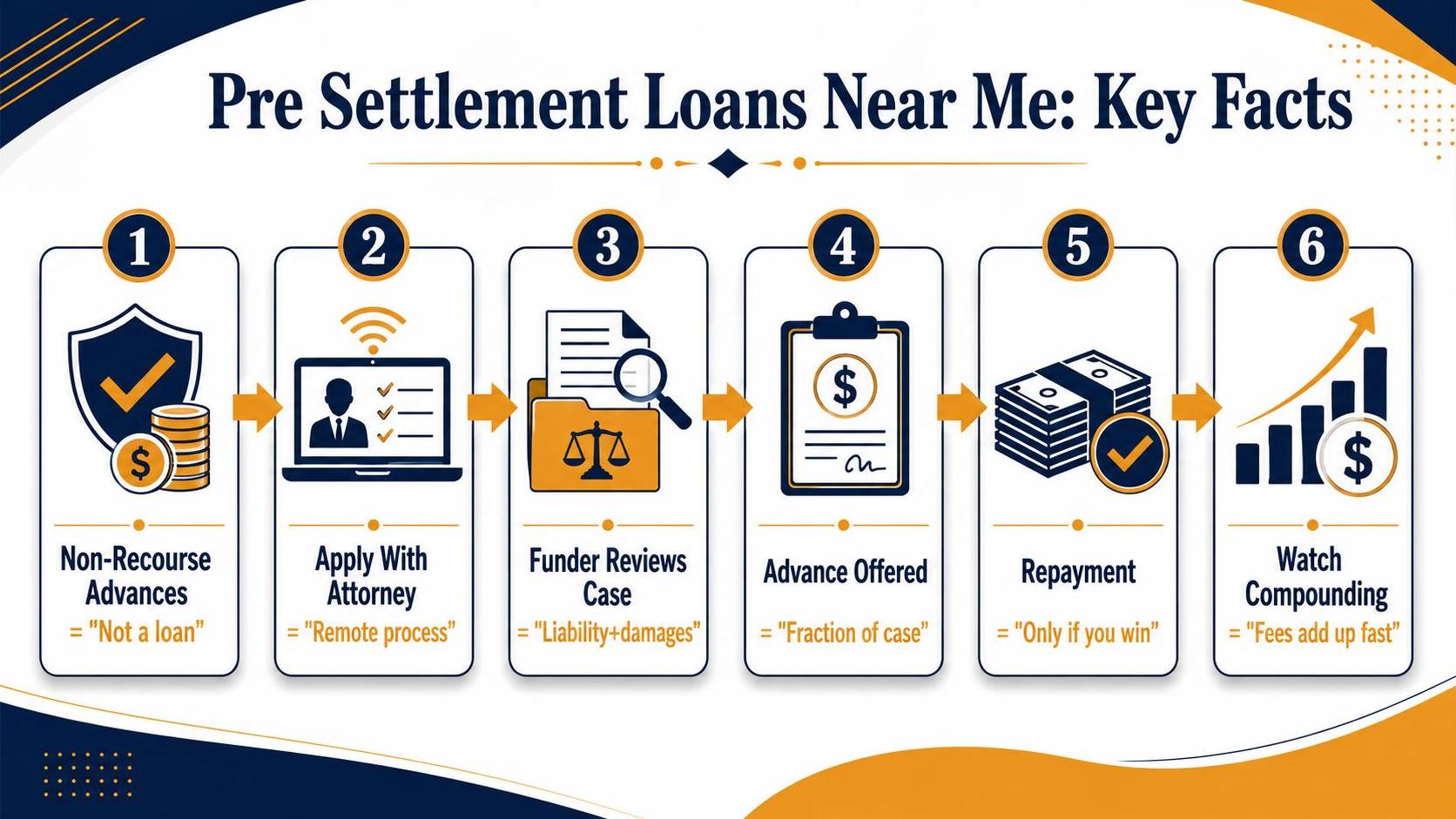
How pre settlement loans near me work
“Pre settlement loans” are usually not traditional loans. They are non-recourse cash advances against a pending legal claim, which means the funding company is typically repaid only if the case settles or wins.
Local results usually mean a company licensed or doing business in the reader’s state, not a storefront nearby.
State rules matter because settlement funding is regulated differently across the U.S., and some states set contract disclosures or fee limits.
The process starts after a plaintiff has an active claim and an attorney handling it. The funder reviews the case, expected settlement value, insurance coverage, and likely timeline before deciding whether to advance money.
Funding amounts are usually a fraction of the expected recovery, not the full case value.
The Consumer Financial Protection Bureau has warned that legal financing can be expensive and may reduce what a consumer keeps from a settlement, so readers should review the contract carefully and ask their lawyer to explain every charge.
| Step | What happens | Source-backed fact |
| 1 | Application | The plaintiff provides basic case details and attorney contact information. |
| 2 | Attorney cooperation | The funder usually needs documents from the lawyer because the claim, not employment income, supports approval. |
| 3 | Underwriting | Companies assess liability, damages, insurance limits, and expected time to resolution. |
| 4 | Advance offer | The offer states the amount advanced and the pricing method, often monthly use fees or compounded charges. |
| 5 | Repayment | If the plaintiff recovers money, the funder is paid from the settlement proceeds before the plaintiff receives the remainder. |
Costs vary sharply by company and state.
The CFPB reported in a 2022 issue spotlight that consumers may not understand how compounding fees increase payoff amounts over time, which is why contract language on monthly charges, payoff schedules, and caps matters.
Some states require disclosures. For example, West Virginia’s litigation financing law requires a written contract with specific consumer notices, according to the West Virginia Code.
Other states have different rules, and some court decisions affect enforceability, so readers should verify current law with the state statute or regulator.
- Ask whether fees are simple or compounded. Compounding can raise repayment faster.
- Request a payoff schedule at 6, 12, and 18 months.
- Confirm whether there are origination, underwriting, or payoff-processing fees.
- Have the attorney review the agreement before signing.
Caution: a fast advance can solve a cash crunch, but it can also materially cut the plaintiff’s net recovery. Do not rely on advertising alone; check the contract, state law, and the attorney’s advice before accepting funds.

Local funding companies versus national providers
“Near me” can matter for convenience, but the contract usually matters more than the office address.
In lawsuit funding, both local companies and national providers can be expensive, and the Consumer Financial Protection Bureau said consumer legal funding can carry annual costs of 27% to 60%.
That CFPB range matters because pre-settlement funding is usually repaid from the case proceeds, not from the consumer’s paycheck.
A nearby office may help with document drop-off or attorney coordination, but it does not automatically mean lower pricing or better disclosures.
| Comparison point | Local company | National provider | Source |
| Typical service area | Often one state or one metro area | Often multi-state | Company service-area disclosures; verify on the provider’s own website and contract |
| Cost benchmark seen in legal funding | 27% to 60% annual cost can appear in the market | 27% to 60% annual cost can appear in the market | Consumer Financial Protection Bureau, consumer legal funding report |
| Balance growth on a $10,000 advance after 12 months | $12,700 at 27%; $16,000 at 60% | $12,700 at 27%; $16,000 at 60% | Arithmetic using the CFPB’s 27% to 60% annual cost range |
National providers often have more standardized intake systems. That can mean faster document handling when an attorney already has police reports, medical records, and insurer correspondence ready.
A local company may offer more direct access to a decision-maker, but that advantage depends on the business, not the zip code.
Ask both types of companies the same written questions. Compare the total payoff, whether charges are simple or compounding, and whether fees accrue monthly. If a company will not show a payoff schedule, that is a risk signal.
- Request the full funding agreement before signing.
- Ask for payoff amounts at 6, 12, and 18 months.
- Confirm whether the advance is non-recourse in the contract.
- Check whether your state regulates legal funding disclosures or cancellations.
Caution: do not choose a provider based only on “near me,” speed, or an advertised low monthly rate. Terms can vary sharply, and state rules differ. Read the contract and have your attorney review the payoff language before acting.

Costs to compare before signing
The headline number on a pre-settlement advance can hide the real cost. Compare the fee structure, the compounding method, and the total payoff in dollars, not only the cash received today.
This matters because many contracts use a monthly charge instead of a standard APR. A monthly fee can look small, but the payoff can rise fast if the case takes longer than expected.
| Cost measure | Number to compare | Source |
| Personal loan benchmark | 11.92% average APR for a 24-month personal loan at commercial banks, May 2024 | Federal Reserve, G.19 Consumer Credit |
| Credit card benchmark | 21.47% average APR on credit card accounts assessed interest, May 2024 | Federal Reserve, G.19 Consumer Credit |
| Monthly fee example | 3% per month = 36% simple annual rate | Arithmetic from the contract rate |
| Compounded example | 3% per month compounded monthly = 42.58% effective annual rate | Arithmetic from the contract rate |
| Higher monthly fee example | 4% per month = 48% simple annual rate | Arithmetic from the contract rate |
| Higher compounded example | 4% per month compounded monthly = 60.10% effective annual rate | Arithmetic from the contract rate |
Ask for the payoff amount at multiple dates. If the advance is $10,000 and the contract uses a 3% monthly fee, the cost is $3,600 after 12 months on a simple basis, making the payoff $13,600.
If that same 3% fee compounds monthly, the 12-month payoff becomes about $14,257. The difference is about $657 in one year, created only by compounding.
Also check whether the company adds flat charges. Common examples include application, underwriting, wire, or case-servicing fees. A contract can become materially more expensive if those fees are deducted from proceeds or added to the payoff.
- Request a payoff schedule for 6, 12, 18, and 24 months.
- Ask whether fees are simple or compounded.
- Ask whether any fee is charged before funding or after cancellation.
- Ask whether your attorney must repay costs from settlement proceeds before the funding company is paid.
Caution: Do not sign based on a monthly percentage alone. Read the contract and have your attorney explain the total repayment in dollars and any state-law limits that apply where the case is filed.

What approval depends on in your case
Approval for a pre-settlement advance usually turns on the strength and value of the legal claim, not the applicant’s credit score or job history.
Lawsuit funders commonly review whether liability is clear, whether insurance or other assets are available, and whether a lawyer is actively handling the case.
The core question is simple: is there likely to be a settlement or verdict large enough to repay the advance, fees, and the plaintiff’s share? If that is uncertain, approval gets harder or the offered amount gets smaller.
Liability is often the first screen. A rear-end crash with a police report and treatment records is easier to underwrite than a disputed slip-and-fall with no witness.
Funders also look at comparative fault rules in the state because partial fault can reduce recoverable damages.
Damages matter because the case needs enough value after attorney fees, case costs, medical liens, and any prior advances.
Medical records, imaging, surgery recommendations, lost-wage proof, and long-term impairment evidence usually strengthen the file.
Insurance coverage is critical. In auto cases, the available policy can cap practical recovery even when injuries are serious.
The Insurance Information Institute reported that the average auto liability claim severity for bodily injury was $26,501 in 2022, while property damage averaged $5,313.
| Claim measure | Figure | Source |
| Average auto bodily injury liability claim severity | $26,501 in 2022 | Insurance Information Institute, Facts + Statistics: Auto insurance |
| Average auto property damage liability claim severity | $5,313 in 2022 | Insurance Information Institute, Facts + Statistics: Auto insurance |
| Contingency fee benchmark often referenced by consumers | 33% to 40% of recovery | American Bar Association consumer guidance; actual contracts vary |
Attorney involvement also affects approval. Many funders require an attorney because they need case documents and payoff coordination from settlement proceeds.
If no lawsuit has been filed, some companies still consider the case, but documented liability and treatment usually need to be strong.
Timing matters. A case close to mediation, serious settlement talks, or trial can look more predictable than a newly opened claim. Collectability matters too. A strong liability case against an uninsured or insolvent defendant may still be declined.
- Clear defendant fault and solid evidence usually help.
- Higher policy limits or other collectible assets usually help.
- Severe, well-documented injuries usually help.
- Large liens, weak medical proof, or disputed fault usually hurt.
Use caution before signing. Pre-settlement advances can be expensive, and the contract terms control the payoff.
Check the pricing, compounding method, fees, and state rules in the written agreement and ask the handling attorney to review the documents before acting.

State rules that affect settlement funding
State law can change the price, disclosures, and cancellation rights tied to pre-settlement funding. A company that can fund a case in one state may face registration, contract, or fee rules in another, so location matters before anyone signs.
Readers should not rely on a national ad alone. The safest next step is to check the current statute in the state where the lawsuit is filed and ask a lawyer to review the contract before money changes hands.
Many states regulate these deals as “consumer legal funding” or “litigation financing.” Common rules include a mandatory disclosure that the transaction is nonrecourse, a right to cancel within a short window.
And a requirement that the consumer’s attorney acknowledge the lien or assignment terms.
| State | Named law | Example rule with a number |
| Illinois | Illinois Consumer Legal Funding Act | The law gives the consumer 5 business days to cancel after receiving the funds, if the consumer returns the full amount. Source: Illinois Consumer Legal Funding Act. |
| Indiana | Indiana Code, Nonrecourse Civil Litigation Funding | Indiana also provides a 5 business-day cancellation period in covered transactions. Source: Indiana Code provisions on nonrecourse civil litigation funding. |
| Nebraska | Nebraska Nonrecourse Civil Litigation Act | Nebraska gives the consumer 5 business days to rescind the contract without penalty if the funded amount is returned. Source: Nebraska Nonrecourse Civil Litigation Act. |
| West Virginia | West Virginia Consumer Litigation Financing Act | West Virginia requires a 5 business-day cancellation right and statutory disclosures in the contract. Source: West Virginia Consumer Litigation Financing Act. |
Those numbers matter because cancellation rights are one of the few clear protections a consumer can use quickly. If a contract does not match the state statute on timing, disclosures, or attorney acknowledgments, that is a warning sign.
States also differ on pricing controls. Some statutes limit certain fees or require itemized disclosure of the total amount due at 6-month intervals; others focus more on format, registration, and prohibited contract terms.
Because fee caps and compounding rules change by state, readers should verify the current law in the statute itself.
- Check whether the provider must register or hold a license in that state.
- Check the cancellation period and whether it is counted in calendar days or business days.
- Check whether the contract shows the payoff schedule at set intervals.
- Check whether the consumer’s attorney must sign an acknowledgment.
Caution: signing without checking state law can raise the payoff far beyond the cash received. A local attorney can confirm whether the contract follows the current statute and whether any court approval or notice rules apply.

Risks before borrowing against a lawsuit
Pre-settlement funding can solve a cash shortfall, but the main risk is time. The longer a case stays open, the more expensive many advances become, especially when fees are charged monthly rather than once.
Another risk is expecting a payout that never arrives. A settlement can shrink after medical liens, attorney fees, expert costs, and case expenses are deducted, leaving far less than the headline number.
Delay is not theoretical. Court rules create built-in waiting periods, and any appeal or post-trial motion can extend the timeline further. If a contract adds charges every month, those extra weeks matter.
| Delay point | Number | Primary source | Why it matters |
| Notice of appeal in most federal civil cases | 30 days after entry of judgment | Federal Rules of Appellate Procedure 4(a)(1)(A) | Repayment may be pushed back while an appeal proceeds. |
| Notice of appeal when the United States is a party | 60 days | Federal Rules of Appellate Procedure 4(a)(1)(B) | A longer appeal window can extend the funding period. |
| Motion for a new trial or to alter or amend judgment | 28 days | Federal Rules of Civil Procedure 59(b) and 59(e) | Post-trial motions can delay final resolution. |
Contract structure is the second major risk. Some legal funding contracts use compounding fees. Compound pricing grows faster than simple pricing because charges are added on top of prior charges, not only on the original advance.
Disclosure quality also varies.
The Consumer Financial Protection Bureau has said consumer litigation funding is generally not covered by the federal Truth in Lending Act, which means the standardized APR disclosures borrowers see in many loans may not be required here.
That creates comparison risk. Two companies can advertise the same cash advance, but one contract may include origination fees, underwriting fees, or compounding terms that make the payoff much higher.
- Read whether charges are simple or compound, and how often they accrue.
- Ask for the total payoff at 6, 12, and 18 months in writing.
- Check whether the company can fund more than once on the same case.
- Confirm how medical liens and attorney fees are paid before funding is repaid.
Plain caution: do not sign based on an ad or a phone quote alone. Ask a lawyer to review the contract and check state law, because pricing rules and disclosure requirements can differ by state and may change.

What the editorial team independently reviewed
We limited this review to facts readers can verify from primary sources.
We did not treat “pre-settlement loans” as ordinary loans, because the Consumer Financial Protection Bureau says many lawsuit advances are structured as nonrecourse products and may fall outside standard consumer-lending rules.
We focused on disclosures that change the real cost of cash before settlement: whether repayment is nonrecourse, how fees are described, how quickly a company says funds may arrive, and whether state laws or court approval can delay payment.
Readers should confirm current terms in the provider’s contract and with their attorney before signing.
| Item reviewed | What we checked | Primary source |
| Product type | Whether the company describes the advance as nonrecourse, meaning repayment usually depends on a recovery in the case. | Consumer Financial Protection Bureau, 2017 consumer bulletin on lawsuit settlement advances |
| Speed claims | Whether the company states an approval or funding timeline, and whether the language says “may,” “can,” or guarantees timing. | Provider websites and disclosures; timing language varies by company |
| Cost disclosure | Whether pricing is shown as a flat fee, monthly use rate, compounding charge, or another structure. | Provider contract samples where publicly posted; state filings where available |
| State limits | Whether state law requires contract language, cooling-off periods, attorney acknowledgment, or court approval. | State statutes and legislative materials |
For baseline facts, we used the CFPB’s warning that charges can be high and that consumers should compare the total repayment amount, not only the cash received.
That matters because two offers for the same advance amount can lead to very different payoff totals.
We also checked state-level legal sources. For example, Maine’s 2023 law regulating certain litigation funding transactions sets disclosure and contract rules. Colorado enacted consumer protections for litigation financing in 2024.
State rules can change availability, cancellation rights, and attorney paperwork.
- We treated “same-day” and “24-hour” language as marketing claims unless the contract or statute supported the condition.
- We excluded any provider page that did not clearly explain whether fees were simple or compounding.
- We gave more weight to statutes, regulator publications, and signed contract samples than to homepage summaries.
Plain caution: a lawsuit advance can reduce the money left from a settlement. No reader should rely on a directory result or ad alone.
Check the contract, ask a lawyer to calculate the total payoff at se

veral dates, and verify whether state law adds protections or restrictions.
Questions to ask nearby settlement funders
Local access can make meetings easier, but convenience does not make funding cheaper or safer. Ask direct questions about pricing, timing, legal review, and cancellation rights before signing any pre-settlement funding agreement.
Pre-settlement funding is usually nonrecourse, meaning repayment typically comes only from the case proceeds if the case succeeds.
The Consumer Financial Protection Bureau describes lawsuit advances as costly and says consumers should read the contract carefully and compare offers.
| Question | Why it matters | What to verify |
| What is the total payoff if the case settles in 6, 12, and 18 months? | Time-based charges can raise the payoff fast. | Get dollar figures in writing for each month or interval. |
| Is the pricing simple interest or compounding? | Compounding can increase costs faster than simple charges. | Ask for the exact formula in the contract. |
| Are there origination, underwriting, processing, or wire fees? | Fees change the real cost even if the headline rate looks lower. | Request an itemized fee list. |
| How long does approval and funding usually take? | Timing matters if rent, medical bills, or utilities are due. | Ask what documents are required from the attorney. |
| Does my attorney have to approve the advance? | Most funders require attorney cooperation because the lien is tied to the case. | Confirm the attorney acknowledgment process. |
Ask for the funder’s written disclosure of all charges. In Illinois, the Consumer Legal Funding Act requires a consumer contract to state the funded amount and the itemized charges, under 815 ILCS 121/25.
State rules vary, so check your state statute or regulator.
Ask whether there is a cancellation period. For example, Illinois law gives consumers 5 business days to cancel without penalty, under 815 ILCS 121/30.
Do not assume the same rule applies elsewhere; nearby funders may operate under different state laws.
- Ask whether the company is funding directly or brokering the file to another company. A broker layer can add cost.
- Ask whether partial repayments are allowed. This can matter if a case resolves in stages.
- Ask what happens if the case loses or settles for less than expected. Confirm the nonrecourse language in writing.
- Ask for a sample contract before applying. Review it with your attorney before signing.
Caution: do not rely on an advertisement alone. The Federal Trade Commission says financing terms should be reviewed carefully; for legal funding, the contract and state law control the real obligation.
Frequently Asked Questions
What does “pre-settlement loans near me” usually mean?
The phrase usually refers to pre-settlement funding companies that advance money to plaintiffs with pending legal claims, not traditional banks or personal loan lenders.
In many cases, location matters less than whether the company can legally fund cases in the reader’s state and whether the plaintiff’s attorney will cooperate with the review process.
Are pre-settlement loans actually loans?
They are often structured as non-recourse cash advances rather than standard consumer loans, which means repayment is typically expected only if the case settles or ends with a recovery.
Terms vary by company and state, so readers should review the contract carefully and ask a lawyer to explain fees, payoff rules, and what happens if the case is lost.
How can someone find a legitimate pre-settlement funding company nearby?
A practical step is to check whether the company clearly discloses its process, contract terms, state availability, and contact information, and whether the plaintiff’s attorney has experience dealing with that funder.
Readers should be cautious with any company that promises guaranteed approval, refuses to provide written terms, or pressures applicants to sign before their lawyer reviews the agreement.
What factors affect approval for pre-settlement funding?
Funding decisions usually depend more on the strength of the legal claim, expected settlement value, and case status than on employment, income, or credit score.
The funding company commonly asks the plaintiff’s attorney for case documents and a case up

date, so delays often happen when records are incomplete or liability is unclear.
Related Reading
- Lawsuit Loans With Low Interest Rates
- Settlement Loan Companies
- High Rise Financial Reviews – What You Need to Know
- Tribeca Group Review – The Truth You Didn't Know
- Behind the Oasis Financial Lawsuit
- Best Pre Settlement Loans
- JG Wentworth Pre Settlement Funding
- National Lawsuit Funding Reviews
- Sunrise Lawsuit Funding Reviews
- All Blog Guides