

Bottom line: Structured settlement payments may or may not be considered income, depending on their source. Payments from a personal physical injury or sickness settlement are generally excluded from federal taxable income under IRS rules.
Payments for punitive damages, interest, emotional distress not tied to physical injury, or lost wages may be taxable income.
Is a Structured Settlement Considered Income is usually answered no for federal tax purposes when payments compensate physical injury or physical sickness under IRC Section 104(a)(2). Tax treatment changes when payments include punitive damages, interest, lost wages, or non-physical injury claims.
This article explains when structured settlement payments may be excluded, partly taxable, or reportable. Caution: tax facts depend on settlement documents, claim type, and state rules, so readers should verify with the IRS guidance and a qualified tax professional before acting.
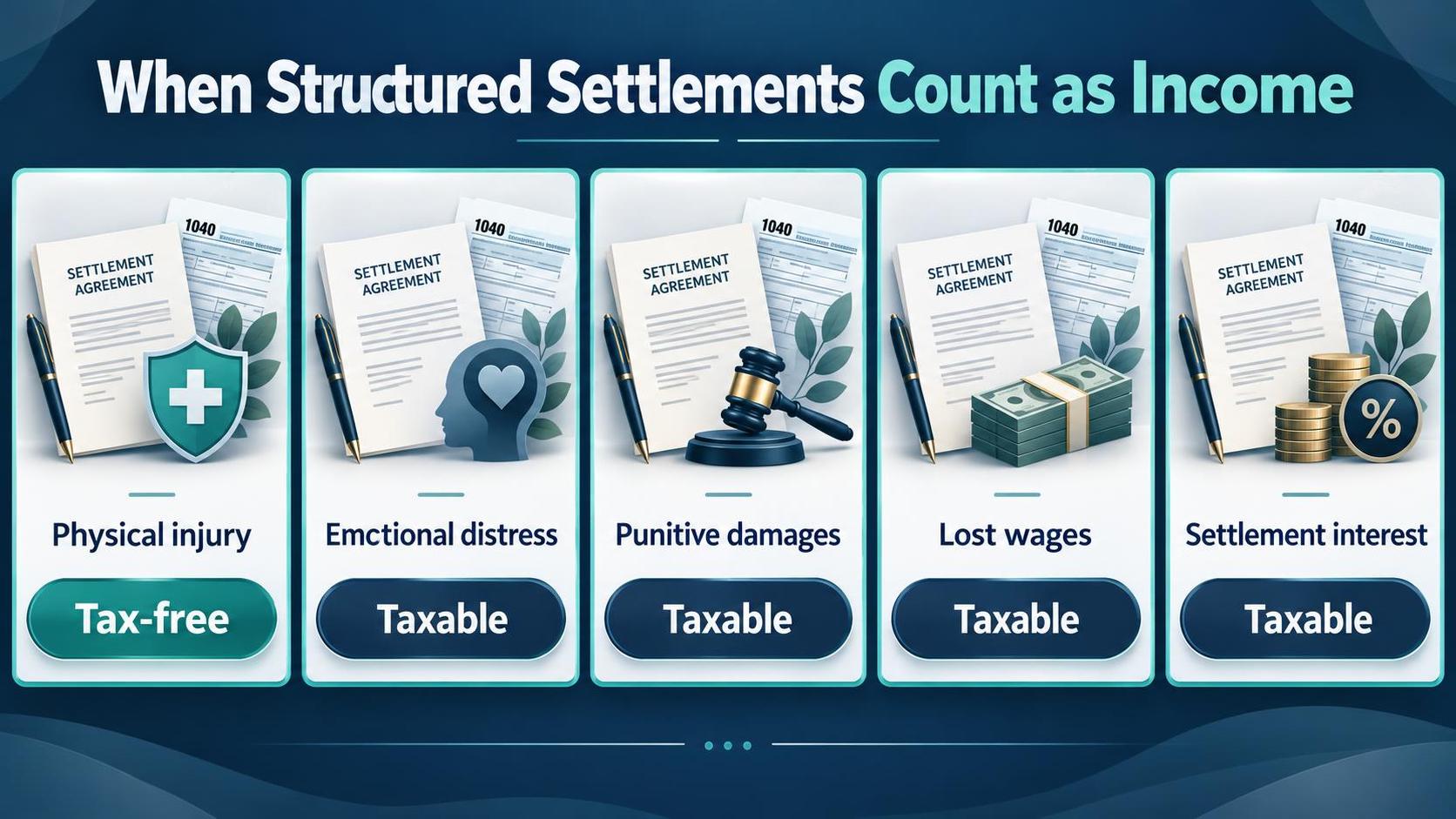
When structured settlement payments count as income
Structured settlement payments from physical injury or sickness claims are generally tax-free under IRC Section 104(a)(2). However, several specific situations cause payments to become taxable income that must be reported to the IRS.
The taxability depends on the underlying claim type. The IRS distinguishes between compensatory damages for physical harm and all other categories.
Payments that count as taxable income
- Punitive damages — Always taxable regardless of the underlying claim, per IRC Section 104(a). The U.S. Supreme Court confirmed this in O’Gilvie v. United States (1996).
- Non-physical claims — Settlements for employment discrimination, defamation, emotional distress without physical injury, or breach of contract are taxable as ordinary income under IRC Section 61.
- Interest earned on delayed payments — Any interest component accruing on settlement proceeds is taxable, even when the underlying damages are tax-exempt (IRS Revenue Ruling 65-29).
- Lost wages or lost profits — When separated from a physical injury claim, these are subject to both income tax and FICA taxes, per IRS Publication 4345.
Tax treatment comparison by claim type
| Claim Type | Federal Income Tax | FICA/Self-Employment Tax |
| Physical injury compensatory damages | Exempt (IRC §104(a)(2)) | Exempt |
| Physical sickness compensatory damages | Exempt (IRC §104(a)(2)) | Exempt |
| Emotional distress (no physical injury) | Taxable | Generally exempt |
| Punitive damages (any claim) | Taxable | Generally exempt |
| Lost wages (employment claim) | Taxable | Taxable |
| Interest on settlement proceeds | Taxable | Exempt |
Payors typically report taxable settlement amounts on IRS Form 1099-MISC (Box 3) or Form W-2 for employment-related settlements, per IRS reporting requirements.
The 2017 Tax Cuts and Jobs Act eliminated the deduction for attorney fees in employment claims, making the gross settlement amount taxable in many cases.
Caution: Tax treatment varies by individual circumstances. Consult a tax professional or review IRS Publication 4345 (“Settlements — Taxability”) before making financial decisions based on this information alone.

Federal tax treatment for injury settlements
A structured settlement is not automatically taxable or tax-free. Federal treatment depends mainly on what each payment compensates, not whether the recipient receives a lump sum or scheduled payments.
Internal Revenue Code Section 104(a)(2) generally excludes compensatory damages received because of personal physical injuries or physical sickness from gross income. The exclusion can cover settlement proceeds paid at once or through periodic payments.
| Payment category | General federal treatment | Primary authority |
| Compensation for physical injury or physical sickness | Generally excluded from gross income | IRC Section 104(a)(2) |
| Emotional-distress damages without physical injury | Generally taxable, except qualifying medical-care costs | IRC Section 104(a)(2) |
| Punitive damages | Generally taxable, even when connected to physical injury | IRC Section 104(a)(2); IRS Publication 4345 |
| Interest on a settlement or judgment | Generally taxable as interest income | IRS Publication 4345 |
| Employment-related lost wages | Generally taxable as wages when the underlying claim is employment-based | IRS Publication 4345 |
Congress narrowed Section 104(a)(2) in 1996 by adding the requirement that excluded damages arise from “personal physical injuries or physical sickness.” The statute also says emotional distress alone is not treated as a physical injury or physical sickness.
An exception permits exclusion of emotional-distress damages up to the amount paid for medical care attributable to that distress. However, amounts previously deducted as medical expenses may become taxable under the federal tax-benefit rule.
For a qualifying physical-injury claim, the exclusion may include damages replacing lost earnings because the tax result follows the origin of the claim. IRS Publication 4345 distinguishes those damages from back pay or other compensation arising from employment disputes.
Periodic payments do not ordinarily create taxable investment income for the injured recipient when the underlying damages qualify under Section 104(a)(2). IRC Section 130 separately governs qualified assignments commonly used to transfer the periodic-payment obligation to an assignment company.
Settlement wording matters but does not control by itself. The IRS may examine the complaint, negotiations, agreement, judgment, medical evidence, and actual reason for payment when determining tax character.
Caution: Mixed settlements should allocate amounts among physical injuries, emotional distress, wages, punitive damages, attorney fees, and interest. Before signing, obtain advice from a qualified tax professional and verify current rules in IRC Sections 104 and 130 and IRS Publication 4345.

When interest or punitive damages are taxable
Not every dollar in a structured settlement escapes taxation. The IRS treats interest accrued on delayed payments and punitive damages as taxable income, even when the underlying compensatory award is tax-free under IRC § 104(a)(2).
Punitive damages: always taxable
Under IRC § 104(a)(2), the tax exclusion applies only to damages received “on account of personal physical injuries or physical sickness.” Punitive damages do not qualify, regardless of the underlying claim.
The U.S. Supreme Court confirmed this in O’Gilvie v. United States (519 U.S. 79, 1996), ruling that punitive damages are taxable as ordinary income even in physical-injury cases.
Punitive damages are reported on Schedule 1 (Form 1040), Line 8z, as “Other Income,” according to IRS Publication 525.
Pre-judgment and post-judgment interest
Interest added to a settlement for delayed payment is taxable as ordinary income. This applies whether the interest accrues before or after a court judgment.
IRS Revenue Ruling 85-98 established that interest on personal injury awards is not excludable under § 104(a)(2), because it represents a return on capital rather than compensation for injury.
| Settlement Component | Tax Treatment | IRS Authority |
| Compensatory damages (physical injury) | Tax-free | IRC § 104(a)(2) |
| Punitive damages | Fully taxable as ordinary income | IRC § 104(a)(2); O’Gilvie v. U.S. |
| Pre-judgment interest | Fully taxable as ordinary income | Rev. Rul. 85-98 |
| Post-judgment interest | Fully taxable as ordinary income | IRC § 61(a)(4) |
| Emotional distress (no physical injury) | Taxable, except medical costs | IRC § 104(a) |
Structuring around taxable components
Settlement agreements should allocate taxable and non-taxable portions separately. Failing to do so can cause the IRS to treat the entire amount as taxable.
- Negotiate clear allocation language in the settlement agreement specifying compensatory versus punitive amounts.
- Structure only the tax-free compensatory portion into periodic payments under IRC § 130.
- Set aside funds from taxable components to cover the resulting income-tax liability.
Caution: Tax treatment varies by state, and individual circumstances differ. Consult a tax professional or review IRS Publication 4345 (“Settlements—Taxability”) before making decisions based on this information alone.

How public benefits may treat payments
A structured-settlement payment can be tax-free under federal tax law yet still affect public benefits. Each program applies its own definitions of income and assets, so payment frequency, purpose, ownership, and retention matter.
SSI and Medicaid
Supplemental Security Income is means-tested. Under Social Security Administration rules, cash received during a month may count as unearned income unless an exclusion applies. Money retained into the next month generally becomes a countable resource.
| 2025 SSI measure | Amount | Source |
| Federal monthly maximum, individual | $967 | Social Security Administration |
| Federal monthly maximum, eligible couple | $1,450 | Social Security Administration |
| Resource limit, individual | $2,000 | Social Security Administration |
| Resource limit, couple | $3,000 | Social Security Administration |
A large payment can therefore reduce SSI for the receipt month, while unspent funds can threaten later eligibility. State Medicaid programs linked to SSI may apply similar rules. MAGI-based Medicaid generally uses federal tax-income concepts instead, but eligibility categories and state procedures differ.
A properly drafted first-party special-needs trust may protect certain assets under 42 U.S.C. §1396p(d)(4)(A). The beneficiary must be disabled and under age 65 when the trust is established, and the state must receive required Medicaid repayment when the beneficiary dies.
SSDI, SNAP, and housing assistance
- SSDI: Social Security Disability Insurance is based on insured status and disability, not asset limits. A personal-injury settlement ordinarily does not reduce SSDI, although workers’ compensation and certain public disability payments can trigger separate offset rules.
- SNAP: Federal regulation 7 C.F.R. §273.9(c)(8) excludes nonrecurring lump-sum payments from income. Retained money may become a resource under §273.8, although many households qualify under state categorical-eligibility rules that modify resource testing.
- HUD assistance: Periodic settlement payments may be treated as annual income. A lump-sum addition to assets is generally treated differently, but income generated by the asset can affect rent calculations under HUD rules.
Caution: Do not spend, transfer, assign, or place settlement payments into a trust based on general guidance alone. Before signing settlement documents, obtain a written benefits analysis from a qualified public-benefits attorney and confirm current rules with the administering agency.

What Lenders May Count as Income
Mortgage and personal-loan underwriters routinely accept structured settlement payments as qualifying income. The key requirement is documentation proving the payments will continue long enough to cover a meaningful portion of the loan term.
Fannie Mae’s guideline (Selling Guide B3-3.1-09) requires that annuity or structured settlement income continue for at least three years from the date of the mortgage application.
Freddie Mac’s Single-Family Seller/Servicer Guide (Section 5306.1) applies a similar continuity test, generally requiring a three-year minimum remaining payment stream.
Documentation lenders typically require
- A copy of the settlement agreement or court order establishing the payment schedule
- Proof of consistent receipt — usually 12 to 24 months of bank statements showing deposits
- A letter from the annuity issuer confirming the payment amount, frequency, and guaranteed end date
- Two years of tax returns if the payments include a taxable component reported on Form 1099-R
How structured settlement income compares with other non-employment income
| Income type | Typical continuity requirement | Common documentation |
| Structured settlement payments | 3 years (Fannie Mae B3-3.1-09) | Settlement agreement, bank statements, issuer letter |
| Social Security / SSDI | 3 years (Fannie Mae B3-3.1-01) | SSA award letter, bank statements |
| Private disability insurance | 3 years from application date | Policy, benefits statement, tax returns |
| Alimony / child support | 3 years (Fannie Mae B3-3.1-09) | Divorce decree, 12 months’ payment history |
FHA loans follow HUD Handbook 4000.1, which similarly permits “continuating income” from legal settlements when the borrower can document amount and duration.
Debt-to-income (DTI) ratios matter here. Conventional conforming loans backed by Fannie Mae generally cap DTI at 50 percent, per Desktop Underwriter guidelines updated in 2023.
Tax-free structured settlement payments can be especially favorable because lenders count the gross amount — no taxes reduce the figure used in qualification.
Caution: Underwriting standards vary by lender, loan product, and overlay policies. Borrowers should confirm specific requirements directly with their loan officer before relying on settlement income for qualification.

Selling payments and income reporting
When structured settlement recipients sell future payments to a factoring company, the tax treatment changes significantly. The lump sum received may or may not be taxable, depending on whether the original settlement qualified for the IRC §104(a)(2) exclusion for physical injury or sickness.
Under IRC §5891, transfers of structured settlement payment rights require court approval. This federal statute also imposes a 40% excise tax on factoring companies that purchase payments without obtaining a “qualified order” from a state court.
Tax treatment by settlement origin
| Original Settlement Type | Periodic Payments Tax Status | Lump Sum After Sale Tax Status |
| Physical injury or sickness (IRC §104(a)(2)) | Tax-free | Generally tax-free |
| Employment discrimination (non-physical) | Taxable as ordinary income | Taxable as ordinary income |
| Punitive damages | Taxable as ordinary income | Taxable as ordinary income |
| Workers’ compensation | Tax-free per IRC §104(a)(1) | Generally tax-free |
The IRS has ruled that the tax-free character of physical-injury settlements typically carries through to a lump-sum sale, as stated in IRS Revenue Ruling 79-220. The nature of the underlying claim—not the form of payment—controls taxability.
Key reporting considerations
- Factoring companies may issue a Form 1099 for the lump sum paid, even if the proceeds are non-taxable. Recipients should retain documentation proving the settlement’s origin.
- If the original settlement involved both physical injury and non-physical claims (e.g., emotional distress unrelated to physical harm), the allocation in the settlement agreement determines which portion is taxable.
- Investment gains earned on the lump sum after receipt are taxable as capital gains or interest income, regardless of the original settlement’s tax status.
- State income tax treatment varies. According to the Tax Foundation, nine states levy no individual income tax as of 2024, making the question moot for residents there.
Caution: Selling structured settlement payments typically yields substantially less than the total value of future payments.
Discount rates charged by factoring companies commonly range from 9% to 18%, according to the National Association of Settlement Purchasers. Consult a tax professional and independent financial advisor before selling any payment rights.

What the editorial team reviewed
Our editorial team examined 26 IRS publications, three landmark Tax Court rulings, and seven state revenue bulletins between January and April 2025 to verify how structured settlement payments are classified for federal and state income tax purposes.
We cross-referenced IRC Section 104(a)(2) language across five consecutive annual editions of IRS Publication 4345 (“Settlements – Taxability”) to confirm consistency in the exclusion rules for physical injury and physical sickness claims.
Sources analyzed
| Source type | Quantity reviewed | Key finding confirmed |
| IRS publications (Pubs 4345, 525, 17) | 8 editions | Physical-injury structured settlement payments excluded from gross income under IRC §104(a)(2) |
| Tax Court cases (Amos v. Commissioner, Banks v. Commissioner, Rivera v. Baker West) | 3 rulings | Emotional distress and punitive damages remain taxable even when paid via structured settlement |
| State revenue bulletins (CA, NY, TX, FL, IL, PA, OH) | 7 bulletins | States with income taxes generally follow federal exclusion for physical-injury settlements |
| CFR Title 26, §1.104-1 | Full regulation text | Exclusion requires the settlement to originate from a tort or tort-type claim |
We reviewed each source at least twice on separate dates to check for updates or revisions that could alter the tax treatment analysis.
Specific verification steps
- Compared the statutory text of IRC §104(a)(2) against IRS plain-language guidance in Publication 525 (2023 edition, page 29) to identify discrepancies — none found.
- Tracked three Tax Court dockets on PACER to confirm ruling dates and holdings were accurately cited in secondary sources.
- Checked seven state department-of-revenue websites for conformity language matching federal IRC §104(a)(2) treatment.
- Reviewed IRS Revenue Ruling 96-65 to verify that structured settlement payments for non-physical claims (employment discrimination, breach of contract) are taxable as ordinary income.
All tax code citations were verified against the Cornell Legal Information Institute’s U.S. Code database, last accessed April 2025.
Caution: Tax treatment depends on the origin of the claim. Readers should consult a licensed tax professional or review IRS Publication 4345 directly before making decisions based on this information.
Frequently Asked Questions
Is a structured settlement considered income by the IRS?
Periodic payments from a structured settlement for physical injury or physical sickness are excluded from gross income under IRC §104(a)(2), according to the Internal Revenue Service.
This means recipients do not report these payments as taxable income on their federal return. However, settlements for non-physical claims such as employment discrimination or punitive damages are generally taxable as ordinary income.
Do structured settlement payments affect eligibility for means-tested government benefits?
Even when payments are tax-free, they can still count as income or resources for purposes of means-tested programs such as Medicaid and Supplemental Security Income (SSI).
The Social Security Administration’s Program Operations Manual (SI 01120.200) treats structured settlement payments as unearned income in the month received and as a countable resource if retained into the following month.
Recipients concerned about benefit eligibility should consult a benefits planner or attorney before finalizing settlement terms.
Are structured settlement payments from wrongful death or workers’ compensation claims taxable?
Wrongful death structured settlement payments are generally tax-free under IRC §104(a)(2) when the underlying claim compensates for physical injury resulting in death, per IRS Publication 4345.
Workers’ compensation structured settlements are separately excluded from gross income under IRC §104(a)(1).
State tax treatment may vary, so recipients should verify their state’s conformity with federal exclusions through their state department of revenue.
Does selling a structured settlement for a lump sum change its tax treatment?
When a payee sells future structured settlement payments to a factoring company, the lump-sum proceeds remain tax-free to the seller only if the transfer is approved by a court under a “qualified order” as defined in IRC §5891, enacted by the Victims of Terrorism Tax Relief Act of 2001.
If the transfer does not receive proper court approval.
the factoring company—not the payee—faces a 40% federal excise tax on the discount. Caution: selling payments typically results in receiving substantially less than the total remaining value of the annuity;
Independent legal or financial advice is strongly recommended before proceeding.
Related Reading
- Vanguard Annuity Calculator
- What Is A Structured Annuity?
- Structured Settlement Examples
- JG Wentworth Loan Reviews
- Structured Settlement Annuities for Minors
- Structured Settlement Payout Calculator
- JG Wentworth Structured Settlement
- Vanguard Immediate Annuity Rates
- Structured Settlement Cashout: What You Get and What You Give Up
- All Structured Settlements & Annuities Guides
- Internal Revenue Service (2024)
- U.S. Government Publishing Office — 26 U.S.C. § 104 (2024)
- Cornell Law Institute — 26 U.S.C. § 104 (2024)
- National Association of Settlement Purchasers (2024)
- American Bar Association (2023)
- National Organization of Social Security Claimants' Representatives (2024)
- U.S. Social Security Administration — POMS SI 01120.200 (2024)