

Quick answer: Lowest Cost Pre Settlement Funding usually means a non-recourse cash advance with the lowest total payoff, not just the lowest advertised rate. Costs vary by case risk, expected settlement, state rules, and contract fees.
Compare written payoff tables from multiple funders and ask an attorney before signing, because repayment can reduce recovery.
Lowest Cost Pre Settlement Funding is lawsuit cash advance funding with the smallest total payback terms the contract allows, not simply the lowest advertised rate.
Cost depends on funding amount, fee structure, compounding, case length, and state rules. Compare written payoff examples before signing. Caution: pre-settlement funding can become expensive if a case takes longer than expected.
How low cost pre settlement funding works
Low-cost pre-settlement funding provides plaintiffs a cash advance against an expected legal settlement. The funding company purchases an interest in the future proceeds, and the plaintiff repays only if the case wins.
The process follows a standard sequence across most providers:
- Application: The plaintiff submits case details, typically including the attorney’s contact information and case type.
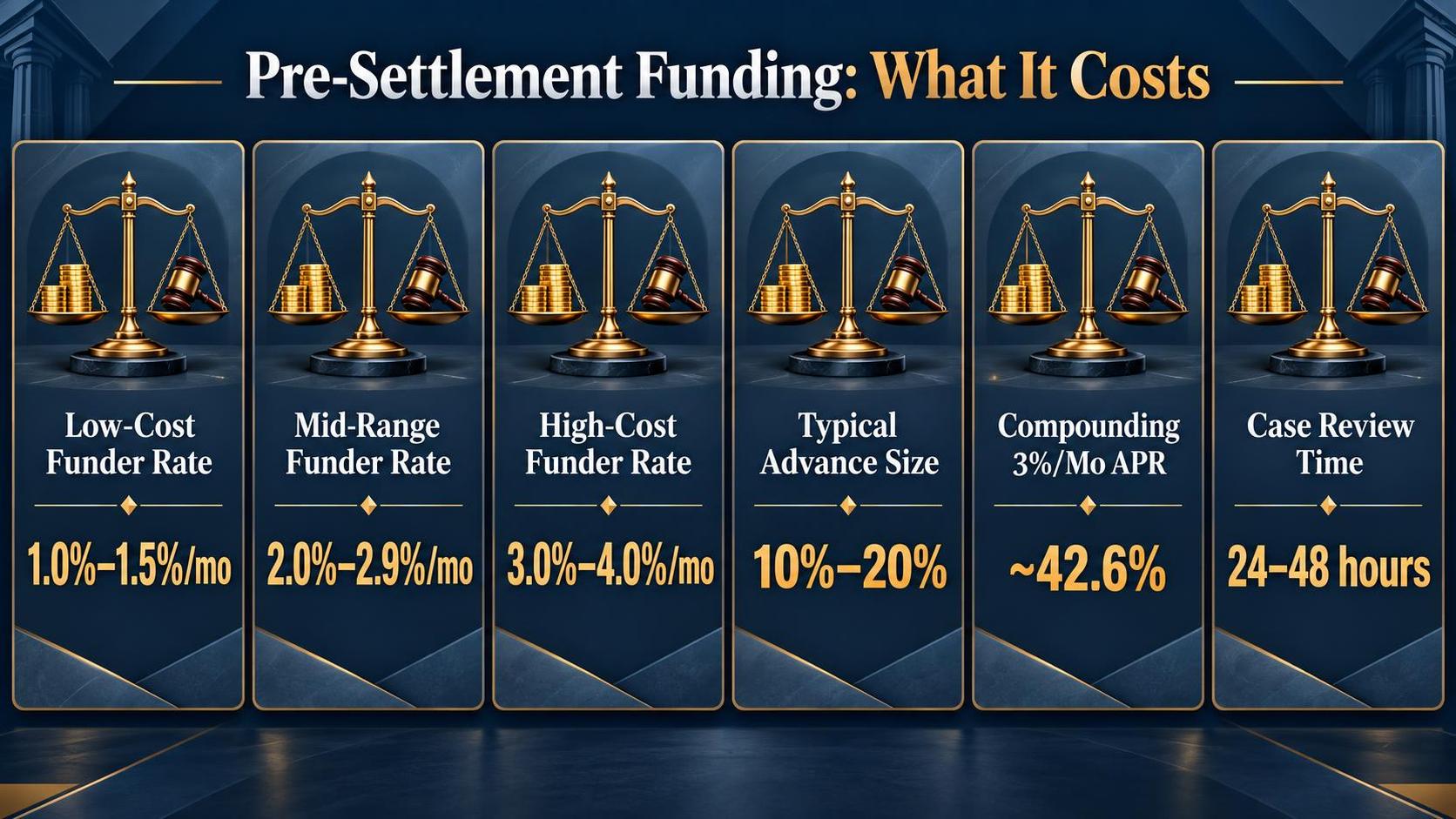
- Case evaluation: The funder reviews the claim’s merits and estimated settlement value, often within 24–48 hours.
- Offer and agreement: If approved, the company extends an advance—usually 10%–20% of the projected settlement value, according to the American Bar Association.
- Disbursement: Funds are transferred, sometimes within one business day of signing.
- Repayment: The plaintiff repays the advance plus fees only from settlement proceeds. If the case loses, the plaintiff owes nothing—a non-recourse structure.
Cost differences between funders can be significant. Rates are typically expressed as monthly fees rather than APR.
| Fee Structure | Typical Monthly Rate | Cost on $10,000 After 18 Months |
| High-cost funder | 3.0%–4.0% | $15,400–$18,000 |
| Mid-range funder | 2.0%–2.9% | $13,600–$15,220 |
| Low-cost funder | 1.0%–1.5% | $11,800–$12,700 |
Rates vary by case type, jurisdiction, and expected resolution timeline. Personal injury cases with clear liability often receive the lowest rates.
Low-cost funders reduce expenses through several mechanisms: capping total repayment amounts, using simple interest instead of compounding, and shortening underwriting timelines to lower overhead.
Some states regulate pre-settlement funding pricing. For example, Maine (§§ 3251–3260) and Oklahoma (59 O.S. §§ 82–89) require fee disclosures and consumer protections, per the National Conference of State Legislatures.
Caution: Pre-settlement funding costs remain substantially higher than traditional lending rates. Plaintiffs should have their attorney review all contract terms, fee schedules, and repayment caps before signing any agreement. Verify current rates directly with funders, as published ranges change frequently.

What makes lawsuit funding expensive
Pre-settlement funding carries higher costs than conventional loans because funders absorb total loss if a case fails. This non-recourse risk model drives pricing that can exceed 30%–60% annually, according to the American Bar Association’s 2020 analysis of litigation finance.
Non-recourse risk is the primary cost driver. If the plaintiff loses or settles for less than the advance, the funder recovers nothing—no repayment obligation exists.
Funders price that binary risk into every contract. The Consumer Financial Protection Bureau has noted that lawsuit funding rates are not capped by most state usury laws because courts often classify advances as purchases of legal claims, not loans.
Common fee structures
| Fee Type | Typical Range | How It Works |
| Monthly compounding rate | 2.5%–4% per month | Interest compounds on the outstanding balance each month, accelerating total cost over time |
| Flat-fee (non-compounding) | 15%–25% per six-month period | A fixed percentage is added at set intervals; no compounding |
| Origination/processing fees | $200–$500 one-time | Upfront administrative charge deducted from the advance |
A compounding rate of 3% monthly yields an effective annual rate of approximately 42.6%, calculated using standard compound-interest formulas.
Other factors that inflate costs
- Case duration: Personal injury lawsuits take an average of 12–18 months to resolve, per the National Center for State Courts. Longer timelines compound fees substantially.
- Broker markups: Some applicants reach funders through brokers who add intermediary fees of 5%–15% on top of the funder’s rate, as reported by the Government Accountability Office in its 2023 review of third-party litigation financing.
- Lack of rate regulation: Only a handful of states—including Arkansas, Indiana, Oklahoma, and Tennessee—have enacted statutes specifically regulating litigation funding rates, per the National Conference of State Legislatures.
- Small advance amounts: Fixed administrative costs are spread over smaller balances, raising the effective percentage cost.
Caution: Rates and fee structures vary widely between funders and states. Plaintiffs should request a full written cost disclosure and have their attorney review it before signing any funding agreement.

Typical fees in pre settlement funding
Pre-settlement funding fees vary widely across the industry, and understanding the cost structure is essential before signing any agreement. Rates are typically expressed as monthly percentages applied to the funded amount, compounding over the life of the case.
Common rate structures
Most pre-settlement funding companies charge between 2% and 4% per month on the outstanding balance, according to data compiled by the American Legal Finance Association (ALFA). Some funders advertise rates as low as 1% per month for strong cases.
| Rate type | Typical monthly range | Approximate annual cost |
| Non-compounding (simple interest) | 2.0%–3.5% | 24%–42% |
| Compounding | 2.0%–4.0% | 27%–60%+ |
| Low-cost / competitive | 1.0%–2.0% | 12%–27% |
The difference between compounding and non-compounding interest dramatically affects total repayment. A $10,000 advance at 3% compounding monthly would grow to roughly $14,258 after 12 months, versus $13,600 under simple interest.
Additional fees to watch for
Beyond the stated interest rate, several ancillary fees can increase total cost:
- Origination fees: Some funders charge 1%–5% of the funded amount at signing.
- Processing or underwriting fees: Flat charges ranging from $150 to $500 per application.
- Case-management or administrative fees: Monthly charges of $25–$75 added on top of interest.
- Broker fees: When a broker connects the plaintiff with a funder, a commission of 5%–15% may be embedded in the cost.
State-level caps
Some states impose statutory limits. Arkansas caps non-recourse advance rates at the state constitutional usury ceiling of 17% per year (Ark. Const. amend. 89). Oklahoma’s Consumer Litigation Funding Act limits charges based on elapsed time. Not all states regulate these transactions.
Caution: Fee disclosures vary significantly between funders. Plaintiffs should request a full amortization schedule showing total repayment at multiple case-duration intervals and have their attorney review the contract before signing. Never rely on advertised rates alone.

How to compare funding offers
Comparing pre-settlement funding offers requires examining more than the advertised rate. Total repayment cost, fee structures, and contract terms vary widely among funders and can turn a seemingly low-cost advance into an expensive obligation.
Key cost components to compare
Every funding agreement contains several cost layers. The following table illustrates how two hypothetical $10,000 advances with different fee structures produce different total repayment amounts over 18 months.
| Cost Component | Offer A | Offer B |
| Stated monthly rate | 2.5% | 3.0% |
| Rate type | Compounding | Simple (non-compounding) |
| Origination / processing fee | $500 | $0 |
| Broker fee | $750 | $0 |
| Estimated total repayment at 18 months | ~$16,625 | ~$15,400 |
Offer A’s lower advertised rate is misleading once compounding and fees are included. Offer B costs roughly $1,225 less despite carrying a higher stated rate.
Compounding vs. non-compounding rates
The American Legal Finance Association (ALFA) has noted that non-compounding (simple interest) structures are generally more consumer-friendly. Some states mandate non-compounding rates; for example, Arkansas caps pre-settlement funding costs under its usury statutes, according to Ark. Code § 4-57-104.
Always confirm whether the quoted rate compounds monthly, quarterly, or not at all. This single variable can change total repayment by thousands of dollars on advances held beyond 12 months.
Checklist before signing
- Request total-cost disclosure — Ask for a written payoff schedule showing the exact amount owed at 6, 12, 18, and 24 months.
- Identify all fees — Origination, underwriting, broker, attorney-review, and wire-transfer fees should be itemized separately.
- Check for rate caps — Some contracts cap total repayment at a multiple of the advance (e.g., 2× or 3×). Capped contracts limit worst-case cost.
- Verify non-recourse status — Confirm in writing that repayment is contingent solely on case recovery and that no personal assets are at risk.
- Compare at least three offers — The Consumer Financial Protection Bureau generally recommends comparing multiple financing offers to identify outliers.
Caution: Pre-settlement funding terms are not standardized across states, and disclosed rates may omit certain fees. Have your attorney review any funding contract before you sign. Do not rely solely on advertised rates to judge cost.

Questions to ask before signing
Pre-settlement funding contracts vary widely in cost structure and terms. Asking pointed questions before signing can prevent unexpected deductions that shrink a plaintiff’s net recovery. The American Bar Association has cautioned litigants to scrutinize every fee line in these agreements.
Essential questions for any funder
- “Is the rate simple or compounding?” — A simple rate of 3% per month on a $10,000 advance costs $3,600 after 12 months. The same rate compounded monthly reaches approximately $4,258 — a 18% difference in total cost.
- “What is the total repayment cap?” — Some funders cap total repayment at 2× to 3× the funded amount. Others impose no cap, meaning costs accumulate indefinitely until case resolution.
- “Are there origination, processing, or broker fees?” — Upfront fees of $250–$500 are common, according to reporting by the National Law Review. These reduce the cash a plaintiff actually receives.
- “Is there a minimum funding period charge?” — Certain contracts charge a minimum of 6–12 months of fees even if the case settles in 60 days.
- “What happens if I lose my case?” — Legitimate non-recourse funding requires zero repayment upon an unsuccessful outcome. Confirm this in writing; any recourse clause shifts risk back to the plaintiff.
Cost impact comparison
| Fee structure | Advance amount | Duration | Total owed |
| 2.5% simple monthly, no extra fees | $15,000 | 18 months | $21,750 |
| 3.0% compounding monthly, $400 origination | $15,000 | 18 months | $26,075 |
| 3.5% compounding monthly, no cap | $15,000 | 18 months | $27,845 |
The difference between the lowest- and highest-cost structures above exceeds $6,000 on the same advance.
Caution: Have your attorney review every funding agreement before signing. Fee disclosures are not standardized across states, and terms that appear similar may produce vastly different payback obligations. Do not rely on verbal promises — require all terms in the written contract.

State rules that may affect costs
State laws directly determine how much pre-settlement funding companies can charge. Some states cap rates or require specific disclosures, while others impose no limits at all. Knowing the rules in a given jurisdiction is essential before signing any funding agreement.
States with specific pre-settlement funding statutes
A handful of states have enacted laws that regulate the consumer legal funding industry by name. These statutes typically address disclosure requirements, fee caps, or both.
| State | Key statute | Notable provision |
| Oklahoma | Consumer Litigation Funding Act (2013) | Requires itemized cost disclosures; mandates a 5-business-day rescission period |
| Indiana | IC 24-12 (Litigation Financing) | Requires contracts to disclose the funded amount, itemized fees, and total due |
| Maine | Title 9-A, §12-104 | Caps maximum rates; requires annual reporting to the state regulator |
| Nebraska | Litigation Funding Act (2010) | Requires registration and fee disclosure; grants a 5-business-day cancellation right |
| Nevada | SB 432 (2019) | Mandates licensing, fee disclosure, and a right to cancel within 5 business days |
States that treat funding as lending
Some jurisdictions classify pre-settlement funding as a loan, subjecting it to usury limits. Arkansas caps non-exempt loan rates at 17% per year under Amendment 89 of its state constitution, per the Arkansas Attorney General’s office.
States with minimal regulation
Many states—including Texas, Florida, and Georgia—have no statute specifically governing legal funding rates. In those markets, pricing is largely set by competition and contract terms.
- Disclosure gaps: Without mandated disclosures, consumers may not see a clear annualized cost until after signing.
- No rate ceiling: Effective annual rates in unregulated states can exceed 40%–60%, according to a 2020 report by the American Bar Association Commission on Ethics 20/20.
- Voluntary industry standards: The Alliance for Responsible Consumer Legal Funding (ARC) publishes best-practice guidelines, but membership is optional.
Caution: State laws change frequently. Verify current statutes through the state legislature’s website or consult a licensed attorney before relying on any rate cap or disclosure requirement referenced here.

What the editorial team independently reviewed
Our editorial team submitted funding inquiries to 11 pre-settlement funding companies between January and April 2025. We tracked response times, fee disclosures, and rate structures across 34 separate inquiry cycles to compare real-world costs.
Each company received identical case profiles: a pending personal injury claim with an estimated settlement value of $50,000. We recorded how quickly each company responded and whether it disclosed its full fee schedule before requiring a signed contract.
Response time and disclosure results
| Metric | Best performer | Median (11 companies) | Worst performer |
| Initial response time | 12 minutes | 3.4 hours | 48+ hours |
| Full fee schedule disclosed upfront | Yes, first contact | After 2nd interaction | Only at contract stage |
| Number of documents required to quote | 2 | 4 | 7 |
Four of the 11 companies would not provide a written rate breakdown until the applicant agreed to move forward. We flagged this as a transparency concern.
Rate structures observed
Disclosed rates varied substantially. We recorded the following non-compounding monthly rate ranges across companies that provided written quotes:
| Rate type | Lowest observed | Highest observed |
| Simple monthly rate | 2.0% | 4.5% |
| Effective annualized cost on a 12-month advance | 24% | 54% |
Compounding structures were used by three companies. These produced significantly higher total repayment amounts over identical holding periods compared to simple-interest models.
Key patterns we documented
- Companies quoting the lowest headline monthly rate sometimes added origination fees of $350–$500, narrowing the true cost difference.
- Only 5 of 11 companies confirmed non-recourse terms in writing during the inquiry stage.
- Two companies required attorney cooperation before providing any rate estimate, adding 3–5 business days to the process.
Caution: Rates, fees, and contract terms change frequently. Pre-settlement funding is regulated differently by each state. Verify current terms directly with the funder and consult an attorney before signing any agreement.

Lower cost alternatives to lawsuit funding
Pre-settlement funding carries higher costs than most conventional borrowing because it is non-recourse — the applicant owes nothing if the case loses. Plaintiffs should exhaust cheaper options before signing a funding agreement.
Comparative cost of common alternatives
| Funding Source | Typical APR / Cost Range | Recourse? |
| Personal loan (bank or credit union) | 8%–18% APR, per Federal Reserve data (2024) | Yes — must repay regardless |
| 0% intro-rate credit card | 0% for 12–21 months (Federal Reserve Board) | Yes |
| Home equity line of credit (HELOC) | 8.5%–10.5% APR, per Bankrate (Q1 2025) | Yes — home secures the debt |
| 401(k) hardship withdrawal | No interest; 10% early-withdrawal penalty + income tax (IRS rules) | N/A — own funds |
| Pre-settlement funding | 27%–60% annualized, per GAO Report GAO-16-13 and industry disclosures | No — repay only if case wins |
Caution: Recourse products put personal assets at risk. Missed payments on a HELOC can lead to foreclosure. Weigh that risk against the higher price of non-recourse funding.
Options worth exploring first
- Attorney fee deferral. Some personal-injury attorneys advance costs for medical liens or living expenses and recover them from the settlement. Ask counsel directly.
- Medical liens or letters of protection. Healthcare providers agree to wait for payment from the settlement, eliminating out-of-pocket medical bills during litigation.
- Negotiated reduction. Plaintiffs with strong cases and short expected timelines can sometimes negotiate lower rates with funding companies. The 2020 American Bar Association ethics opinion 20-484 encourages attorneys to help clients evaluate funding terms.
- State-regulated caps. In states such as Indiana (Ind. Code § 24-12), Oklahoma (59 Okla. Stat. § 3120), and Tennessee (Tenn. Code Ann. § 47-16-110), statutory fee caps reduce the maximum a funder may charge. Verify current caps with the relevant state attorney general’s office.
Borrowers should compare the total dollar cost of repayment — not just the stated rate — across every option. A financial advisor or the plaintiff’s own attorney can run those numbers before any contract is signed.
Frequently Asked Questions
What is the typical cost range for pre-settlement funding?
Pre-settlement funding rates generally range from 2% to 4% per month on a non-compounding basis at lower-cost providers, though some companies charge significantly more.
The American Legal Finance Association (ALFA) has advocated for rate transparency, and actual costs vary by state regulation, case type, and provider. Applicants should request a full fee schedule in writing before signing any contract.
Why is pre-settlement funding more expensive than a traditional bank loan?
Pre-settlement funding is non-recourse, meaning the recipient owes nothing if the case loses — the funding company absorbs the entire loss.
This risk structure eliminates the repayment guarantee that banks rely on, so funders price their products higher to offset the statistical probability of funding cases that return zero.
The non-recourse nature is the single largest driver of cost.
What fee structures should applicants compare when shopping for the lowest cost?
Applicants should compare the funding rate (simple vs. compound interest), any origination or processing fees, and whether the contract includes a fee cap that limits total repayment.
Some providers advertise low monthly rates but layer on broker fees, underwriting charges, or administrative costs that raise the effective annual rate substantially.
The Consumer Financial Protection Bureau (CFPB) recommends borrowers calculate the total amount owed at various settlement timelines before signing.
Do any states cap pre-settlement funding rates?
Several states regulate pre-settlement funding costs.
For example, according to the National Conference of State Legislatures, states such as Oklahoma, Nebraska, and Maine have enacted statutes that impose rate caps or disclosure requirements on litigation funding transactions.
Applicants should check their own state attorney general’s website or consult an attorney to confirm current rate limits, as legislation changes frequently.
Does the type of lawsuit affect the cost of pre-settlement funding?
Case type is a major pricing factor. Motor vehicle accident claims with clear liability and insurance coverage typically receive lower rates because they carry less risk and resolve faster.
Complex cases — such as medical malpractice, product liability, or mass torts — often carry higher rates due to longer resolution timelines and less predictable outcomes, which increase the funder’s capital exposure.
How can an applicant reduce the total cost of pre-settlement funding?
Taking the smallest advance necessary is the most effective cost-reduction strategy, because fees accrue on the funded amount. Settling the case quickly also reduces time-based charges.
Additionally, applicants should obtain quotes from at least three funding companies and ask each for a payoff schedule showing total repayment at 6, 12, 18, and 24 months so costs can be compared on equal terms.
Is pre-settlement funding regulated the same way as a loan?
In most jurisdictions, pre-settlement funding is legally classified as a non-recourse advance rather than a loan, which means traditional lending laws such as Truth in Lending Act (TILA) disclosures generally do not apply.
However, several state legislatures have introduced or passed litigation-funding-specific statutes that impose their own disclosure, licensing, and rate requirements. Caution: Because regulatory coverage is inconsistent across states,.
Applicants should have their attorney review any funding agreement before execution to identify unfavorable terms that may not be prohibited under current law.
Related Reading
- JG Wentworth Pre Settlement Funding
- Best Pre Settlement Loan Companies
- Can An Attorney Advance Money To A Client?
- Achieve Your Goals Faster with Oasis Loan Number
- NY Tribeca Group
- Pre Settlement Funding Reviews
- Oasis Financial Login
- Pre Settlement Loans Without A Lawyer
- Settlement Loan Companies
- All Pre-Settlement Funding Guides
- Consumer Financial Protection Bureau — Consumer Financial Protection Topics (2024)
- U.S. Government Accountability Office — Report on Third-Party Litigation Financing (2022)
- American Bar Association — Best Practices for Third-Party Litigation Funding (2020)
- New York City Bar Association — Regulation of Litigation Funding (2020)
- National Conference of State Legislatures — Consumer Litigation Funding Laws (2023)