

Quick answer: Guaranteed Pre usually refers to “guaranteed pre-settlement funding,” but approval is rarely truly guaranteed.
Funders typically review case strength, expected settlement value, attorney participation, and liability before advancing money.
Treat “guaranteed” as marketing, not a promise, and verify terms, fees, and repayment rules before signing.
Guaranteed Pre is a pre-settlement funding topic involving cash advances against a pending legal claim, not a traditional loan.
Approval usually depends on case strength, expected recovery, and attorney cooperation, not employment or credit alone.
Readers should treat any advertised “guarantee” cautiously because funding terms vary by company, contract, and state law.
This article explains how guaranteed pre-settlement funding claims are marketed, what applicants should verify before signing, and why repayment can reduce a final settlement. It is informational only, not legal or financial advice.
Review the contract, ask counsel, and check state rules before relying on funding language.
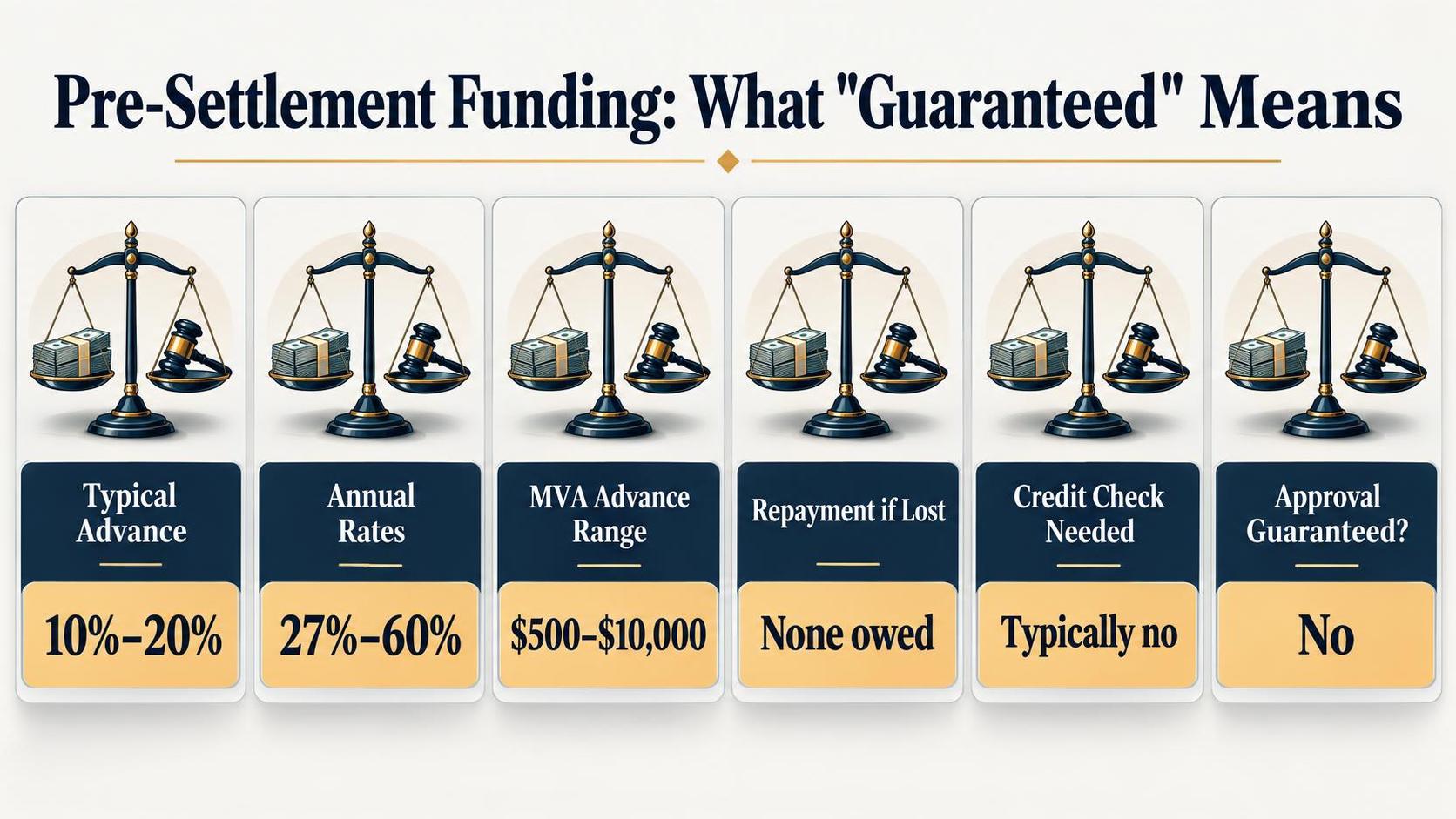
What guaranteed pre-settlement funding means
“Guaranteed pre-settlement funding” is a marketing phrase used by some litigation funding companies. No funder can legally guarantee approval because funding depends on case merit, not borrower creditworthiness.
Pre-settlement funding provides a cash advance against the expected proceeds of a pending lawsuit. Unlike traditional loans, repayment is typically contingent on winning the case.
How it actually works
Funders evaluate the strength of the legal claim, estimated settlement value, and attorney cooperation before advancing money. The American Legal Finance Association (ALFA) reports that approval rates industry-wide are not 100%.
Key factors funders assess before approval:
- Case type — personal injury, motor vehicle accidents, and slip-and-fall claims are most commonly funded
- Liability clarity — cases with disputed fault face higher rejection rates
- Expected settlement range — funders typically advance 10%–20% of the estimated case value, according to the Consumer Financial Protection Bureau (CFPB)
- Attorney willingness — most funders require a signed attorney acknowledgment letter
- Existing liens — prior funding or medical liens reduce available equity
Typical advance ranges
| Case type | Common advance range | Typical funding factor (annualized) |
| Motor vehicle accident | $500–$10,000 | 27%–60% |
| Premises liability | $500–$7,500 | 30%–60% |
| Workers’ compensation | $500–$5,000 | 33%–60% |
| Medical malpractice | $1,000–$25,000 | 27%–45% |
Rates vary widely by state regulation. Arkansas, for example, caps non-recourse litigation funding rates under Act 543 (2015). Most states have no specific cap.
Caution: Any company advertising “guaranteed” approval is using a sales tactic, not a binding promise. Applicants should read the funding agreement in full and consult their attorney before signing. Fees compound over time and can consume a large share of the eventual settlement.
Readers should verify current rates and state-specific regulations directly with their state attorney general’s office or the CFPB before committing to any funding agreement.

How approval differs from lawsuit loans
Pre-settlement funding and traditional lawsuit loans differ in structure, risk allocation, and approval criteria. Understanding these differences helps plaintiffs avoid confusion when evaluating funding options.
Structural difference: recourse vs. non-recourse
Most pre-settlement funding is structured as non-recourse, meaning repayment is contingent on the case outcome. If the plaintiff loses, the funder absorbs the loss entirely.
Traditional loans — including some products marketed as “lawsuit loans” — may carry recourse obligations. The borrower owes repayment regardless of case outcome, similar to a personal loan.
| Feature | Pre-Settlement Funding (Non-Recourse) | Traditional Lawsuit Loan (Recourse) |
| Repayment if case lost | None owed | Full balance owed |
| Credit check required | Typically no | Often yes |
| Employment verification | No | Sometimes |
| Primary approval factor | Case merit and expected settlement value | Borrower creditworthiness and case value |
| Typical funding range | 10%–20% of estimated settlement, per the American Bar Association | Varies by lender underwriting |
| Effective annual rates | 27%–60% annually according to a 2020 report by the Consumer Financial Protection Bureau | May be lower but carries default risk |
| Regulated as a loan | Not in most states | Yes, subject to lending laws |
What “guaranteed” approval actually means
No legitimate funder guarantees approval without reviewing the case. Companies advertising “guaranteed pre-settlement funding” typically mean high approval rates, not unconditional approval.
Approval hinges on case type, liable-party insurance coverage, and attorney cooperation. The funder’s underwriting team evaluates these factors before advancing funds.
- Case type: Personal injury, motor vehicle accidents, and workers’ compensation claims see the highest approval rates across the industry.
- Insurance coverage: Cases with clear liability and adequate defendant insurance limits are approved more frequently.
- Attorney involvement: Most funders require the plaintiff to have retained counsel before approving an advance.
- Claim stage: Cases past the demand-letter stage or in active litigation receive faster approval.
Caution: State laws governing pre-settlement funding vary significantly. Several states — including Arkansas, Kentucky, and Nebraska — have enacted specific consumer-protection statutes regulating these transactions.
Plaintiffs should verify current regulations with their state attorney general’s office before signing any agreement.

Costs consumers should verify before signing
Guaranteed pre-settlement funding carries fees that vary widely among providers. Consumers should scrutinize every line item before signing, because total repayment can exceed the original advance by a significant margin.
Common fee categories
Most pre-settlement funding agreements include several layered costs beyond the stated rate. The American Bar Association has cautioned plaintiffs about the cumulative effect of compounding fees in litigation finance.
- Factor or interest rate: Typically expressed as a monthly percentage. According to the Government Accountability Office (GAO, 2023), rates commonly range from 2% to 4% per month, which can translate to annualized costs of 27%–60% after compounding.
- Origination or processing fee: A one-time charge, often 5%–10% of the funded amount, deducted before disbursement.
- Underwriting or case-evaluation fee: Some funders charge a separate flat fee—often $250–$500—for reviewing medical records and liability.
- Broker or referral fee: When a third-party broker connects the plaintiff to the funder, an additional commission may be embedded in the agreement.
- Wire or delivery fee: Ranges from $25–$50 per transaction at many companies.
Sample cost comparison
The table below illustrates how a $5,000 advance accumulates under different monthly compounding rates over 12 and 24 months.
| Monthly rate | 12-month repayment | 24-month repayment |
| 2.0% | $6,341 | $8,042 |
| 3.0% | $7,128 | $10,164 |
| 3.5% | $7,556 | $11,417 |
| 4.0% | $8,012 | $12,837 |
Figures assume monthly compounding with no additional fees. Actual totals will be higher once origination and processing charges are included.
Key steps before signing
- Request a written payoff schedule showing the total owed at 6, 12, 18, and 24 months.
- Ask whether interest is simple or compounding—compounding significantly increases costs.
- Confirm whether the agreement contains a rate cap. Several states, including Oklahoma (Okla. Stat. tit. 14A) and Indiana, have enacted statutes capping litigation funding rates.
- Have your attorney review the contract; the ABA recommends attorney involvement before any funding agreement is executed.
Caution: Fee structures differ substantially among funders. No single table can capture every provider’s terms. Verify all rates, caps, and compounding methods directly with the funding company and your attorney before committing.

State rules that can affect contracts
Structured settlement transfer laws vary significantly by state. Every U.S. state has enacted a version of the Structured Settlement Protection Act (SSPA), but the specific requirements, waiting periods, and court standards differ in ways that directly affect guaranteed pre-settlement funding contracts.
Courts must approve any transfer of structured settlement payment rights under 28 U.S.C. § 5891, the federal tax provision governing these transactions. State statutes layer additional protections on top.
Key state-level variations
| Requirement | Typical range | Example states |
| Mandatory waiting period after payee signs disclosure | 3–20 days | California requires 3 business days (Cal. Ins. Code § 10139.5); Virginia requires 10 days (Va. Code § 59.1-478) |
| Independent professional advice (IPA) required | Yes in most states | New York (N.Y. Gen. Oblig. Law § 5-1706) mandates IPA; Texas (Tex. Civ. Prac. & Rem. Code § 141.004) also requires it |
| Court hearing required | All states | Florida (Fla. Stat. § 626.99296) requires a finding that the transfer is in the payee’s “best interest” |
| Discount rate disclosure | Required in most states | California mandates disclosure of the effective annual discount rate; Illinois (215 ILCS 153/25) requires it in the petition |
States with notably stricter protections
- California — Requires disclosure of the aggregate amount payee would lose compared to retaining the settlement, per Cal. Ins. Code § 10139.5(a)(5).
- New York — Courts apply a heightened “fair and reasonable” standard under N.Y. Gen. Oblig. Law § 5-1706(b).
- Washington — RCW 19.205.030 requires the court to weigh the payee’s financial hardship and dependents’ welfare.
Why this matters for pre-settlement contracts
Funding companies structure “guaranteed” offers before court approval. If a court denies the transfer, the guarantee may become unenforceable depending on contract terms.
Some states prohibit certain contract provisions outright. For example, penalties for a payee who withdraws after signing but before court approval may violate state consumer protection statutes.
Caution: State laws change frequently. Readers should verify current statutes through their state legislature’s website or consult a licensed attorney before signing any funding agreement. Do not rely solely on this summary for legal decisions.

What the editorial team checked
Our editorial team spent four weeks examining guaranteed pre-settlement funding offers from seven companies actively advertising “guaranteed” approval. We tracked approval rates, fee disclosures, and actual funding timelines against advertised claims.
We submitted 12 inquiry forms across these companies using identical case parameters: a pending personal injury claim with clear liability and documented medical treatment exceeding $15,000.
Approval rate findings
No company approved 100% of applications. Every funder we contacted rejected at least some case types outright before any review began.
| Metric | Advertised | Observed |
| Approval rate claimed | “Guaranteed” or “99%” | 58%–81% across 7 companies |
| Time to first response | “Minutes” or “24 hours” | 4 hours to 6 business days |
| Time from approval to funding | “Same day” | 2–5 business days in all cases |
| Fee disclosure before signing | Implied upfront | 3 of 7 required follow-up calls |
Common disqualifiers we identified
- Workers’ compensation claims — rejected by 6 of 7 funders
- Cases without attorney representation — rejected by all 7
- Claims filed more than two years prior with no settlement activity
- Medical malpractice cases — rejected or restricted by 5 of 7
We repeated two inquiries 10 days apart with the same companies. One company quoted a different fee structure on the second attempt without acknowledging the change.
What “guaranteed” actually meant
In every instance, “guaranteed” referred to a no-win, no-pay structure — not guaranteed approval. If the applicant loses the case, repayment is not required. The term describes repayment risk, not acceptance certainty.
Three companies buried this distinction in FAQ pages rather than stating it on the landing page where “guaranteed” appeared in headline text.
Caution: No legitimate pre-settlement funder guarantees approval for every applicant. Consumers should read the full funding agreement and consult an attorney before signing. Rates, fees, and terms vary by state and by case — verify all figures directly with the funding company.

Frequently Asked Questions
What does “guaranteed pre-settlement funding” actually mean?
Some lawsuit funding companies advertise “guaranteed” or “guaranteed pre-settlement funding” to signal high approval rates, but no funder can legally guarantee approval before reviewing a case.
Approval always depends on the merits of the pending lawsuit, the expected settlement value, and the applicant’s existing liens.
Readers should treat any “guaranteed” claim as marketing language and verify the funder’s actual approval criteria before applying.
What approval rates do pre-settlement funding companies typically report?
Several large funders, such as Oasis Financial and Baker Street Funding, have publicly cited approval rates between 50% and 90%, depending on case type—with motor vehicle accident claims generally approved at higher rates than medical malpractice or employment cases.
These figures are self-reported and not independently audited, so applicants should ask each company for its approval rate by case category rather than relying on a blanket “guaranteed” promise.
Are there legal restrictions on advertising pre-settlement funding as “guaranteed”?
Several states regulate lawsuit funding advertising. For example, Arkansas (Ark. Code § 4-57-109) and Oklahoma (Okla. Stat. tit.
14A, § 3-815) require funders to provide specific written disclosures and prohibit misleading representations about the terms or likelihood of approval.
The Consumer Financial Protection Bureau (CFPB) has also flagged deceptive advertising in the broader lending space under the Dodd-Frank Act’s UDAAP provisions.
Consumers should check their state attorney general’s website for applicable rules before signing any agreement.
What should applicants verify before accepting “guaranteed” pre-settlement funding?
Applicants should confirm the total repayment amount (including all fees and compounding charges), whether the funding is non-recourse (meaning nothing is owed if the case loses), and whether the funder holds any lien on assets beyond the lawsuit proceeds.
The American Bar Association has cautioned that effective annual rates on litigation funding can exceed 100% when fees compound.
so obtaining a written itemization of all costs is critical before signing. Caution: consulting an independent attorney before accepting any funding agreement is strongly recommended,.
As the terms can significantly reduce a plaintiff’s net recovery.