

At a glance: personal injury settlement funding is a nonrecourse cash advance against a pending injury settlement. The recipient generally repays the funder only from settlement proceeds, not personal assets if the case loses.
Costs can substantially reduce the final recovery and vary by contract and state law. Review terms with an attorney before signing.
Personal injury settlement funding is an advance against expected lawsuit proceeds, typically repaid from the settlement rather than through scheduled monthly payments.
It can help an injured claimant cover medical bills, housing, transportation, or daily expenses while a personal injury case remains unresolved.
The funding is generally non-recourse, meaning repayment may depend on receiving a settlement, but the contract controls the legal obligation.
Costs, approval standards, lien rights, and repayment terms vary by provider and state law. A funding agreement can reduce the amount ultimately retained from a settlement, especially when fees accumulate during lengthy litigation.
Before signing, review the contract with the attorney handling the claim and confirm applicable disclosures or consumer protections with the relevant state regulator. Do not rely on funding alone to make legal or financial decisions.
What personal injury settlement funding means
Personal injury settlement funding provides cash advances to plaintiffs who have pending lawsuits but need money before their case resolves. It is not a traditional loan—repayment is contingent on winning the case.
The legal finance industry uses the term “pre-settlement funding” or “lawsuit funding” to describe non-recourse cash advances. If the plaintiff loses, the funding company absorbs the loss entirely.
According to the American Legal Finance Association (ALFA), the consumer legal funding industry provides hundreds of thousands of transactions annually across the United States.
How it differs from a traditional loan
| Feature | Traditional personal loan | Pre-settlement funding |
| Repayment obligation | Required regardless of outcome | Only if the case wins or settles |
| Credit check | Yes — score affects approval | Typically none; approval based on case merits |
| Collateral | May require assets | The pending settlement itself |
| Cost structure | APR (federal Truth in Lending Act) | Funding fee or multiplier; varies by state regulation |
| Recourse if borrower cannot pay | Collections, credit damage, lawsuits | No recourse against the plaintiff personally |
Common case types funded
- Motor vehicle accidents
- Slip-and-fall and premises liability
- Medical malpractice
- Product liability
- Workers’ compensation disputes (where state law permits)
- Wrongful death claims
Advance amounts typically range from a few hundred dollars to several hundred thousand dollars, depending on the estimated settlement value. Funding companies generally advance a fraction—often cited in industry sources as roughly 10%–20%—of the projected case value.
Attorney cooperation is required. The funding company reviews case documents, medical records, and liability evidence before approving an advance. The plaintiff’s lawyer must sign an acknowledgment or lien letter.
Caution: Fees and cost structures vary dramatically by provider and by state.
Several states—including Arkansas, Indiana, Maine, Nebraska, Oklahoma, Tennessee, and Vermont—have enacted specific consumer legal funding statutes with disclosure or rate requirements, per the National Conference of State Legislatures.
Readers should verify current laws in their jurisdiction before proceeding.

How lawsuit funding agreements work
Lawsuit funding is not a loan. It is a non-recourse cash advance against the expected proceeds of a pending personal injury claim, meaning the applicant owes nothing if the case loses.
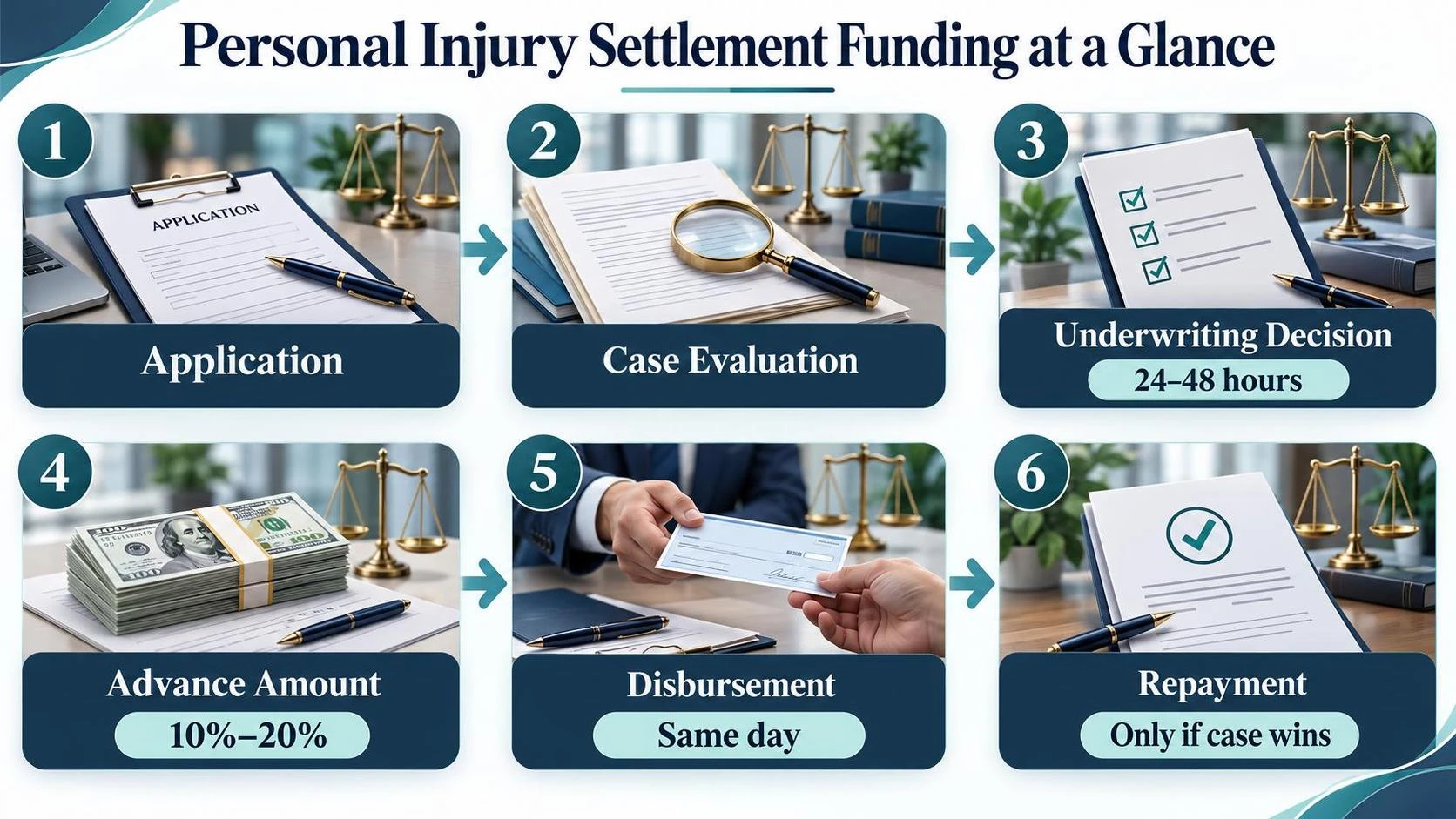
The process follows a standard sequence at most funding companies:
- Application: The claimant submits basic case details—defendant, injury type, and attorney contact information.
- Case evaluation: The funder contacts the attorney, reviews medical records, liability evidence, and estimated settlement value.
- Underwriting decision: Approval or denial typically occurs within 24 to 48 hours, according to the American Legal Finance Association (ALFA).
- Funding amount: Companies generally advance 10% to 20% of the estimated settlement value, as reported by the Consumer Financial Protection Bureau (CFPB) in its 2020 issue spotlight on litigation funding.
- Disbursement: Funds are wired or sent by check, often the same day as approval.
Repayment occurs only when the case settles or receives a court judgment. The funder is repaid from settlement proceeds before the claimant receives the remainder.
Typical cost structure
Lawsuit funding companies charge fees or “funding rates” rather than traditional interest. Costs vary widely and compound over time.
| Holding period | Typical cumulative cost range |
| 6 months | 15%–24% of the funded amount |
| 12 months | 30%–60% of the funded amount |
| 18 months | 45%–100% of the funded amount |
| 24 months | 60%–150% of the funded amount |
These ranges are drawn from rate disclosures compiled by ALFA and individual state regulatory filings. Actual rates differ by provider and jurisdiction.
Several states cap lawsuit funding costs. For example, Oklahoma (Okla. Stat. tit. 14A, §3-801 et seq.) requires rate disclosures and cooling-off periods. Indiana caps charges at certain thresholds under IC 24-12.
Caution: Compounding fees can consume a large share of the eventual settlement. Applicants should have their attorney review every funding agreement before signing. Rates, caps, and consumer protections vary by state—verify current law with a licensed attorney or the relevant state regulator.

Who may qualify for settlement funding
Eligibility for personal injury settlement funding depends primarily on the strength of the pending legal claim, not the applicant’s credit score or employment status. Funding companies evaluate the case itself as collateral, making this a unique form of non-recourse financing.
Core eligibility requirements
Most pre-settlement funding companies require applicants to meet all of the following baseline criteria:
- Active personal injury lawsuit — a claim must be filed or in the process of being filed against a liable party.
- Retained attorney — applicants must have legal representation on a contingency-fee basis.
- Liable defendant with insurance or assets — the at-fault party must carry liability coverage or have attachable assets sufficient to pay a judgment.
- Minimum expected settlement value — many funders require anticipated recoveries of at least $5,000 to $10,000, according to the American Bar Association’s 2020 report on litigation funding practices.
Case types commonly approved
Not every personal injury matter qualifies. The following table summarizes typical approval likelihood by case category, based on industry disclosures compiled by the American Legal Finance Association (ALFA):
| Case type | Typical approval rate |
| Motor vehicle accidents | High — most frequently funded category |
| Slip-and-fall / premises liability | Moderate to high |
| Medical malpractice | Moderate — longer resolution timelines |
| Product liability | Moderate |
| Workers’ compensation | Low — prohibited in several states |
Factors that may disqualify applicants
- Weak or disputed liability (e.g., comparative fault exceeding 50% in modified comparative negligence states).
- Pre-existing liens that consume most of the anticipated recovery.
- Pending claims in states that ban or heavily restrict litigation funding, such as certain provisions under Arkansas Code § 4-57-109.
Caution: Qualification criteria vary significantly among funding companies. Readers should consult a licensed attorney before signing any funding agreement to understand fee structures and state-specific restrictions.

Costs, fees, and repayment risks
Pre-settlement funding is not a loan in most states; it is a non-recourse advance repaid only if the plaintiff wins or settles. That structure shifts risk to the funder — and the price reflects it. Effective annual rates routinely reach triple digits.
Typical fee structures
Most funders charge compounding monthly rates rather than APRs. The American Bar Association has noted that annualized costs can range from roughly 27% to over 60% before compounding effects are considered (ABA Journal, 2020).
| Fee model | Common range | Effective APR (approx.) |
| Simple monthly rate | 2%–4% per month | 24%–48% |
| Compounding monthly rate | 2.5%–3.5% per month | 34%–51% (higher with compounding) |
| Flat fee per period (e.g., every 6 months) | 15%–25% per period | Varies by case duration |
Some contracts double or triple the funded amount within 18–24 months. The U.S. Government Accountability Office (GAO) flagged cases where plaintiffs owed more than three times the original advance after three years.
Additional fees to watch
- Origination or processing fees: Often 3%–5% of the advance, deducted upfront from proceeds.
- Broker or referral fees: Some intermediaries add a separate charge, increasing total cost without the plaintiff’s full awareness.
- Case-monitoring or administrative fees: Recurring charges billed monthly or quarterly.
- Early payoff penalties: Not universal, but present in some contracts.
Repayment risks
Non-recourse means no repayment if the case loses. However, if the case settles, the funder is paid before the plaintiff receives any remaining balance.
A 2020 study published in the Journal of Empirical Legal Studies found that plaintiffs who used litigation funding received, on average, smaller net recoveries than those who did not.
Long-duration cases magnify costs. A $10,000 advance at 3% compounding monthly grows to approximately $17,000 in 18 months and over $21,000 in 24 months.
Caution: Readers should have an attorney review any funding agreement before signing.
Fee disclosures vary by state, and several jurisdictions — including Arkansas, Indiana, and Oklahoma — have enacted specific consumer-protection statutes governing litigation funding terms.
Verify current requirements with your state attorney general’s office.

Settlement funding versus traditional borrowing
Settlement funding and traditional loans differ in structure, risk allocation, and repayment obligations. Understanding these distinctions helps plaintiffs evaluate which option suits their financial situation during pending litigation.
Key structural differences
Settlement funding is technically a non-recourse cash advance, not a loan. If the plaintiff loses the case, the funding company absorbs the loss entirely.
Traditional loans — personal loans, credit cards, home equity lines — require repayment regardless of case outcome. Lenders evaluate creditworthiness; funders evaluate case merit.
| Feature | Settlement funding | Traditional loan |
| Repayment obligation | Only if the case wins or settles | Required regardless of case outcome |
| Credit check required | Typically no | Yes |
| Approval basis | Strength of legal claim | Credit score, income, debt-to-income ratio |
| Typical cost range | Annual rates often 27%–60%, per the American Bar Association | Personal loans average 12.35% APR as of Q1 2025, per the Federal Reserve |
| Collateral | Potential settlement proceeds | Varies (unsecured or asset-backed) |
| Employment verification | No | Yes |
Cost trade-off
Settlement funding carries significantly higher effective rates than bank products. The non-recourse risk structure accounts for much of the premium.
Compounding intervals vary by company. Some funders compound monthly, others every six months. According to the Consumer Financial Protection Bureau, total repayment can reach two to four times the original advance on cases lasting several years.
When traditional borrowing may not be available
- The plaintiff is unable to work due to injury and lacks verifiable income
- Medical debt has damaged the plaintiff’s credit score
- Existing debt-to-income ratios disqualify the plaintiff from bank lending
In these scenarios, settlement funding may be the only accessible capital source — but the cost reflects that access.
Caution: Rates, fee structures, and compounding methods vary widely among funding companies and are regulated differently by state. Plaintiffs should request a full written fee schedule, consult their attorney, and compare total repayment amounts before signing any funding agreement.

State laws affecting injury funding
State regulation of pre-settlement funding varies dramatically across the United States. Some states impose strict fee caps and disclosure requirements, while others have no specific statutes governing the industry at all.
States with dedicated funding statutes
Several states have enacted laws that directly regulate consumer litigation funding transactions. These statutes typically mandate disclosures, cap fees, or both.
| State | Key statute | Notable provision |
| Indiana | IC § 24-12 (2015) | Requires itemized cost disclosure before contract execution |
| Maine | 9-A M.R.S. § 12-A (2007) | Mandates registration with the Bureau of Consumer Credit Protection |
| Nebraska | Neb. Rev. Stat. § 25-3301 et seq. | Caps fees and requires right-to-cancel period |
| Nevada | NRS § 604C (2019) | Annual fee cap of 40% of funded amount |
| Ohio | ORC § 1349.55 et seq. (2008) | Requires annual rate disclosure; 10% maximum annual fee on amounts under $500 |
| Oklahoma | Okla. Stat. tit. 14A § 3-801 (2013) | Requires attorney acknowledgment of funding contract |
| Vermont | 8 V.S.A. § 2251 (2016) | Licensing requirement; fee caps tied to duration of funding |
States that restrict or ban the practice
A small number of jurisdictions have imposed significant restrictions. Arkansas courts have scrutinized funding agreements under the state’s usury provisions, which cap interest at 17% per annum under Amendment 89 of the Arkansas Constitution.
Key consumer protections to look for
- Right to cancel: States like Nebraska and Indiana mandate a minimum rescission window, often 5 business days after signing.
- Attorney involvement: Oklahoma and several other states require the applicant’s attorney to review and acknowledge the contract.
- Fee cap structures: Nevada’s 40% annual cap (NRS § 604C) is among the most explicit numerical limits in the country.
- Registration or licensing: Maine and Vermont require funders to register with a state agency before operating.
Caution: Statutes change frequently, and court interpretations can alter their practical effect. Readers should verify current law through their state legislature’s website or consult a licensed attorney before signing any funding agreement.
In states without specific statutes, general consumer-protection and contract-law principles apply. This patchwork means consumer protections depend heavily on jurisdiction.

What this guide independently reviewed
This guide examined the personal injury settlement funding industry across multiple dimensions: company practices, fee structures, regulatory frameworks, and consumer protections. All findings reflect publicly available data and disclosed terms as of 2025.
The review covered funding companies operating in the U.S. pre-settlement funding market, which the American Legal Finance Association (ALFA) estimates serves hundreds of thousands of plaintiffs annually.
Key areas analyzed
- Fee and rate structures disclosed by major funders, including compounding versus simple interest models
- State-level regulations governing lawsuit funding transactions
- Consumer complaint records filed with the Better Business Bureau (BBB) and state attorneys general
- Court rulings that have shaped industry practices and disclosure requirements
- Contract terms, including buy-back provisions and non-recourse language
Funding cost ranges observed
| Fee structure type | Typical annualized range | Source basis |
| Simple interest (non-compounding) | 27%–60% per year | Disclosed rate sheets from funders reporting to ALFA |
| Compounding interest | Can exceed 100% effective APR over multi-year cases | Consumer Financial Protection Bureau (CFPB) consumer advisories |
| Flat-fee / tiered models | Varies by case duration brackets | Individual company disclosures |
Caution: Actual rates vary significantly by company, case type, state, and expected settlement timeline. Readers should request a full fee schedule in writing before signing any funding agreement.
Regulatory landscape reviewed
As of 2025, at least 30 states have enacted statutes or issued court opinions addressing pre-settlement funding, according to tracking by the National Conference of State Legislatures (NCSL).
States such as Arkansas, Indiana, Maine, Nebraska, Oklahoma, Tennessee, Vermont, and West Virginia have passed laws requiring specific disclosures, rate caps, or right-of-rescission periods.
This guide did not accept compensation from any funding company. No affiliate relationships influenced the analysis. Readers should verify current rates and state laws directly with regulators and prospective funders before making financial decisions.

Frequently Asked Questions
What is personal injury settlement funding?
Personal injury settlement funding—also called pre-settlement funding or a lawsuit advance—provides cash to plaintiffs before their case resolves.
The funding company purchases a portion of the expected settlement proceeds, and repayment is typically contingent on the plaintiff winning or settling the case, according to the American Bar Association.
Because repayment depends on the outcome, the transaction is generally structured as a non-recourse advance rather than a traditional loan.
How much does personal injury settlement funding cost?
Rates vary widely by provider and state, but the Consumer Financial Protection Bureau (CFPB) has noted that annualized costs can range from roughly 27% to over 60% when compounding is factored in.
Some states cap these rates—for example, Ohio Rev. Code § 1349.55 limits fees on consumer litigation funding—while many states impose no ceiling at all.
Plaintiffs should request a full fee schedule showing the total repayment amount at 6-, 12-, 18-, and 24-month intervals before signing any contract.
Does personal injury settlement funding affect the outcome of a lawsuit?
Funding itself does not change the legal merits of a case, but it can influence settlement timing.
The U.S. Chamber of Commerce Institute for Legal Reform has argued that funded plaintiffs may reject reasonable offers and prolong litigation, while consumer advocates counter that funding prevents financially pressured plaintiffs from accepting lowball settlements.
Courts in some jurisdictions, such as New York and New Jersey, have required disclosure of funding agreements to opposing counsel.
Is personal injury settlement funding available in every state?
Most states permit some form of pre-settlement funding, but regulatory frameworks differ significantly. States like Maine (ME Rev. Stat. tit.
9-A, § 12-104), Arkansas, and Indiana have enacted specific consumer litigation funding statutes that impose registration, disclosure, and fee requirements on funders.
A handful of states have restricted or heavily regulated the practice; plaintiffs should verify current licensing and rate rules with their state attorney general’s office before entering any agreement.
Caution: Settlement funding contracts are legally binding financial obligations tied to pending litigation. Readers should consult a licensed attorney in their jurisdiction before signing any funding agreement, as terms, enforceability, and consumer protections vary by state.
Related Reading
- Pre Settlement Funding Without My Attorney Consent
- Pre Settlement Loans Without A Lawyer
- NY Tribeca Group
- Peachtree Pre Settlement Funding
- Tribeca Group Review
- All Pre-Settlement Funding Guides
- Consumer Financial Protection Bureau — Consumer Advisory on Settlement Funding (2023)
- U.S. Government Accountability Office — Third-Party Litigation Financing Report (2022)
- New York City Bar Association — Report on Litigation Funding (2020)
- American Bar Association — Litigation Funding Ethics (2020)
- National Conference of State Legislatures — Consumer Litigation Funding Laws (2023)
- Vanderbilt Law Review — The Rise of Third-Party Litigation Finance (2014)
- U.S. Chamber of Commerce Institute for Legal Reform — Litigation Funding Overview (2022)