

The gist: Pre settlement funding interest rates typically range from roughly 2% to 4% per month, according to industry providers and consumer guides.
Two structures exist: non-compounding (capped) rates, where interest applies only to the original advance, and compounding (uncapped) rates, which grow monthly and can consume a large share of settlement proceeds.
Compare total repayment costs before signing.
Pre settlement funding interest rates are the charges lawsuit funding companies apply to cash advances given to plaintiffs before their cases settle.
And they typically run far higher than conventional loan rates — often the equivalent of 27% to 60% annually or more, according to the National Consumer Law Center’s 2010 report “Roadblock on the Road to Work.”.
Because most funders express rates as a non-compounding monthly charge rather than an annual percentage rate, comparing total costs across companies is difficult.
This article explains how pre settlement funding interest rates work, typical ranges reported by consumer advocates, state laws that cap them, and the questions plaintiffs should ask before signing a funding agreement.
How Pre Settlement Funding Interest Rates Work
Pre-settlement funding is commonly structured as a purchase of part of a future settlement, not a conventional loan. The contract may still make the amount owed grow over time through fees or periodic charges, so compare the total repayment amount and the date used to calculate it.
The U.S. Government Accountability Office’s 2015 report, Legal Funding: Consumer Protection Issues and Interest Rate Caps on Loans (GAO-15-129),.
Describes legal funding arrangements and notes that their terms and oversight vary. “Interest rate” may therefore be an imprecise label: contracts can use monthly charges, one-time fees, or compounding.
The contract’s wording and applicable state law determine how the cost works.
How charges accumulate
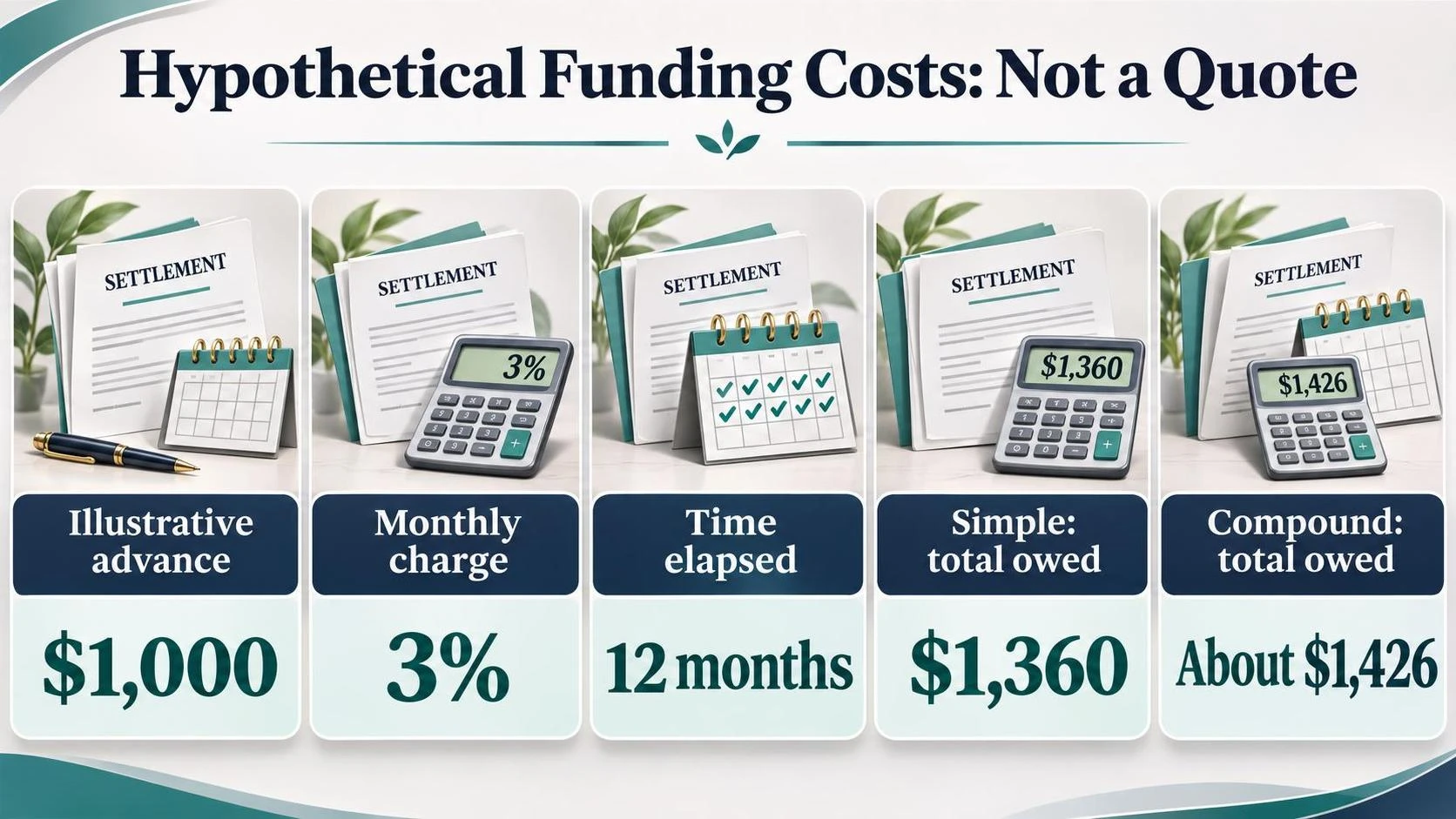
A charge stated as a percentage per month is not directly comparable with the same percentage per year. For example, the table uses a hypothetical $1,000 advance, a 3% monthly charge, and 12 months. These are illustrative assumptions, not a quoted industry rate or offer.
| Illustrative calculation | Amount after 12 months |
| 3% monthly, simple calculation: $1,000 + ($1,000 × 0.03 × 12) | $1,360 |
| 3% monthly, compounded: $1,000 × (1.03)12 | About $1,426 |
The difference arises because compounding applies each month’s charge to the growing balance. Actual contracts may use different calculation methods, add origination or processing fees, or set a maximum repayment amount.
Ask for a written payoff estimate for several possible case durations and confirm whether charges continue after that maximum is reached.
What to compare
- Compare the cash received with the maximum and estimated repayment amounts, not only a stated monthly percentage.
- Check whether the contract charges simple or compound growth, how often it accrues, and whether fees are added to the balance.
- Check what happens if the case is lost, delayed, or settles for less than expected. “Nonrecourse” terms differ; do not assume they eliminate every obligation.
- Have the lawyer handling the claim review the contract and explain any effect on the client’s net recovery.
State rules vary, and some jurisdictions regulate legal funding or restrict contract terms. Verify current requirements with the state regulator or a qualified attorney before signing.
Taking funding can reduce settlement proceeds; do not rely on an illustrative calculation to decide whether a specific contract is affordable.

Typical Interest Rate Ranges by Funding Company
Pre-settlement funding has no single rate range that reliably applies across companies and cases. Compare current written quotes rather than treating advertised starting rates as typical prices or assuming a monthly percentage captures the full repayment cost.
Where to Verify Company-Specific Rates
The companies below provide primary sources for checking their pricing. This table does not assign numerical ranges because current, comparable rate disclosures have not been verified here.
| Funding company | Primary source | Pricing details to request |
| Oasis Financial | https://www.oasisfinancial.com/ | Written rate, accrual method, fees, and repayment schedule. |
| USClaims | https://usclaims.com/ | Case-specific pricing, any minimum charge, and maximum repayment obligation. |
| Express Legal Funding | https://expresslegalfunding.com/ | Written funding charge, calculation method, and applicable fees. |
An advertised “as low as” rate establishes neither an average customer rate nor eligibility for that price. Ask whether the quoted percentage applies monthly, annually, or to a fixed funding period, and whether charges compound.
How Identical Monthly Rates Can Produce Different Costs
The following figures are illustrative calculations, not company quotes or market averages. They assume a $1,000 advance, a hypothetical 3% monthly charge, no additional fees, and no payments before the stated payoff date.
| Payoff timing | Simple monthly charge | Monthly compounding |
| After 6 months | $1,180.00 | $1,194.05 |
| After 12 months | $1,360.00 | $1,425.76 |
Source: arithmetic using principal × (1 + monthly rate × months) for simple charges, and principal × (1 + monthly rate) raised to the number of months for compounding. Results are rounded to cents; actual contracts may calculate charges differently.
Compare the Payoff, Not Just the Percentage
- Request payoff amounts at identical dates from each company.
- Confirm the cash you receive after any deducted charges.
- Check whether additional advances create separate charges or change existing terms.
- Read the provisions governing unsuccessful claims, repayment caps, and contractual exceptions.
Caution: Funding charges can substantially reduce your net settlement. Have your attorney review the agreement and compare projected repayment with your expected recovery after legal fees, case expenses, and liens before signing.

Simple Versus Compound Interest in Advances
Pre-settlement funding charges can grow differently depending on whether the contract uses simple or compound calculations. Simple charges generally apply only to the original advance; compound charges also apply to accumulated charges.
The calculation method matters, but fees, minimum charges, and repayment caps can change the result.
How the Calculations Differ
With simple interest, the calculation is principal × periodic rate × elapsed periods. With compounding, the balance grows each period before the next charge applies.
Investor.gov, the SEC’s investor education website, explains compounding as earning interest on principal and accumulated interest; the same arithmetic can increase financing balances.
The table uses author-selected assumptions, not a provider’s quoted rate or a market average. Calculations assume an unchanged balance, no payments, no additional fees, and charges assessed monthly. Dollar results are rounded to cents.
| Illustrative assumption or result | Simple calculation | Monthly compounding |
| Original advance | $1,000 | $1,000 |
| Assumed monthly rate | 3% | 3% |
| Balance after 6 months | $1,180.00 | $1,194.05 |
| Balance after 12 months | $1,360.00 | $1,425.76 |
| Balance after 24 months | $1,720.00 | $2,032.79 |
Source for every table figure: author calculations using the stated hypothetical inputs. Simple balances equal $1,000 × (1 + 0.03 × months); compound balances equal $1,000 × 1.03 raised to the number of months.
Compounding reference: https://www.investor.gov/financial-tools-calculators/calculators/compound-interest-calculator.
Read the Payoff Terms, Not Just the Rate
- Confirm the charging interval. Ask whether charges accrue daily, monthly, or in fixed blocks, and whether partial periods trigger a full charge.
- Identify the calculation base. Determine whether processing or other fees are added to the balance before charges accrue.
- Request dated payoff amounts. Obtain written totals for several possible resolution dates, including all fees, minimum charges, and any contractual cap.
- Check repayment conditions. Do not assume that calling an advance “nonrecourse” eliminates every repayment obligation. Review unsuccessful-case provisions and contractual exceptions.
A monthly rate alone is not an all-in annual cost disclosure. Before signing, have your attorney review the agreement and estimate what would remain after funding repayment, legal fees, expenses, and liens. Do not use this illustration to predict an actual payoff.

How Rates Differ From Personal Loan APRs
Personal loan APRs and pre-settlement funding rates measure costs differently. APR expresses covered borrowing costs on an annual basis, while a funding quote may show a monthly charge, a repayment multiplier, or a schedule of amounts owed.
Compare the Same Cost Measure
The Consumer Financial Protection Bureau explains that a personal loan’s APR includes interest and additional loan charges, such as origination fees. An advertised interest rate alone does not necessarily capture those costs. Source: CFPB, “What is a personal loan interest rate?”.
| Feature | Personal loan | Pre-settlement funding |
| Rate benchmark | The Federal Reserve reported 12.32% for 24-month personal loans at commercial banks in November 2024. | That bank-loan benchmark does not establish a comparable litigation-funding rate. |
| Payment structure | Usually scheduled installment payments. | Typically repayment from eligible case proceeds, subject to the agreement. |
| Cost disclosure | Covered consumer loans require standardized APR disclosures. | Disclosures depend on the contract and applicable state law. |
Source for the historical bank-rate figure: Federal Reserve, Consumer Credit—G.19, February 7, 2025, https://www.federalreserve.gov/releases/g19/20250207/. This historical benchmark is not a current offer or a rate every borrower could obtain.
Timing and Contract Terms Change the Comparison
A personal loan generally remains payable even if the borrower loses a lawsuit. Funding marketed as nonrecourse generally makes repayment contingent on recovery, but contractual exceptions matter. Do not assume “nonrecourse” eliminates every possible obligation.
A monthly funding charge cannot be compared directly with an annual loan APR. Compounding, upfront deductions, minimum charges, and the settlement date can change the effective cost. Simply multiplying a monthly percentage by the months in a year can miss those effects.
- Request the net cash delivered and an itemized repayment schedule.
- Ask whether charges compound, stop accruing, or reach a contractual cap.
- Compare repayment amounts using the same assumed payoff date.
Federal APR rules appear in Regulation Z, including 12 CFR 1026.4 and 1026.22; their applicability requires legal analysis. Have your attorney review the funding agreement and applicable state protections before signing.
Repayment can substantially reduce the settlement money available after fees, costs, and liens.

Factors That Raise or Lower Your Rate
Pre-settlement funding pricing reflects the funder’s assessment of recovery risk, expected repayment time, and contract terms. A lower advertised monthly rate does not necessarily mean a lower payoff: compounding, minimum charges, and fees can change the result.
Case Strength and Available Recovery
Clear liability, documented injuries, and an identifiable payment source can make a case more attractive to a funder. Disputed fault, uncertain insurance coverage, or collection problems can lead to higher pricing, a smaller advance, or rejection. Strong evidence does not guarantee favorable terms.
- Available proceeds: Attorney fees, case expenses, medical liens, and earlier funding obligations reduce the settlement money available for repayment.
- Advance size: Requesting less money can reduce the funder’s exposure and your total dollar cost, but it does not guarantee a lower contractual rate.
- Timing: Unresolved treatment, discovery, trial scheduling, and appeals can extend the funding period. Even an unchanged rate can produce a larger payoff over time.
Contract Structure Matters as Much as the Rate
| Pricing feature | Effect on repayment |
| Simple charges | Charges calculated only on the original advance do not generate additional charges on accumulated interest. |
| Compounding | Accrued charges enter the calculation base, potentially increasing the payoff faster. |
| Minimum charge period | An early settlement may not eliminate charges owed for the contractual minimum period. |
| Additional fees | Administrative, origination, or other charges can make the advertised rate an incomplete cost measure. |
Ask whether fees are withheld from the advance, added to the repayment balance, or themselves subject to charges. Compare written payoff schedules for the same cash received and the same repayment dates—not monthly rate labels alone.
State Rules Affect the Comparison
Ohio Revised Code Section 1349.55 requires covered contracts to disclose repayment amounts at six-month intervals for 36 months, including fees. It also requires disclosure of the annual percentage rate of return and compounding frequency. Source: https://codes.ohio.gov/ohio-revised-code/section-1349.55.
Caution: Ohio’s requirements are not nationwide rules. Check your state’s primary legal sources, and have your attorney review the agreement, payoff schedule, and effect on your remaining settlement proceeds before signing. Do not budget around an assumed settlement date or award.

State Caps and Rules on Litigation Funding Rates
Pre-settlement funding has no single nationwide rate ceiling. State law determines whether an advance is a regulated loan or a separate nonrecourse transaction, so an ordinary lending cap may not limit the price quoted by a litigation funder.
Loan Rate Limits Are Not Automatically Funding Caps
New York illustrates the distinction. Its general civil and criminal usury thresholds concern loans; they are not automatic price limits for every agreement labeled “pre-settlement funding.” Exceptions and the transaction’s actual repayment obligations matter.
| New York rule | Statutory threshold | Primary source |
| General civil usury ceiling | 16% annually, subject to exceptions | Banking Law §14-a; General Obligations Law §5-501 |
| Criminal usury threshold | Interest exceeding 25% annually, subject to statutory requirements and exceptions | Penal Law §190.40 |
In Cash4Cases, Inc. v. Brunetti, 167 A.D.3d 448 (2018), a New York appellate court rejected a usury challenge because repayment depended on a successful litigation recovery. The decision shows why a contingent advance can fall outside loan-usury rules; it does not validate every funding contract.
Colorado Treats Certain Advances as Loans
In Oasis Legal Finance Group, LLC v. Coffman, 2015 CO 90, the Colorado Supreme Court held that the litigation-finance transactions before it were loans under Colorado’s Uniform Consumer Credit Code, despite their nonrecourse structure.
That classification brings covered transactions within the code’s protections and applicable lending requirements.
Check the current Colorado Uniform Consumer Credit Code and the attorney general’s consumer-credit guidance before assuming either that an agreement is exempt or that one advertised ceiling applies.
Maine Requires Contract Protections
Maine regulates legal funding through Title 9-A, Article 12 of its Consumer Credit Code. Its requirements include cost disclosures and a right to cancel within five business days after receiving funding. Those protections should not be confused with a universal interest-rate cap.
- Ask the funder to identify the state law governing the agreement and its licensing or registration status.
- Request written payoff amounts showing every fee and whether charges compound.
- Have your attorney review cancellation instructions, repayment triggers, and applicable limits before signing. A quoted “legal rate” does not establish affordability or enforceability.

How Compounding Affects Your Final Repayment
Compounding means charges accrue on both the original advance and previously accumulated charges. If your pre-settlement funding agreement compounds monthly, a longer case can leave you owing substantially more than a simple-interest calculation would suggest.
Simple Charges Versus Monthly Compounding
The SEC’s Investor.gov compound-interest calculator illustrates how a balance grows when interest compounds. The same arithmetic can model funding repayment, but your contract determines whether that method applies.
Source: https://www.investor.gov/financial-tools-calculators/calculators/compound-interest-calculator.
The table uses a hypothetical $1,000 advance and a hypothetical 2% monthly charge, with no fees, payments, or repayment cap. These are calculation assumptions, not quoted market rates. Every repayment figure comes from the formulas below, rounded to the nearest cent.
| Calculation point | Simple monthly charges | Monthly compounding |
| Original advance | $1,000 | $1,000 |
| Assumed monthly rate | 2% | 2% |
| Repayment after 12 months | $1,240.00 | $1,268.24 |
| Repayment after 24 months | $1,480.00 | $1,608.44 |
Calculation source: Simple repayment equals principal × (1 + monthly rate × months). Monthly-compounded repayment equals principal × (1 + monthly rate) raised to the number of months. Actual payoff calculations may use different accrual periods, rounding rules, or fee treatment.
Check What Actually Increases the Balance
- Compounding frequency: Determine whether charges compound monthly, annually, or not at all. Do not assume that a quoted monthly rate means simple interest.
- Added fees: Ask whether administrative or other charges enter the balance on which future charges accrue. Capitalized fees can increase repayment beyond the illustration.
- Minimum periods: Check whether repayment triggers a full charging period even when the funding remained outstanding for only part of it.
- Caps and timing: Identify any contractual repayment ceiling and the event that stops charges. Signing a settlement may not stop accrual if the agreement uses a later payment date.
Before signing: Request written payoff projections for several possible resolution dates.
Have your attorney compare them with the agreement and estimate your remaining settlement proceeds after legal fees, case expenses, liens, and funding repayment. Do not rely on this illustration to judge affordability or enforceability.

Questions to Ask Before Signing a Funding Agreement
A quoted funding rate does not reveal the total amount deducted from your settlement. Before signing, ask the funding company for the complete contract and a written payoff schedule, then have your attorney explain how repayment could affect your net recovery.
How does the balance grow?
- Is the charge simple or compounded? Ask whether charges apply only to the original advance or also to previously accumulated charges. Confirm how often charges accrue and whether the advertised rate is monthly, annual, or a flat charge.
- What triggers another charge? Ask whether a partial billing period counts as a full period. Identify any minimum repayment amount, administrative fee, origination charge, or fee added to the balance before charges accrue.
- Does repayment stop growing? Request the contractual repayment cap, if any. Ask whether charges stop when the case settles, when the insurer sends payment, or when the funding company receives its money.
What happens if the case changes?
- What if nothing is recovered? Do not rely on “nonrecourse” advertising alone. Ask the company to identify every provision that could create personal liability, including alleged fraud, breach of contract, or failure to cooperate.
- What if the settlement is smaller than expected? Ask your attorney to calculate what remains after legal fees, case expenses, liens, and funding repayment. A successful case can still leave you with little cash.
- Who controls settlement decisions? Ask whether the agreement gives the company approval rights or restricts changing attorneys. Have counsel review those provisions before signing.
Can you cancel, and which law applies?
Cancellation rights depend on applicable law. Maine’s Consumer Credit Code, Title 9-A, §12-104, requires covered legal funding contracts to provide a cancellation right within five business days, subject to returning the funding as prescribed. Do not assume that protection applies elsewhere.
Primary source: Maine Legislature, https://legislature.maine.gov/statutes/9-A/title9-Asec12-104.html. Check the current statute and ask your attorney which jurisdiction governs your agreement.
Before signing: Obtain cancellation instructions, dispute-resolution terms, and all repayment disclosures in writing. Do not sign an incomplete agreement or rely on verbal promises that conflict with its terms.

What Our Editorial Team Verified About Advertised Rates
We cannot report first-hand provider testing because no dated advertisements, written quotes, contracts, or testing records were supplied for this section. We can verify the arithmetic behind a clearly labeled illustration, but that does not establish what any funding company currently charges.
What the Rate Calculation Shows
We calculated the balances below using an assumed advance, an illustrative monthly rate, and no fees. These are mathematical examples, not advertised prices, measured market averages, or offers available to readers.
| Calculation input or result | Simple charges | Monthly compounding |
| Assumed advance | $1,000 | $1,000 |
| Illustrative monthly rate | 3% | 3% |
| Balance after 6 months | $1,180.00 | $1,194.05 |
| Balance after 12 months | $1,360.00 | $1,425.76 |
| Increase after 12 months, excluding fees | 36% | 42.58% |
Source: our arithmetic using the stated hypothetical inputs. Simple charges equal principal multiplied by the monthly rate and elapsed months. Monthly compounding multiplies principal by the monthly growth factor raised to the elapsed months. Displayed balances are rounded to cents.
The comparison shows why a monthly percentage alone cannot establish affordability. Compounding increases the balance even when the stated rate stays unchanged. Fees, minimum charge periods, and contractual payoff caps can change the result further.
What an Advertisement Cannot Verify
The Consumer Financial Protection Bureau explains in “What is the difference between a loan interest rate and the APR?” that a loan’s APR includes the interest rate and additional loan fees. That distinction helps explain why an advertised rate may not capture total cost.
We would not treat that loan guidance as proof that every pre-settlement funding agreement must disclose an APR. Legal classification and disclosure duties depend on the transaction and applicable law. Check the contract and current state requirements with your attorney.
- Request a dated, written payoff schedule showing how the balance changes over time.
- Check whether charges compound, when they begin, and whether fees also accrue charges.
- Confirm the amount actually disbursed and what happens if the case produces no recovery.
Do not sign based on this illustration or an advertised starting rate. Ask your attorney to review the repayment terms and estimate how funding could reduce your net settlement.

Frequently Asked Questions
What interest rate should I expect for pre-settlement funding?
There is no single nationwide rate: pricing depends on the provider, the case’s expected recovery, repayment risk, and contract terms.
The New York Attorney General’s agreement with litigation-financing companies emphasized clear cost disclosures; request a written rate, every fee, and repayment totals at several possible settlement dates before signing.
Is an advertised monthly rate the same as an APR?
No. The Consumer Financial Protection Bureau explains that a loan’s APR includes interest and certain additional charges, while its interest rate excludes those charges.
Do not treat a monthly funding rate as an APR; ask for an annualized cost comparison that accounts for fees and compounding, even if loan-style APR disclosures are not required for that transaction.
How does compounding affect pre-settlement funding costs?
With compounding, charges accrue on previously accumulated charges as well as the amount advanced; simple-interest pricing generally calculates interest on the original advance.
The CFPB’s explanation of compound interest describes this mechanism, but the funding contract determines the actual calculation, so check the compounding frequency and any separate fees.
Will I owe more if my lawsuit takes longer to settle?
Your repayment generally grows when the contract continues accruing charges, although a contractual cap or cutoff can limit that growth.
The New York Attorney General’s litigation-financing disclosure agreement called for repayment amounts at different time intervals; request that schedule and have your attorney assess how delays could affect your net recovery.
Do state interest-rate limits apply to pre-settlement funding?
That depends on state law and how the transaction is legally classified; calling funding “non-recourse” does not automatically exempt it from lending rules. In Oasis Legal Finance Group, LLC v.
Coffman, the Colorado Supreme Court held that the transactions at issue were loans under Colorado’s Uniform Consumer Credit Code, so verify current requirements with your state regulator or a licensed attorney.
Does non-recourse funding mean I never have to repay it?
No; non-recourse funding generally ties repayment to a successful recovery rather than eliminating repayment altogether, as discussed in the American Bar Association’s white paper on alternative litigation finance.
Review the agreement’s recovery definition, repayment priority, and exceptions with your attorney because a settlement can trigger substantial charges even when little remains after legal fees and liens.
Related Reading
- Pre Settlement Loans Near Me
- New York Tribeca Group Reviews
- Behind the Oasis Financial Lawsuit
- Pre Settlement Funding Buyout
- High Rise Financial Reviews – What You Need to Know
- Guaranteed Pre-settlement Funding
- Same Day Pre Settlement Loans – What You Need to Know
- Personal Injury Settlement Funding Explained
- All Pre-Settlement Funding Guides
- Maine Legislature — Consumer Litigation Funding, § 12-104 (2007)
- Nebraska Legislature — Nonrecourse Civil Litigation Act, § 25-3303 (2010)
- Ohio Laws — Nonrecourse Civil Litigation Advances, § 1349.55 (2008)
- Indiana General Assembly — Civil Proceeding Advance Payment Transactions, IC 24-12 (2025)
- Vermont Statutes via Justia — Consumer Litigation Funding Companies, Title 8, Chapter 74 (2024)
- Tennessee Code via Justia — Litigation Financing Consumer Protection Act, Title 47, Chapter 16 (2024)
- Colorado Supreme Court via Justia — Oasis Legal Finance Group v. Coffman (2015)