

Quick answer: Settlement advance loans are cash advances against an expected lawsuit settlement, often structured as nonrecourse funding rather than traditional loans.
Under a nonrecourse agreement, repayment generally depends on recovering money from the case, subject to contractual exceptions. Fees can substantially reduce your payout.
Have your attorney review the total repayment obligation and exceptions before signing.
Settlement Advance Loans are cash advances against an expected legal settlement, commonly structured as nonrecourse funding rather than conventional loans.
Repayment generally comes from case proceeds, with no repayment required if the case fails, subject to contract terms. Coin Abul is an independent publisher, not a lender or broker.
The central risk is cost: fees and accumulating charges can substantially reduce the settlement money you keep. This guide explains repayment terms, eligibility, alternatives, and contract questions.
Before signing, ask your attorney to review the agreement and obtain written payoff estimates from the funding company for different settlement dates.
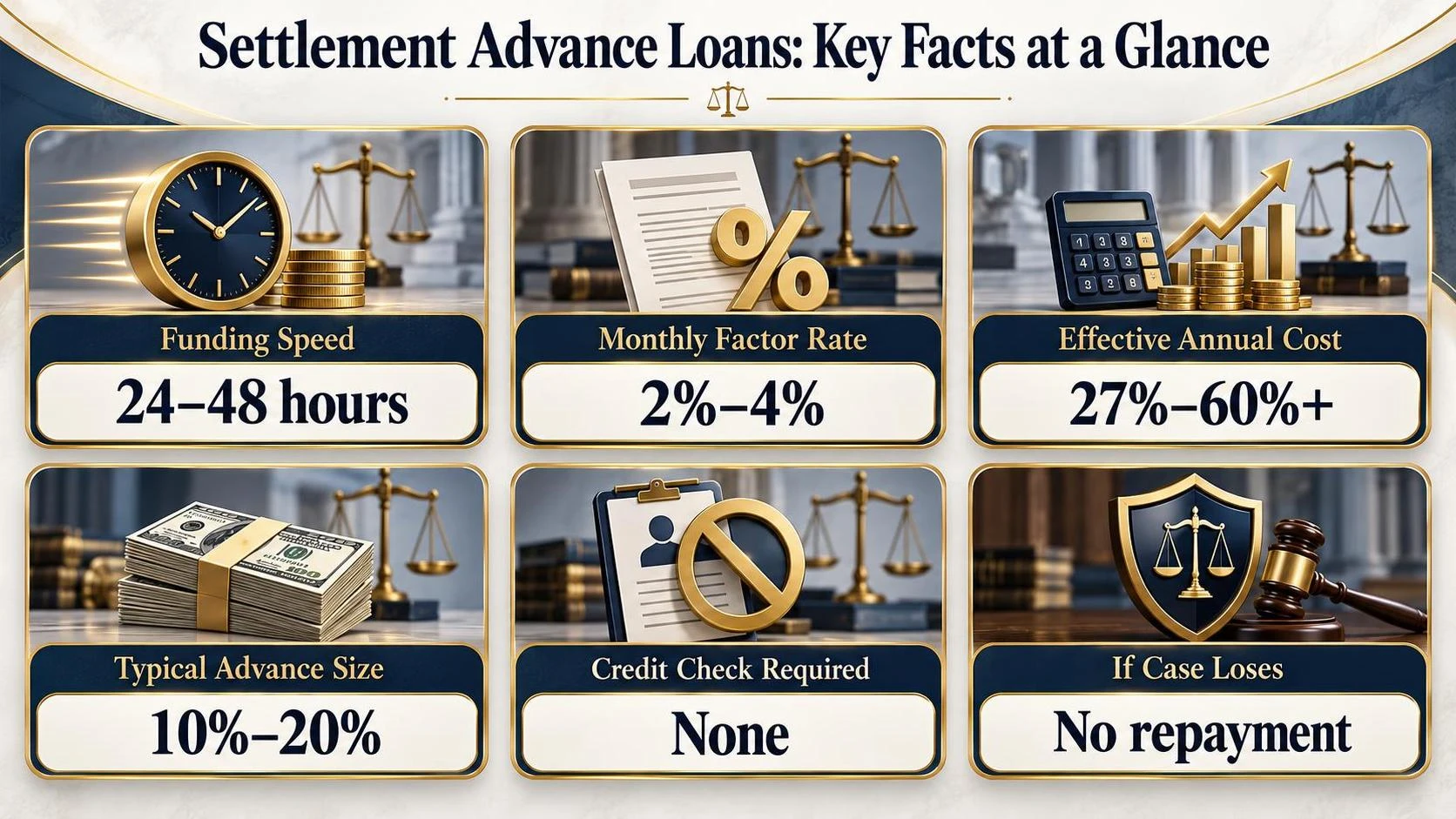
Settlement advance loans and how they work
A settlement advance provides cash to a plaintiff before a lawsuit resolves. Technically, most are non-recourse funding agreements, not loans — the recipient owes nothing if the case loses.
Pre-settlement funding companies purchase a portion of a plaintiff’s expected settlement at a discount. The transaction hinges entirely on case merit, not the applicant’s credit score or employment status.
How the process works
- Application: The plaintiff applies with a funding company and signs a medical-records release.
- Case evaluation: The funder reviews case details directly with the plaintiff’s attorney.
- Approval and advance: If approved, funds typically arrive within 24–48 hours, according to the American Legal Finance Association (ALFA).
- Repayment: The funder is repaid from settlement proceeds. If the plaintiff loses, no repayment is owed under a non-recourse agreement.
Typical cost structure
Funding companies charge fees often expressed as monthly rates rather than APR. Costs vary widely by state regulation and provider.
| Fee structure | Typical range | Source |
| Monthly factor rate | 2%–4% (non-compounding) | Consumer Financial Protection Bureau (CFPB) |
| Effective annualized cost | 27%–60%+ | CFPB, state AG reports |
| Common advance amount | 10%–20% of expected settlement value | ALFA industry data |
Some states cap rates. Arkansas limits charges to the Federal Discount Rate plus 5 percentage points under Amendment 89 of its constitution. Indiana caps rates at 36% annually for lawsuit lending under IC § 24-4.5.
Key distinctions from traditional loans
Unlike bank loans, settlement advances require no monthly payments during litigation. No income verification or minimum credit score applies. The case itself serves as collateral.
Because cases can take years to settle, total repayment amounts can grow substantially. A $10,000 advance at a 3% monthly rate would accumulate roughly $10,800 in fees over one year if non-compounding.
Caution: Fee structures differ significantly across providers and states. Plaintiffs should have their attorney review any funding contract before signing. Verify current rate caps with the relevant state attorney general’s office.

Who qualifies for a pending lawsuit advance
Qualification for a pending lawsuit advance depends primarily on the merits of the case, not the applicant’s credit score or employment status. Funding companies evaluate the likelihood of a favorable settlement or verdict before approving an advance.
Core eligibility requirements
- Active pending lawsuit: The applicant must have a filed claim or lawsuit that has not yet reached final resolution.
- Attorney representation: Nearly all funding companies require the applicant to have retained a licensed attorney on a contingency-fee basis.
- Sufficient expected recovery: The projected settlement or award must be large enough to repay the advance plus fees and still leave the plaintiff with meaningful proceeds.
- Attorney cooperation: The plaintiff’s attorney must agree to communicate case details with the funder and sign a lien or assignment letter.
Case types commonly approved
| Case type | Typical approval likelihood |
| Motor vehicle accidents | High — clear liability and insurance coverage |
| Slip-and-fall / premises liability | Moderate to high |
| Medical malpractice | Moderate — requires strong expert evidence |
| Workers’ compensation | Varies by state; some funders exclude these |
| Employment discrimination | Lower — damages harder to quantify |
| Product liability / mass tort | Moderate to high for established MDLs |
What does NOT affect qualification
Credit history, income level, and employment status are generally irrelevant. The American Legal Finance Association (ALFA) confirms that funding decisions rest on case merits, not consumer creditworthiness.
Applicants with bankruptcies, prior collections, or no current income can still qualify if the underlying lawsuit is strong.
Common disqualifiers
- Cases without clear liability or with disputed fault
- Defendants who carry no insurance or have minimal assets
- Lawsuits in very early stages with no medical documentation or demand letter filed
- Pro se plaintiffs — those representing themselves without an attorney
Caution: Lawsuit advances carry fees that can exceed equivalent annualized rates of 30%–60% or more, according to reporting by the Consumer Financial Protection Bureau. Readers should review all contract terms with their attorney before accepting any funding offer.

How settlement advance applications and funding work
Settlement advance applications follow a streamlined process designed to provide plaintiffs with cash before their case resolves. Most funders evaluate the merits of the underlying lawsuit rather than the applicant’s credit score or employment history.
The process typically involves four to six steps, depending on the funding company.
Standard application steps
- Initial application: The plaintiff submits basic case details—case type, attorney name, and estimated settlement value—online or by phone.
- Attorney cooperation: The funder contacts the plaintiff’s attorney to obtain case documents, medical records, and demand letters.
- Underwriting review: An in-house team evaluates the likelihood of a favorable outcome and estimates the expected settlement range.
- Offer and contract: If approved, the funder issues a funding agreement specifying the advance amount, fee structure, and repayment terms.
- Disbursement: Once the plaintiff signs, funds are typically disbursed within 24 to 48 hours, according to the American Legal Finance Association (ALFA).
Typical approval and funding timelines
| Stage | Typical duration |
| Application submission | 15–30 minutes |
| Attorney document review | 1–3 business days |
| Underwriting decision | 24–72 hours |
| Fund disbursement after signing | 24–48 hours |
| Total elapsed time | 3–7 business days on average |
Advance amounts generally range from $500 to $250,000, as reported by Bloomberg Law, depending on the case type and projected settlement value.
Funders typically advance between 10% and 20% of the anticipated settlement, per data cited by the Consumer Financial Protection Bureau (CFPB).
No repayment is required if the plaintiff loses the case. This non-recourse structure is the defining feature that distinguishes settlement advances from traditional loans, according to ALFA guidelines.
Caution: Fee structures vary widely among funders and may compound over time. Plaintiffs should have their attorney review any funding agreement before signing and compare offers from multiple companies.

Settlement advance fees and compounding costs
Settlement advance companies typically do not charge traditional interest rates. Instead, they apply fees that compound over time, often converting to effective annual rates far exceeding conventional lending products. Understanding these costs is critical before signing any funding agreement.
Common fee structures
Most pre-settlement funding companies use one of three pricing models, each with different long-term cost implications.
- Monthly compounding rates: Typically 2%–4% per month, compounding on the outstanding balance plus accrued fees (source: American Bar Association, “Litigation Funding” overview).
- Fixed-fee (non-compounding) rates: A flat percentage charged per period—often 1%–3% monthly—applied only to the original advance amount.
- Tiered pricing: Rates that increase after set intervals, such as a lower rate for the first 12 months escalating thereafter.
How compounding inflates repayment
The table below illustrates the total repayment on a $10,000 advance under compounding versus non-compounding structures at 3% monthly.
| Case duration | Compounding (3%/mo) | Non-compounding (3%/mo) |
| 12 months | $14,258 | $13,600 |
| 24 months | $20,328 | $17,200 |
| 36 months | $28,983 | $20,800 |
At 36 months with compounding, the borrower owes nearly three times the original advance. The effective annual percentage rate exceeds 42% (Consumer Financial Protection Bureau, marketplace lending data).
Additional fees to watch
- Origination or processing fees: Often 3%–5% of the advance, deducted at funding.
- Broker fees: Third-party referral commissions that can add 5%–10% to total cost.
- Case-monitoring or administrative fees: Flat monthly or annual charges layered on top of the funding rate.
Some states cap allowable fees. Arkansas, for example, limits annual rates under its constitution, and several other states have introduced disclosure requirements (National Conference of State Legislatures).
Caution: Exact fee structures vary widely. Readers should request a full written breakdown of all charges—including compounding terms—and have an attorney review the agreement before accepting any settlement advance.

Settlement advance repayment when cases settle or fail
Settlement advance repayment is contingent on the outcome of the underlying legal case. Unlike traditional loans, most pre-settlement funding agreements are structured as non-recourse transactions, meaning repayment is required only if the plaintiff wins or settles.
How repayment works after a settlement
When a case settles, the funding company is repaid directly from the settlement proceeds before the plaintiff receives the remaining balance. The plaintiff’s attorney typically disburses funds according to a priority structure.
| Deduction order | Typical recipient |
| 1st | Court costs and case expenses |
| 2nd | Attorney contingency fee (commonly 33%–40% of the gross settlement, per the American Bar Association) |
| 3rd | Medical liens and outstanding balances |
| 4th | Settlement funding company (principal + fees/interest) |
| 5th | Plaintiff receives remaining balance |
Cost accumulation over time
Funding companies typically charge compounding rates that vary widely. According to the American Legal Finance Association (ALFA), annualized rates can range from roughly 27% to over 60% depending on the provider and state regulation.
| Advance amount | Effective annual rate | Owed after 12 months | Owed after 24 months |
| $5,000 | 36% | $6,800 | $9,248 |
| $10,000 | 36% | $13,600 | $18,496 |
| $25,000 | 36% | $34,000 | $46,240 |
Some states cap these rates. Arkansas limits consumer lending rates to 17% per the state constitution (Amendment 89). Other states, such as Oklahoma (2020 Consumer Settlement Funding Act), require fee disclosures but do not impose strict rate ceilings.
What happens if the case is lost
Under a non-recourse agreement, the plaintiff owes nothing if the case is dismissed or results in a defense verdict. The funding company absorbs the total loss, including principal and accumulated fees.
- No repayment obligation if the plaintiff recovers nothing
- No impact on the plaintiff’s credit score, as most funders do not report to credit bureaus
- No collection activity permitted against the plaintiff’s personal assets
Caution: Not all funding contracts are truly non-recourse. Some agreements contain recourse clauses or partial-recourse provisions. Plaintiffs should have an attorney review the full contract before signing and verify the non-recourse language explicitly.

State rules and settlement advance contract protections
Settlement advance transactions are regulated unevenly across the United States. Some states impose strict disclosure and judicial-approval requirements, while others have no specific statute governing these transactions at all.
As of 2024, at least 18 states have enacted laws specifically addressing structured settlement transfer transactions, according to the National Conference of State Legislatures (NCSL).
Key state regulatory approaches
| State | Key Requirement | Governing Statute |
| California | Court approval required; judge must find transfer is in payee’s “best interest” | Insurance Code §10139.5 |
| New York | Court approval required; minimum 20-day advance written notice to annuity issuer | GOL §5-1705 |
| Virginia | Court must find transfer does not “contravene” applicable law and is in payee’s best interest | Va. Code §59.1-475 et seq. |
| Illinois | Requires independent professional advice disclosure before transfer | 215 ILCS 153/ |
| Florida | Court approval with express finding of best interest; 3-day right to cancel | Fla. Stat. §626.99296 |
Common contract protections required by state law
- Right to cancel: Many states mandate a cooling-off period — typically 3 to 15 business days — during which the payee can rescind the agreement without penalty.
- Disclosure of discount rate: States like California require the funding company to disclose the effective annual discount rate and the total dollar difference between the present value and the gross advance amount.
- Independent professional advice: Several statutes require proof that the payee received independent legal or financial counsel before signing.
- Court approval (judicial “best interest” finding): Most state structured-settlement protection acts follow the model set by the federal Structured Settlement Protection Act of 2002 (P.L. 107-22, 26 U.S.C. §5891), which imposes a 40% federal excise tax on transfers not approved by a state court.
Caution: State laws change frequently. Readers should verify current statutes through their state legislature’s website or consult a licensed attorney before entering any settlement advance agreement. Acting on outdated information could result in financial loss or unenforceable contracts.

How to compare settlement advance funding offers
Comparing settlement advance offers requires examining more than the advertised funding amount. Fees, repayment structures, and effective annual costs vary dramatically between companies, making side-by-side analysis essential before signing any agreement.
Key factors to evaluate
- Effective annual rate: Settlement funding companies typically charge between 27% and 60% annualized, according to the American Bar Association. Some structures compound monthly, others use simple interest — the distinction significantly affects total repayment.
- Fee transparency: Look for origination fees, broker fees, underwriting charges, and document preparation costs. The National Association of Consumer Advocates has noted that undisclosed fees can add 10–15 percentage points to the effective cost.
- Non-recourse vs. recourse terms: Most legitimate pre-settlement advances are non-recourse, meaning the applicant owes nothing if the case loses. Verify this term explicitly in the contract.
- Funding speed: Approval timelines range from 24 hours to several weeks depending on the company and case complexity.
Sample cost comparison
The table below illustrates how compounding frequency changes the total owed on a $10,000 advance held for 18 months.
| Rate Structure | Monthly Rate | Total Owed at 18 Months | Effective Annual Cost |
| Simple interest | 3.0% | $15,400 | 36% |
| Monthly compounding | 3.0% | $17,024 | 42.6% |
| Monthly compounding | 4.0% | $20,258 | 60.1% |
Figures are calculated using standard compound-interest formulas. Actual contracts may include additional fees that increase total cost.
Steps before signing
- Request a written disclosure of all fees and the total repayment amount at 6, 12, 18, and 24 months.
- Have your attorney review the funding agreement — the Consumer Financial Protection Bureau recommends legal review for any structured financial product.
- Obtain quotes from at least three companies to benchmark pricing.
- Confirm the agreement is non-recourse and contains no hidden personal guarantees.
Caution: Settlement advances are not regulated uniformly across states. Laws in New York, Arkansas, and several other states impose specific disclosure or rate-cap requirements. Verify the rules in your jurisdiction before proceeding.

What editors independently reviewed about settlement advances
Settlement advances are not traditional loans — they are non-recourse cash advances against pending lawsuit proceeds. Multiple independent editorial reviews have examined how these products work, their cost structures, and consumer protections.
The Consumer Financial Protection Bureau (CFPB) has noted that lawsuit lending products typically do not require credit checks or employment verification, since repayment depends solely on case outcome.
Typical cost structures identified in editorial reviews
Funding rates vary widely. The American Bar Association (ABA) has reported that annualized rates on pre-settlement funding can range from roughly 27% to over 60%, depending on the provider and case type.
| Factor | Typical range | Source |
| Monthly fee structure | 2%–4% per month (non-compounding, some providers) | ABA Journal reporting |
| Effective annualized cost | 27%–60%+ | ABA Commission on Ethics |
| Average advance amount | $500–$100,000 | Alliance for Responsible Consumer Legal Funding (ARC) |
| Typical funding timeline | 24–48 hours after approval | Industry disclosures reviewed by NerdWallet |
Key findings from independent sources
- Non-recourse structure: If the case loses, the consumer owes nothing. The National Conference of State Legislatures (NCSL) confirms this is standard across the industry.
- State regulation varies sharply: According to NCSL data, at least 30 states have introduced or enacted legislation addressing lawsuit lending. States like Arkansas, Indiana, Maine, Nebraska, Nevada, Oklahoma, Tennessee, Vermont, and West Virginia have specific consumer-protection statutes governing these transactions.
- Attorney involvement: Most funders require the applicant’s attorney to cooperate in the process. The New York City Bar Association has recommended that attorneys carefully review funding agreements before clients sign.
- Compounding vs. simple interest: Some providers charge compounding fees, which can significantly increase total repayment. ARC member companies have voluntarily adopted caps and non-compounding rate disclosures.
Caution: Rates, fee structures, and regulatory protections differ by state and provider. Readers should consult their attorney and verify current terms directly with the funder before signing any agreement. Do not rely solely on this article for financial or legal decisions.

Alternatives to settlement advance loans
Settlement advance loans carry effective annual rates that can exceed 100%, according to the American Bar Association. Before committing to one, plaintiffs should evaluate several lower-cost alternatives that preserve more of the eventual award.
Personal loans from banks or credit unions
Unsecured personal loans from credit unions averaged 11.04% APR in Q1 2024, per the National Credit Union Administration. Bank personal loans ranged from roughly 8% to 36% APR depending on creditworthiness, according to Federal Reserve data.
| Funding Source | Typical Effective APR | Recourse? |
| Settlement advance (pre-settlement funding) | 27%–60%+ (often compounding) | Non-recourse |
| Credit union personal loan | ~11% (NCUA, Q1 2024) | Full recourse |
| Credit card cash advance | 20%–30% | Full recourse |
| 401(k) hardship withdrawal | No interest; 10% penalty + taxes if under 59½ | N/A |
Borrowing from retirement accounts
The IRS allows 401(k) loans up to $50,000 or 50% of the vested balance, whichever is less (IRC §72(p)). These loans carry no credit check and interest is paid back to the borrower’s own account.
Caution: Leaving employment before repayment triggers taxes plus a 10% early-withdrawal penalty for those under age 59½. Consult a tax professional before proceeding.
Negotiating medical-provider liens
Many physicians and hospitals accept a letter of protection (LOP), deferring payment until the case resolves. This eliminates the need for upfront cash without any financing cost, according to the American Association for Justice.
Attorney fee advances or cost loans
Some plaintiff attorneys advance litigation costs and, where state ethics rules permit, living expenses. Model Rule 1.8(e) of the ABA Model Rules of Professional Conduct governs these arrangements. Readers should verify their state’s specific version of this rule.
Community and government assistance
- SNAP benefits — covers food costs; eligibility tied to household income (USDA FNS).
- Medicaid — covers medical bills for qualifying individuals during litigation.
- Local legal-aid societies — may connect plaintiffs with emergency hardship funds.
Caution: Each alternative carries its own risks. Plaintiffs should consult their attorney and a licensed financial advisor before borrowing against any asset or government benefit while a lawsuit is pending.

Frequently Asked Questions
What is a settlement advance loan?
A settlement advance — technically a non-recourse cash advance, not a loan — gives a plaintiff money before a lawsuit settles, using the expected settlement as collateral.
If the case loses, the plaintiff typically owes nothing back, which is why funding companies call the transaction a “purchase of a future receivable” rather than a loan.
The Consumer Financial Protection Bureau (CFPB) has noted this distinction affects whether state lending laws apply.
How much money can a plaintiff receive from a settlement advance?
Most pre-settlement funding companies advance between 10% and 20% of the estimated value of the case, according to the American Bar Association.
The exact amount depends on the funder’s risk assessment, the type of claim, and the projected timeline to resolution.
Plaintiffs should request a written breakdown of the funded amount and all associated costs before signing any agreement.
What fees and interest rates are typical for settlement advances?
Annualized rates on pre-settlement funding can range from roughly 27% to over 60% depending on the provider and the state, as reported by the National Association of Consumer Advocates (NACA).
Fees are usually compounded monthly or applied as a flat fee per period, and the total repayment amount can exceed the original advance several times over on cases that take years to resolve.
Plaintiffs should demand a payoff schedule showing the total cost at 6-month, 12-month, and 24-month intervals before agreeing.
Which states regulate settlement advance transactions?
As of 2024, at least 30 states plus the District of Columbia have enacted some form of litigation funding regulation, according to data tracked by the American Legal Finance Association (ALFA).
States such as Arkansas, Indiana, Maine, Nebraska, Nevada, Ohio, Oklahoma, Tennessee, Vermont, and West Virginia have specific consumer litigation funding statutes that cap fees, require disclosures, or grant a right of rescission.
Readers should verify current rules with their state attorney general’s office, because the regulatory landscape changes frequently.
Does a plaintiff need good credit or employment to qualify?
No. Because the advance is repaid solely from the settlement proceeds, funders base approval on the merits and estimated value of the case rather than the applicant’s credit score, employment status, or income.
The plaintiff’s attorney is typically contacted to verify the claim’s status and projected value. This non-recourse structure is what distinguishes settlement funding from traditional consumer lending.
What role does the plaintiff’s attorney play in the funding process?
Most funding companies require the plaintiff’s attorney to sign an acknowledgment letter confirming the case details and agreeing to direct repayment to the funder from any settlement or judgment proceeds.
Some state statutes — Ohio Rev. Code §1349.55, for example — mandate attorney involvement and disclosure requirements to protect the client.
Plaintiffs should discuss any funding decision with their attorney, who can evaluate whether the terms are reasonable relative to the likely recovery.
Can a plaintiff pay off a settlement advance early to reduce costs?
Many funding agreements allow early repayment, and some state laws — such as Indiana Code §24-12-7 — require funders to provide a schedule showing reduced costs for early payoff.
However, not all contracts include this provision.
and some impose minimum holding periods or flat fees that do not decrease with early repayment. Caution: plaintiffs should read the buyout and prepayment clauses carefully and have their attorney review the contract before signing,.
Because terms vary widely across providers.
Related Reading
- Is Oasis Financial Legit?
- Pre Settlement Funding California
- Pre Settlement Loans Without A Lawyer
- Embracing New Beginnings: Onder Law Firm Break Up Guide
- Cash Advance on Settlement
- Nova Legal Funding Reviews
- Best Pre Settlement Funding Companies
- NY Tribeca Group
- All Pre-Settlement Funding Guides
- Consumer Financial Protection Bureau — "What Is a Lawsuit Loan or Lawsuit Funding?" (2023)
- U.S. Government Accountability Office — "Third-Party Litigation Financing: Market Characteristics, Data, and Trends" (2022)
- Federal Trade Commission — Consumer Advice on Advance-Fee Loan Scams (2024)
- New York City Bar Association — "Regulation of Litigation Funding" (2020)
- American Bar Association — "Litigation Funding: A Framework for Lawyers" (2020)