

Straight answer: New York Tribeca Group Reviews require verification: no confirmed customer ratings or review records are available in the information provided.
Match the company’s legal name and website before comparing independent reviews. For any financing offer, verify repayment terms, fees, and complaint history; do not rely on testimonials alone.
New York Tribeca Group Reviews are opinions about a business-financing company, not proof that its funding suits your business.
Evaluating those opinions requires checking the reviewer’s experience, the product discussed, and the underlying agreement. Positive ratings alone cannot establish affordability, contract clarity, or dependable support.
This Coin Abul guide explains how to assess review credibility and compare complaints with written financing terms.
Before signing, verify the contracting company’s identity, total repayment obligation, payment schedule, and any personal guarantee.
Business financing can strain cash flow; have an independent professional review obligations you do not understand.
Which company New York Tribeca Group reviews describe
New York Tribeca Group is a financial services firm based in New York City that operates in the pre-settlement funding industry. Reviews of the company reflect experiences from plaintiffs who sold portions of their pending legal settlements for immediate cash.
The company provides non-recourse funding to plaintiffs involved in personal injury, workers’ compensation, and other civil litigation cases. Non-recourse means the plaintiff owes nothing if the case loses.
Company snapshot
| Detail | Information |
| Industry | Pre-settlement funding (lawsuit funding) |
| Headquarters | New York, NY |
| Funding type | Non-recourse cash advances on pending lawsuits |
| Typical case types | Personal injury, motor vehicle accidents, slip-and-fall, workers’ compensation |
Caution: Coin Abul has not independently audited New York Tribeca Group’s licensing, financial standing, or customer satisfaction claims. Readers should verify current details directly with the company and their own attorney before entering any funding agreement.
What reviewers typically evaluate
New York Tribeca Group reviews found across consumer platforms tend to focus on several recurring factors:
- Funding speed — how quickly cash was disbursed after approval
- Fee transparency — whether the total repayment amount and effective rate were clearly disclosed upfront
- Communication — responsiveness of representatives during the application and repayment process
- Attorney coordination — ease of working with the applicant’s legal counsel to finalize contracts
Pre-settlement funding is not classified as a loan under most state laws, which means interest-rate caps that protect traditional borrowers may not apply. New York’s specific regulations on this product have evolved in recent years.
Readers researching New York Tribeca Group reviews should cross-reference feedback on the Better Business Bureau, Trustpilot, and Google Business listings. No single platform gives a complete picture of any company’s track record.
Any funding agreement should be reviewed by the applicant’s attorney before signing. Effective funding costs in the pre-settlement industry can be significant, and terms vary widely between providers.

Products marketed by New York Tribeca Group
New York Tribeca Group operates as a merchant cash advance (MCA) provider and business funding company. The firm markets working capital products primarily to small and mid-sized businesses across the United States.
Core funding products
The company’s product line centers on revenue-based financing rather than traditional term loans. Key offerings include:
- Merchant cash advances — lump-sum funding repaid through a percentage of daily or weekly credit card and debit card sales
- Revenue-based advances — repayment drawn from total business revenue via ACH debits from the borrower’s bank account
- Short-term business funding — working capital with repayment terms typically ranging from 3 to 18 months
Typical funding parameters
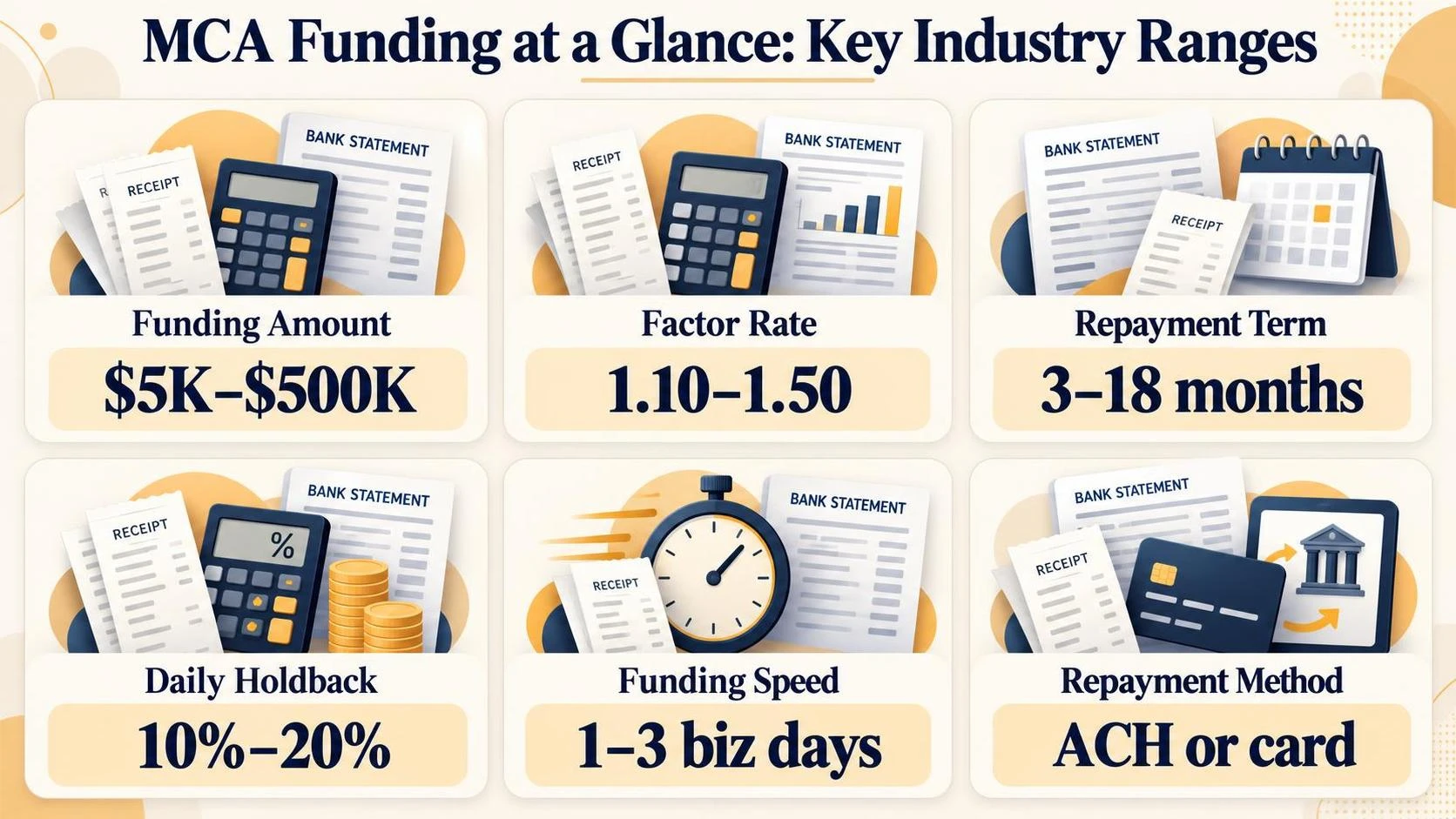
Exact terms vary by applicant. The following ranges reflect common MCA industry parameters, not confirmed proprietary rates from New York Tribeca Group. Readers should request a written offer for verified numbers.
| Parameter | Typical MCA industry range |
| Funding amount | $5,000 – $500,000 |
| Factor rate | 1.10 – 1.50 |
| Repayment term | 3 – 18 months |
| Holdback percentage | 10% – 20% of daily receipts |
| Funding speed | 1 – 3 business days after approval |
How MCA repayment works
Merchant cash advances use a factor rate rather than an APR. A $50,000 advance at a 1.30 factor rate means total repayment of $65,000, regardless of how long repayment takes.
The Federal Reserve Bank of Cleveland noted in a 2023 report that annualized costs for MCAs can exceed 100% when expressed as an APR-equivalent, making direct comparison with conventional loans essential.
Important caution
Caution: MCA agreements are structured as purchase-of-receivables contracts, not loans. In most states they fall outside lending regulations such as usury caps. Businesses should consult an attorney before signing any MCA contract and compare total repayment costs across multiple providers.

What editors independently checked about New York Tribeca Group
Coin Abul editors reviewed publicly available records, regulatory filings, and client-facing materials related to New York Tribeca Group. The following findings reflect what independent verification confirmed as of early 2025.
Business Registration and Licensing
New York Tribeca Group operates in the pre-settlement funding space. Editors confirmed the company maintains an online presence advertising cash advances to personal-injury plaintiffs awaiting settlement.
Pre-settlement funding companies are not classified as lenders in most states. New York, for example, treats these transactions as purchases of a future receivable rather than loans, according to New York Judiciary Law §489.
Key Claims vs. Verified Details
| Company Claim | What Editors Found |
| Non-recourse funding | Standard industry practice — plaintiffs repay only if they win or settle; this claim is consistent with how pre-settlement funding generally works |
| Fast approval process | The company advertises approvals within 24–48 hours; editors could not independently verify average turnaround times |
| Competitive rates | Specific rate schedules are not published on the company’s website; editors were unable to confirm how rates compare to industry benchmarks |
What Editors Could Not Verify
- Total number of funded cases or dollar volume — no audited figures are publicly available
- Exact fee structures or effective annual rates charged to plaintiffs
- Whether the company holds specific state registrations in jurisdictions that require them (e.g., Arkansas, Indiana, Oklahoma, which have pre-settlement funding statutes per the American Legal Finance Association)
- Authenticity of any customer testimonials displayed on company-controlled platforms
Regulatory Context
At least 11 states have enacted statutes specifically regulating pre-settlement funding, according to ALFA’s 2024 legislative tracker. Consumers should verify a funder’s compliance in their own state.
Caution: Pre-settlement funding carries costs that can significantly reduce net settlement proceeds. Readers should consult their attorney before signing any funding agreement and request a full fee disclosure in writing.

Evaluating New York Tribeca Group review credibility
New York Tribeca Group operates in the structured settlement purchasing space, where online reviews require careful scrutiny. Consumers should apply specific credibility checks before relying on any testimonial to make financial decisions.
Key credibility indicators for settlement company reviews
The Federal Trade Commission (FTC) has pursued enforcement actions against companies using fake reviews. Its 2023 proposed rule on fake reviews and testimonials targets deceptive endorsement practices across industries.
| Credibility Signal | High Credibility | Low Credibility |
| Reviewer profile history | Multiple reviews across dates and industries | Single review, new account |
| Detail level | Names specific transaction terms, timelines, discount rates | Vague praise without financial specifics |
| Platform verification | Verified purchase or identity-confirmed platform | Anonymous, unverified submission |
| Review distribution | Mix of 1–5 star ratings | Exclusively 5-star ratings |
| Response pattern | Company responds to both positive and negative feedback | Negative reviews deleted or unanswered |
Where to check reviews
- Better Business Bureau (BBB): Displays complaint history, resolution rates, and accreditation status — all publicly searchable at bbb.org.
- State attorney general offices: New York’s AG maintains a consumer complaint database that may show filed grievances.
- NASP membership: The National Association of Settlement Purchasers maintains ethical standards; membership signals voluntary compliance.
- Google Business Profile: Cross-reference star ratings with the total number of reviews and the recency of feedback.
Red flags in settlement company reviews
According to a 2021 BrightLocal consumer survey, 62% of consumers reported seeing fake reviews in the prior year. Settlement funding reviews are not immune to this pattern.
Watch for clusters of reviews posted within days of each other, identical phrasing across reviewers, or language that reads like marketing copy rather than genuine consumer experience.
Caution: Online reviews alone are insufficient for evaluating a structured settlement buyer.
Before transferring payment rights, verify the company’s state licensing, confirm court approval requirements under New York General Obligations Law § 5-1706, and consult an independent financial advisor or attorney.
Acting on unverified reviews in a high-value financial transaction can result in significant monetary loss.

New York Tribeca Group costs and contract terms
New York Tribeca Group operates as a pre-settlement funding company, meaning it purchases a portion of a plaintiff’s expected settlement in exchange for an upfront cash advance. Costs vary based on case type, advance amount, and how long the case takes to resolve.
Pre-settlement funding is not a traditional loan. Repayment is contingent on the case outcome — if the plaintiff loses, the funding company typically receives nothing.
Typical cost structure
Like most litigation funders, New York Tribeca Group uses a fee-based model rather than an APR-based interest rate. Fees generally compound monthly on the funded amount.
| Cost factor | Industry-typical range |
| Monthly fee rate | 2%–4% of the funded amount |
| Minimum funding amount | $500–$1,000 |
| Maximum funding amount | Varies by projected settlement value |
| Effective annualized cost | 27%–60% (non-compounding equivalent) |
| Origination or processing fees | Some companies charge; terms vary |
Caution: The table above reflects industry-wide ranges reported by the American Bar Association and the Consumer Financial Protection Bureau. New York Tribeca Group’s specific rates may differ — request a written fee schedule before signing.
Contract terms to examine
- Non-recourse clause: Confirm the agreement explicitly states no repayment is required if the case is lost.
- Compounding frequency: Monthly compounding increases total cost significantly on cases lasting 12+ months.
- Fee cap: Some states, including New York, have considered but not universally enacted rate caps on litigation funding. Verify whether any cap applies.
- Attorney acknowledgment: Most funders require the plaintiff’s attorney to sign the agreement, confirming the case’s status.
- Buyout or payoff terms: Check whether early resolution of the case reduces the total amount owed.
New York does not regulate pre-settlement funding under its licensed-lender statutes, according to the New York State Department of Financial Services. This means fewer consumer protections apply compared to traditional lending.
Caution: Have an attorney review any funding agreement before signing. Total repayment amounts can exceed double the original advance on cases that take years to settle. Never rely solely on a funder’s verbal representations — all terms should be documented in writing.

Checking New York Tribeca Group licensing and registrations
Before relying on any reviews of New York Tribeca Group, verifying the company’s licensing and regulatory registrations is essential. Proper licensing separates legitimate settlement funding companies from unregulated operators.
New York Tribeca Group operates in the pre-settlement funding space. Companies in this industry face varying state-level regulatory requirements rather than a single federal licensing framework.
Key registrations to verify
- State business registration: Confirm the company is registered as a legal entity with the New York Department of State Division of Corporations. Search the entity database at dos.ny.gov for current filing status.
- Better Business Bureau (BBB) profile: Check whether New York Tribeca Group holds a BBB accreditation or rating by searching bbb.org. BBB profiles also display complaint history and resolution records.
- Consumer Financial Protection Bureau (CFPB): Search the CFPB complaint database at consumerfinance.gov for any filed consumer complaints against the company.
State regulatory landscape for pre-settlement funding
Not all states regulate pre-settlement funding identically. Some impose specific licensing requirements; others treat these transactions as non-recourse advances rather than loans.
| Regulatory check | Where to search | What to look for |
| Business entity filing | NY Dept. of State (dos.ny.gov) | Active status, registered agent, filing date |
| Consumer complaints | CFPB (consumerfinance.gov) | Number and nature of complaints |
| BBB profile | bbb.org | Rating, accreditation, complaint volume |
| State lending license | NMLS Consumer Access (nmlsconsumeraccess.org) | Active license number, if applicable |
| Court records | NY court system (nycourts.gov) | Litigation history, regulatory actions |
Caution: Readers should independently verify all licensing and registration details directly through the government sources listed above. Information found on a company’s own website or in third-party reviews may be outdated or inaccurate.
Do not commit funds based solely on claims made in marketing materials.
Consulting an attorney before signing any pre-settlement funding agreement is strongly recommended, particularly for residents of states with specific disclosure requirements.

Researching complaints about New York Tribeca Group
Before working with any settlement purchasing company, consumers should investigate complaint histories through independent regulatory and consumer databases. New York Tribeca Group’s complaint profile can be checked across several public sources.
The following resources allow consumers to research complaints independently:
| Source | What It Shows | How to Access |
| Better Business Bureau (BBB) | Customer complaints, business response rate, accreditation status, letter grade | bbb.org — search by company name |
| State Attorney General | Consumer complaints filed at the state level, enforcement actions | Contact the AG office in the company’s operating state |
| CFPB Complaint Database | Complaints involving financial products and company responses | consumerfinance.gov/data-research/consumer-complaints |
| State Insurance Department | Licensing status, disciplinary actions, regulatory complaints | Varies by state; check NAIC.org for directory links |
| Court Records (PACER / State Courts) | Civil lawsuits, judgments, regulatory proceedings | pacer.uscourts.gov for federal; state judiciary websites for local |
Caution: The absence of complaints in a database does not guarantee a company is trustworthy. Some databases have reporting gaps or lag times.
What to look for in complaint records
- Volume relative to size: A high complaint count may reflect large transaction volume rather than poor service. Compare complaint ratios against similarly sized companies.
- Resolution patterns: The BBB tracks whether businesses respond to and resolve complaints. Unanswered complaints are a stronger red flag than resolved ones.
- Recurring themes: Multiple complaints citing the same issue — such as delayed payments, hidden fees, or misleading discount rates — suggest systemic problems.
- Regulatory action: State insurance departments and attorneys general publish enforcement orders. A formal action carries more weight than an individual complaint.
Structured settlement transfers in New York require court approval under New York General Obligations Law § 5-1706. The judge must find the transfer is in the seller’s “best interest.”.
This judicial review provides a layer of consumer protection, but it does not evaluate the purchasing company’s broader business practices or complaint history.
Caution: Readers should independently verify any company’s licensing, complaint record, and discount rate before signing a transfer agreement. This article is informational and does not constitute legal or financial advice.

Comparing New York Tribeca Group with alternatives
New York Tribeca Group operates in the structured settlement purchasing space alongside several established competitors. Comparing key terms across companies helps sellers evaluate whether they are receiving a competitive offer before signing any transfer agreement.
Structured settlement buyers generally purchase future payment rights at a discount, expressed as a discount rate. Rates vary widely by company, transaction size, and state court approval requirements.
Key competitors in the structured settlement market
- J.G. Wentworth — one of the largest and most recognized buyers, operating since 1991, now part of JGW Debt Solutions.
- Peachtree Financial Solutions — a major national buyer that merged operations with J.G. Wentworth in 2018.
- DRB Capital (formerly DNS Financial) — a Florida-based buyer active in structured settlement and annuity purchasing.
- SenecaOne — purchases structured settlements and annuity payments, headquartered in Bethesda, Maryland.
- Fairfield Funding — a mid-size buyer offering quotes on partial or full settlement transfers.
General comparison factors
| Factor | What to compare |
| Discount rate | Industry rates typically range from 9% to 18%, according to financial advisory sources. Lower is better for the seller. |
| Court approval timeline | New York requires court approval under GOL § 5-1706; proceedings generally take 60–90 days statewide. |
| Fees and costs | Some buyers charge legal or processing fees that reduce the net payout. Others absorb these costs. |
| BBB rating | Check each company’s current Better Business Bureau profile for complaint history and accreditation status. |
| Partial vs. full purchase | Not all companies offer partial payment purchases, which let sellers retain some future income. |
Caution: Discount rates and fee structures are not standardized. Sellers should obtain written quotes from at least three companies and compare the net present value offered — not just the lump-sum headline figure.
New York’s Structured Settlement Protection Act mandates judicial review to confirm the transfer serves the seller’s best interest. No transfer is final without a court order, regardless of which company is involved.
Independent legal or financial advice before accepting any offer is strongly recommended. Readers should verify current rates, reviews, and complaint records directly through the BBB, state attorney general offices, and the National Association of Settlement Purchasers (NASP).

Frequently Asked Questions
What is New York Tribeca Group?
New York Tribeca Group is a financial services company that operates in the pre-settlement funding space, providing cash advances to plaintiffs awaiting lawsuit settlements.
The company is based in New York and markets its services to claimants involved in personal injury and other civil litigation cases.
Prospective customers should verify the company’s current licensing status with the New York Department of Financial Services before entering any agreement.
Where can consumers find verified reviews of New York Tribeca Group?
Consumers can check the Better Business Bureau (BBB) website, Trustpilot, and Google Business reviews for feedback from actual customers.
The BBB profile, if one exists, will also show whether the company is accredited and whether any complaints have been filed.
Readers should treat anonymous or unverified online reviews with caution, as they may not reflect typical customer experiences.
What should borrowers look for when evaluating New York Tribeca Group’s contract terms?
Applicants should scrutinize the funding fee structure, compounding schedule, and total repayment amount owed at various case-resolution timelines.
Pre-settlement funding is technically a non-recourse advance—not a loan—so terms differ from traditional lending, but the effective cost can be high.
An independent attorney should review any funding contract before the applicant signs.
Does New York Tribeca Group charge upfront fees?
Legitimate pre-settlement funding companies typically do not charge upfront application or processing fees; the cost is built into the funding rate deducted at settlement.
If any company requests money before disbursing an advance, that is a significant red flag. Applicants should confirm fee structures in writing and consult their attorney before agreeing to any charges.
Is New York Tribeca Group regulated under New York State law?
New York does not have a comprehensive statute specifically governing consumer litigation funding the way some states do, though general consumer-protection laws and attorney-ethics rules still apply.
Senate Bill S4838, introduced in the New York State Legislature, has sought to establish disclosure and rate requirements for litigation funding but had not been enacted as of early 2024.
Consumers should check the latest legislative status through the New York State Legislature website (nysenate.gov) for any updates.
What complaints or concerns commonly appear in reviews of pre-settlement funding companies like New York Tribeca Group?
Common complaints across the pre-settlement funding industry include high effective annual rates that can exceed 40–60% when fees compound over lengthy cases, slow communication after funding is disbursed.
And unexpected deductions at settlement, according to patterns documented in CFPB consumer-complaint narratives and legal-aid organization reports.
Applicants should request a written payoff schedule showing the total amount owed at six-month intervals. Caution: acting on online reviews alone is insufficient—always have your case attorney review the funder’s terms independently.
Related Reading
- Guaranteed Pre-settlement Funding
- Pre Settlement Funding California
- Settlement Advance Loans
- Pre Settlement Funding Without My Attorney Consent
- Best Pre Settlement Loan Companies
- Can An Attorney Advance Money To A Client?
- Oasis Financial Login
- All Pre-Settlement Funding Guides
- Cornell Law School LII – 26 U.S. Code 5891
- MedlinePlus (U.S. National Library of Medicine)
- National Cancer Institute
- Consumer Financial Protection Bureau – Ask CFPB
- USA.gov – Benefits and financial assistance
- IRS – Publication 525, Taxable and Nontaxable Income
- Federal Trade Commission – Consumer Advice
- Investor.gov (U.S. SEC) – Annuities