

Key takeaway:
How post settlement funding rates are quoted
Post-settlement funding rates may appear as a monthly charge, a flat fee, or a scheduled payoff amount. The headline rate does not establish the total cost: the contract’s calculation method, fees, and repayment date determine how much comes out of the settlement.
Identify what the quoted rate measures
- Simple interest: The charge applies to the original funded amount rather than accumulated interest. Check whether the provider charges for partial months.
- Compounding: Charges accrue on a growing balance. Confirm the compounding interval and whether financed fees also accumulate charges.
- Flat or minimum charges: A fixed fee or minimum funding period can make early repayment more expensive than a monthly headline suggests.
- Payoff schedule: Request dated repayment amounts, including every fee and any contractual maximum.
Compare the calculation, not just the percentage
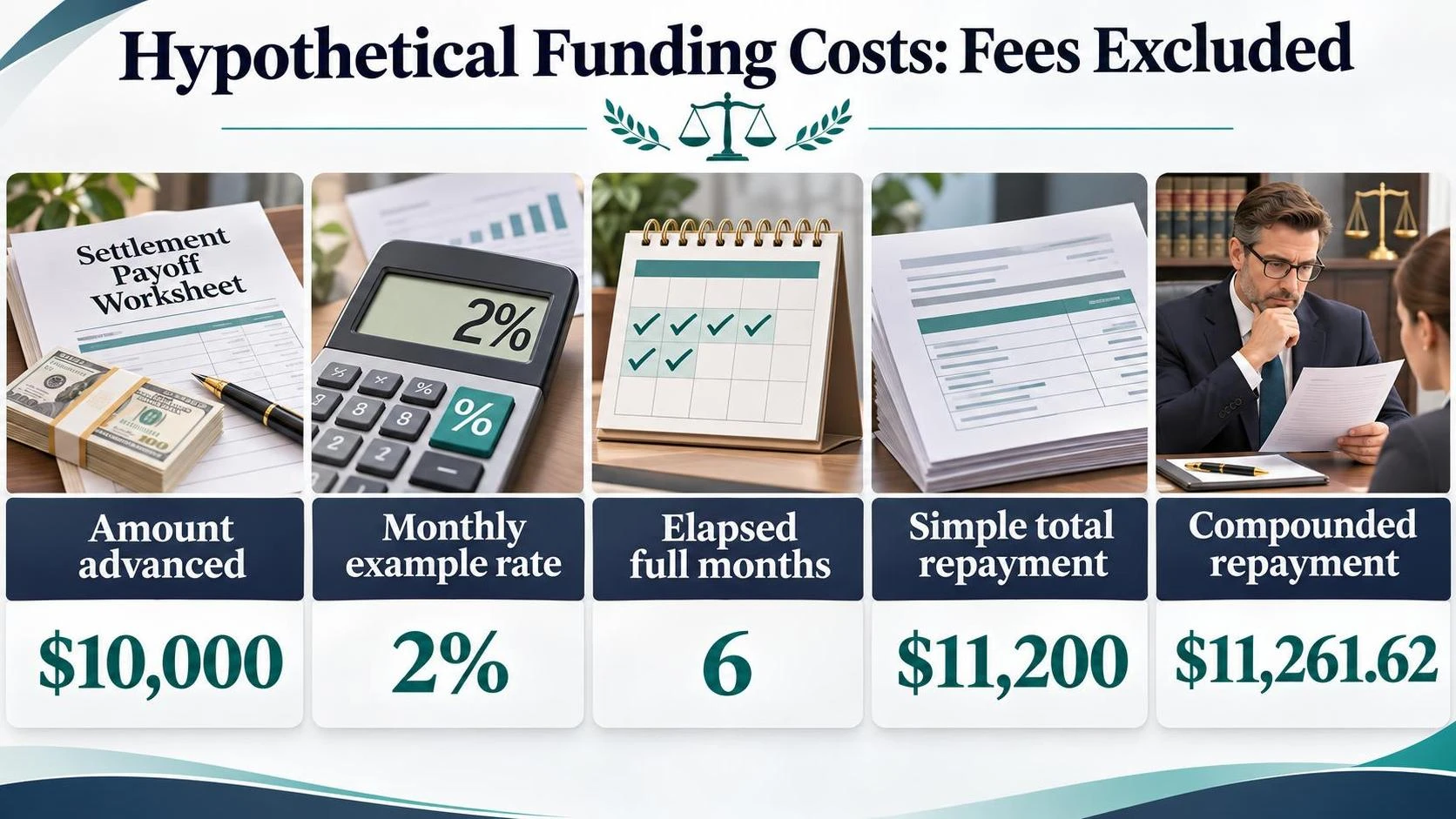
The following hypothetical example demonstrates arithmetic, not available pricing or a market average. Both methods use identical funding, monthly rates, and elapsed time; only the treatment of accumulated charges changes.
| Input or result | Simple interest | Monthly compounding |
| Amount advanced | $10,000 | $10,000 |
| Hypothetical monthly rate | 2% | 2% |
| Elapsed time | 6 full months | 6 full months |
| Funding charge, excluding fees | $1,200 | $1,261.62 |
| Total repayment, excluding fees | $11,200 | $11,261.62 |
Calculation source: These figures follow standard interest formulas: simple repayment equals principal multiplied by one plus the monthly rate times elapsed months; compounded repayment equals principal multiplied by one plus the monthly rate raised to elapsed months. Compounded results are rounded to cents.
Ask for the all-in cost
The Consumer Financial Protection Bureau’s Regulation Z defines APR as a yearly measure of credit cost and addresses finance charges separately.
Source: https://www.consumerfinance.gov/rules-policy/regulations/1026/22/ and https://www.consumerfinance.gov/rules-policy/regulations/1026/4/. Do not assume a settlement-funding contract qualifies as credit covered by those disclosure rules.
Ask each provider for the cash actually delivered, every deduction, the accrual start date, and written payoff amounts for matching dates. Confirm whether charges stop when settlement funds reach the attorney or only when the provider receives repayment.
Caution: Payment delays can increase the deduction from your settlement. Have your attorney review the agreement and check applicable requirements with your state regulator before signing.

Why discount rates differ from APRs
A discount rate values future settlement payments in today’s dollars. An annual percentage rate, or APR, expresses the annualized cost of covered credit under standardized disclosure rules. They answer different questions, so matching percentages do not establish matching costs.
Discount rates price a payment stream
In a structured-settlement sale, the buyer discounts scheduled payments to calculate a present value. Payment dates, payment amounts, and the discounting convention affect that calculation. Separate transaction charges can further reduce the cash the seller receives.
A higher discount rate generally means a lower purchase price for the same payment stream. But the rate alone does not reveal the seller’s net proceeds, which payments transfer, or whether deductions have been included.
The SEC’s Investor.gov bulletin, “Pension or Settlement Income Streams,” explains that sellers receive a lump sum below the value of their future income stream. It also warns that these transactions can involve substantial costs. Request the complete payment schedule and every deduction.
APR follows credit-disclosure rules
The Consumer Financial Protection Bureau’s Regulation Z defines APR as a yearly measure relating the amount and timing of value received to the amount and timing of payments. Applicable finance charges affect the calculation; not every charge necessarily belongs in it.
Regulation Z also specifies these general accuracy tolerances for closed-end APR disclosures. They are disclosure tolerances, not rate caps or acceptable funding prices.
| Transaction category | General APR tolerance |
| Regular transactions | Within 1/8 percentage point above or below the calculated APR. |
| Irregular transactions | Within 1/4 percentage point above or below the calculated APR. |
Source: CFPB, Regulation Z, 12 CFR 1026.22(a). https://www.consumerfinance.gov/rules-policy/regulations/1026/22/.
Compare the actual transaction
“Post-settlement funding” can describe an advance while disbursement is pending, rather than a structured-settlement sale. Do not assume either product carries mandatory APR disclosures; legal classification and applicable law matter.
- Request net cash received, all fees, and repayment or transferred-payment schedules.
- For an advance, request payoff amounts at different disbursement dates.
- For a sale, compare offers using identical payments and dates.
Do not sign based on a headline rate. Have an independent attorney review the agreement, particularly any permanent surrender of future settlement income.

State approval rules that cap transfer costs
State approval rules can constrain structured-settlement transfer costs, but court review does not necessarily impose a numerical rate ceiling.
These protections govern sales of future structured-settlement payments; they do not automatically cover advances against an already-settled lawsuit or attorney receivables.
New York: fairness review, not a guaranteed maximum rate
New York General Obligations Law § 5-1706 requires a court to find that a transfer serves the payee’s best interest, considering dependents’ welfare and support. The court must also find the transaction fair and reasonable, including its discount rate, fees and expenses.
Under § 5-1703, the buyer must provide a separate disclosure statement at least 10 days before the seller signs. Required disclosures include the gross advance, itemized transfer expenses, net advance and effective annual interest rate.
These requirements support scrutiny of the offer; they do not establish a universal numerical discount-rate cap. A seller should examine the disclosed net proceeds rather than treating court approval as proof that the offer is competitively priced.
California: advance disclosure and judicial findings
California Insurance Code § 10136 requires a separate disclosure statement at least 10 days before execution of the transfer agreement, in at least 12-point type. It must identify the payments being sold, the gross advance, itemized expenses and the net amount payable.
California Insurance Code § 10139.5 requires express court findings, including that the transfer is fair, reasonable and in the payee’s best interest, considering dependents. It also addresses independent professional advice.
These safeguards are not a promise that every approved transaction carries a low cost.
The federal tax penalty is not a consumer rate cap
Internal Revenue Code § 5891 imposes a 40% excise tax on the factoring discount for covered acquisitions without a qualifying exception. A qualifying court or administrative order can exempt the acquisition. The tax applies to the acquirer; it is not a maximum permitted charge to the seller.
- Request written gross proceeds, every deduction and net proceeds.
- Compare offers covering identical payment rights and payment dates.
- Check current statutes and obtain independent legal advice before signing. Selling payments permanently reduces future income; approval does not establish affordability or the best available price.

Factors that move a funding rate quote
Post-settlement funding pricing depends on how much money remains available, what could delay payment, and how the contract calculates charges. A signed settlement reduces uncertainty, but unresolved liens, missing releases, or payment disputes can still affect the quote.
Expected time until payment
Longer payment delays can increase the total funding charge when charges accrue over time. Payment deadlines also vary by jurisdiction and defendant. New York illustrates why a funder needs more than the settlement date to estimate repayment timing.
| New York settling defendant | Statutory payment timing |
| Generally, a defendant covered by CPLR 5003-a(a) | Within 21 days after tender of the required release and stipulation of discontinuance. |
| A municipality covered by CPLR 5003-a(b) | Within 90 days after tender of those documents. |
Source: New York Civil Practice Law and Rules, Section 5003-a(a)–(b), https://www.nysenate.gov/legislation/laws/CVP/5003-A. These deadlines have conditions and exceptions; they do not guarantee when cash reaches the plaintiff. Ask the handling attorney which deadline applies before relying on it.
Available proceeds and unresolved deductions
- Net settlement proceeds. Attorney fees, litigation expenses, existing funding balances, and liens reduce the money available for repayment. A larger requested advance relative to verified net proceeds can affect pricing or approval.
- Outstanding liens. Medicare recovery claims can require additional coordination. CMS explains that Medicare may recover conditional payments when a settlement occurs. Check CMS’s “Medicare’s Recovery Process” guidance and have counsel confirm the case-specific obligation.
- Payment certainty. Executed releases, required court approval, and confirmation that the payer has authorized disbursement help clarify remaining risk. Missing documentation can affect underwriting.
Contract mechanics and competing quotes
A headline rate does not establish total cost. Minimum charges, compounding, administrative fees, and payoff caps can change repayment even when advertised rates look similar. Ask whether charges accrue on the original advance or an increasing balance.
Compare written payoff amounts for identical advance amounts and payoff dates. Confirm early-payment treatment and what happens if proceeds arrive late or fall short. Have the handling attorney review repayment obligations; do not assume every post-settlement agreement is nonrecourse.

Reading a payout schedule before signing
A post-settlement funding payout schedule should show what the funding company will collect when settlement money arrives, not merely the advertised rate. Match each repayment amount to a specific payoff date, and distinguish the amount advanced from the cash actually delivered after deductions.
Read the schedule against the contract
Ask for written payoff quotes assuming payment arrives 30, 60, and 90 days after funding. These are comparison checkpoints, not predictions. Each quote should identify principal, financing charges, fees, and the date through which the total remains valid.
| Schedule entry | What to verify before signing |
| Net proceeds | Confirm the cash delivered after origination, processing, wire, or other deductions. |
| Charge calculation | Determine whether charges use the original advance, an increasing balance, or fixed time-based tiers. |
| Payoff dates | Check whether repayment increases daily, monthly, or when another contractual period begins. |
| Minimum charge | Identify any amount owed even if settlement funds arrive immediately. |
| Maximum repayment | Locate any enforceable cap and confirm which charges it includes. |
Separate funding charges from judgment interest
Federal post-judgment interest does not establish a funding company’s price.
Under 28 U.S.C. § 1961(a), qualifying federal civil money judgments generally accrue interest using the preceding calendar week’s weekly average 1-year constant-maturity Treasury yield.
Section 1961(b) provides for daily computation and annual compounding.
Source: U.S. House Office of the Law Revision Counsel, 28 U.S.C. § 1961. That statute concerns judgments, not every settlement or private funding agreement. Check the contract and applicable state law rather than assuming a court-related interest rate limits funding charges.
Check when the repayment clock stops
Determine whether charges stop when the insurer sends payment, counsel receives it, or the funder receives cleared money. Ask how weekends, lien resolution, and administrative delays affect payoff. A signed settlement does not guarantee immediate disbursement.
Caution: Have your attorney review the payoff schedule, payment instructions, and any personal-repayment obligation before signing. Request an estimated client distribution after attorney fees, case expenses, liens, and funding repayment. Do not treat the gross settlement as spendable cash.

How our editorial team verified rate figures
We have not independently verified current provider rates for this section. No dated offers, executed contracts, or calculation logs were supplied, so we cannot report firsthand testing, repeated trials, or measured quote turnaround times.
What counts as rate evidence
We distinguish advertised pricing from a documented transaction cost. A headline rate does not establish what someone will owe: the contract must identify the calculation method, fees, payment dates, and any minimum charge.
“Post-settlement funding” can describe different transactions. An advance against an unpaid settlement differs from selling future structured-settlement payments. Comparing their headline percentages without identifying the product can misstate the cost.
What a reproducible check requires
The following describes the verification procedure needed before publishing a rate comparison, not testing we have already completed:
- Document the offer. Record the provider, product, state, quote date, expiration date, amount advanced, and actual cash delivered after deductions.
- Reconstruct the obligation. Use the agreement’s accrual rules, compounding provisions, fees, minimum charges, and payment schedule to calculate the amount due.
- Check timing sensitivity. Recalculate using alternative payment dates permitted by the contract. Preserve the inputs and formulas so another editor can reproduce each result.
- Separate unlike measures. Label monthly charges, annual percentage rates, and structured-settlement discount rates accurately. Do not present them as interchangeable.
Primary-source checks and limits
For covered credit, the Consumer Financial Protection Bureau’s Regulation Z addresses finance charges in 12 CFR 1026.4 and annual percentage rate calculations in 12 CFR 1026.22. These provisions do not establish that every settlement-funding transaction is covered credit.
For structured-settlement factoring, 26 U.S.C. § 5891 imposes an excise tax equal to 40% of the factoring discount, with an exception for transfers approved in advance through a qualified order. That tax is not a consumer funding rate or a universal price cap.
Primary sources: https://www.consumerfinance.gov/rules-policy/regulations/1026/4/ and https://www.consumerfinance.gov/rules-policy/regulations/1026/22/. The structured-settlement tax provision appears in the U.S. Code, available through https://uscode.house.gov/.
Caution: Do not choose funding from an advertised percentage alone. Obtain the written agreement and a dated payment calculation; have an independent attorney review repayment obligations or any transfer of future payments.

Questions to ask before accepting a rate quote
A post-settlement funding quote should show the cash you receive, how charges accumulate, and what the company collects when settlement proceeds arrive. Do not accept a headline rate without a written payoff schedule and a clear explanation of repayment risk.
- What transaction am I accepting? Ask whether the agreement is a loan, a nonrecourse advance against an unpaid settlement, or a purchase of structured-settlement payments. These arrangements have different costs and legal requirements. The contract’s substance matters more than its marketing label.
- Is the quoted rate monthly or annual, simple or compounded? Ask what balance attracts charges and when charges are added. With compounding, previously accumulated charges can themselves generate charges. Request the calculation method in writing, not merely a percentage.
- What is the annualized cost, including fees? The Consumer Financial Protection Bureau explains that an annual percentage rate, or APR, includes the interest rate plus additional loan fees. Ask for an equivalent annualized comparison, but do not assume every settlement advance legally requires an APR disclosure.
- How much cash reaches me? Request an itemized statement showing the advance, deductions, and net disbursement. Ask about origination, underwriting, processing, broker, and transfer charges, including whether deducted fees also become part of the balance on which charges accrue.
- What happens if payment arrives late or early? Request dated payoff amounts covering the expected disbursement date and possible delays. Identify minimum charges, billing increments, any cost cap, and early-payoff rules. Ask whether charges stop when the defendant pays or only when the funding company receives its money.
- Who bears a shortfall? Have your attorney check repayment priority, liens, attorney fees, and contractual exceptions to nonrecourse treatment. A signed settlement does not guarantee prompt disbursement. Do not assume “nonrecourse” protects you from every repayment obligation.
- Am I selling future structured payments? That requires separate scrutiny. Under 26 U.S.C. § 5891, a structured-settlement factoring transaction generally triggers a 40% excise tax on the factoring discount, payable by the acquirer, unless statutory conditions for an exemption are met. Obtain independent legal advice before transferring payment rights.

Frequently Asked Questions
What rate should I expect for post-settlement funding?
There is no single rate that applies to every post-settlement advance; check the provider’s written agreement for its charges, calculation method, and repayment conditions.
Confirm whether the quote funds a plaintiff’s settlement proceeds or an attorney’s earned fees, because those are different transactions. Do not treat an advertised starting rate as your final cost.
How do flat fees and compounding charges affect repayment?
A flat charge does not itself compound, while a compounding charge can increase the balance by applying additional charges to previously accrued amounts.
The Consumer Financial Protection Bureau’s explanation of compound interest describes this interest-on-interest mechanism; your funding agreement determines whether it applies.
Request written payoff amounts for several possible disbursement dates before signing.
Is a quoted monthly funding rate the same as an APR?
No. The Consumer Financial Protection Bureau explains that a loan’s annual percentage rate measures interest plus certain additional fees on an annual basis, so a monthly charge alone is not an equivalent comparison.
Whether a funding transaction must disclose an APR depends on applicable law and the transaction’s classification; do not assume loan disclosure rules automatically apply.
Can repayment increase after the settlement is signed?
Yes, if the agreement continues accruing charges until the funding company receives repayment rather than stopping when the settlement is signed.
The Centers for Medicare & Medicaid Services explains that Medicare conditional payments can require repayment following a settlement, making benefit-recovery obligations important to discuss with your attorney.
Ask the provider to identify the accrual cutoff and explain how disbursement delays affect your payoff.
How should I compare post-settlement funding with other borrowing options?
Compare the total dollar cost over the same expected repayment period, including administrative charges, minimum charges, and any early-payment terms.
The Consumer Financial Protection Bureau’s personal installment loan guidance recommends checking fees as well as interest when comparing loans.
Also compare repayment risk: a conventional loan generally remains payable despite settlement problems, while any nonrecourse protection in settlement funding depends on the written agreement.
Related Reading
- Same Day Pre Settlement Loans – What You Need to Know
- Personal Injury Settlement Funding Explained
- Class Action Lawsuit Pre-settlement Funding
- Sunrise Lawsuit Funding Reviews
- Pre Settlement Loans Near Me
- National Lawsuit Funding Reviews
- Best Pre Settlement Loans
- Pre Settlement Funding Florida
- Behind the Oasis Financial Lawsuit
- All Pre-Settlement Funding Guides
- Maine Legislature — Maine Consumer Credit Code, Litigation Funding Contract Requirements (2007)
- Vermont General Assembly — Consumer Litigation Funding Contract Requirements (2016)
- Nebraska Legislature — Nonrecourse Civil Litigation Act, Required Disclosures (2010)
- Colorado Supreme Court — Oasis Legal Finance Group, LLC v. Coffman (2015)
- New York State Senate — Structured Settlement Transfers, General Obligations Law § 5-1706 (2002)
- Cornell Legal Information Institute — Structured Settlement Factoring Transactions, 26 U.S.C. § 5891 (2002)
- Internal Revenue Service — Publication 4345, Settlements: Taxability (2023)
- Consumer Financial Protection Bureau – Ask CFPB