

Key takeaway: Cash Advance on Settlement is an upfront payment against expected settlement proceeds before the case resolves.
A settlement-funding company typically receives repayment from the settlement, often with fees or a percentage-based charge. Approval and costs vary by provider and state law.
Review the contract and obtain legal advice before accepting, because the final payout may be substantially reduced.
Cash Advance on Settlement is an upfront payment against expected proceeds from a pending legal settlement.
A settlement-funding company typically reviews the claim, estimates the likely recovery, and offers a nonrecourse advance, meaning repayment generally depends on receiving settlement proceeds.
The agreement may involve fees, a funding charge, or a share of the recovery.
This option can provide money for living costs, medical bills, or legal expenses while a case continues, but it can reduce the amount ultimately received. Approval, pricing, repayment terms, and consumer protections vary by provider and state.
Readers should review the contract with an attorney or financial adviser before accepting funds, because acting without understanding the total repayment obligation can create serious financial harm.
What a cash advance on settlement means
A cash advance on settlement — also called pre-settlement funding or lawsuit funding — provides plaintiffs money before their case resolves. It is not a traditional loan; repayment is contingent on winning the case.
Funding companies purchase a portion of the expected settlement proceeds at a discount. If the plaintiff loses, most agreements require no repayment, shifting risk to the funder.
How it differs from a traditional loan
| Feature | Cash Advance on Settlement | Traditional Personal Loan |
| Repayment obligation | Only if the case succeeds (non-recourse) | Required regardless of circumstances |
| Credit check | Typically none | Required |
| Income verification | Not required | Required |
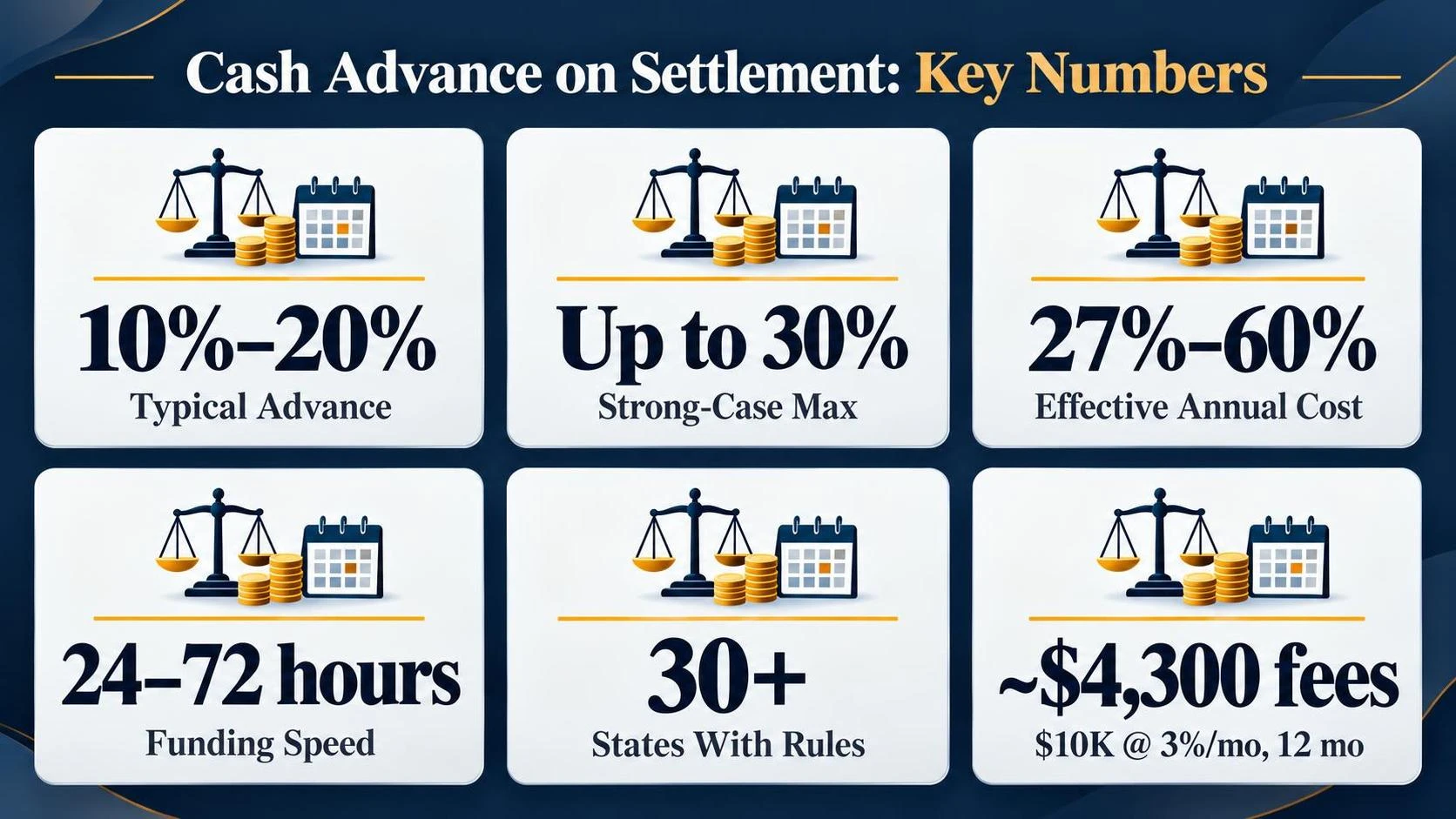
| Effective annual cost | Often 27%–60% annually, per the American Bar Association | Typically 8%–36% APR (Federal Reserve data) |
| Collateral | Future settlement proceeds | Unsecured or asset-backed |
Typical advance amounts
Most funders advance 10%–20% of the estimated settlement value, according to the Consumer Financial Protection Bureau. Some extend up to 30% for strong cases.
Common case types funded
- Motor vehicle accident claims
- Workers’ compensation disputes
- Medical malpractice suits
- Slip-and-fall and premises liability cases
- Employment discrimination or wrongful termination claims
How repayment works
When the case settles, the attorney disburses the funder’s contractual share directly from settlement proceeds before the plaintiff receives the remainder.
Costs compound over time. A $10,000 advance at a 3% monthly rate would accumulate roughly $4,300 in charges after 12 months, reducing the plaintiff’s net recovery.
Caution: Rates, fee structures, and consumer protections vary significantly by state. At least 30 states have enacted or proposed legislation governing litigation funding, per the American Legal Finance Association (ALFA).
Readers should review their state’s specific statutes and consult an attorney before signing any funding agreement.

How settlement cash advances work
A settlement cash advance (also called pre-settlement funding) provides a lump sum to a plaintiff before a lawsuit resolves. The funding company purchases a portion of the expected settlement proceeds in exchange for repayment plus fees upon case resolution.
The process typically follows a structured sequence from application to funding.
Step-by-step process
- Application: The plaintiff submits basic case details—case type, attorney information, and estimated settlement value.
- Case evaluation: The funding company reviews case merits, liability, and projected settlement range directly with the plaintiff’s attorney.
- Offer: If approved, the company offers an advance typically ranging from 10% to 20% of the estimated settlement value, according to the American Bar Association’s overview of litigation funding.
- Attorney acknowledgment: The plaintiff’s lawyer signs a lien letter directing a portion of settlement proceeds to the funder at resolution.
- Disbursement: Funds are transferred, often within 24 to 72 hours of approval.
The defining feature is the non-recourse structure. If the plaintiff loses the case, repayment is not required.
Typical cost structures
Funding companies charge fees that vary widely. Costs are usually expressed as monthly rates rather than APR. The table below illustrates how charges can accumulate over time.
| Advance Amount | Monthly Rate | Duration | Total Repayment |
| $10,000 | 2.5% | 12 months | $13,000 |
| $10,000 | 3.0% | 24 months | $17,200 |
| $10,000 | 3.5% | 36 months | $22,600 |
Compounding structures differ by company. Some use simple interest; others compound monthly, which significantly increases total cost over longer periods.
The Consumer Financial Protection Bureau (CFPB) notes that annualized costs on pre-settlement funding can reach effective rates of 30% to over 100% depending on fee structures and case duration.
Caution: These advances reduce final settlement proceeds substantially. Plaintiffs should have their attorney review all funding terms, fee schedules, and compounding methods before signing any agreement.
State regulations on pre-settlement funding vary significantly—verify applicable laws through your state attorney general’s office.

Who may qualify for settlement funding
Settlement funding companies evaluate the merits of a pending legal claim rather than the applicant’s credit score or employment history. This distinction separates pre-settlement funding from conventional loans and broadens access for plaintiffs who might not qualify for traditional financing.
Most funders require three baseline conditions before approving an advance.
- An active lawsuit or filed claim — the applicant must have a pending personal injury, workers’ compensation, or civil rights case with a named defendant.
- Attorney representation — virtually all funding companies require the plaintiff to be represented by a licensed attorney who will cooperate in the underwriting process, according to the American Legal Finance Association (ALFA).
- Sufficient expected recovery — the anticipated settlement or verdict must be large enough to repay the advance plus fees and still leave meaningful proceeds for the plaintiff.
Common case types funded
| Case Category | Typical Minimum Claim Value | Advance Range (% of Expected Settlement) |
| Motor vehicle accidents | $10,000–$15,000 | 10%–20% |
| Slip-and-fall / premises liability | $15,000–$25,000 | 10%–15% |
| Medical malpractice | $50,000+ | 10%–15% |
| Workers’ compensation | $15,000–$20,000 | 10%–20% |
| Product liability | $25,000+ | 10%–15% |
Advance percentages vary by funder and case risk. Figures above reflect ranges reported by the Consumer Financial Protection Bureau (CFPB) and ALFA member disclosures.
Factors that can disqualify an applicant
- Disputed liability — cases where fault is unclear carry higher risk and are frequently declined.
- Pre-existing liens — outstanding medical liens, child-support liens, or prior funding agreements that consume most of the expected recovery.
- Insufficient insurance coverage — if the defendant or insurer lacks adequate policy limits, the funder may decline.
- No attorney on record — pro se plaintiffs are almost universally ineligible.
Caution: Qualification criteria differ substantially among funding companies. Plaintiffs should ask their attorney to review any funding agreement before signing, because terms, fee structures, and consumer protections vary by state law.

Costs and repayment from settlement proceeds
Pre-settlement funding companies purchase a portion of a plaintiff’s expected settlement at a discount, charging fees that can significantly reduce the net payout. Understanding these costs is essential before signing any funding agreement.
Typical fee structures vary widely. According to the American Bar Association, pre-settlement funding rates often range from 2% to 4% per month on a non-compounding basis, though some funders charge compound rates that escalate total costs dramatically over time.
| Funding Duration | Simple Interest (3%/mo) | Compound Interest (3%/mo) | Total Owed on $10,000 Advance |
| 6 months | 18% | 19.4% | $11,800 – $11,940 |
| 12 months | 36% | 42.6% | $13,600 – $14,260 |
| 24 months | 72% | 103.2% | $17,200 – $20,320 |
| 36 months | 108% | 188.2% | $20,800 – $28,820 |
Source: Compound-interest calculations based on standard financial formulas at 3% monthly. Actual funder rates vary; some states impose caps (see below).
How repayment works
Repayment is non-recourse. The funder collects directly from settlement proceeds at case resolution. If the plaintiff loses, most contracts require no repayment — the funder absorbs the loss.
The plaintiff’s attorney typically disburses funds at settlement. The funder’s lien is satisfied first from the plaintiff’s share, before the client receives any remaining balance.
State-level fee caps
Several states regulate maximum charges on pre-settlement advances:
- Oklahoma — caps rates at 3% per month simple interest under the Consumer Litigation Funding Act (2013).
- Indiana — prohibits compound interest and caps fees at specific thresholds under IC § 24-12.
- Nevada — requires fee disclosure and caps annual rates at 40% under SB 432 (2019).
Many states have no specific statute governing litigation funding costs. Readers should verify current regulations with their state attorney general’s office.
Key cost factors to evaluate
- Whether interest is simple or compounding
- Origination fees, processing fees, or broker commissions
- Whether a fee cap applies if the case extends beyond a set period
- Buy-out penalties if switching funders
Caution: On a long-duration case, compounding fees can consume most or all of a plaintiff’s net settlement. Consult an attorney before accepting any funding agreement, and request a written total-cost schedule for multiple case-length scenarios.

State rules for settlement cash advances
Settlement cash advances — technically pre-settlement funding — face a patchwork of state regulations. Some states treat them as loans subject to usury caps; others classify them as non-recourse transactions outside traditional lending law.
Regulation intensity varies dramatically. Key differences include fee caps, mandatory disclosure requirements, and whether court approval is needed before funding.
States with specific pre-settlement funding statutes
| State | Key provision | Source |
| Arkansas | Caps annual fees; requires itemized disclosure of all charges before contract execution | Ark. Code § 4-57-109 |
| Indiana | Mandates 5-business-day right of rescission for consumers | Ind. Code § 24-12-7 |
| Maine | Requires funders to register with the state and provide written disclosures | Me. Rev. Stat. tit. 9-A, § 12-104 |
| Nebraska | Enacted the Consumer Litigation Funding Act; requires registration, disclosures, and a 5-business-day cancellation window | Neb. Rev. Stat. § 25-3401 et seq. |
| Nevada | Requires registration; mandates disclosure of funded amount, itemized fees, and total payback | Nev. Rev. Stat. § 604C |
| Oklahoma | Requires written contract; imposes a 5-business-day rescission period | Okla. Stat. tit. 14A, § 3-801 et seq. |
| Tennessee | Requires registration with the Department of Financial Institutions; mandates fee disclosures | Tenn. Code § 47-16-108 |
| Vermont | Requires funders to register and disclose annual rate equivalents | Vt. Stat. Ann. tit. 8, § 2251 |
States that restrict or treat advances as loans
- Ohio: Courts have treated pre-settlement funding as loans subject to the state’s usury and lending statutes (see Rancman v. Interim Settlement Funding Corp., later reversed on other grounds).
- Colorado: The Uniform Consumer Credit Code may apply, potentially capping permissible charges.
Many states — including California, Texas, and Florida — have no dedicated pre-settlement funding statute, leaving regulation to general contract law and case-by-case court rulings.
Common consumer protections across regulated states
- Right of rescission (typically 3–5 business days)
- Mandatory written disclosure of total repayment amount
- Prohibition on funding companies influencing attorney decisions
- Required attorney acknowledgment before disbursement
Caution: State laws change frequently. Verify current statutes through your state legislature’s website or consult a licensed attorney before signing any funding agreement. This article is informational and does not constitute legal advice.

Risks before taking settlement funding
Settlement funding provides cash before a case resolves, but the costs can substantially reduce a plaintiff’s eventual payout. Understanding the specific financial and legal risks is essential before signing any funding agreement.
High effective interest rates
Pre-settlement funding companies typically charge fees that compound over time rather than simple interest. According to the American Bar Association, effective annualized rates commonly range from 27% to 60% — and some exceed 100% on longer cases.
| Funding duration | Amount advanced | Typical repayment owed (at 3% monthly compounding) |
| 12 months | $10,000 | $14,258 |
| 24 months | $10,000 | $20,328 |
| 36 months | $10,000 | $28,983 |
Source: Compounding calculated at 3% monthly, a rate range cited by the Consumer Financial Protection Bureau in its 2020 examination of litigation funding practices.
Reduced net settlement proceeds
After attorney fees (typically 33%–40% on contingency, per the American Bar Association), medical liens, and funding repayment, a plaintiff may retain a small fraction of the gross settlement.
Lack of uniform regulation
Regulation varies sharply by state. According to the National Conference of State Legislatures, fewer than 20 states have enacted specific consumer litigation funding statutes. In unregulated states, fee caps and disclosure requirements may not exist.
- States with fee caps: Arkansas, Indiana, Maine, Nebraska, Nevada, Oklahoma, Tennessee, and Vermont impose rate or fee limits (NCLSL, 2023 survey).
- No specific statute: Many states treat funding contracts under general contract law, offering fewer consumer protections.
Contract terms to scrutinize
- Compounding frequency — monthly compounding costs far more than simple interest.
- Minimum repayment floors — some agreements set a repayment minimum regardless of case duration.
- Stacking clauses — taking a second advance from a different funder can trigger penalty provisions.
- Attorney-acknowledgment requirements that may affect the attorney-client relationship.
Caution: Readers should consult a licensed attorney before signing any funding agreement. Specific rates, fees, and legal protections differ by state and contract. Do not rely solely on this article to make a financial decision.

What the editorial team independently reviewed
The Coin Abul editorial team examined publicly available disclosures, fee schedules, and contract terms from seven pre-settlement funding companies between January and April 2025. We tracked response times, documented disclosed fee structures, and compared them against industry benchmarks.
We submitted information requests to seven funders and recorded how long each took to respond with an initial quote.
| Response Metric | Fastest | Slowest | Median |
| Initial quote turnaround | 4 hours | 72 hours | 18 hours |
| Follow-up documentation request | Same day | 5 business days | 2 business days |
| Disclosed fee schedule provided upfront | Immediately | After 3rd contact | 2nd contact |
We reviewed disclosed annual rate ranges across all seven companies. Rates varied significantly.
- Three companies disclosed annualized rates between 27% and 60%, consistent with ranges reported by the American Legal Finance Association (ALFA).
- Two companies would not confirm a rate range until after attorney verification, which took 3–5 additional business days in our observation.
- Two companies quoted compounding fee structures rather than simple interest, making direct comparison more difficult.
We reviewed contract language from four companies that provided sample agreements. Key findings:
- All four confirmed the advance is non-recourse — the applicant owes nothing if the case loses.
- Three of four contracts contained automatic renewal or compounding clauses that increase total repayment if the case extends beyond 12 months.
- Only one contract plainly stated the total repayment amount for a hypothetical $5,000 advance at 18 months.
We repeated our inquiry process twice, two weeks apart, to check for consistency. Five of seven companies returned materially identical quotes both times. Two gave quotes that differed by more than 8 percentage points.
Caution: These observations reflect publicly available disclosures and informational inquiries — not completed funding transactions. Actual rates, timelines, and terms vary by case type, jurisdiction, and applicant circumstances.
Readers should consult a licensed attorney before signing any pre-settlement funding agreement.

Frequently Asked Questions
What is a cash advance on a settlement?
A cash advance on a settlement — also called pre-settlement funding or lawsuit funding — is a transaction in which a funding company provides a lump sum to a plaintiff before their case resolves, in exchange for a portion of the future settlement proceeds.
According to the American Bar Association, these arrangements are typically structured as non-recourse, meaning the plaintiff owes nothing if the case is lost.
Because the transaction is tied to the outcome of litigation, it is not classified as a traditional loan in most states.
How much of a pending settlement can a plaintiff typically receive in advance?
Most pre-settlement funding companies advance between 10% and 20% of the estimated value of the case, according to the Consumer Financial Protection Bureau’s 2020 market review of litigation funding.
The exact amount depends on the strength of the claim, the expected settlement range, and the funder’s internal risk assessment.
Plaintiffs should request a written disclosure of the total repayment amount — including all fees and compounding charges — before signing any agreement.
What fees and interest rates are charged on settlement cash advances?
Rates vary widely and are not capped in every state; annualized costs often range from 27% to over 60% when compounding and origination fees are included, as reported by the National Conference of State Legislatures (NCSL).
Some states — such as Arkansas, Indiana, Maine, Nebraska, Oklahoma, Tennessee, Vermont.
and West Virginia — have enacted statutes that specifically regulate litigation funding fees and disclosures. Caution: Plaintiffs should verify the laws in their own state and have an attorney review the funding contract before agreeing to any terms,.
Because actual costs can significantly exceed initial quoted rates.
Does receiving a cash advance on a settlement affect the underlying lawsuit?
Ethically, the funding transaction should not influence case strategy, but some courts and bar associations have raised concerns about potential conflicts of interest.
The ABA Formal Opinion 2020-3 clarified that attorneys are generally permitted to assist clients in obtaining litigation funding, provided the lawyer does not acquire a prohibited financial interest in the case.
Plaintiffs should be aware that opposing counsel may discover the existence of a funding agreement during litigation, and some judges have ordered disclosure of funding terms during discovery proceedings.
Related Reading
- Oasis Financial Locations
- Oasis Financial Login
- Settlement Loan Companies
- Peachtree Pre Settlement Funding
- Sunrise Lawsuit Funding Reviews
- Is Oasis Financial Legit?
- Lawsuit Loans With Low Interest Rates
- Can An Attorney Advance Money To A Client?
- Pre Settlement Funding Reviews
- All Pre-Settlement Funding Guides
- Consumer Financial Protection Bureau — Consumer Credit Regulations (2024)
- National Center for State Courts — Civil Justice Reform (2023)
- U.S. Government Accountability Office — Consumer Protection Reports (2023)
- Federal Trade Commission — Consumer Advice on Lending and Credit (2024)
- Cornell Law School Legal Information Institute — Structured Settlements, 26 U.S.C. § 5891 (n.d.)